Indefinite integrals
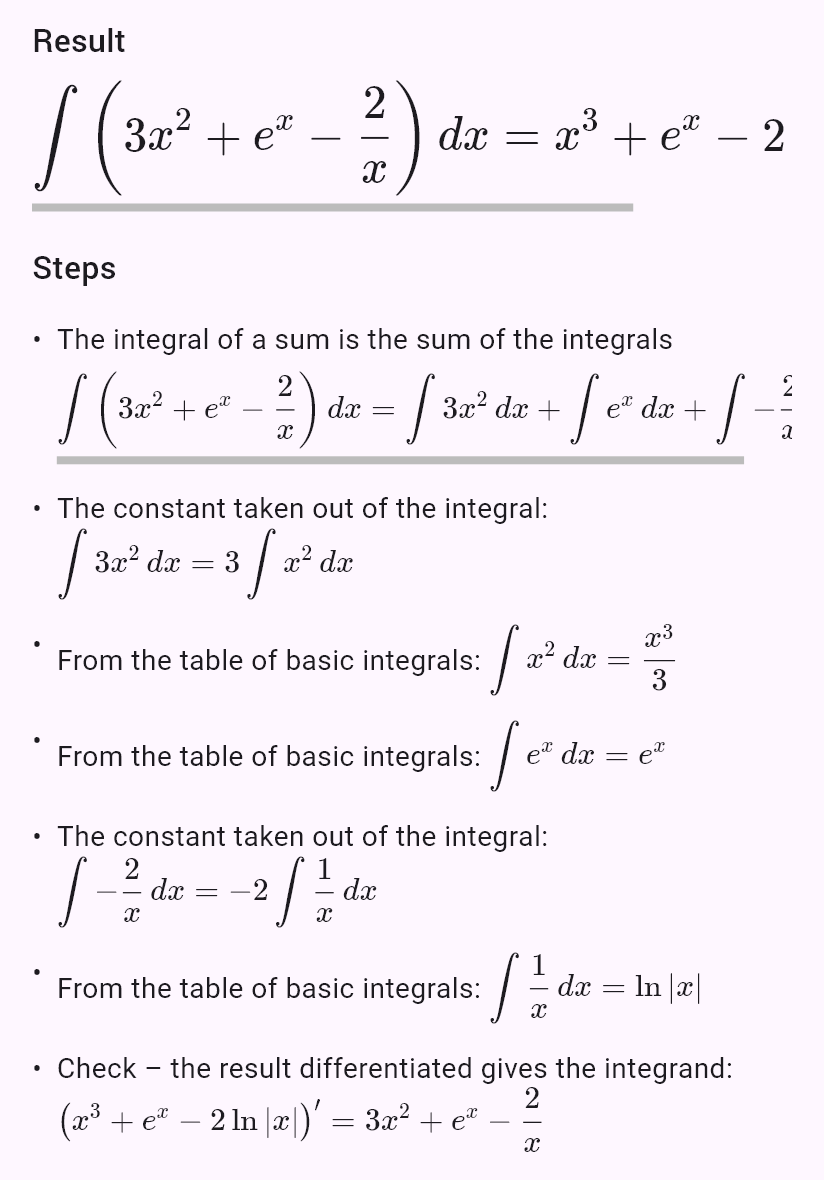
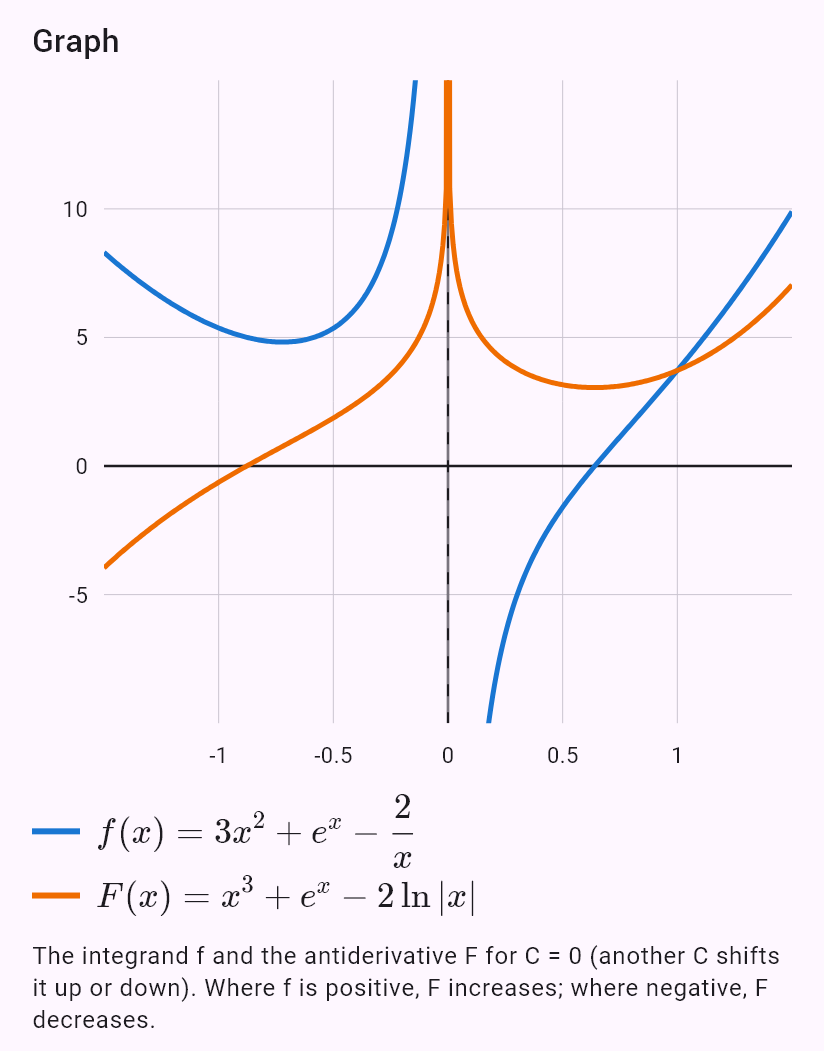
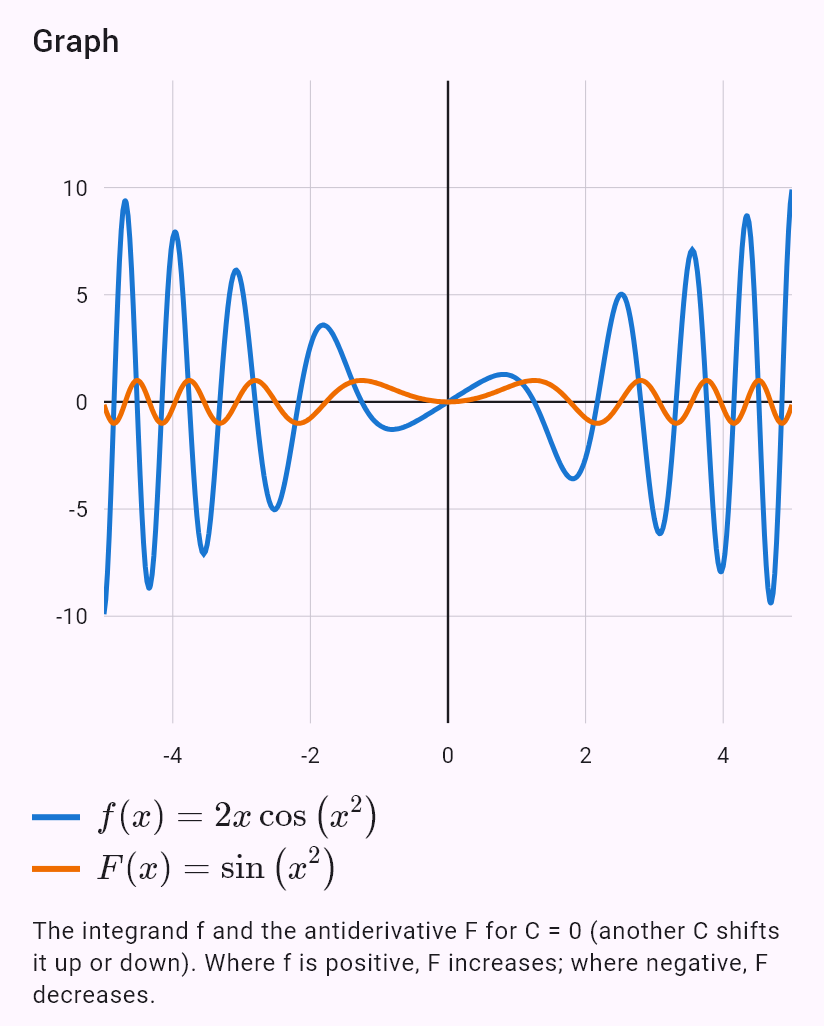
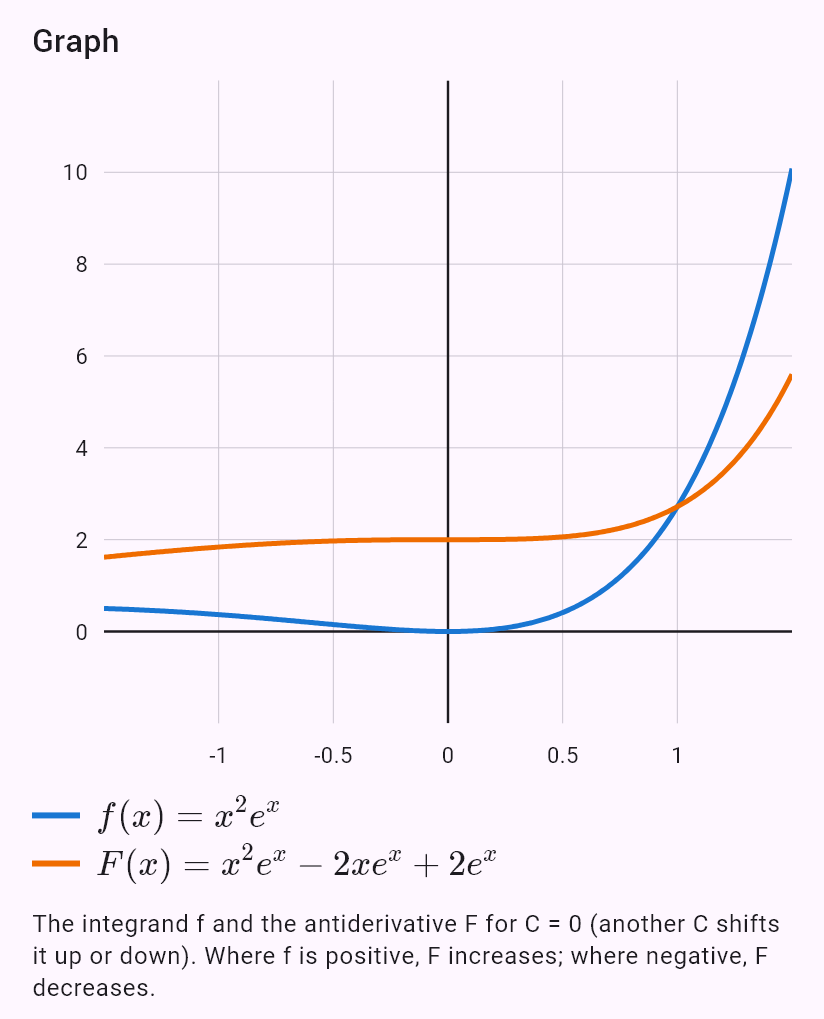
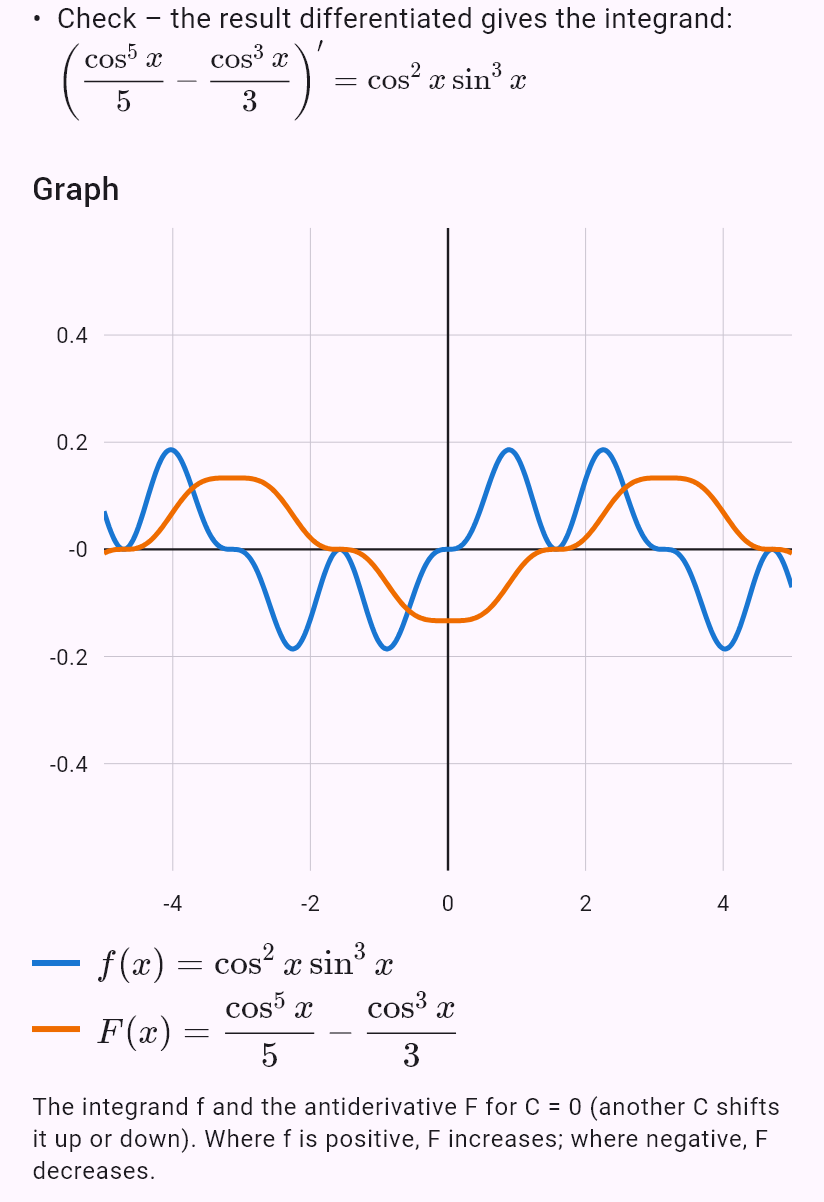
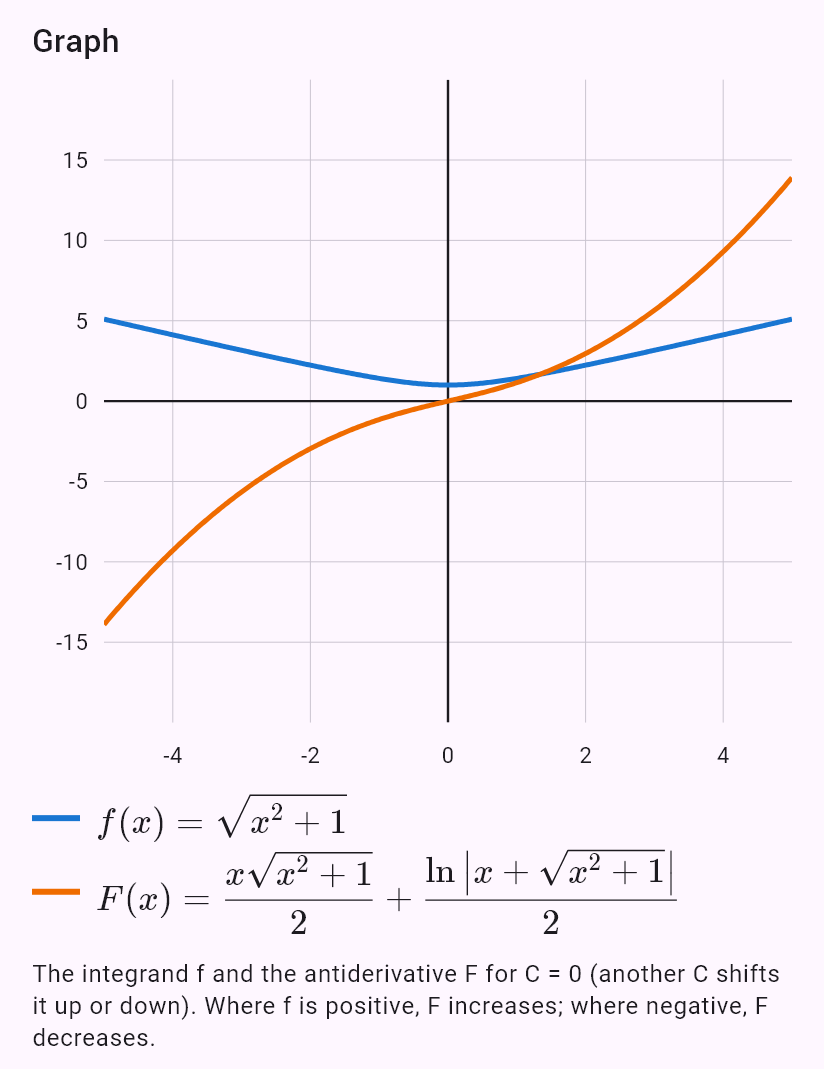
The app integrates with the methods taught at school and says at every step what it does. It checks the result by differentiating (the check is the last step) and draws the integrand and the antiderivative.
Roots of powers of the variable (∛(x⁴), √(x³)) are rewritten as powers with rational exponents; an absolute value (|cos x|, √(1 − sin²x)) is written with the sign function sgn.
If an integral has no elementary antiderivative (such as e^(−x²)), the app says so and gives it in terms of a special function (erf, Si, …).
How to enter it
int(x e^x, x) | An integral with the variable. |
int(x^2 sin x) | Without the variable when there is only one. |
∫ x^2 dx | With the integral sign, also from a photo. |
x e^x | A function with the “Integrate” chip. |
Basic integrals and substitution
The integral of a sum term by term, constants taken out, table integrals (also with a linear inner function) and substitution when the integrand contains a function together with the derivative of its inside.
Examples
int(3x^2 - 2/x + e^x)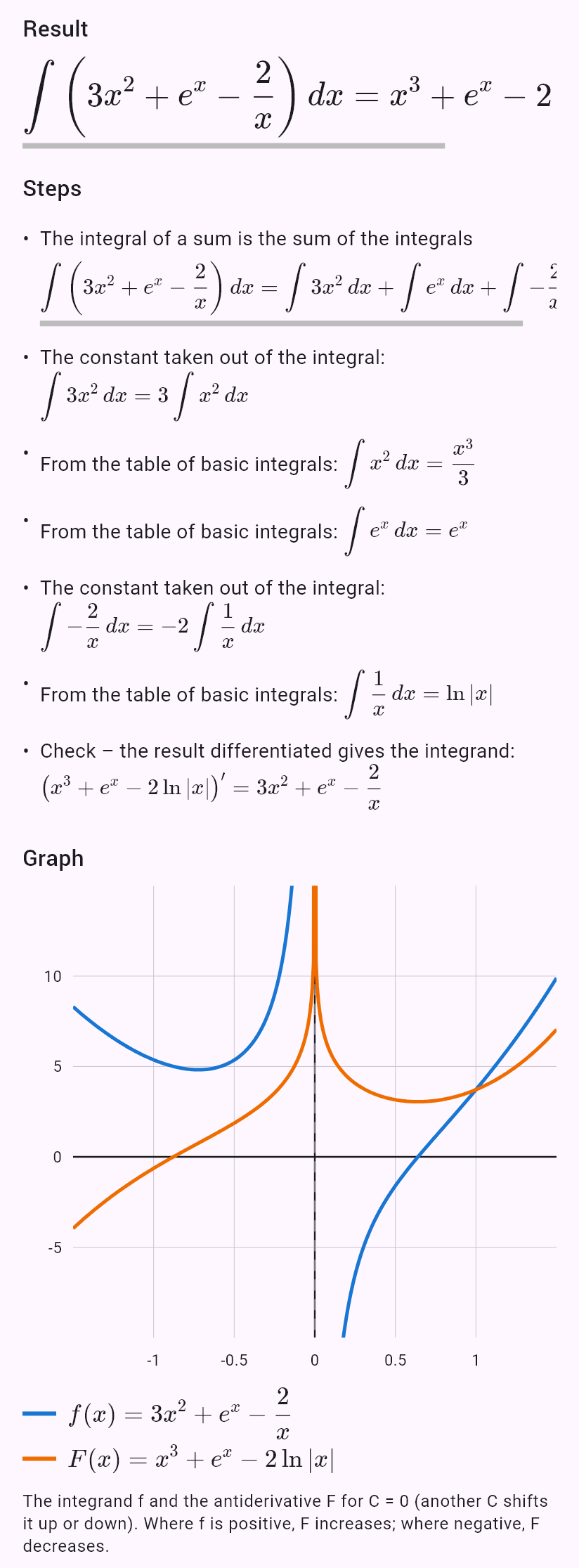
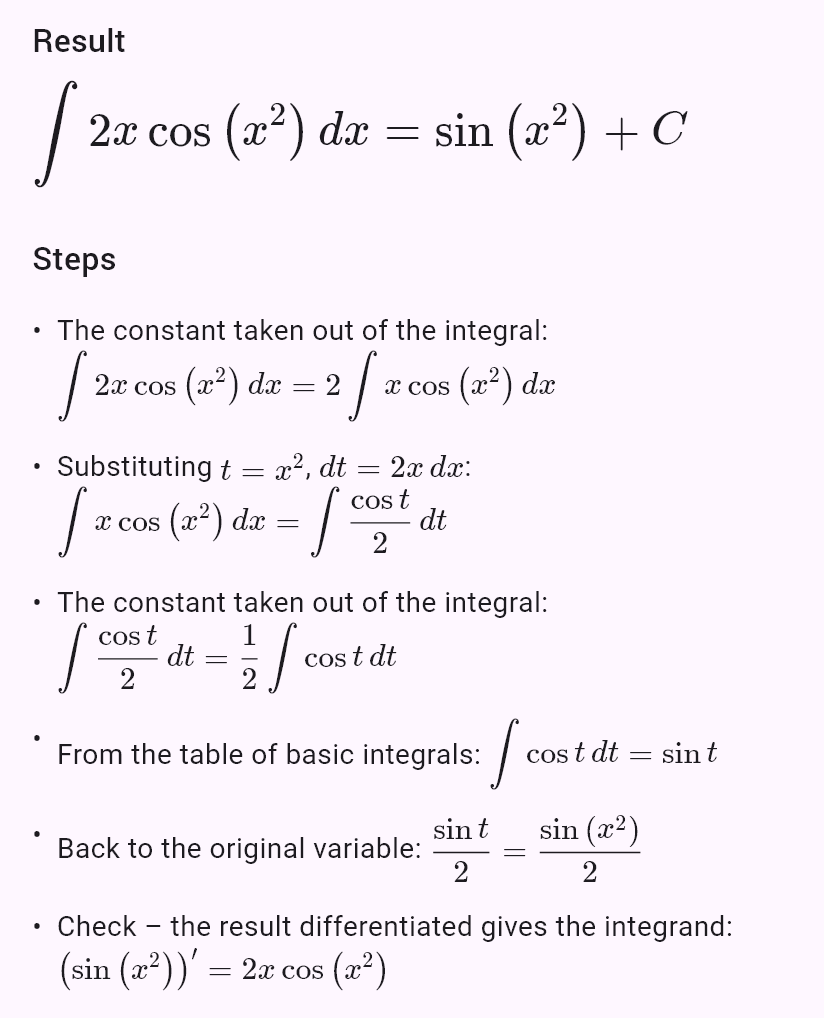
int(2x cos(x^2))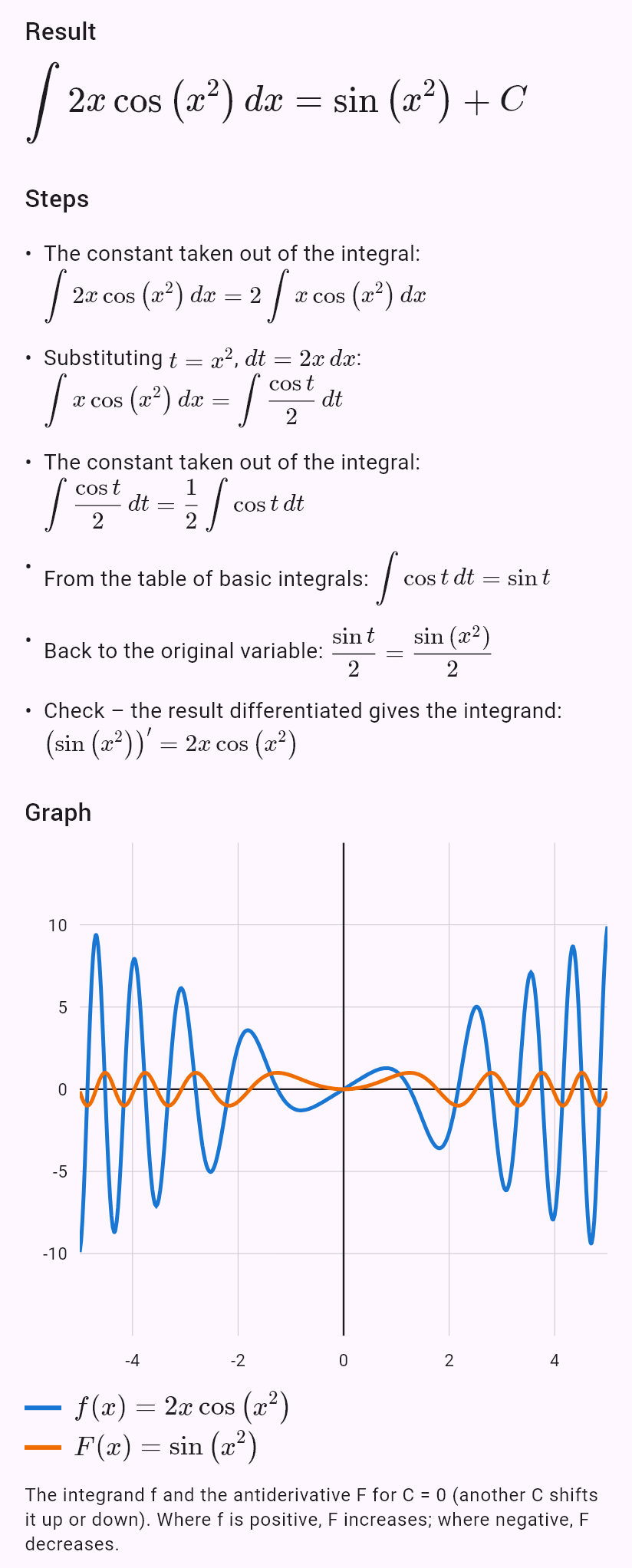
int(1/(a - bx)^3)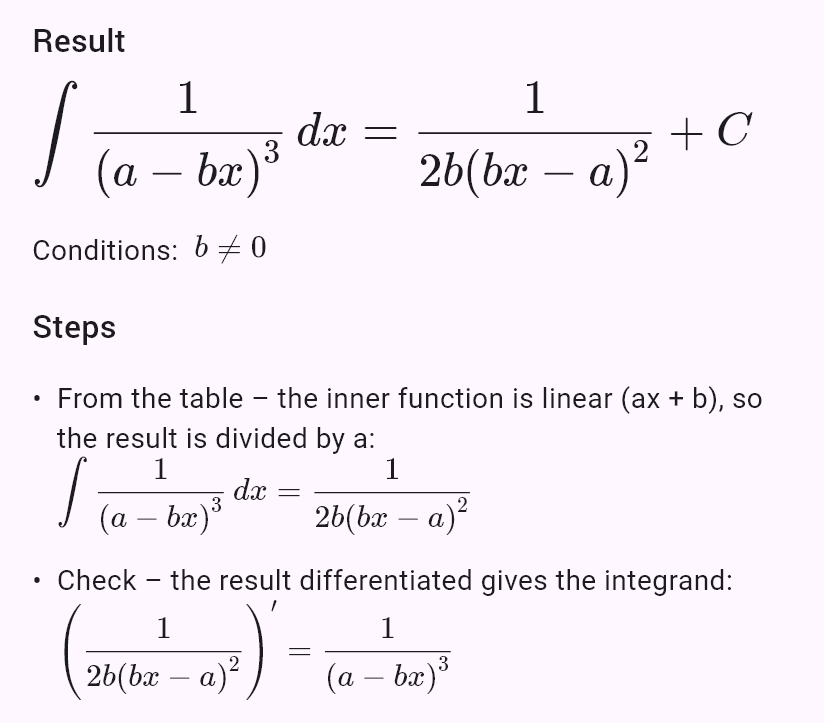
Integration by parts
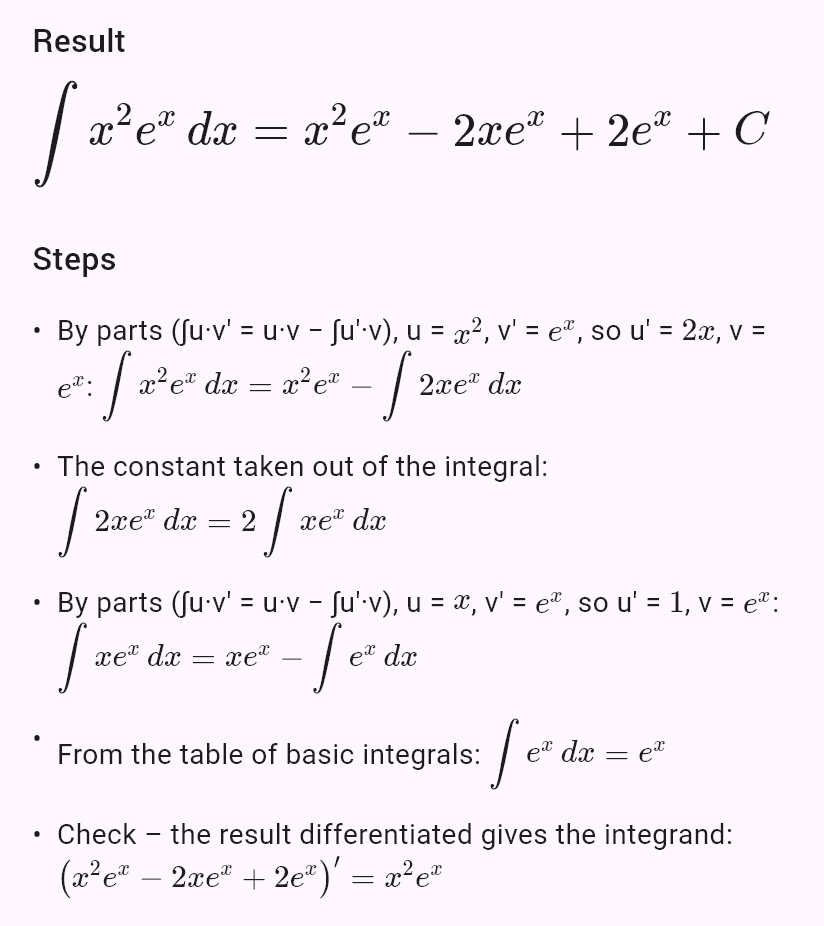
The app integrates a product of a polynomial with an exponential, a trigonometric function or a logarithm by parts, repeatedly if needed; integrals like eˣ sin x by cyclic integration by parts.
Examples
int(x^2 e^x)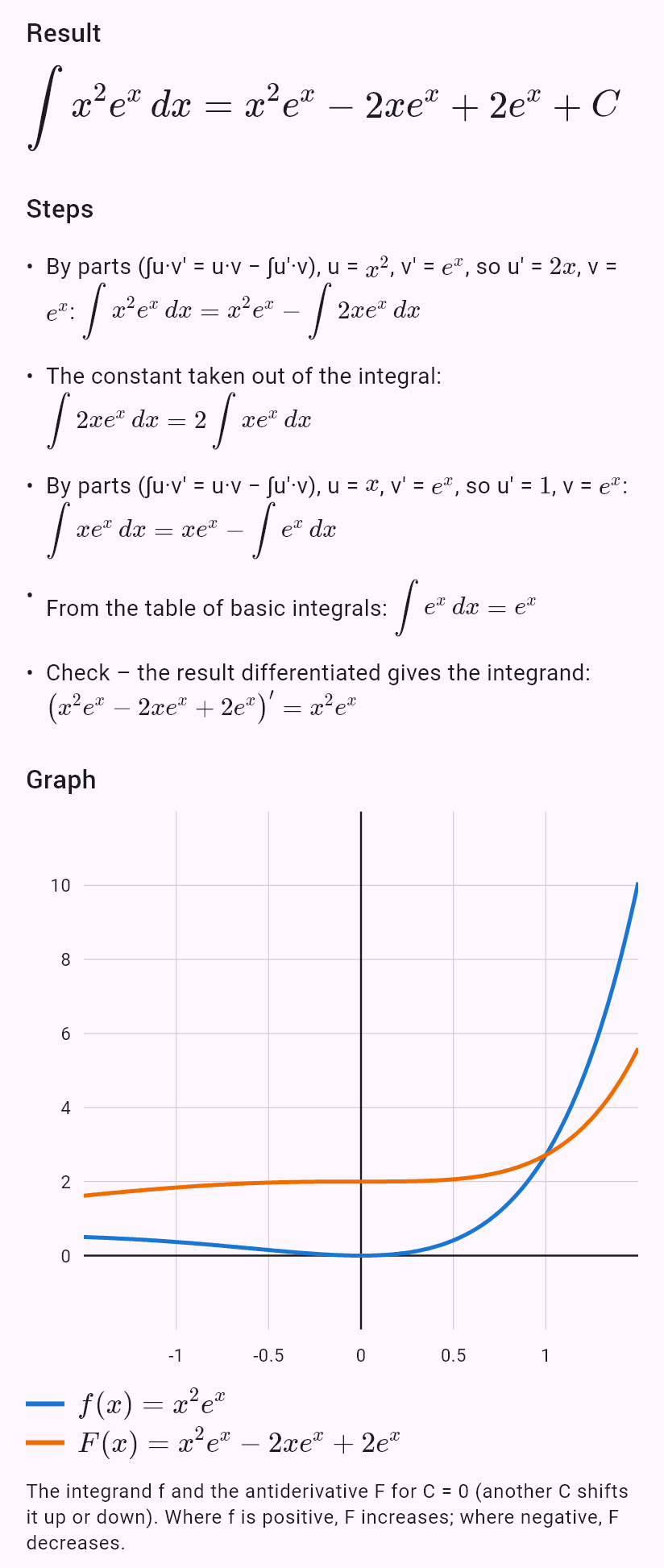
Rational functions
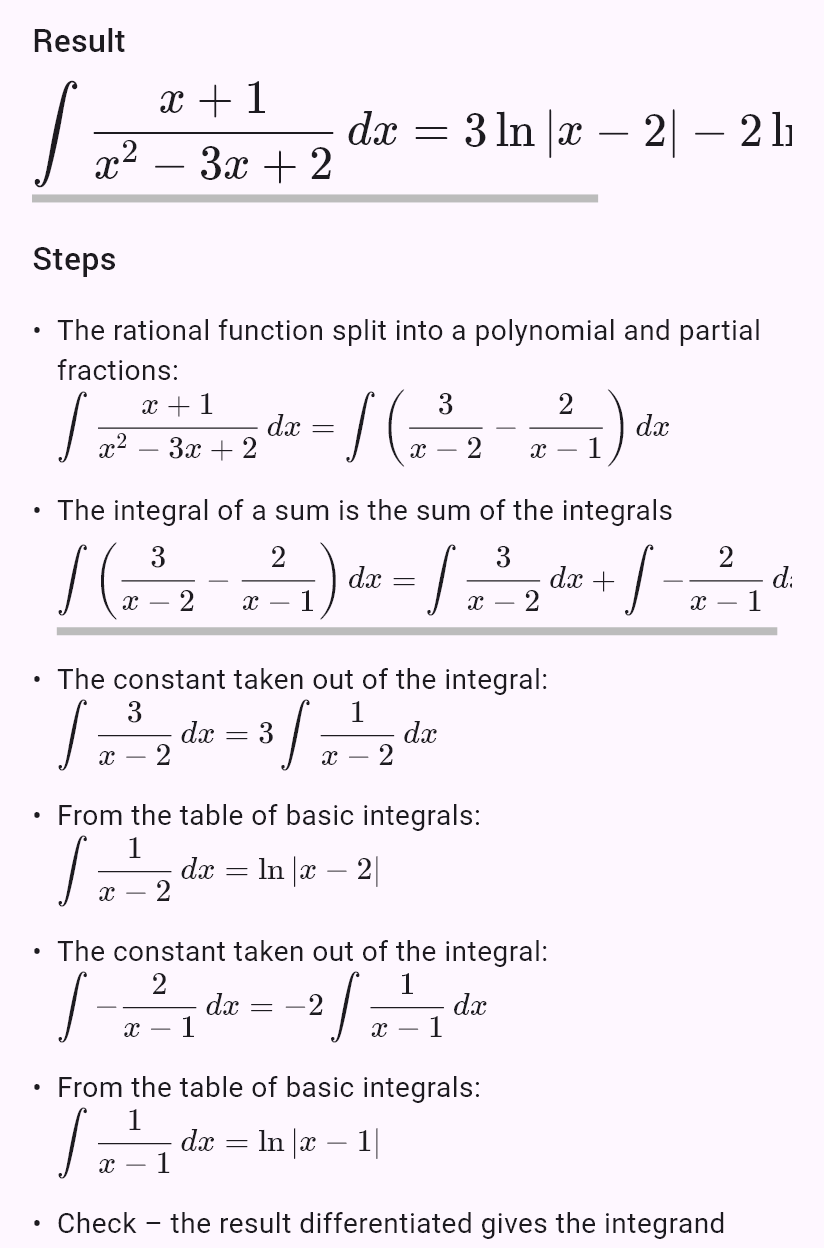
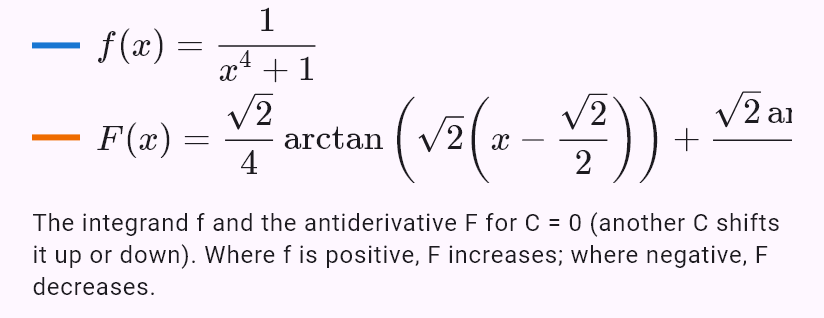
The app divides a rational function if needed, factors the denominator and splits the function into partial fractions, which it integrates into logarithms and arctangents.
A denominator that can’t be factored over the rationals (x⁴ + 1, x⁵ + 1) is factored over the reals – each pair of complex conjugate roots gives a quadratic factor with no real roots.
Examples
int((x + 1)/(x^2 - 3x + 2))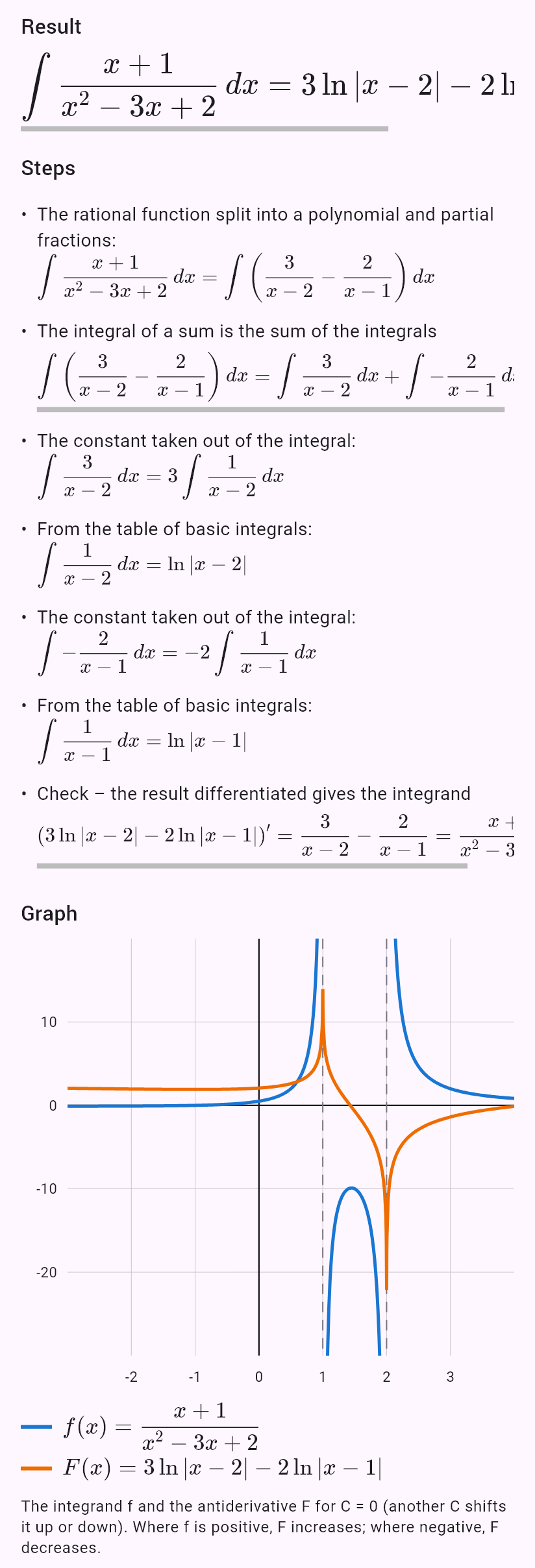
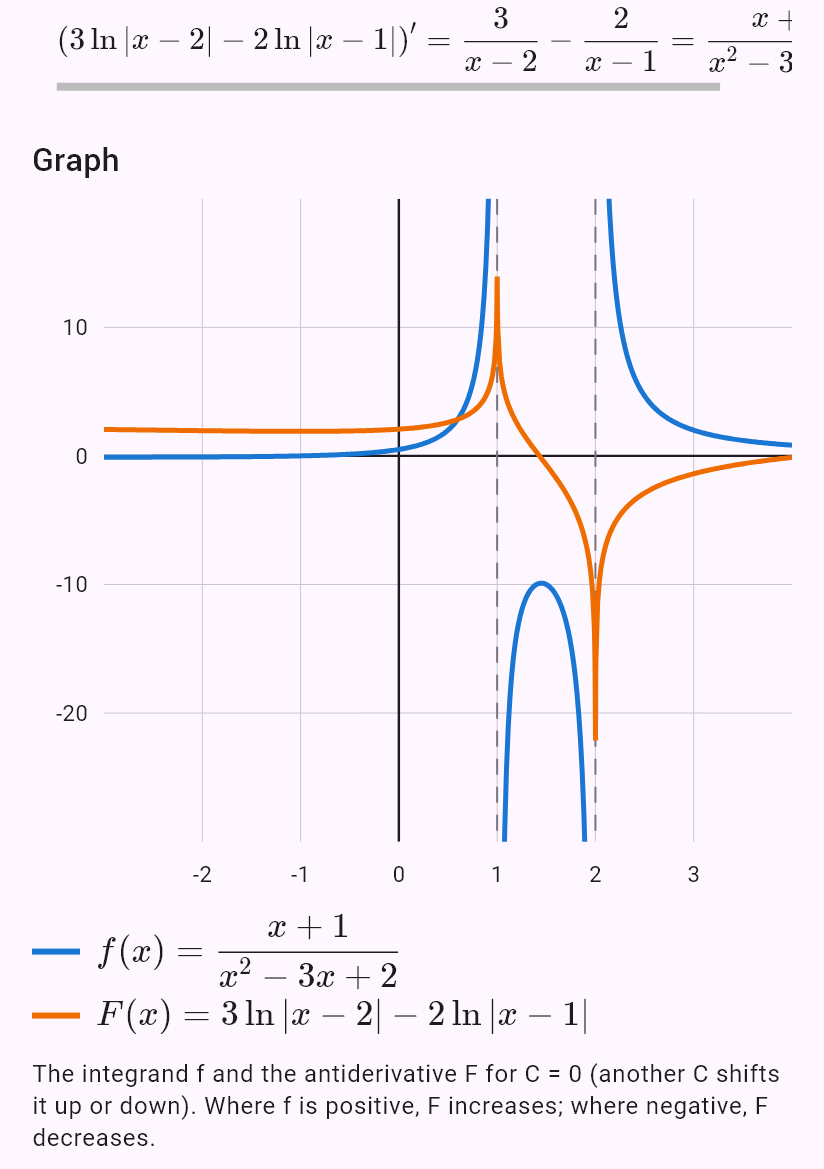
int(1/(x^4 + 1))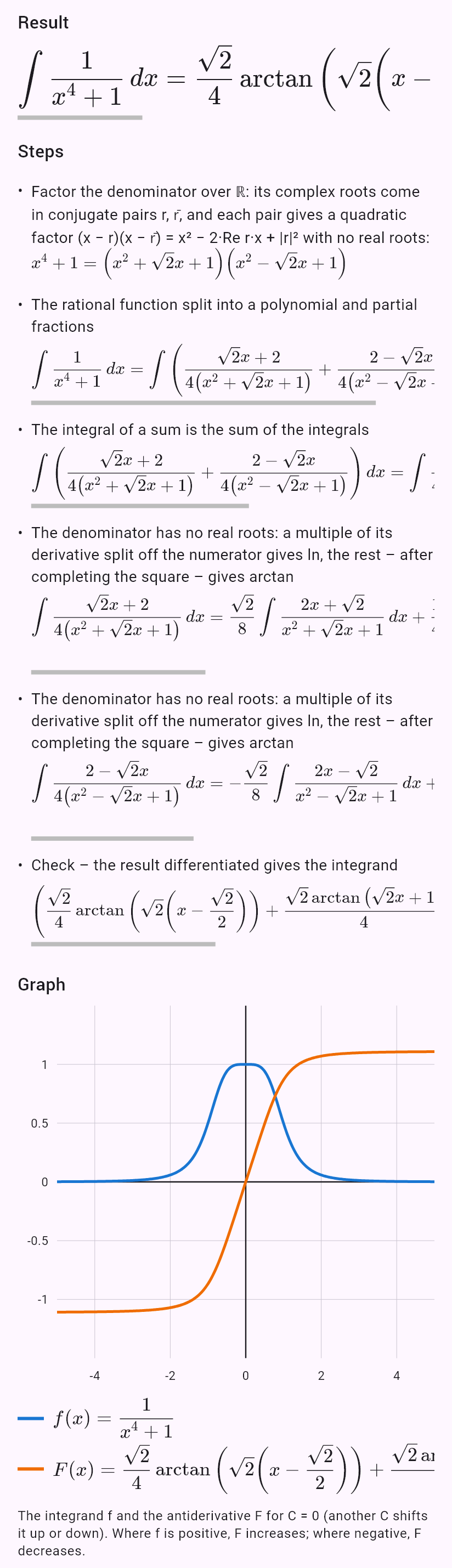
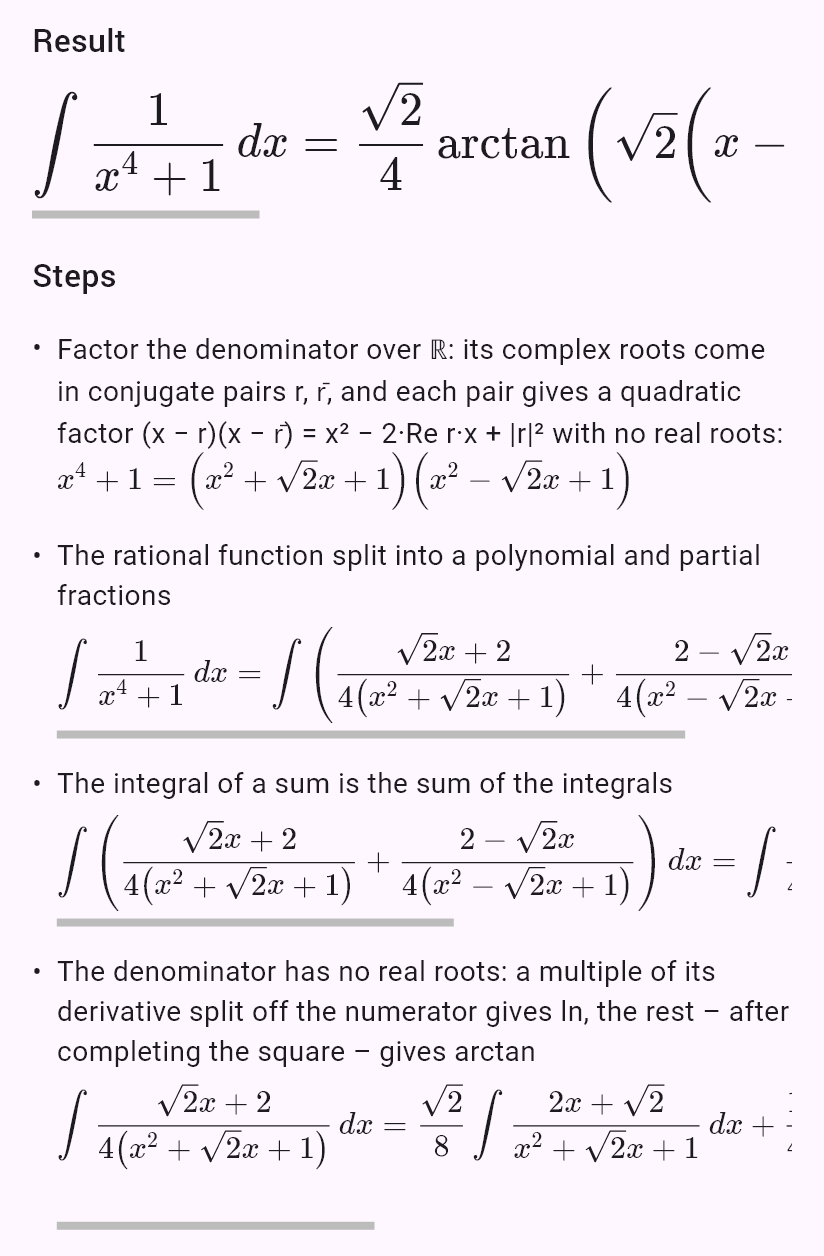
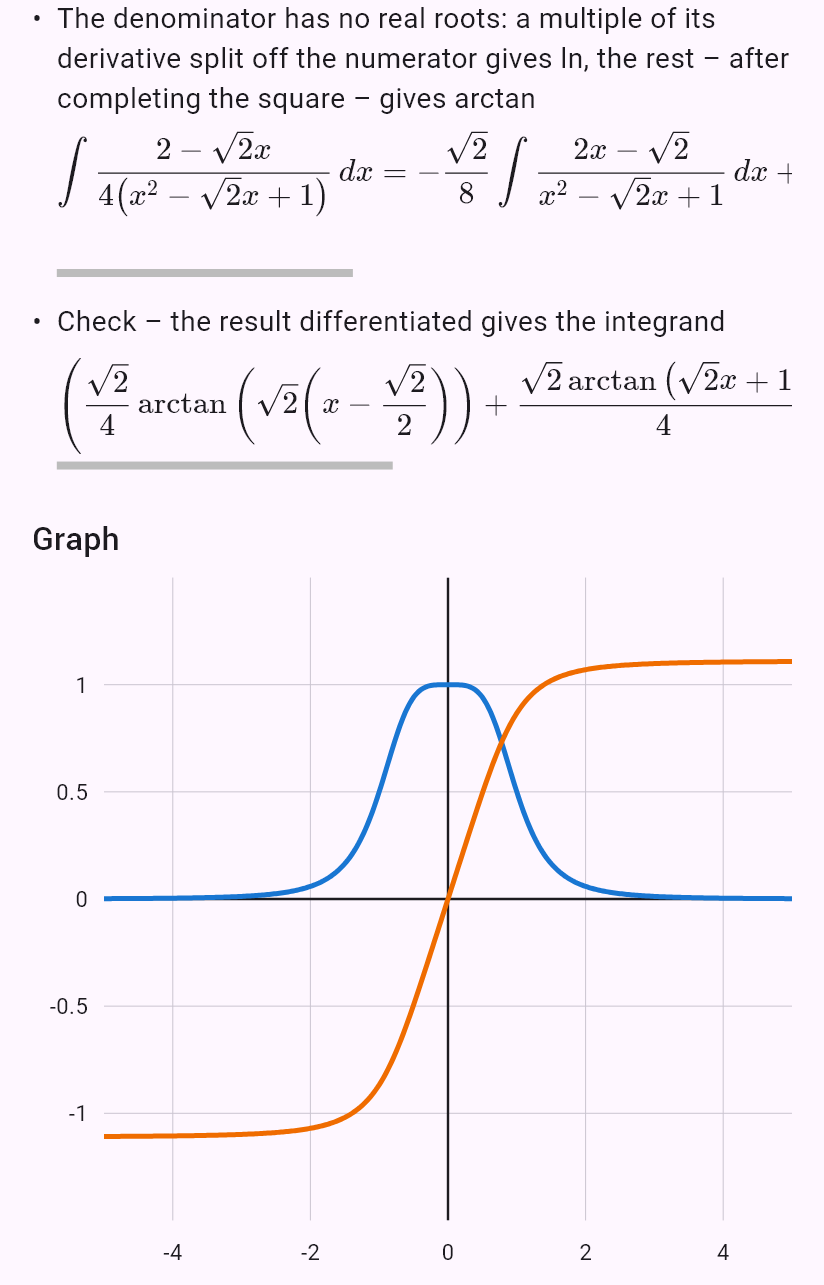
Trigonometric functions
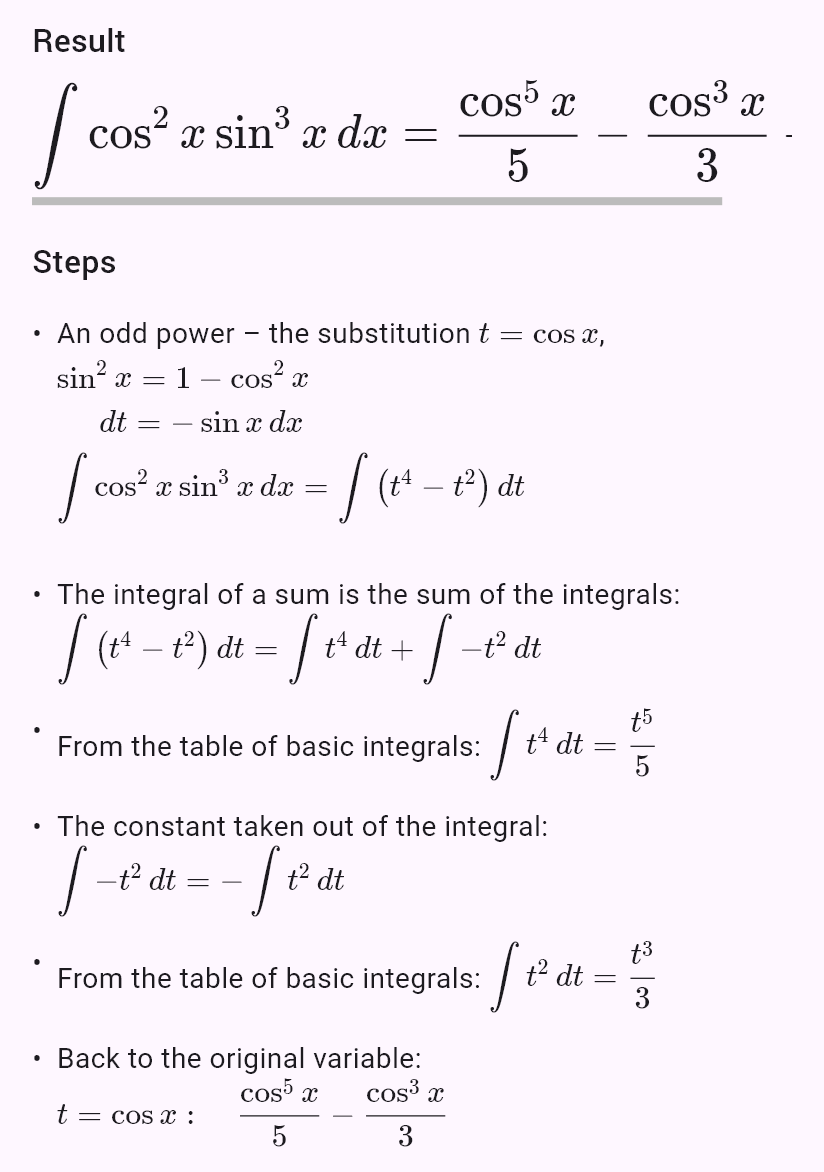
Identities first (sin²x = (1 − cos 2x)/2, products into sums), for an odd power the substitution t = sin x or t = cos x, for a rational function of sine and cosine a substitution by parity, and the Weierstrass substitution t = tan(x/2) only as the last resort.
Examples
int(sin(x)^3 cos(x)^2)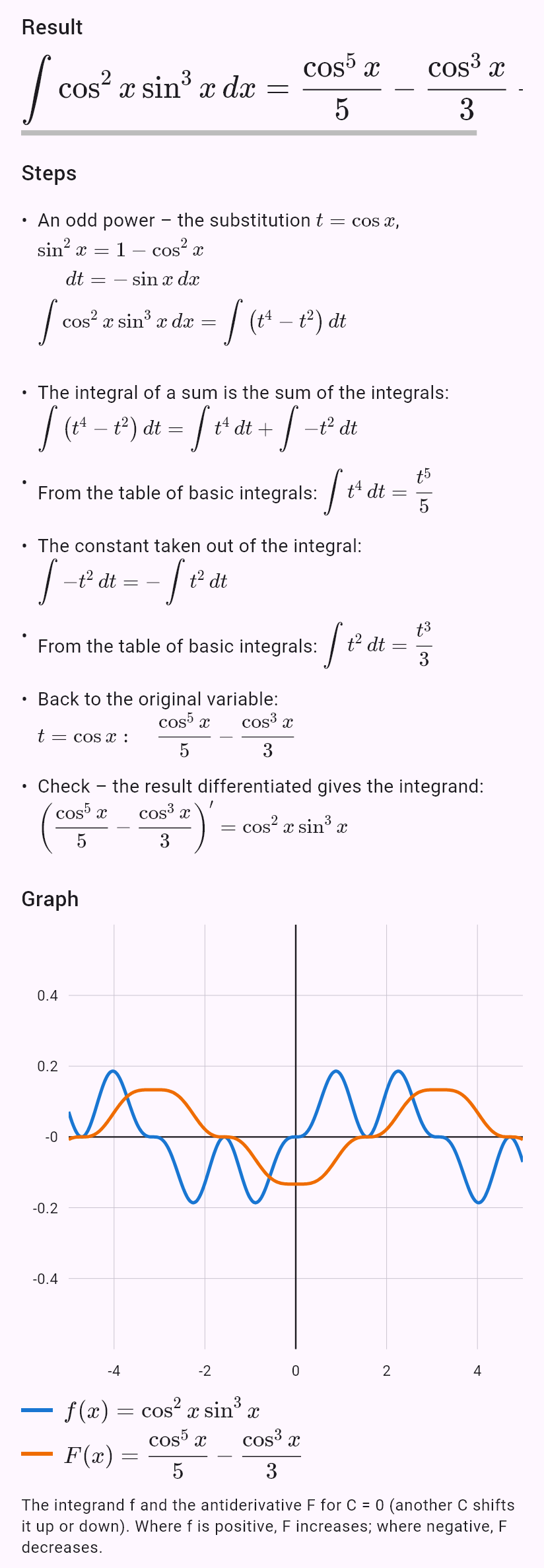
Hyperbolic functions
Table integrals (∫sinh x dx = cosh x + C, ∫1/cosh²x dx = tanh x + C, …), ∫tanh x dx by the logarithm of the derivative, by parts (x sinh x, arsinh x), squares by the formulas sinh²x = (cosh 2x − 1)/2, tanh²x = 1 − 1/cosh²x; the rest by the definition through exponentials.
Examples
int(sinh(x)^2)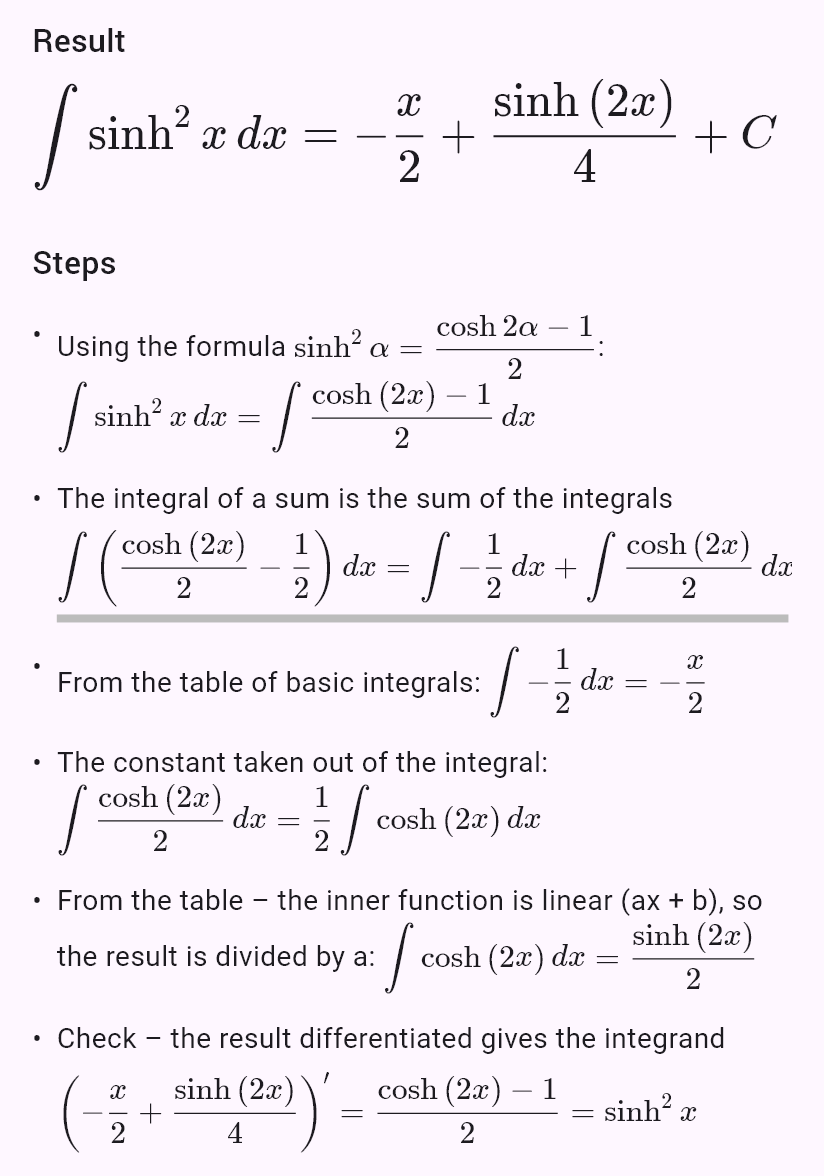
Roots
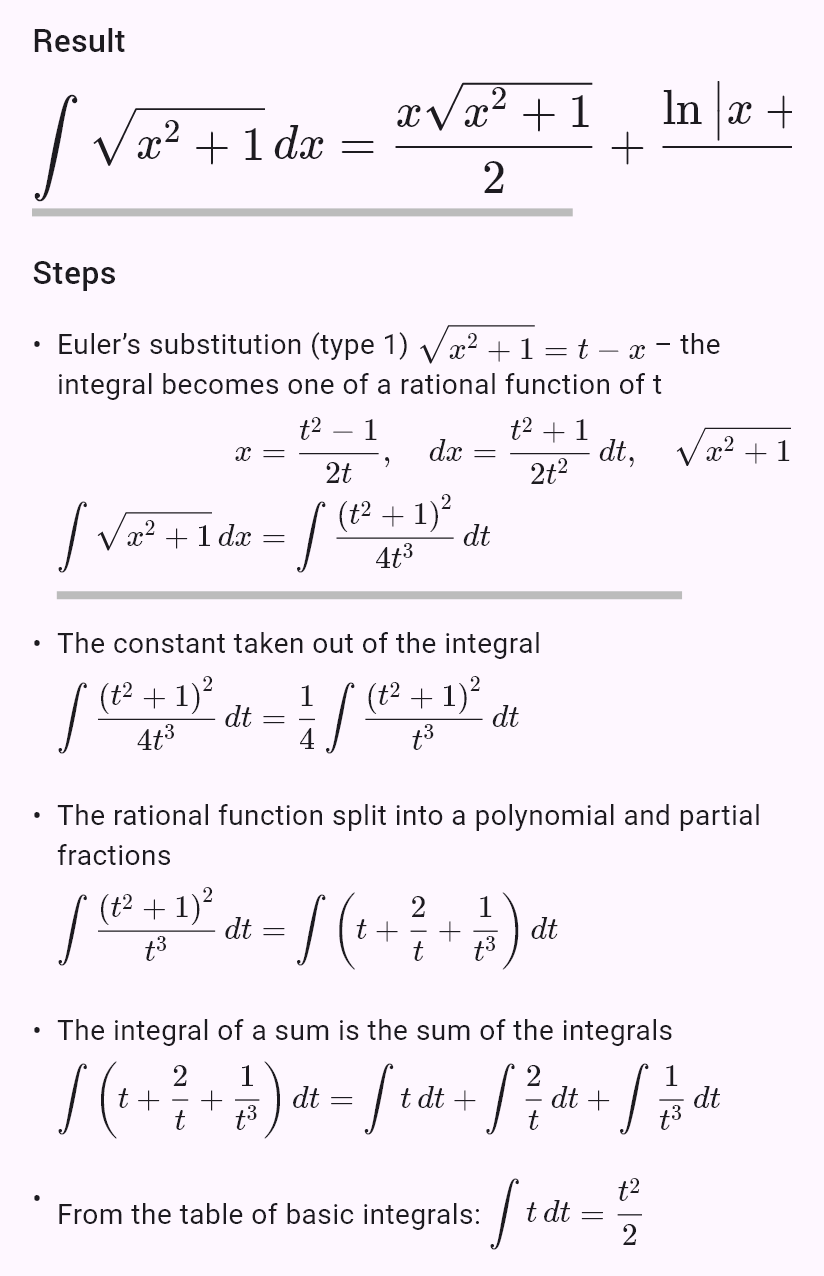
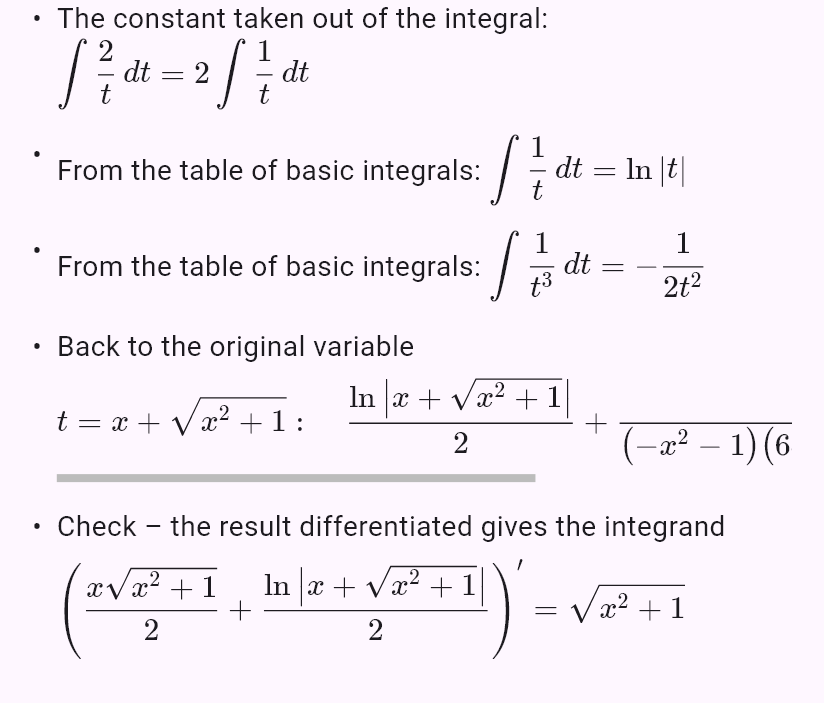
Integrals with a root of a linear fractional function by substitution, with a root of a quadratic by an Euler substitution, and binomial integrals by Chebyshev's conditions – when none of them holds, the app says the integral is not elementary.
Examples
int(sqrt(x^2 + 1))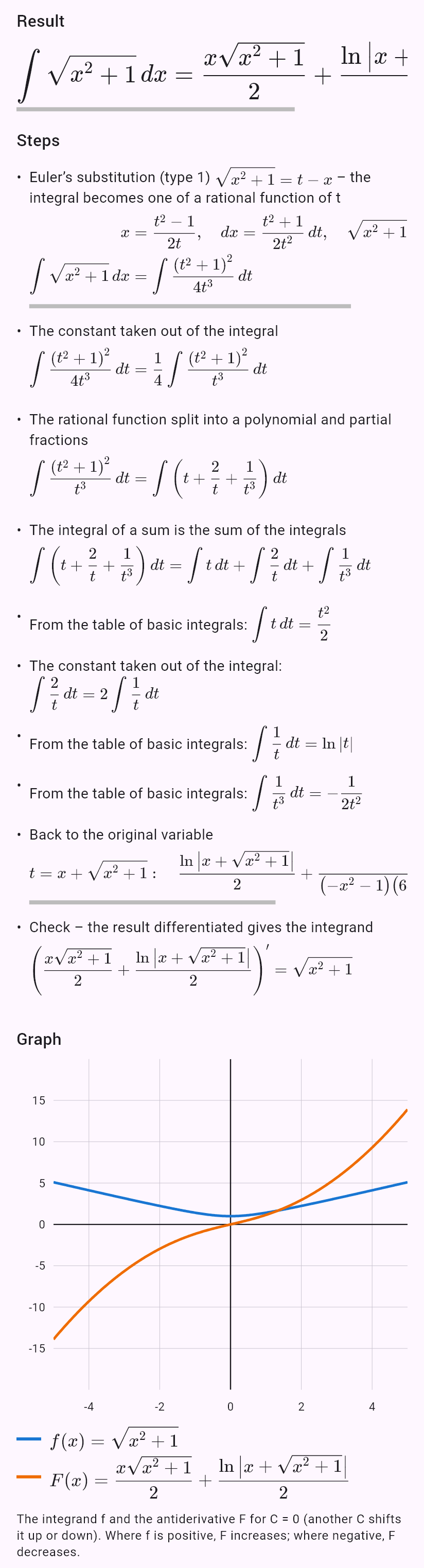
Known limitations
- For some integrals we find the result without the working – the app says so in the steps.
- A computation without steps that takes too long is stopped – the app says so.