III. Calculus
29. Taylor polynomial
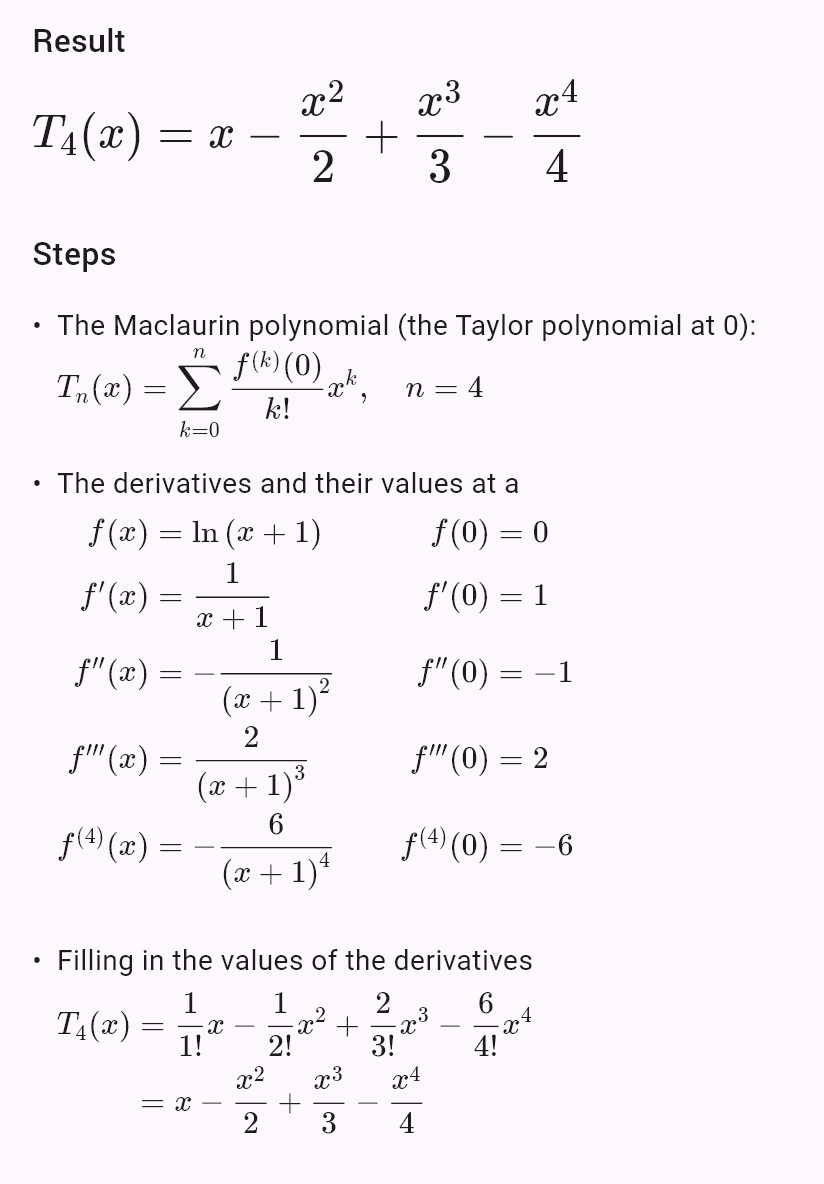
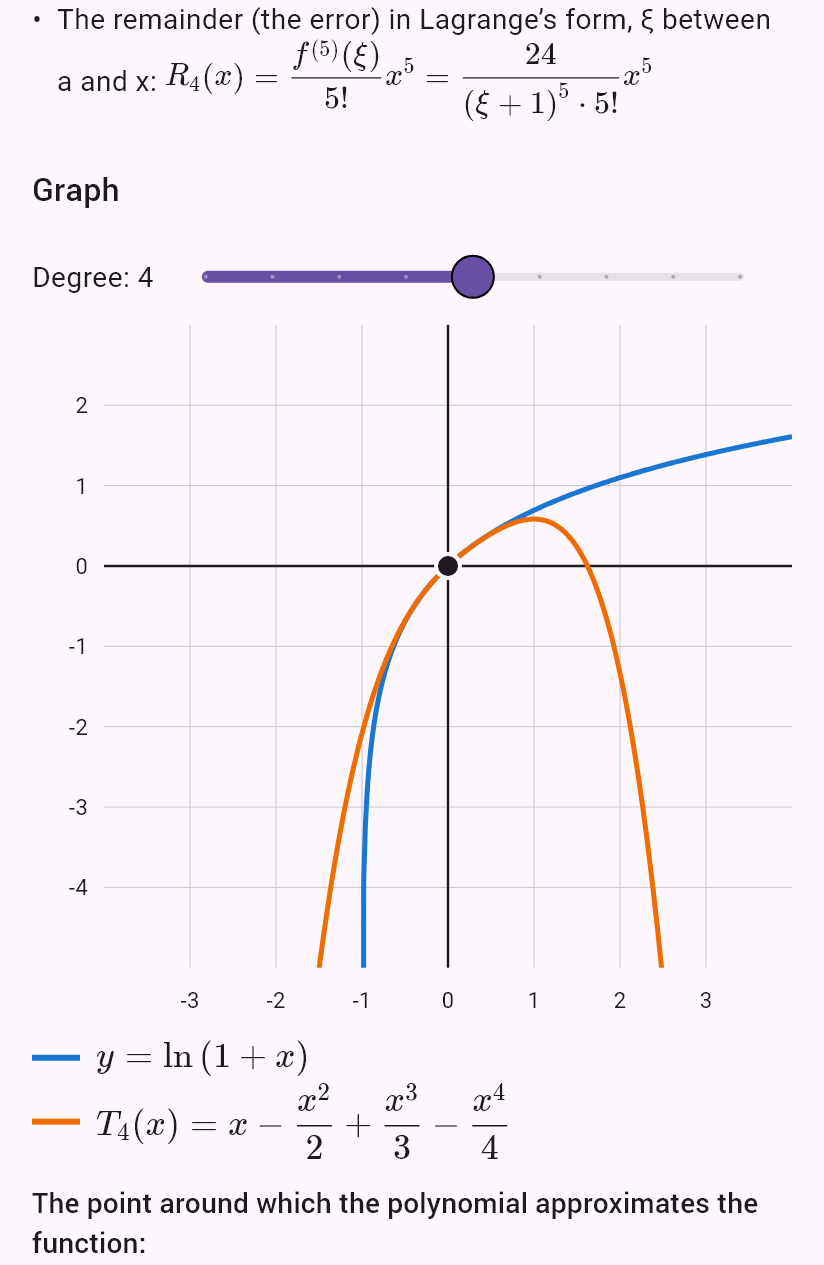
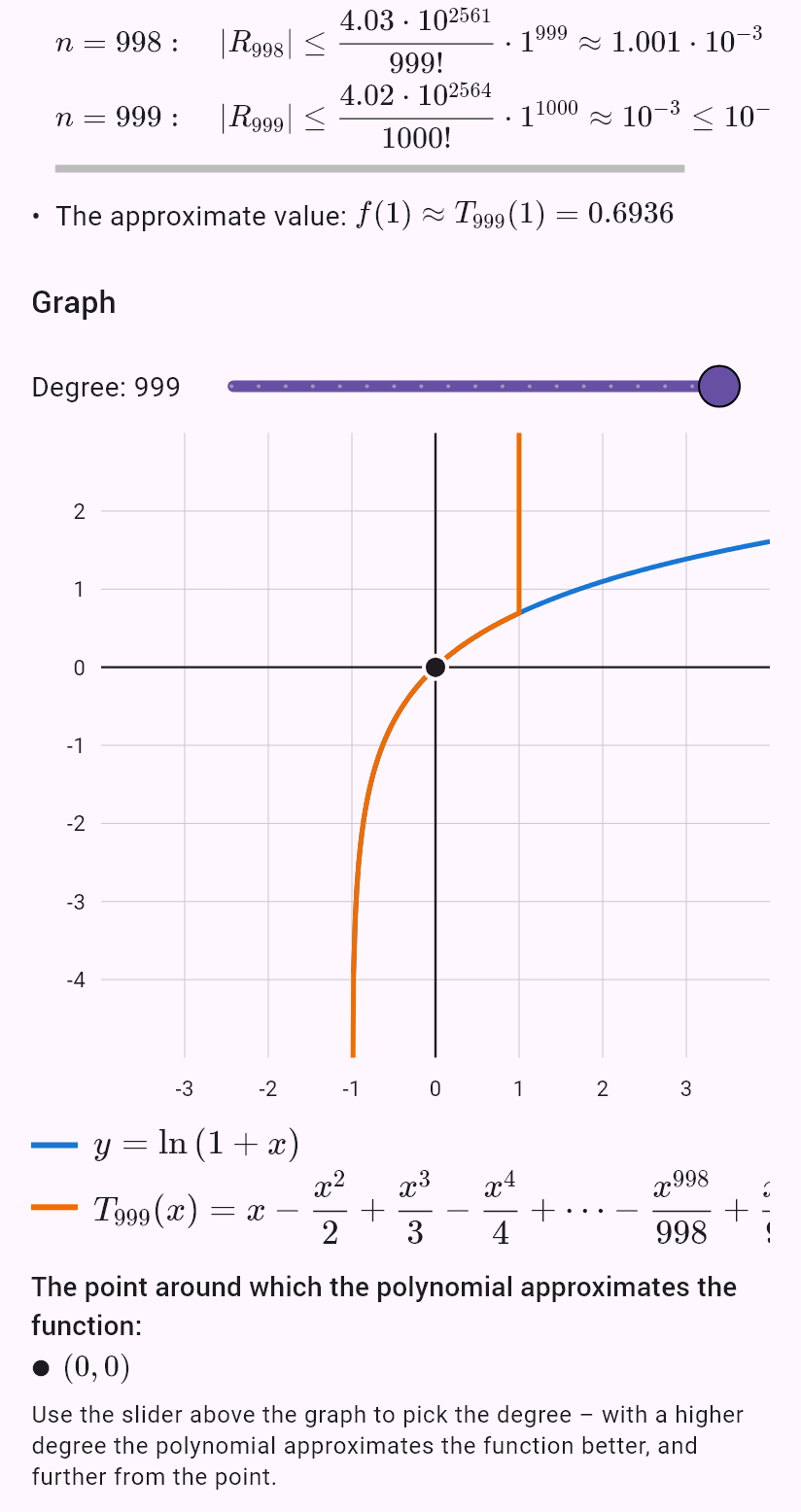
The app builds the Taylor (at 0 the Maclaurin) polynomial of a given degree: a table of the derivatives at the point, substitution into the formula and the remainder in Lagrange form. It can also find the degree itself – the smallest one for which the error at a given point or on an interval stays below a given bound. The graph shows the function and the polynomial; a slider changes the degree so you can see the approximation improve.
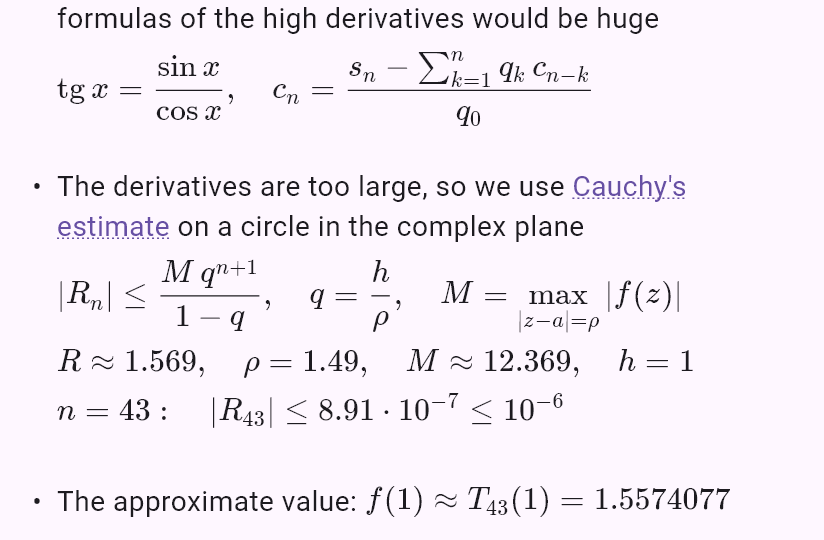
High degrees (up to about 1000) are computed exactly and shortened in the solution and the graph; the degree slider is then logarithmic. Functions whose derivatives grow quickly (tan x) go by dividing series, the error by Cauchy's estimate in the complex plane or an alternating series' estimate. If even that fails, the app explains why and gives advice.
How to enter it
taylor(sin x, 0, 5) | The function, the point and the degree. |
maclaurin(e^x, 4) | The Maclaurin polynomial – the point is 0. |
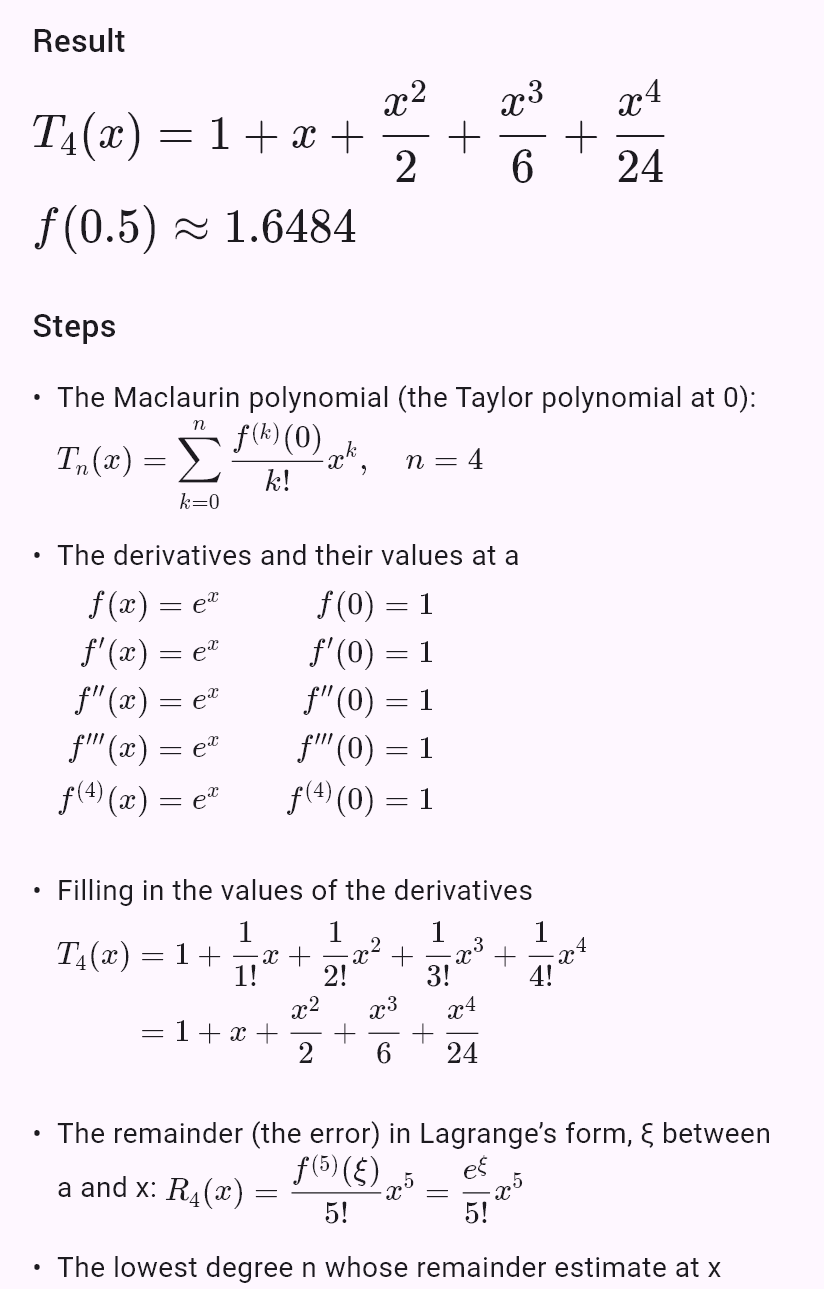
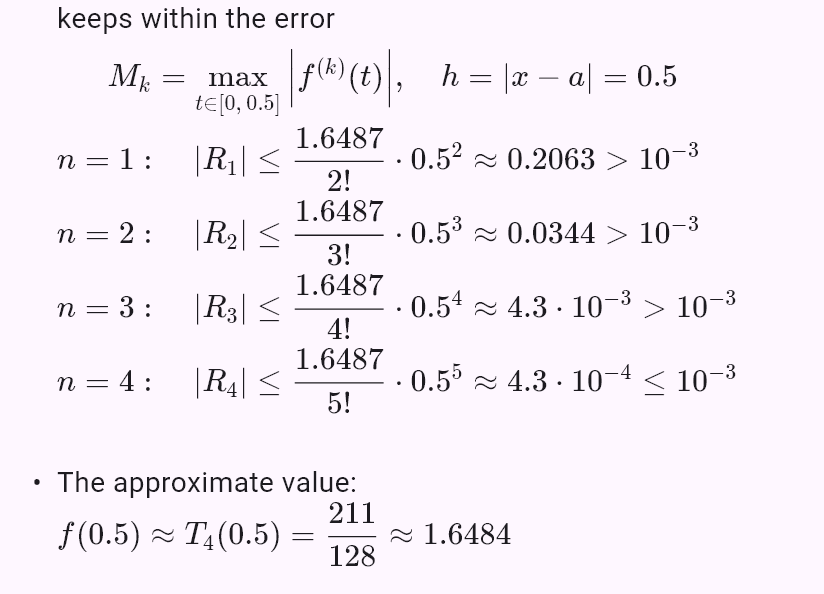
taylor(e^x, 0, error=0.001, x=0.5) | The degree by the error at the point x (on an interval enter r=… instead of x). |
ln(1 + x) | A function with the “Taylor polynomial” chip – fill in the point, the degree or the accuracy there. |
Examples
taylor(ln(1 + x), 0, 4)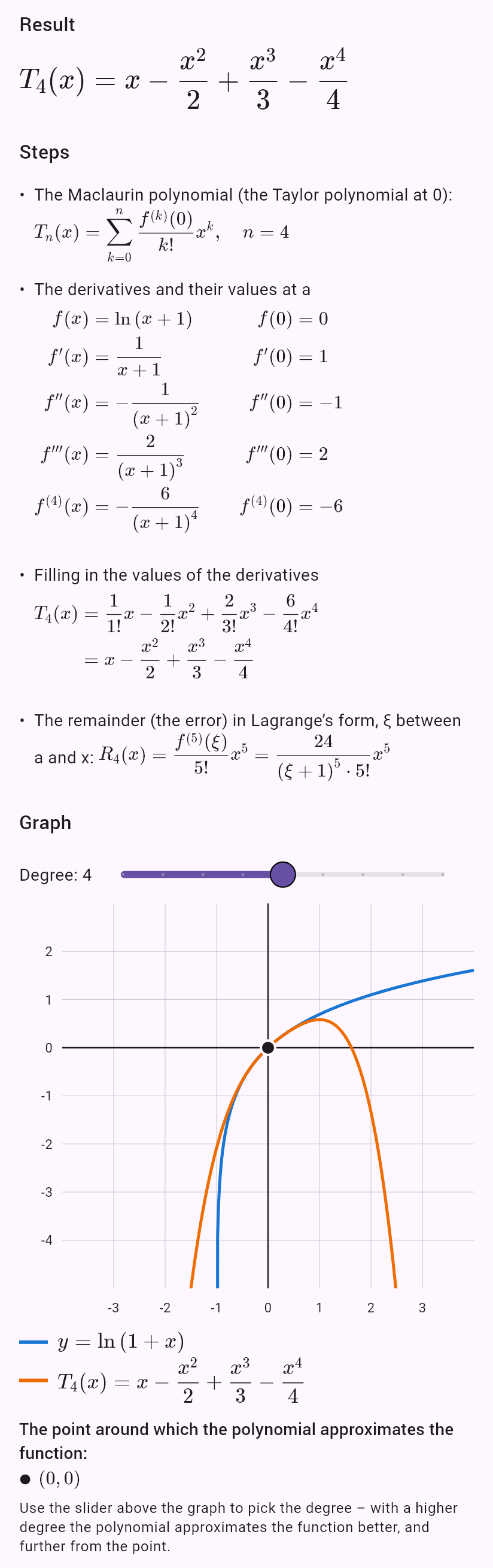
taylor(e^x, 0, error=0.001, x=0.5)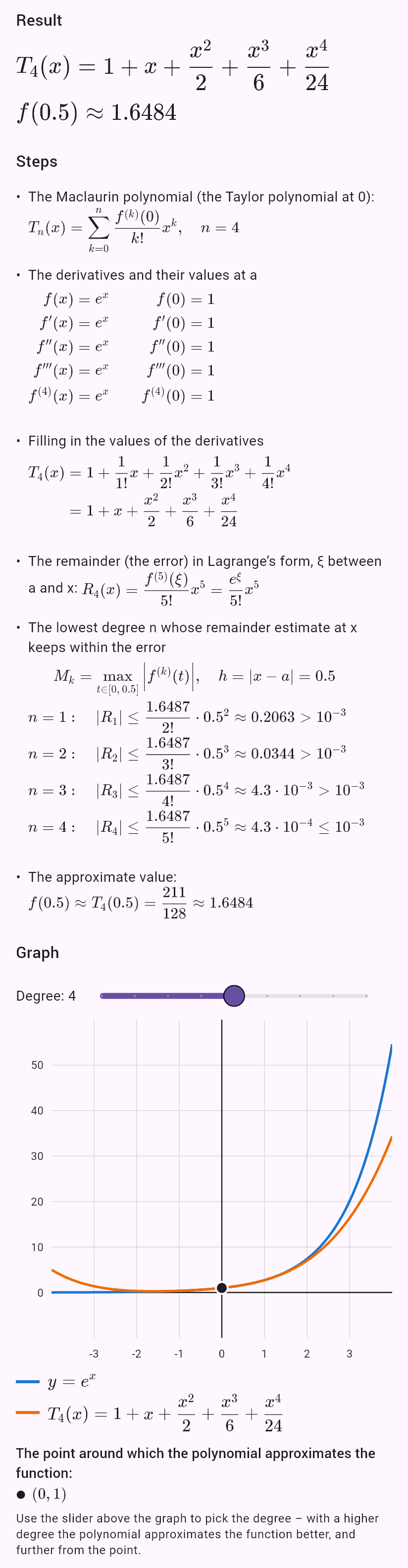
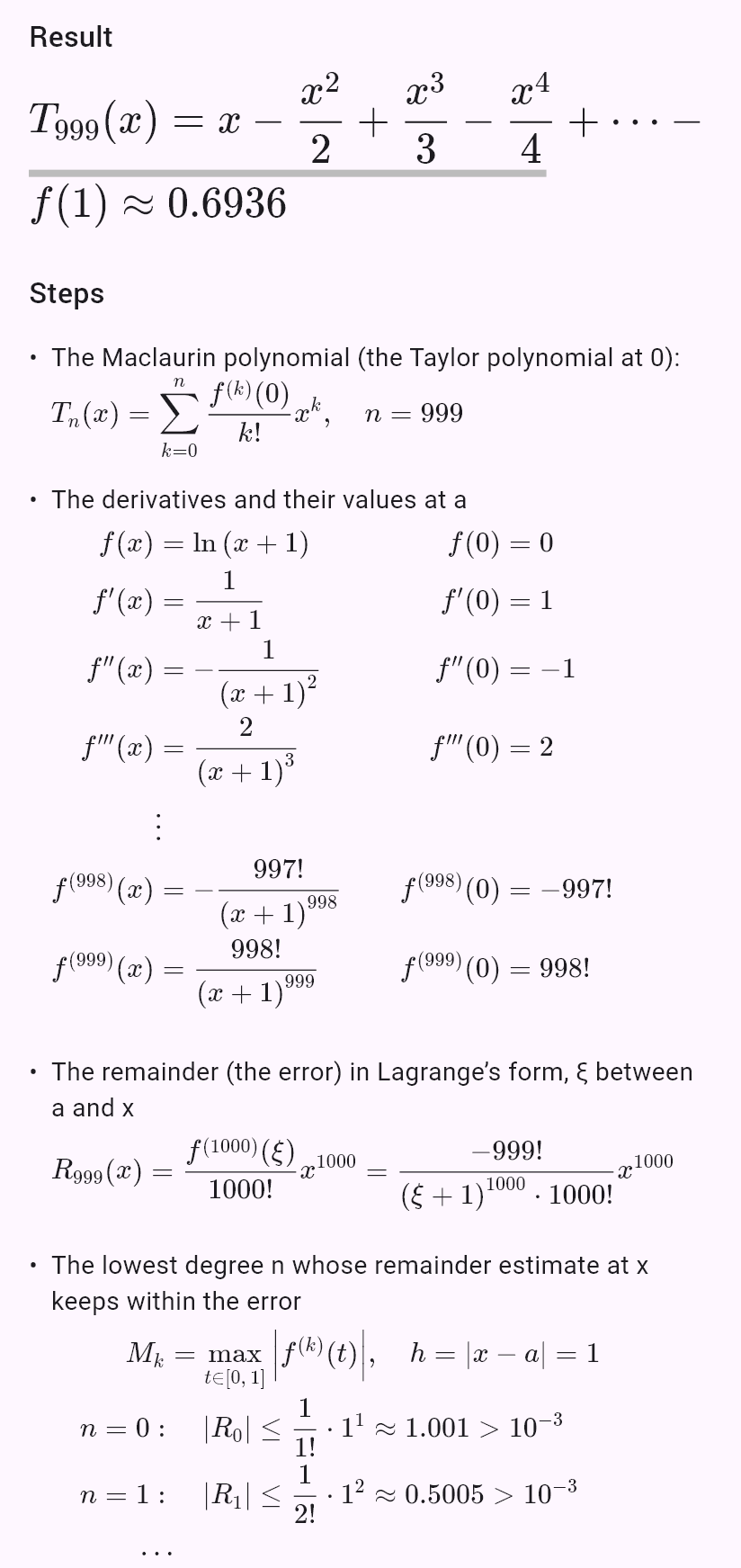
taylor(ln(1 + x), 0, chyba=0.001, x=1)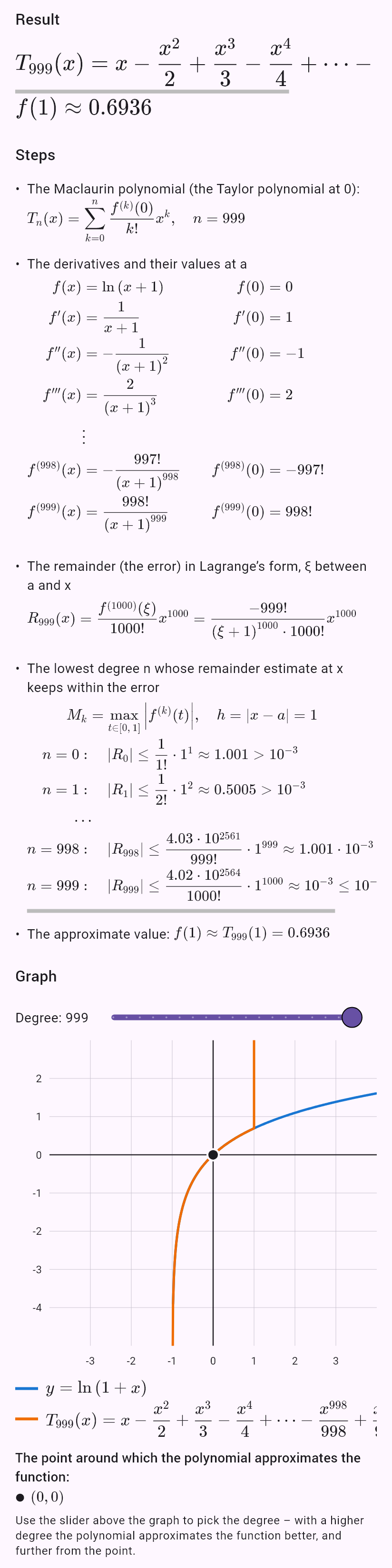
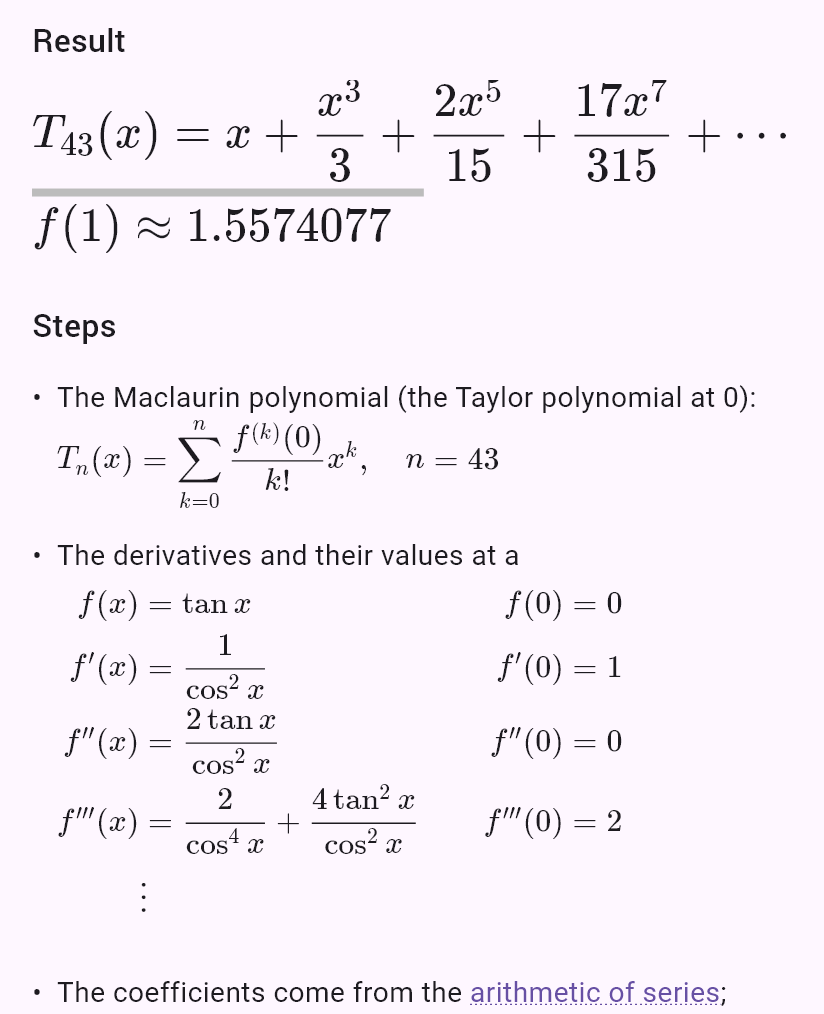
taylor(tan x, 0, chyba=0.000001, x=1)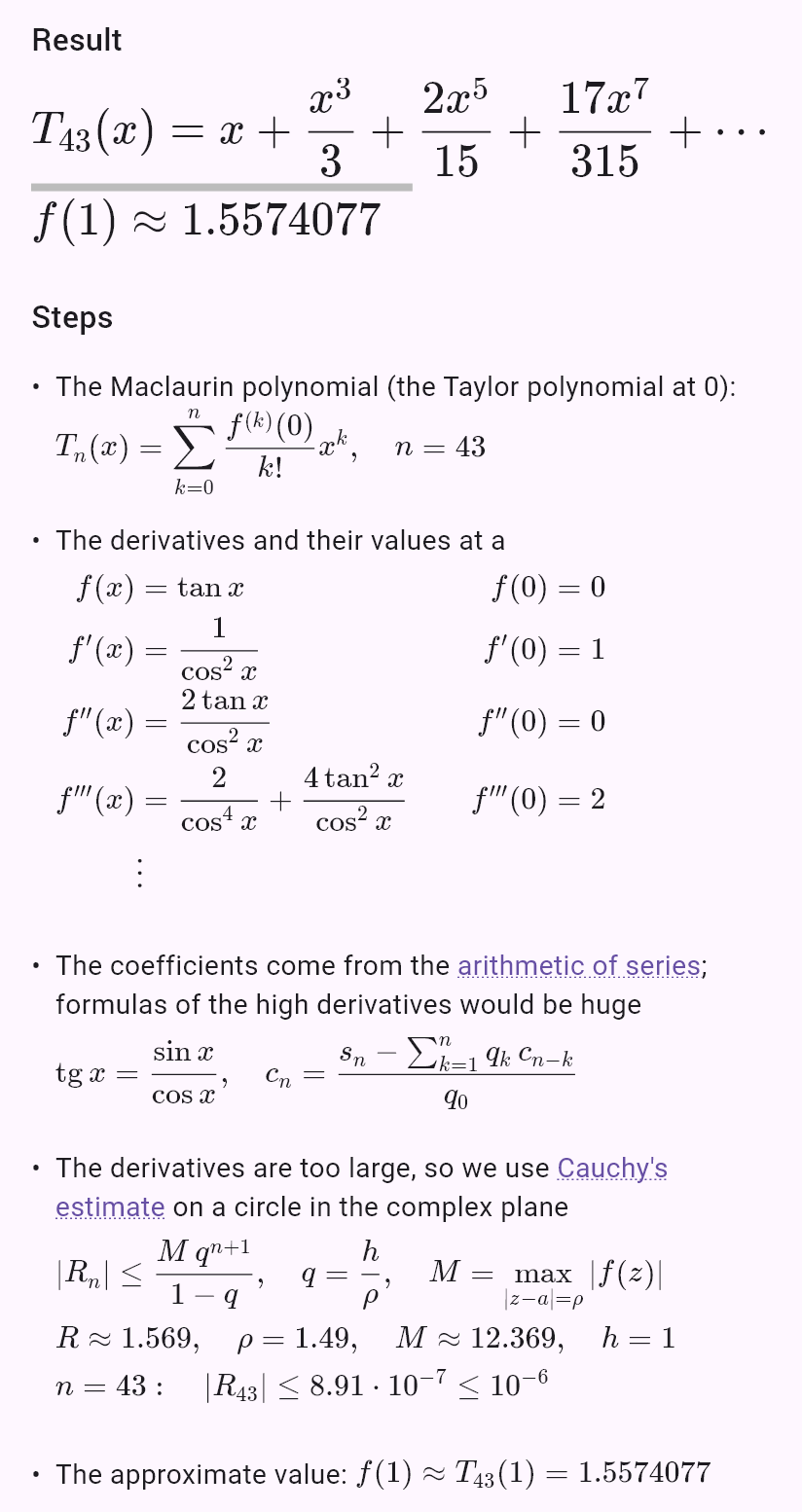
Known limitations
- Degrees above 1000 aren't computed; a point on or beyond the edge of convergence can't be handled by Cauchy's estimate.