II. Linear algebra and geometry
23. Lines and planes
Analytic geometry in the plane and in space. Write a point as for vectors: A[1; 2]. Name a line or a plane and write its equation after a colon, each on its own line: general (p: 2x + 3y − 5 = 0), slope-intercept (p: y = 2x + 1), parametric (p: x = 1 + 2t, y = 3 − t) or vector (p: X = A + t·u). In space an equation in x, y, z is a plane (ρ: x + y + z = 1), so are parametric equations with two parameters; write a line in space parametrically or as the intersection of two planes (p: x + y + z = 1, x − y = 0). The keys p:, q: and ρ: are on the functions keyboard.
A chip says what to compute – the offer follows what you enter: one line or plane gets all forms of its equation, two get their relative position with the intersection, the angle and the distance, a point and a line (plane) the distance, the perpendicular and the parallel through the point, the projection and the reflected point. Two or three points alone get the line AB, the perpendicular bisector and a triangle's centroid with altitudes (in space the plane ABC) among the vectors' chips.
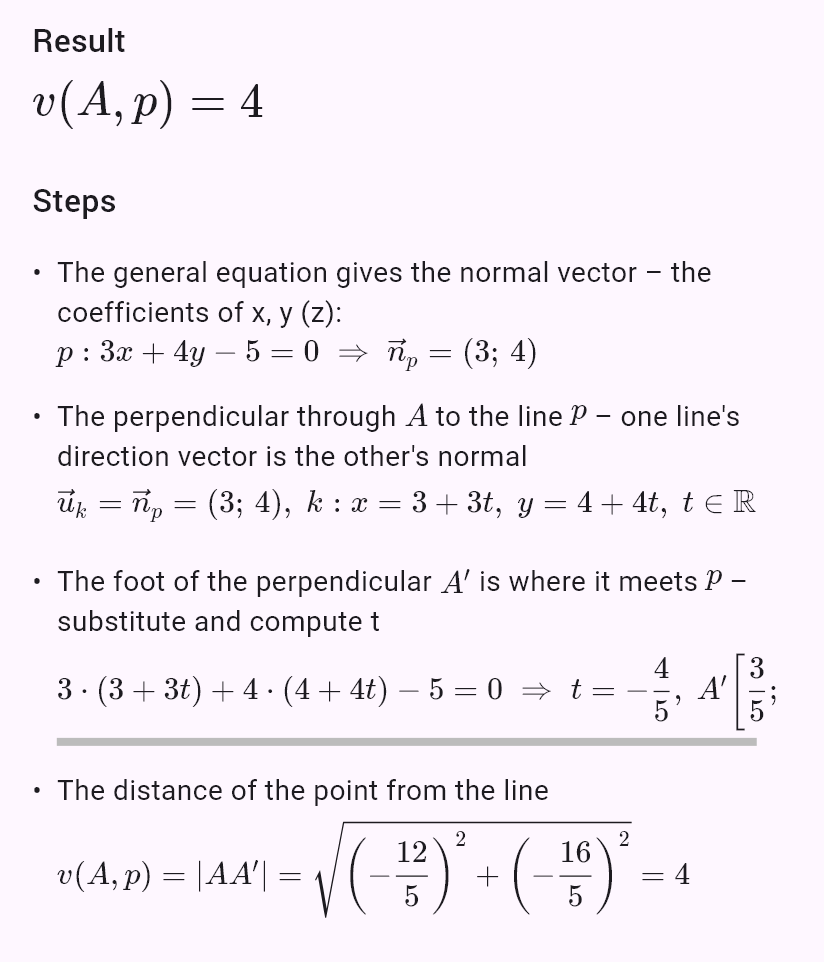
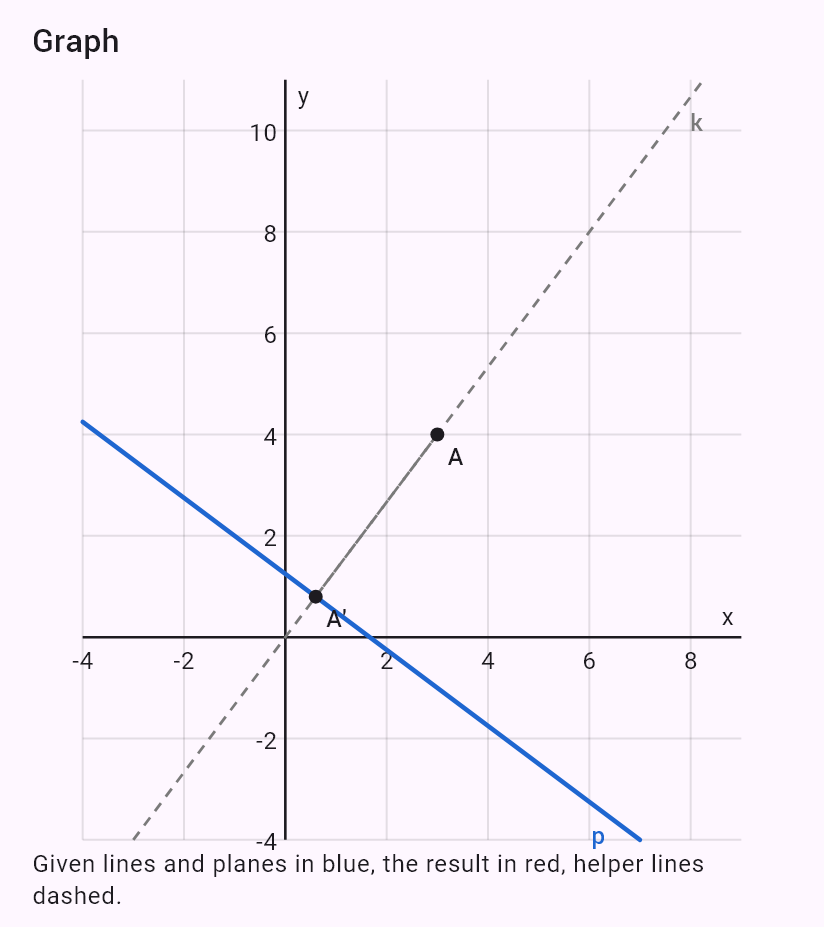
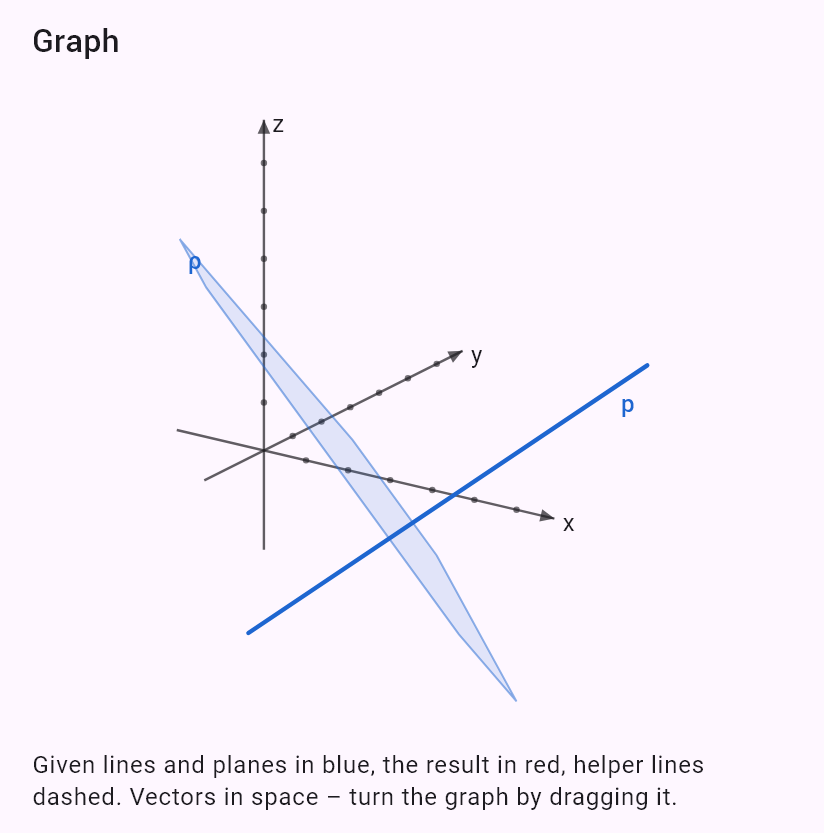
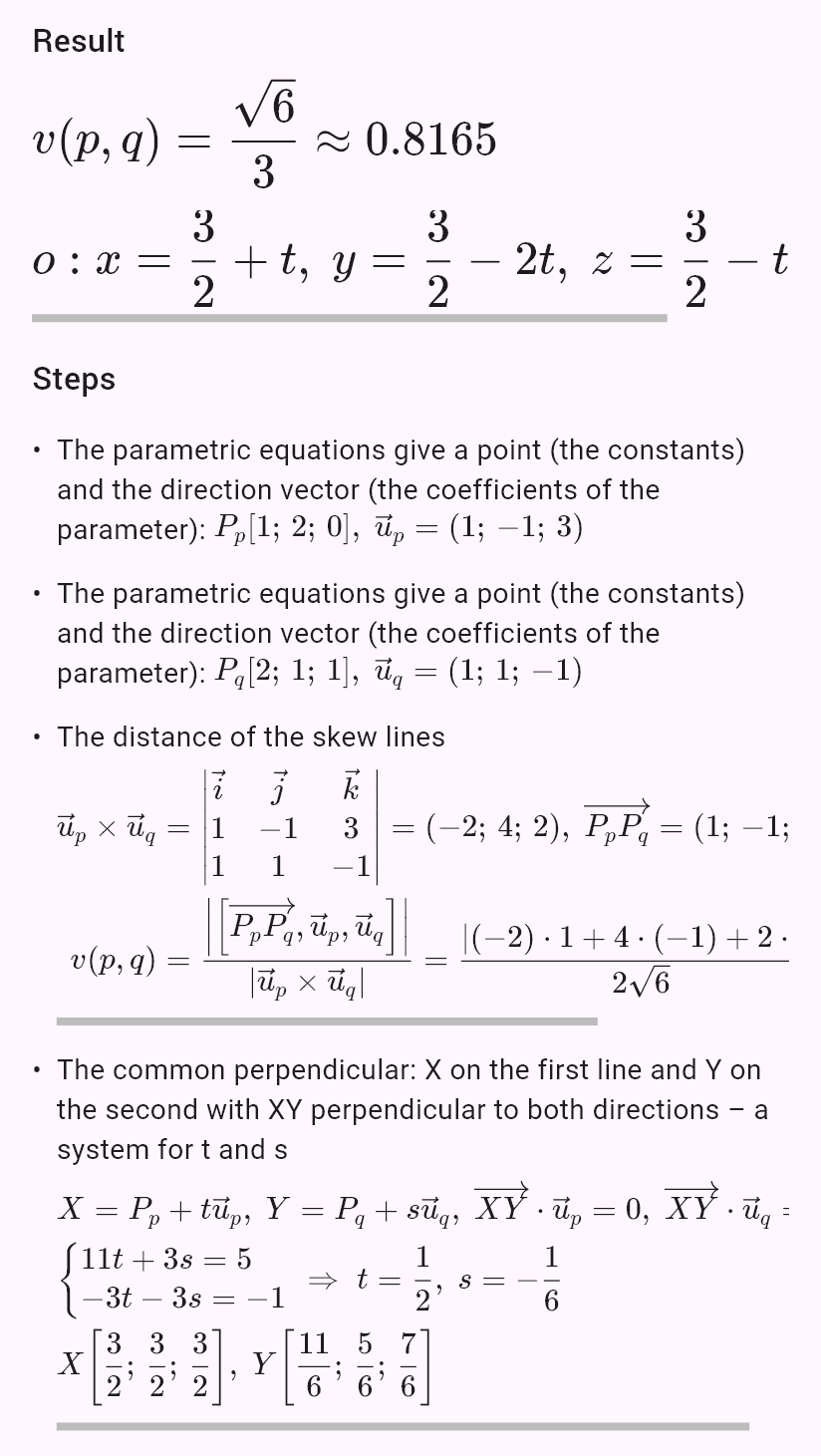
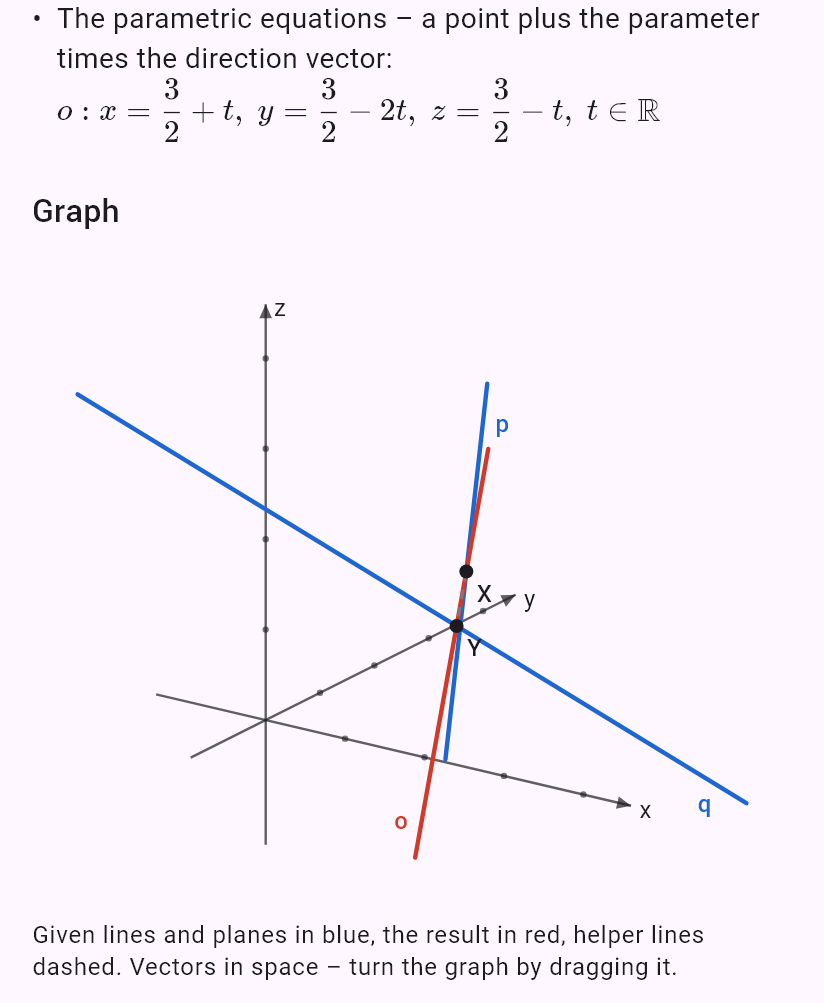
The app computes a distance by the formula or – with the chip “By the projection” – as at a seminar: the perpendicular through the point, its foot and the segment's length. For skew lines it also finds their common perpendicular. Angles are exact for the table values, otherwise in degrees and minutes. You can also write the task on the last line: angle(p, q), distance(A, p), intersection(p, q), perpendicular(A, p), parallel(A, p), projection(A, ρ), reflection(A, p), bisector(A, B), midpoint(A, B), centroid(A, B, C), line(A, B), plane(A, B, C). The graph shows the lines and planes; in space you turn it with your finger.
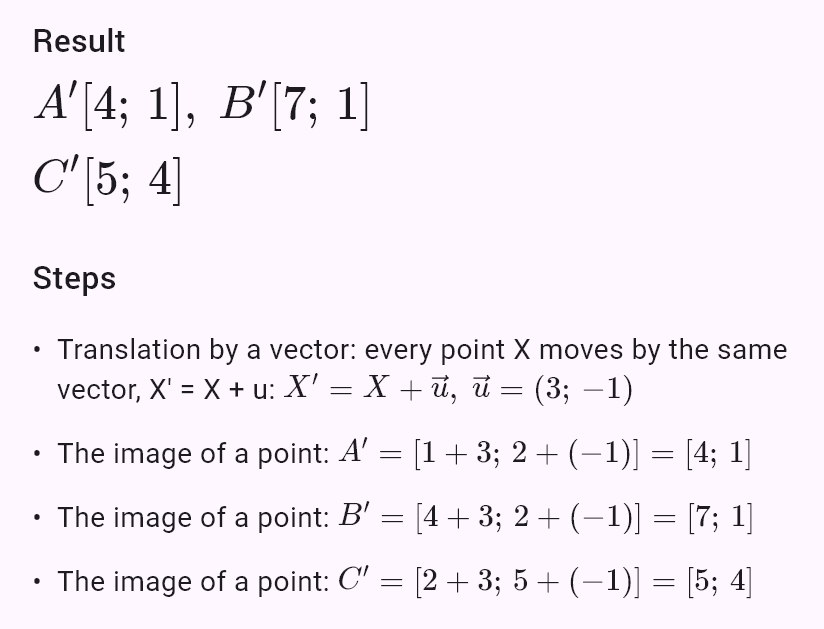
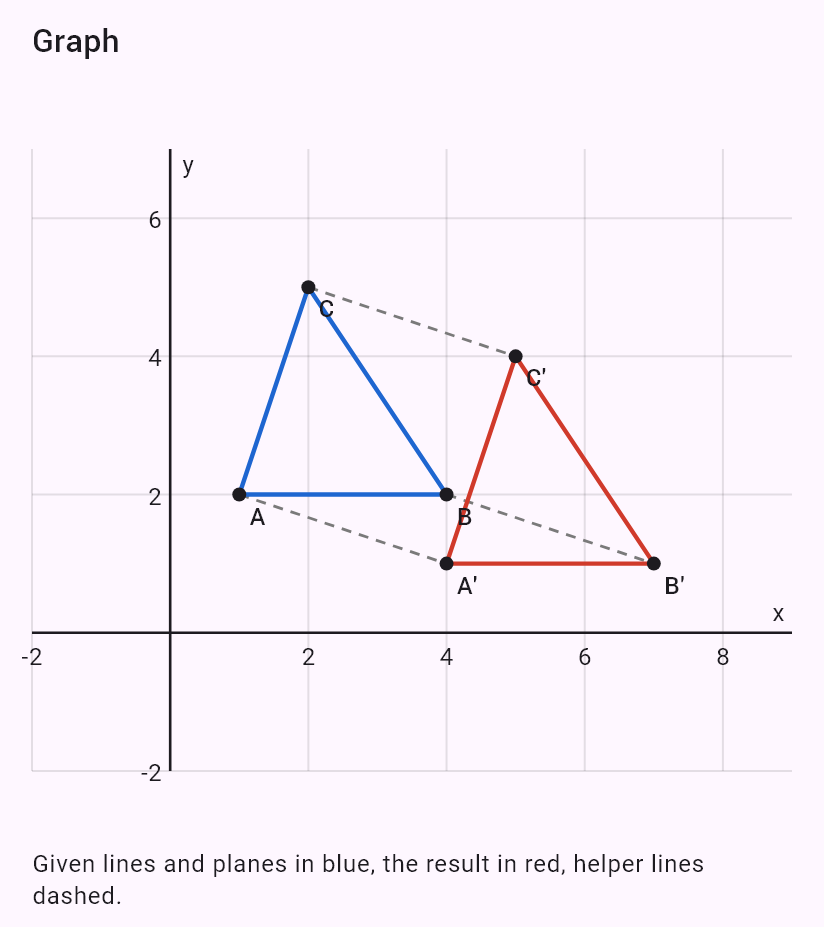
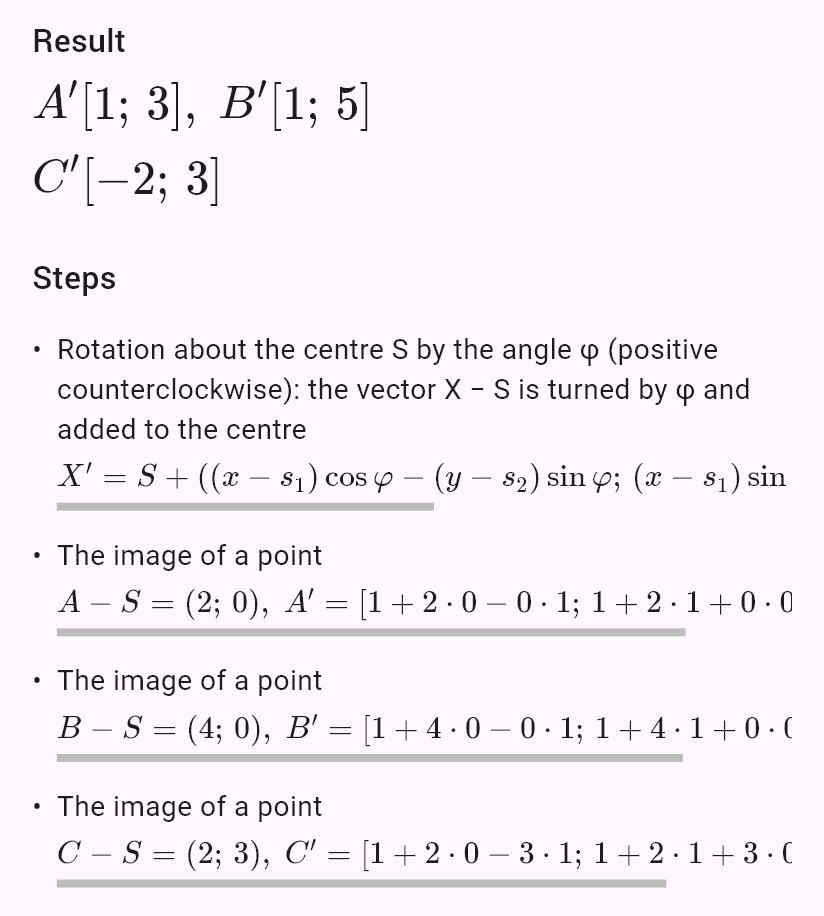
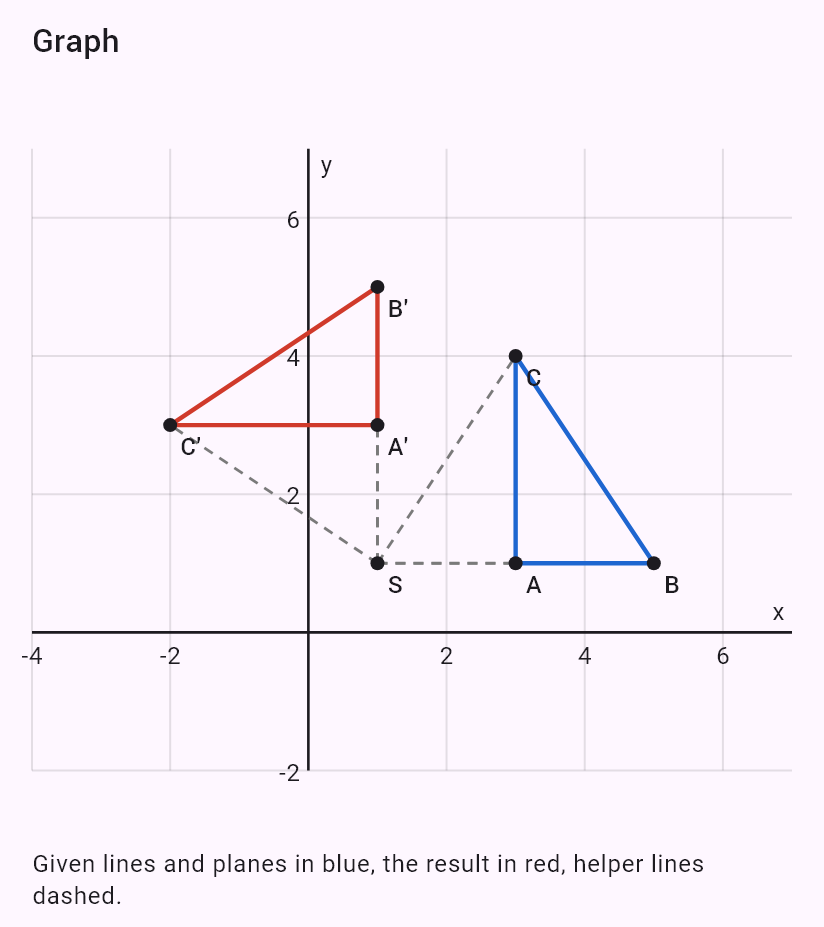
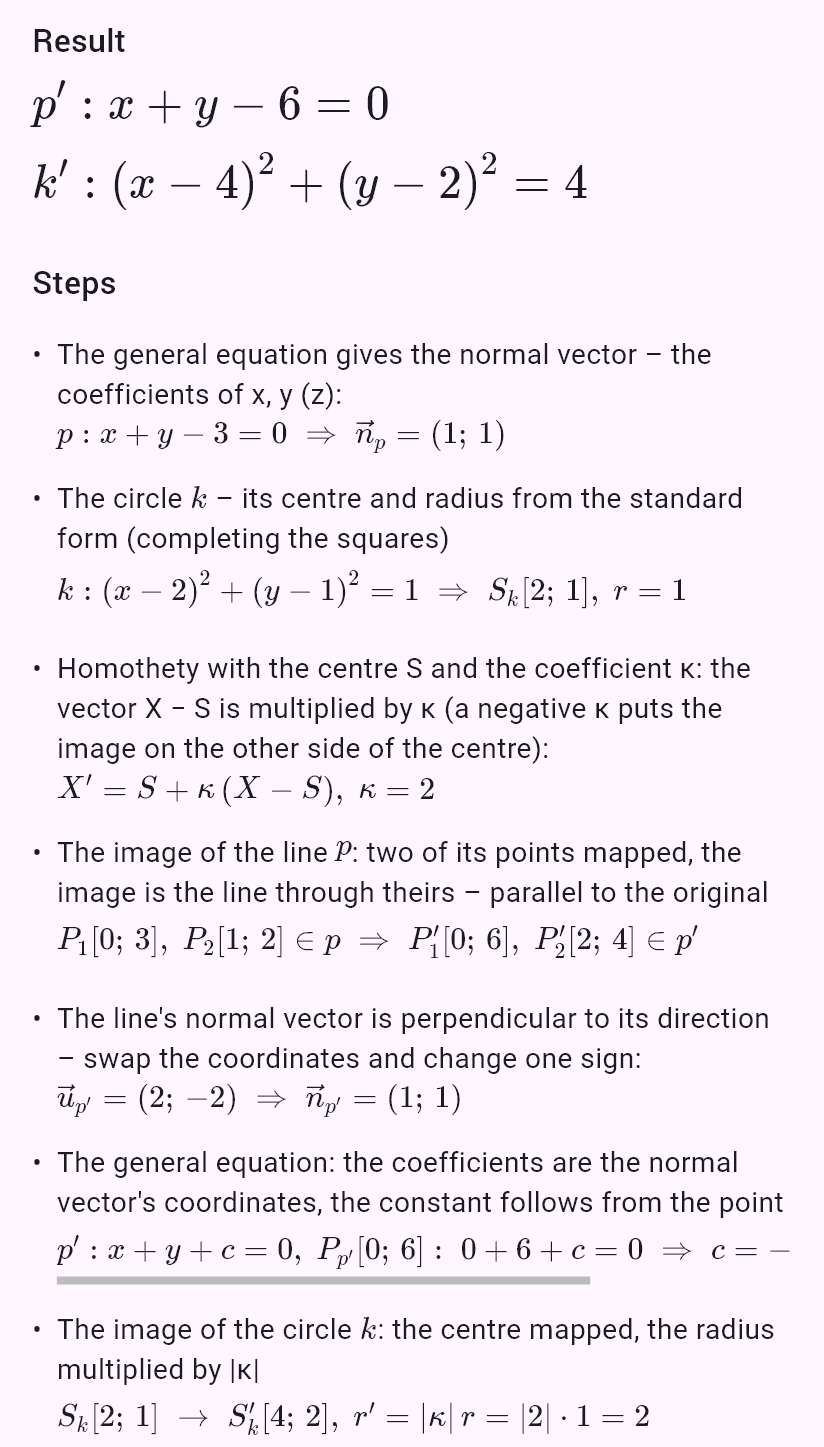
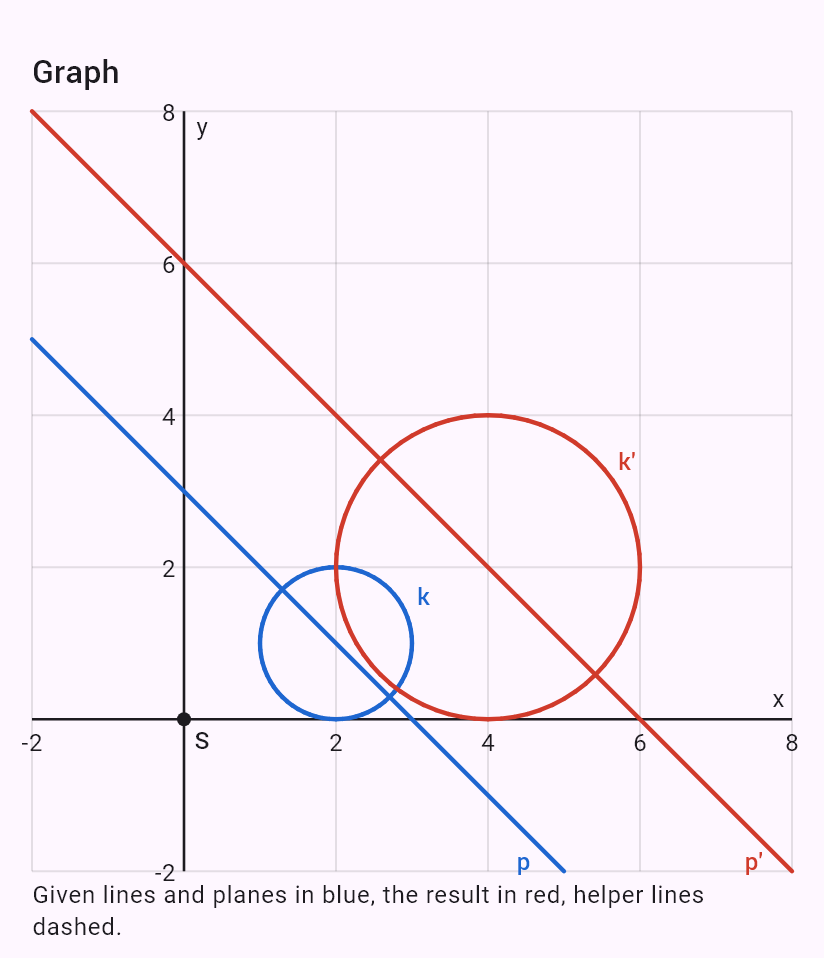
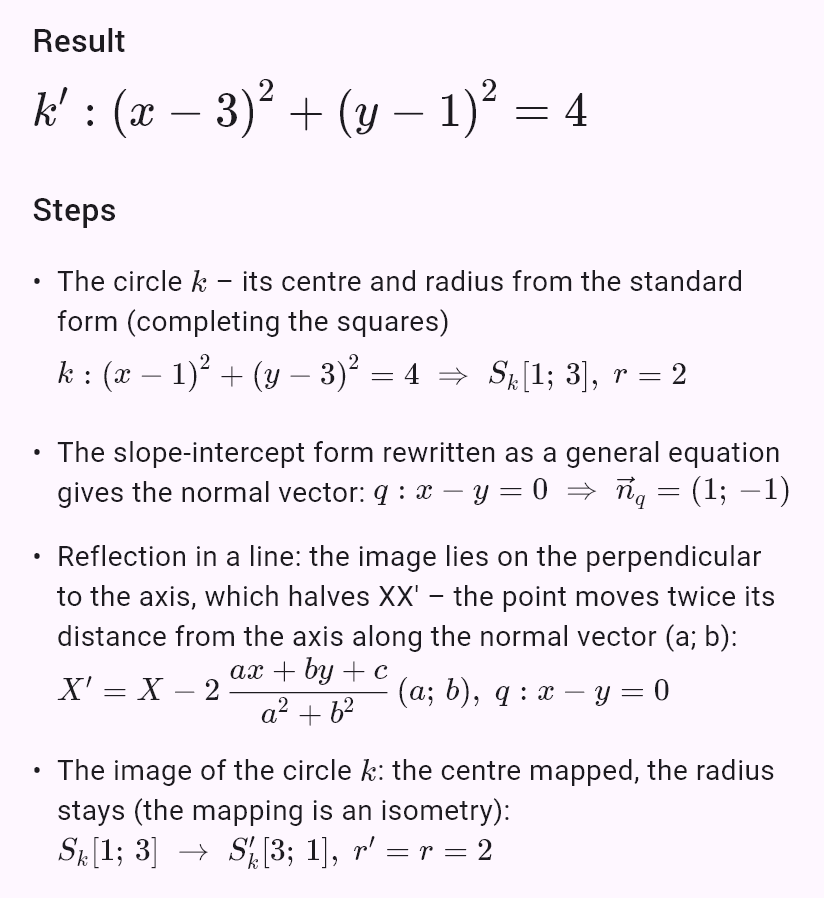
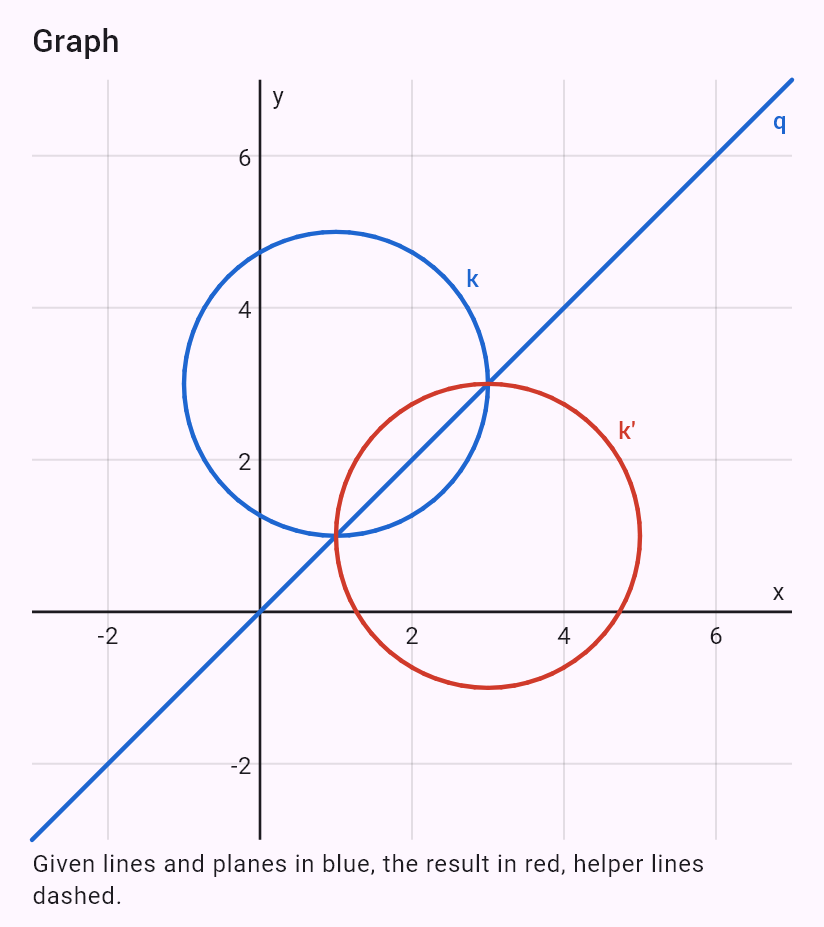
Geometric mappings in the plane: a translation by a vector, a rotation about a centre by an angle (in degrees, positive counterclockwise), a homothety with a centre and a coefficient, and point and line reflections. A point, a polygon (points in a row: translation(A, B, C, u) is a triangle), a line and a circle (k: (x − 1)^2 + (y − 2)^2 = 4) can be mapped. Write the task on the last line, or pick the chip “Translation”, “Rotation”, “Homothety” or “Reflection” – then the angle and the coefficient go on a line of their own (φ = 90, κ = 2) and the centre is the point S. The steps show the mapping in coordinates and every point’s image, two points’ images for a line and the centre and radius for a circle; the graph both the original and the image.
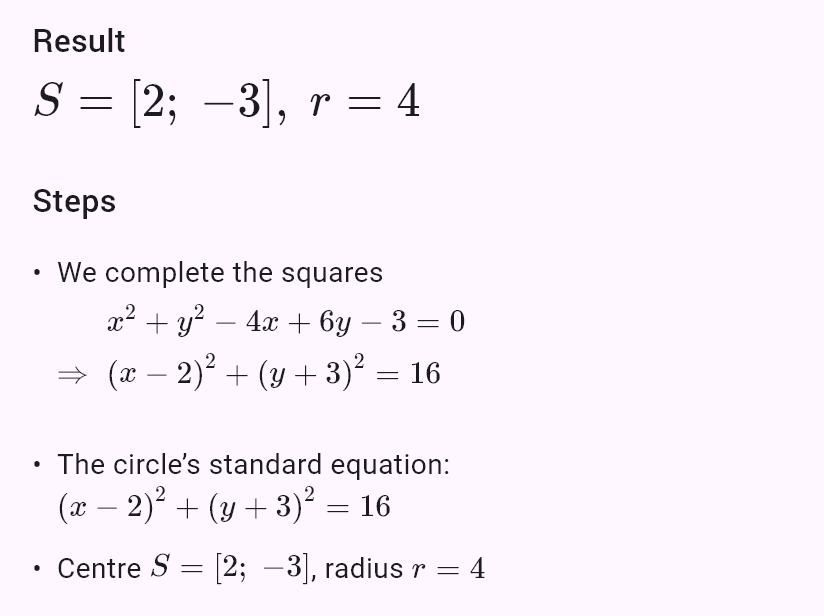
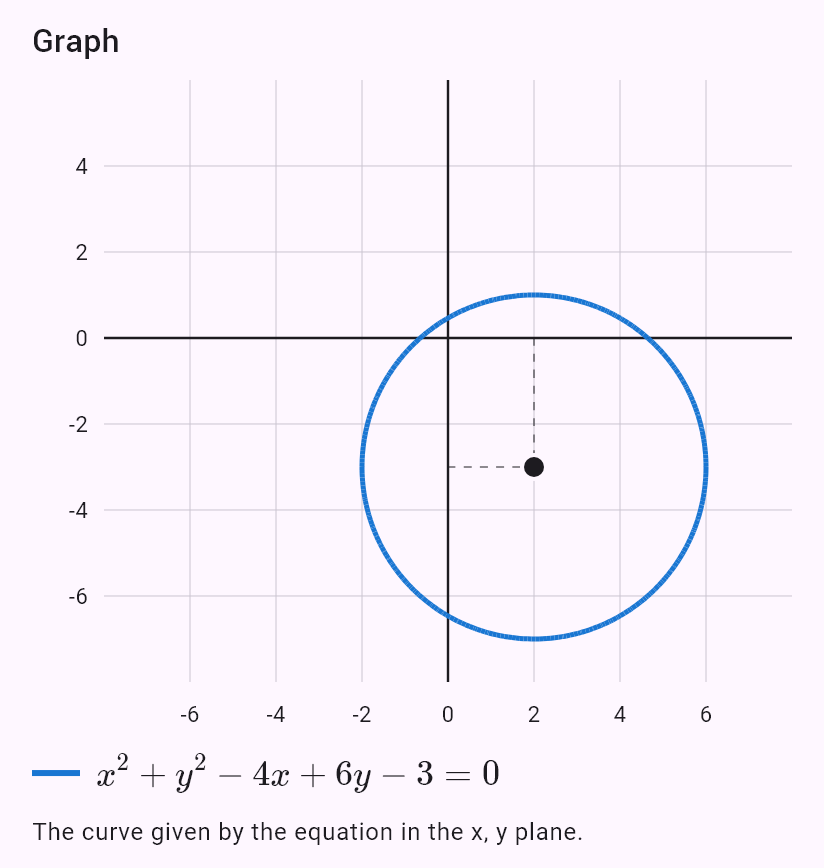
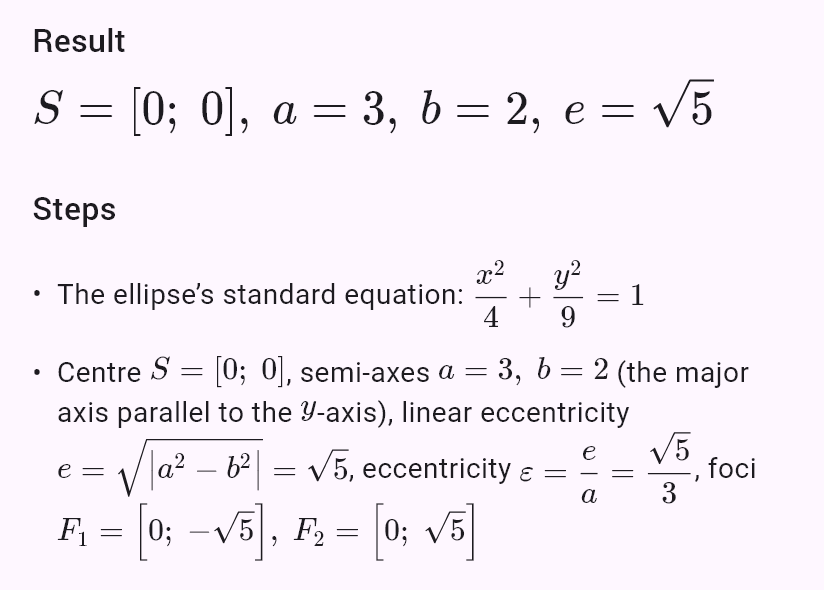
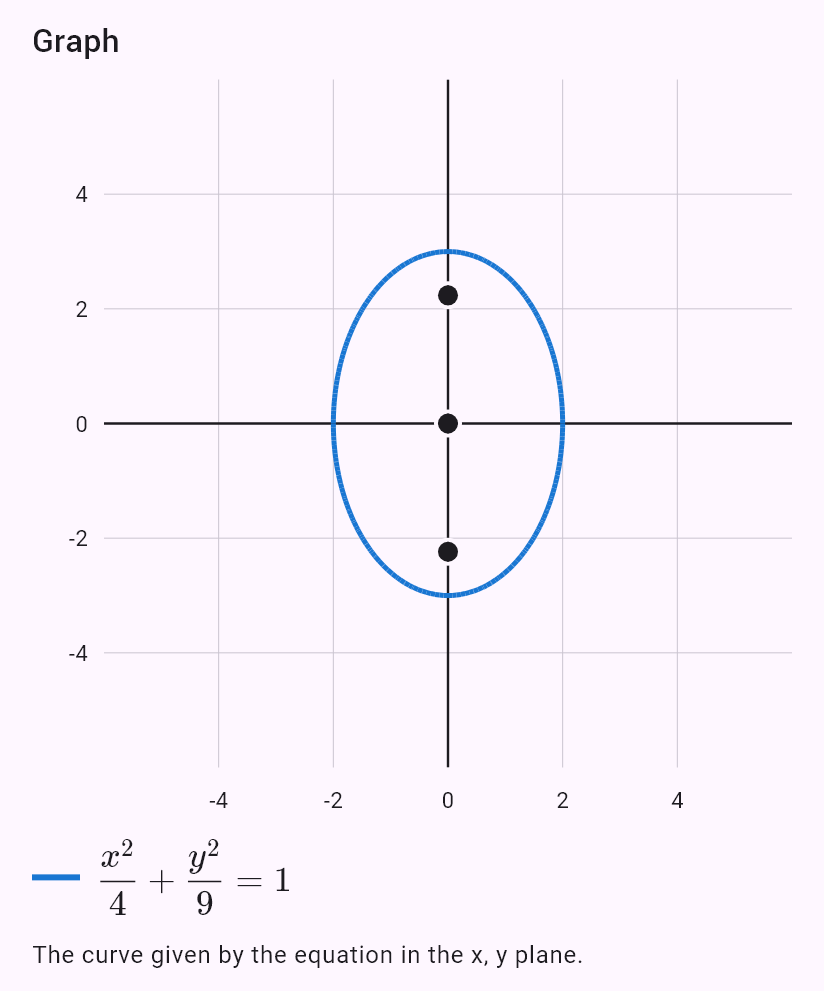
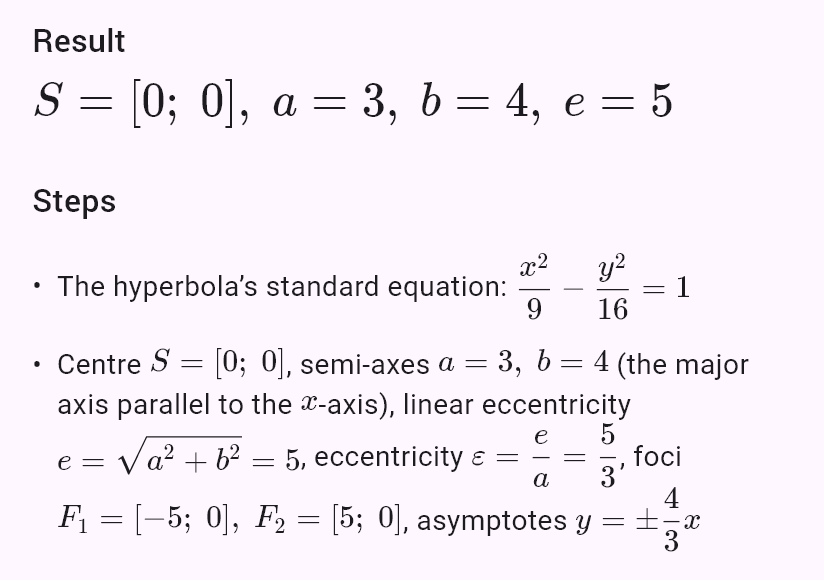
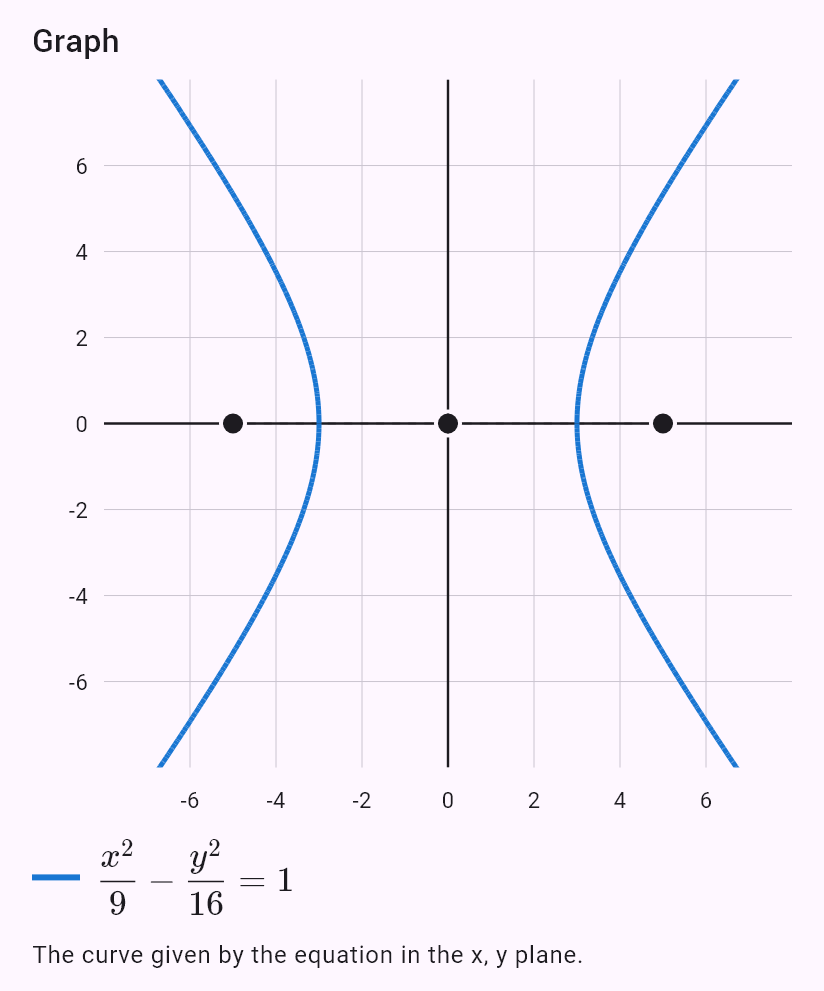
Conic sections in the axes’ position (no xy term): squares completed to the standard or vertex form, a circle’s centre and radius, an ellipse’s and a hyperbola’s centre, semi-axes, eccentricity and foci (a hyperbola’s asymptotes too), a parabola’s vertex, parameter, focus and directrix; the graph shows the curve with its points.
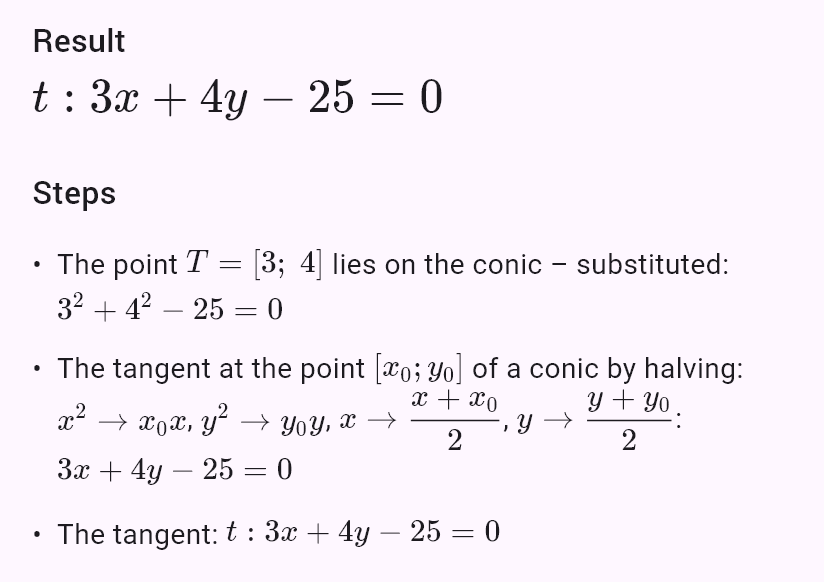
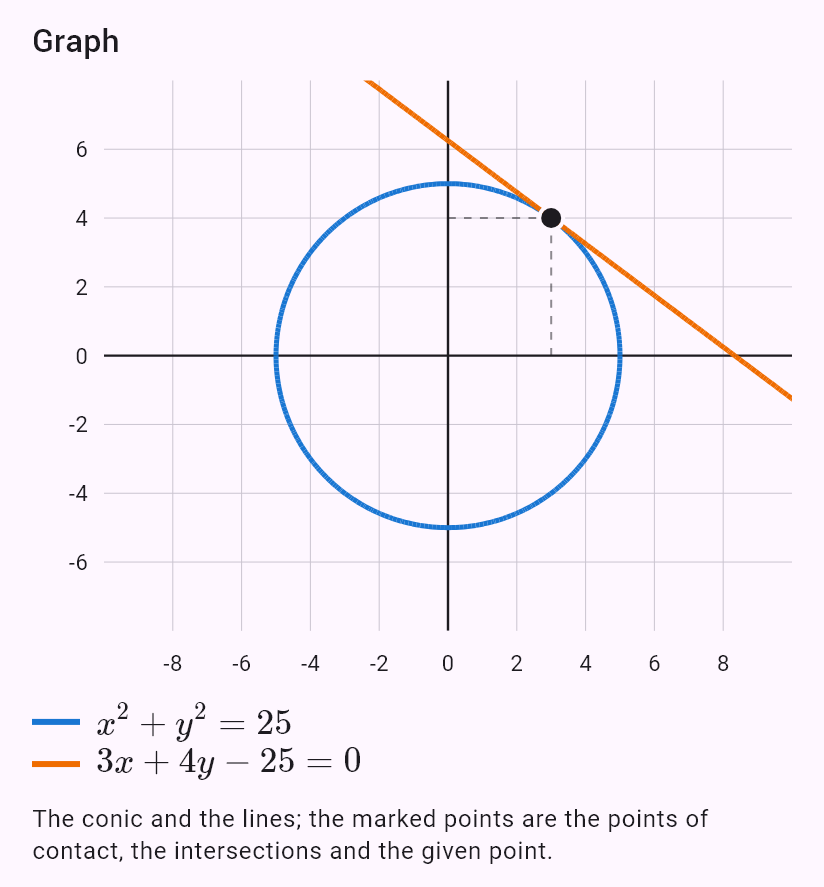
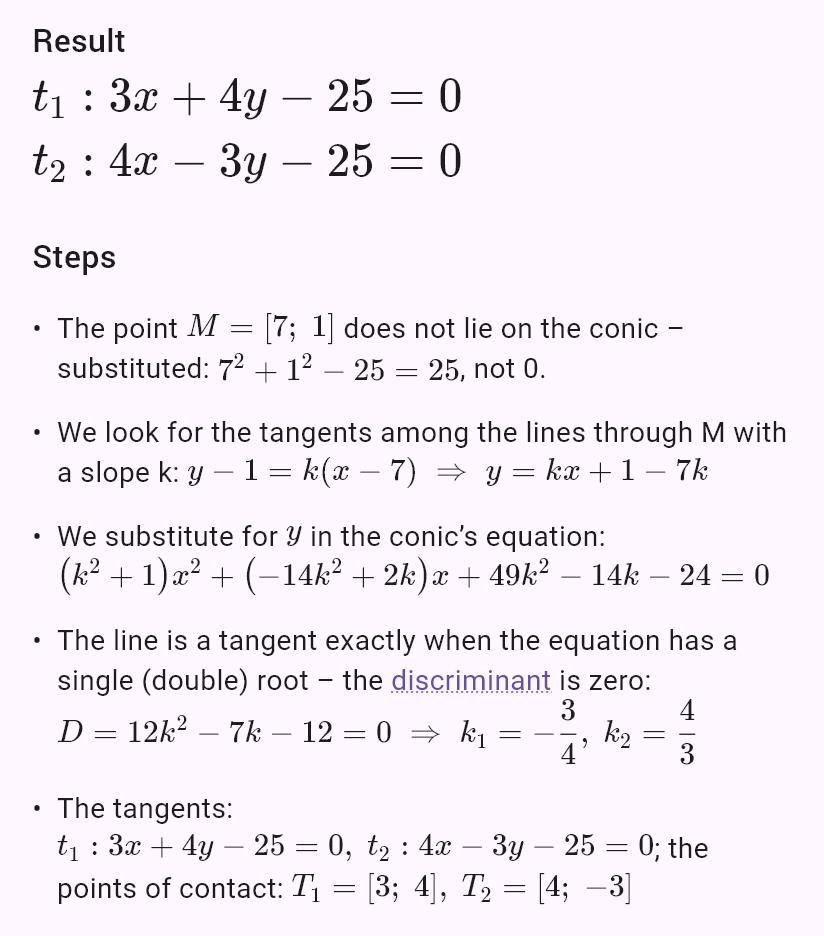
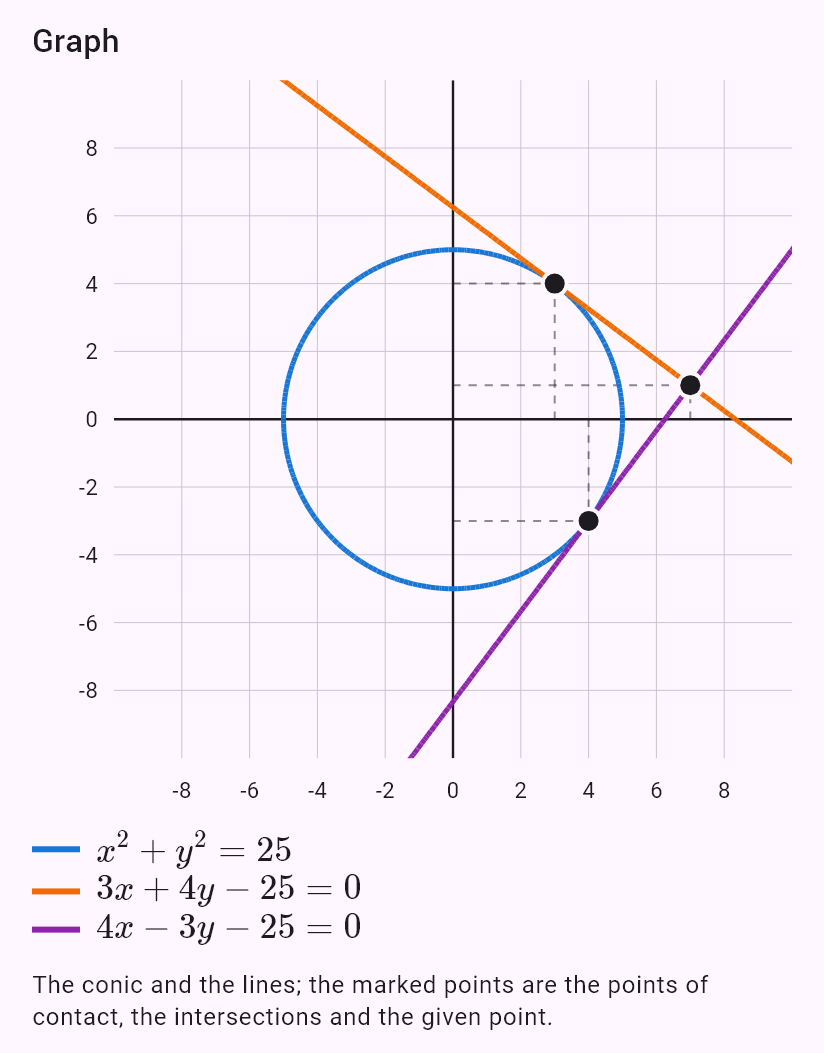
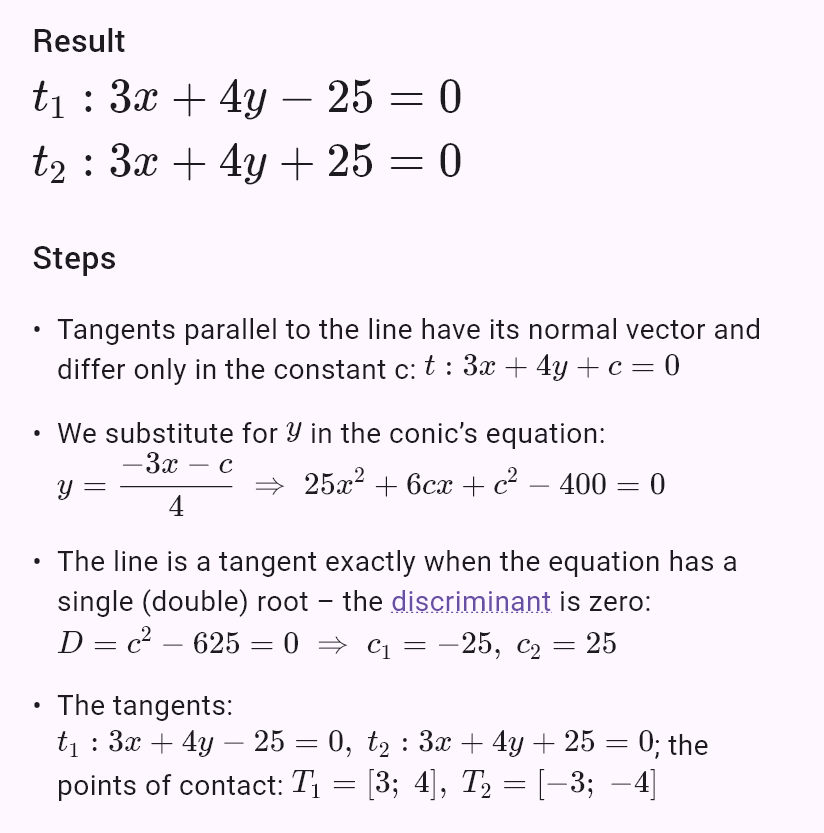
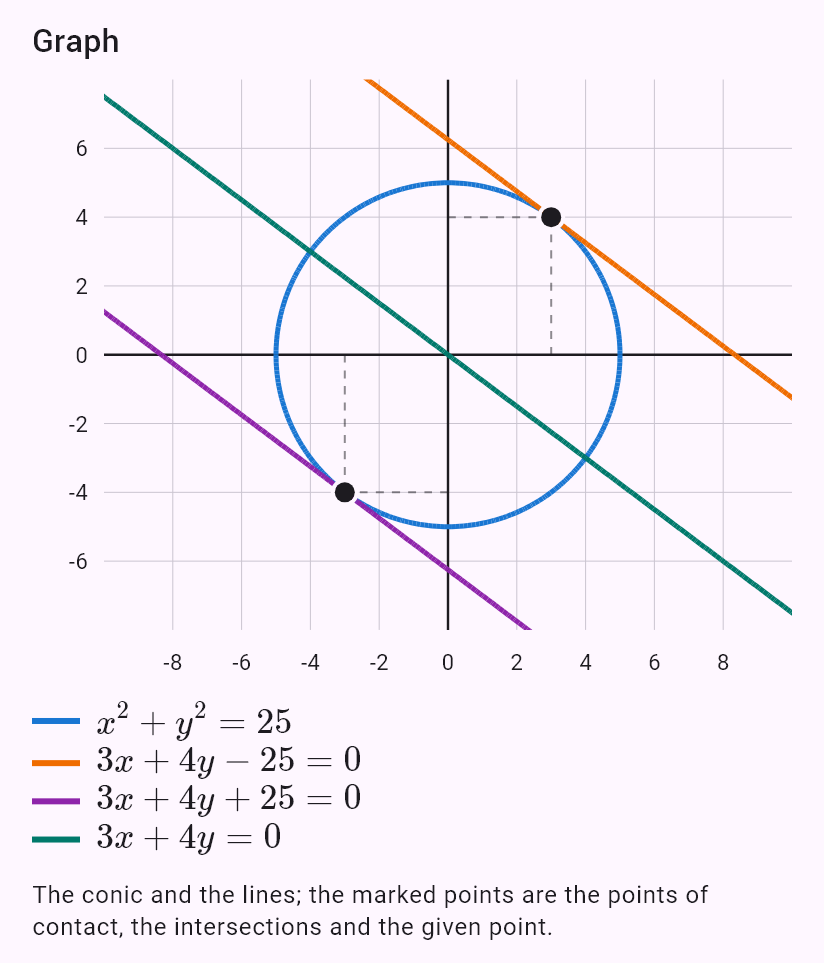
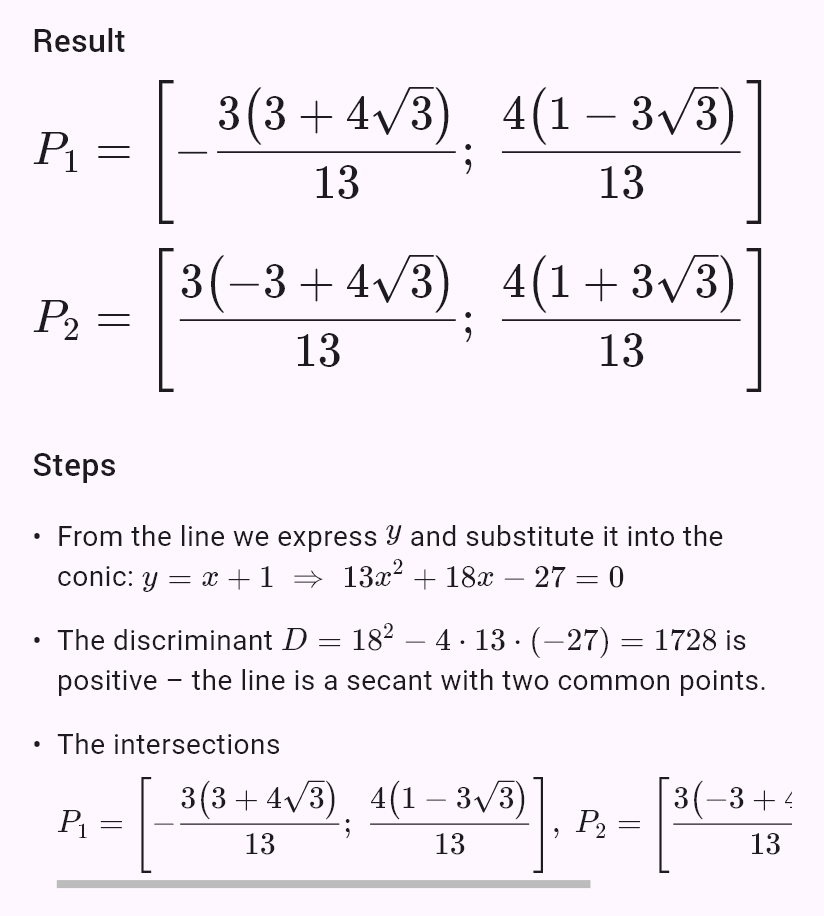
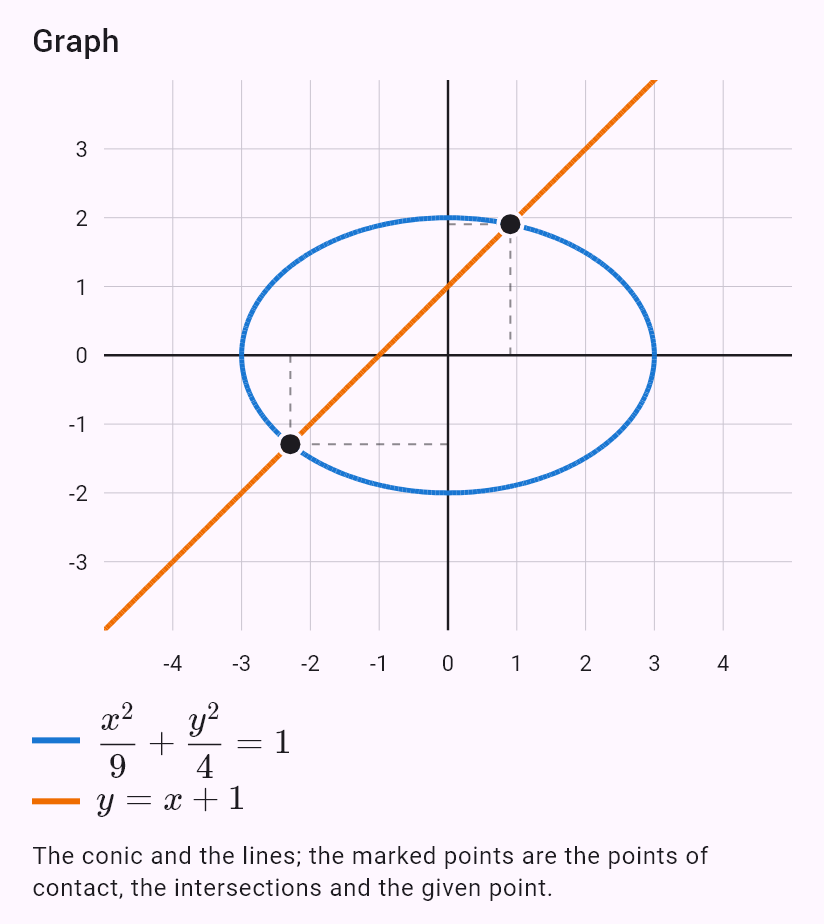
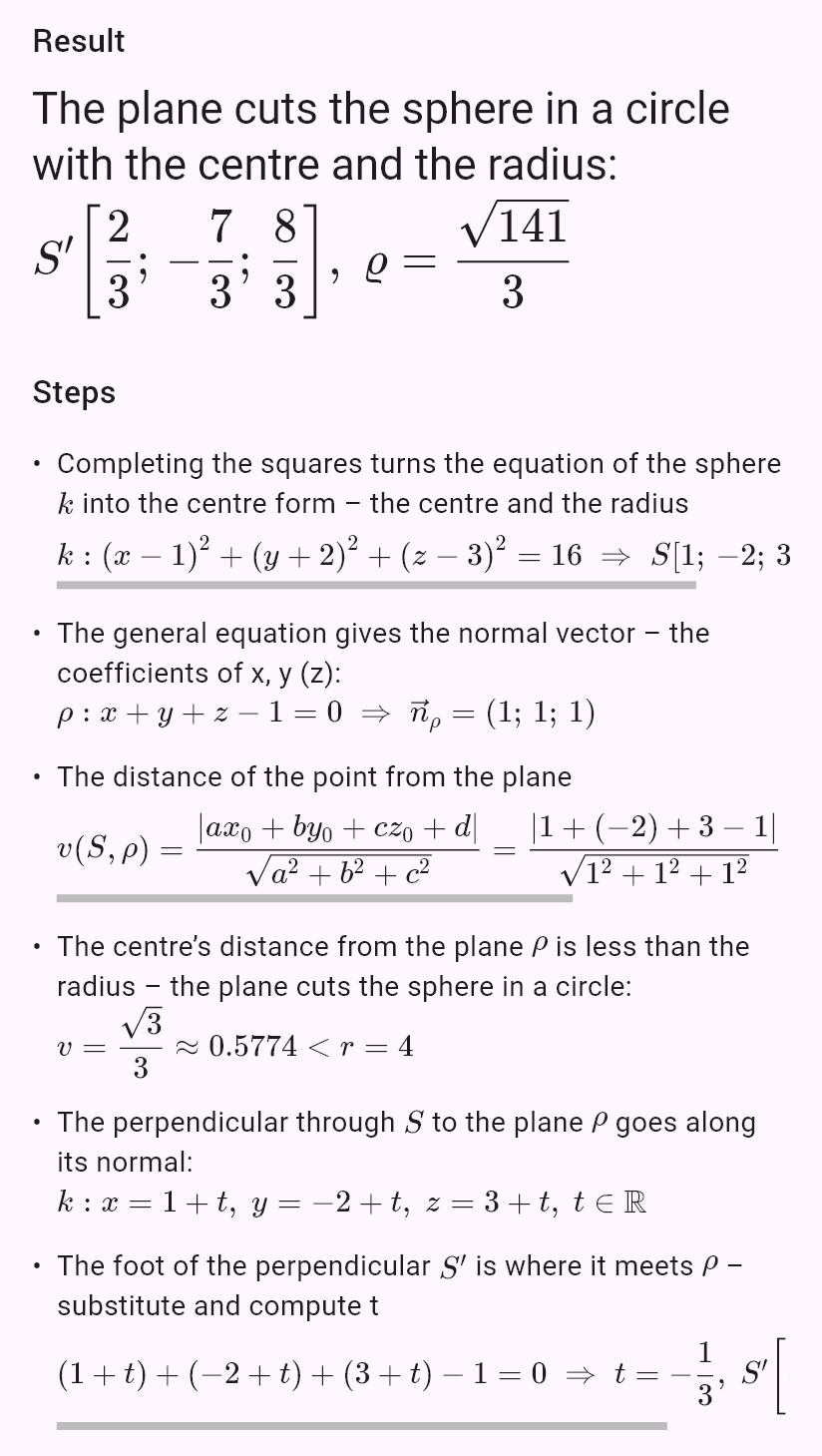
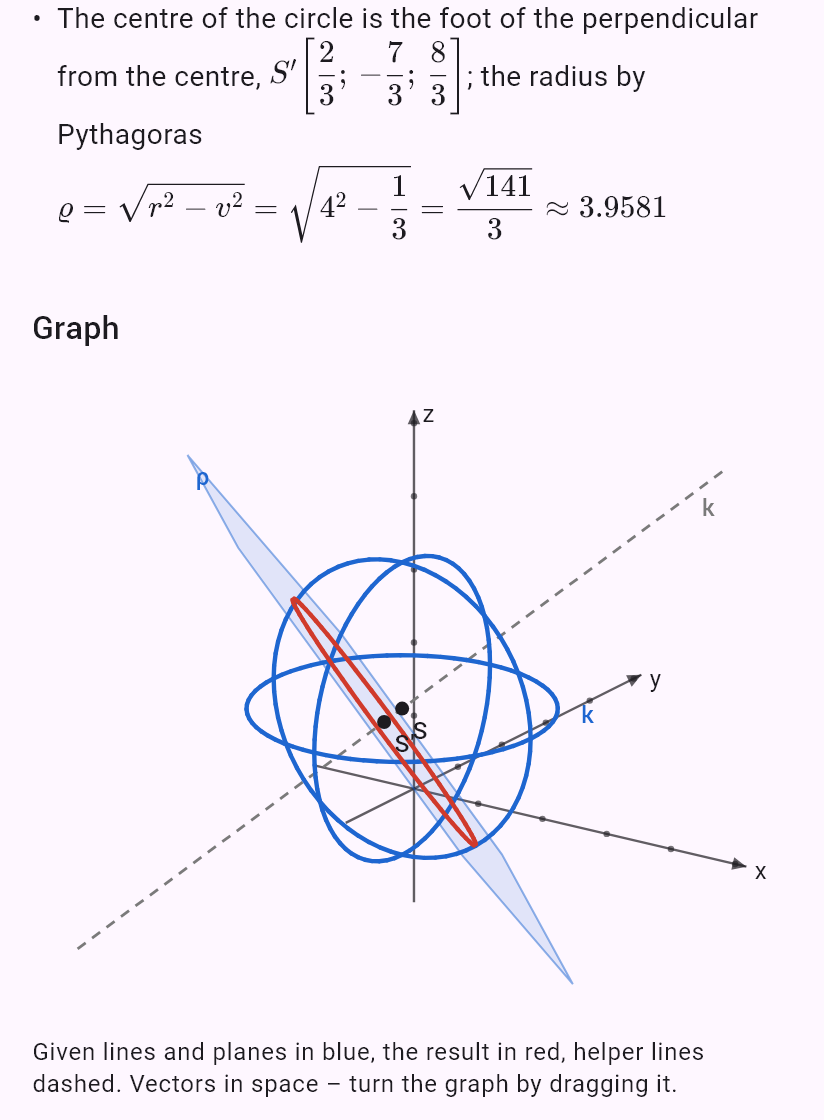
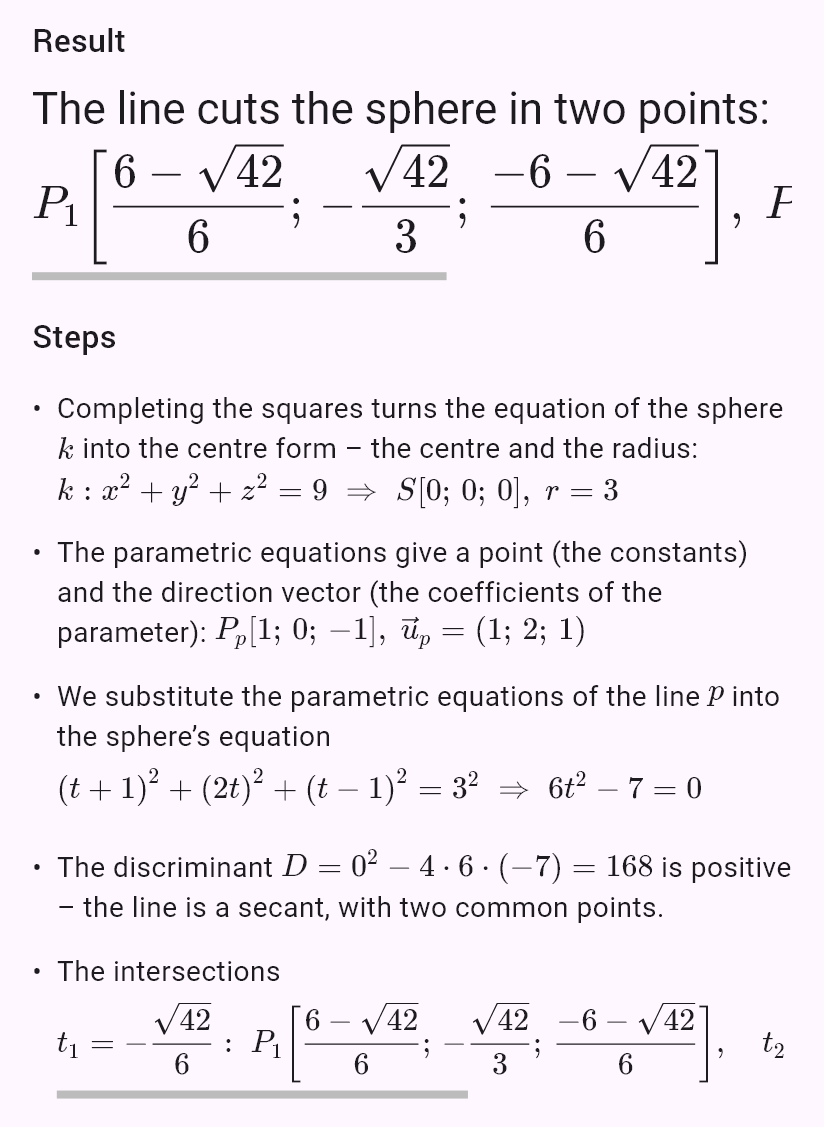
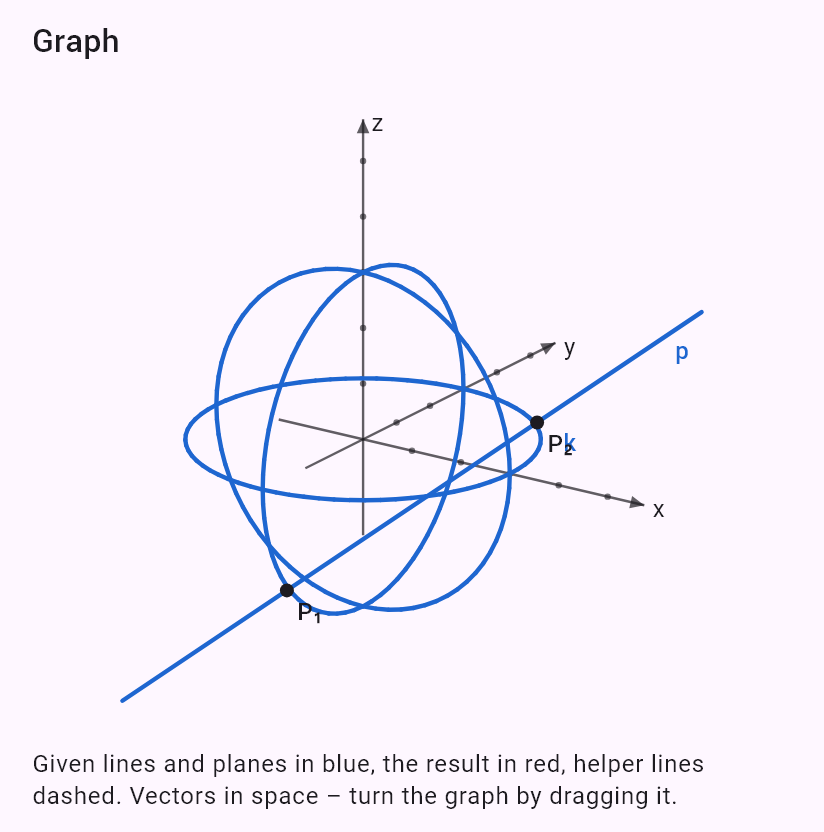
Write a tangent at a point of a conic in words – “tangent to x^2 + y^2 = 25 at [3; 4]” – and the app finds it by halving the equation. The position of a conic and a line (“position of x^2/9 + y^2/4 = 1 and y = x + 1”) comes from substitution and the discriminant: a secant, a tangent or a line missing the conic, with the intersections. A sphere (x² + y² + z² − 2x + 4y − 6z − 2 = 0) is completed to squares for its centre and radius. The forms of a line include the intercept form x/p + y/q = 1. Tangents from a point outside (“tangents to the circle x^2 + y^2 = 25 from the point [7; 1]”) are found among the lines through the point with a slope k – a tangent is one whose discriminant is zero; the vertical line is checked separately. Tangents parallel or perpendicular to a line (“… parallel to the line 3x + 4y = 0”, “… perpendicular to the line y = x”) have the same normal vector and an unknown constant c. Write a sphere with a name and a plane, a line or a point on the next line: with a plane the centre’s distance is compared with the radius (the circle of the section with its centre and radius, a point of contact, or nothing), a line’s parametric equations are substituted and the discriminant decides, at a point of the sphere the tangent plane is found.
How to enter it
p: 2x + 3y - 5 = 0, q: x = 1 + 2t, y = 3 - t | A line by a general, slope-intercept or parametric equation, each on its own line. |
p: X = A + t·u | A line by a vector equation from a point and a vector. |
ρ: x + 2y - 2z + 3 = 0 | A plane by a general equation (in space). |
p: x + y + z = 1, x - y = 0 | A line in space as the intersection of two planes. |
angle(p, q), distance(A, p), centroid(A, B, C) | The task on the last line. |
translation(A, B, C, u), rotation(A, S, 90), homothety(p, k, S, 2), reflection(k, q) | A geometric mapping: the figures, then the vector, the centre and the angle or coefficient, or the centre or axis of a reflection. |
x^2 + y^2 - 4x + 6y - 3 = 0 | A conic – an equation in x and y of the second degree. |
Examples
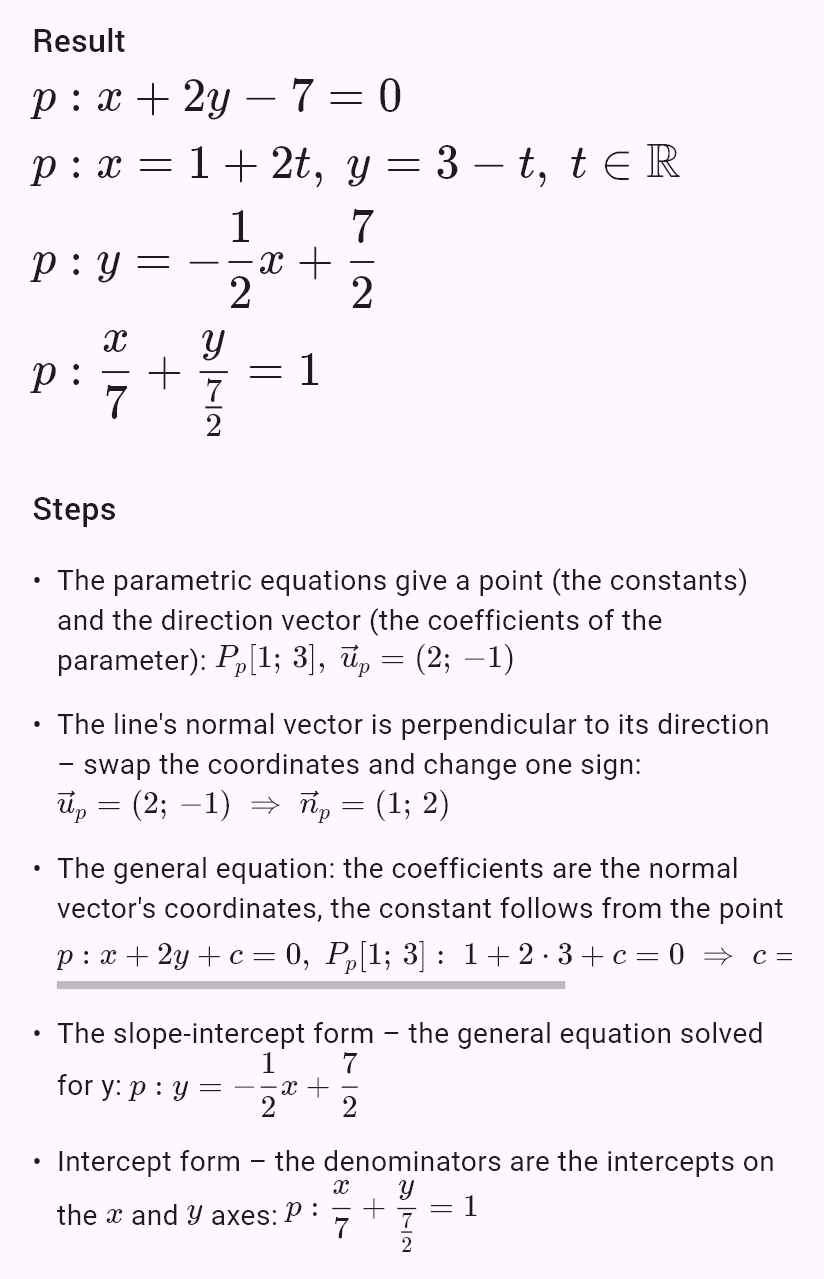
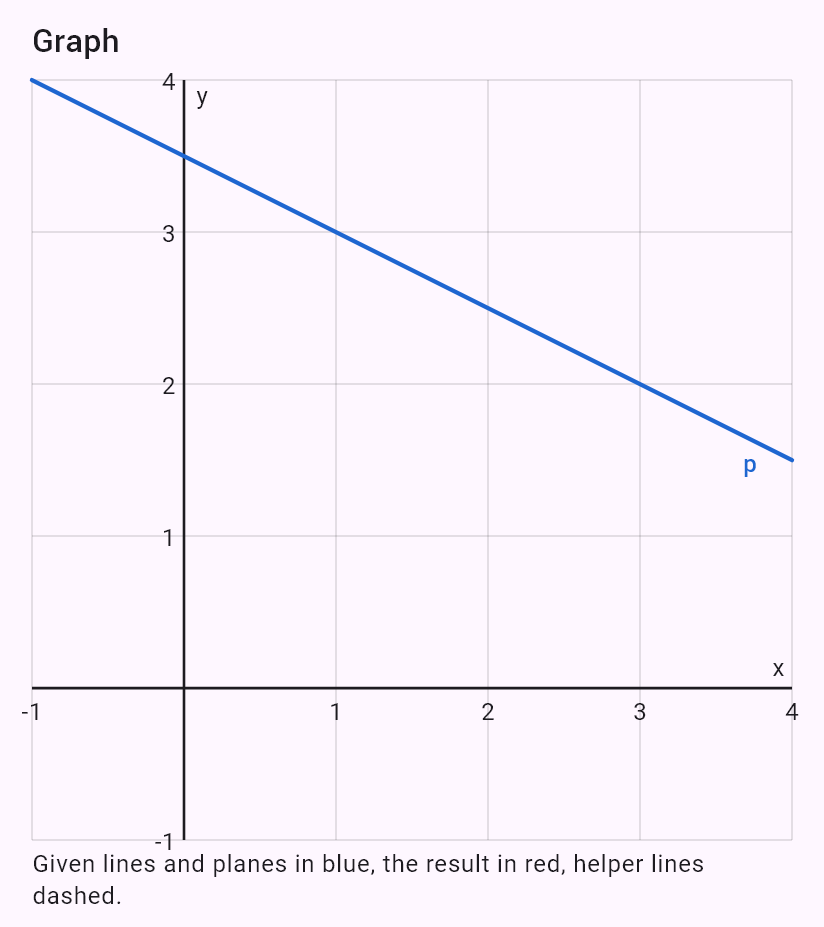
p: x = 1 + 2t, y = 3 - t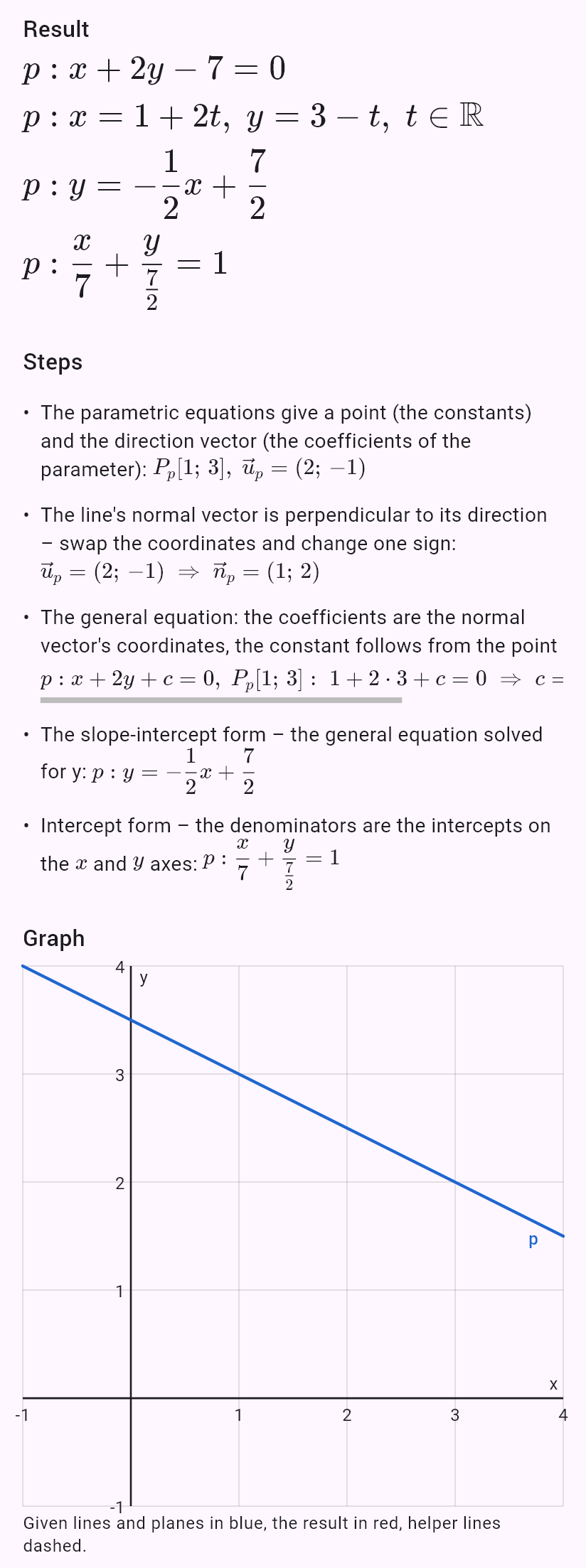
p: 2x + 3y - 5 = 0
q: x - y + 1 = 0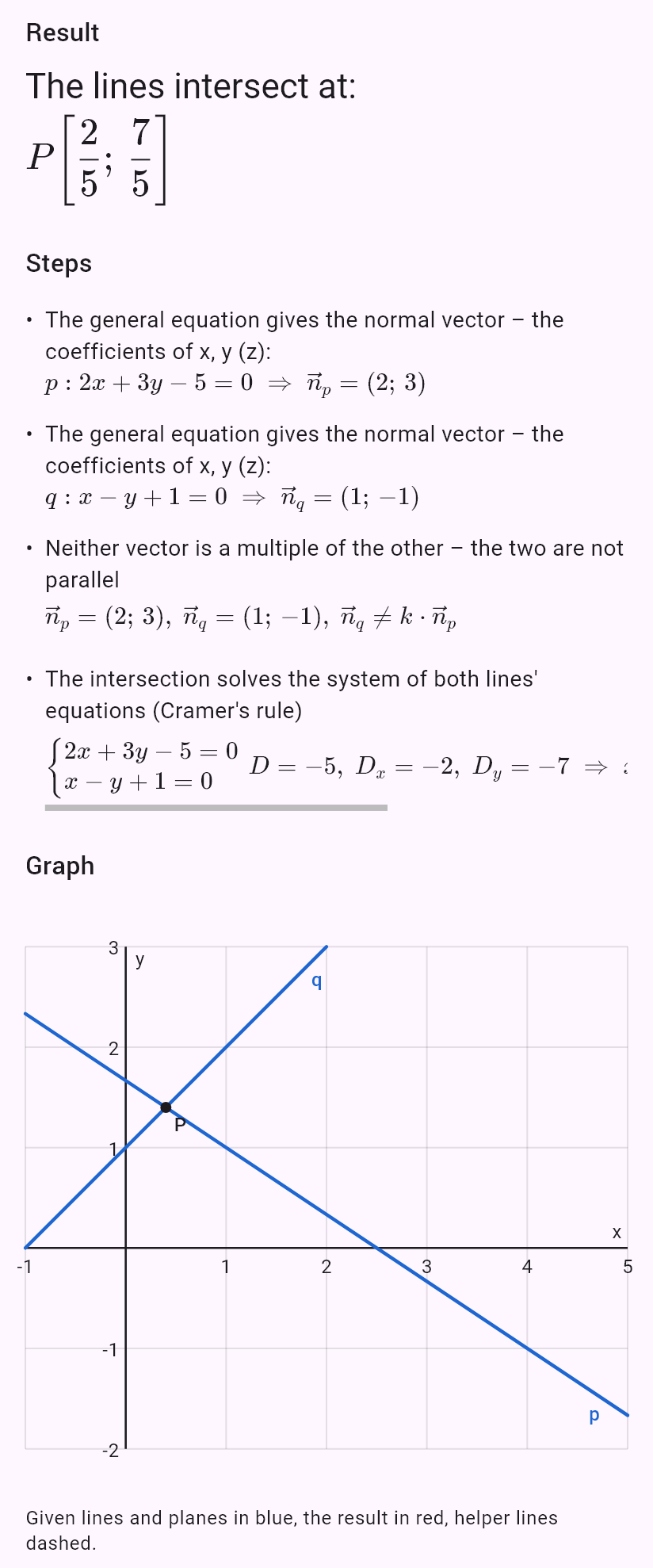
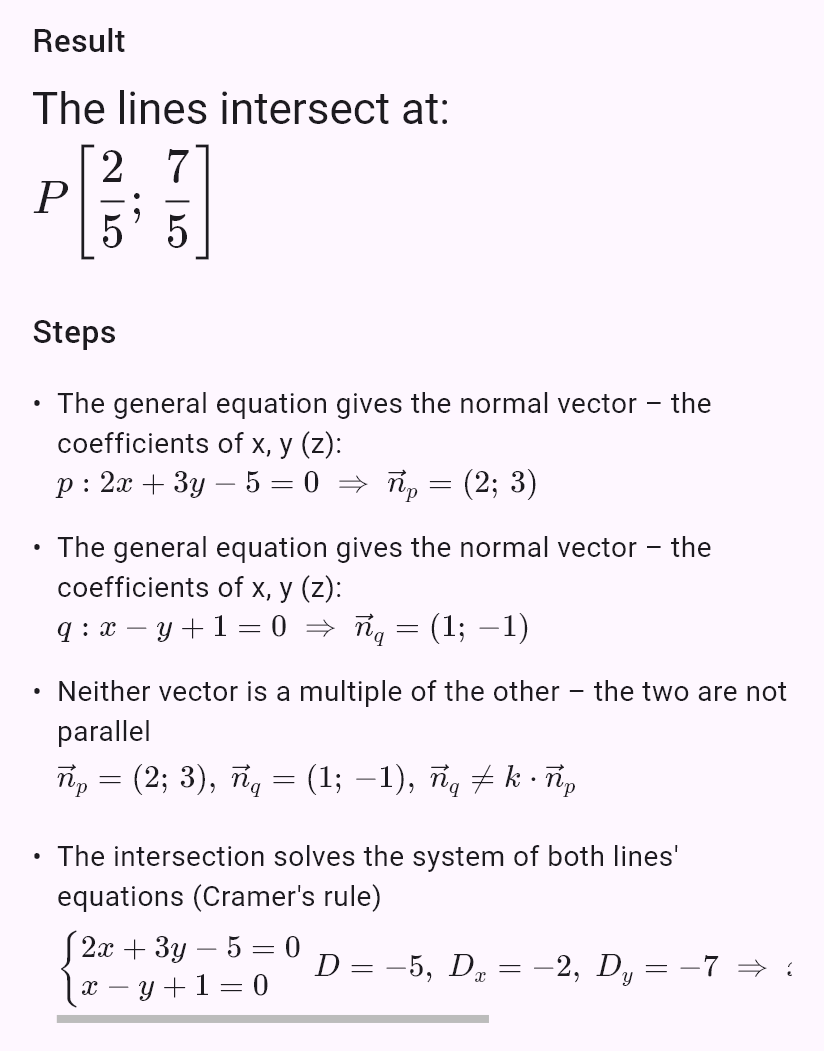
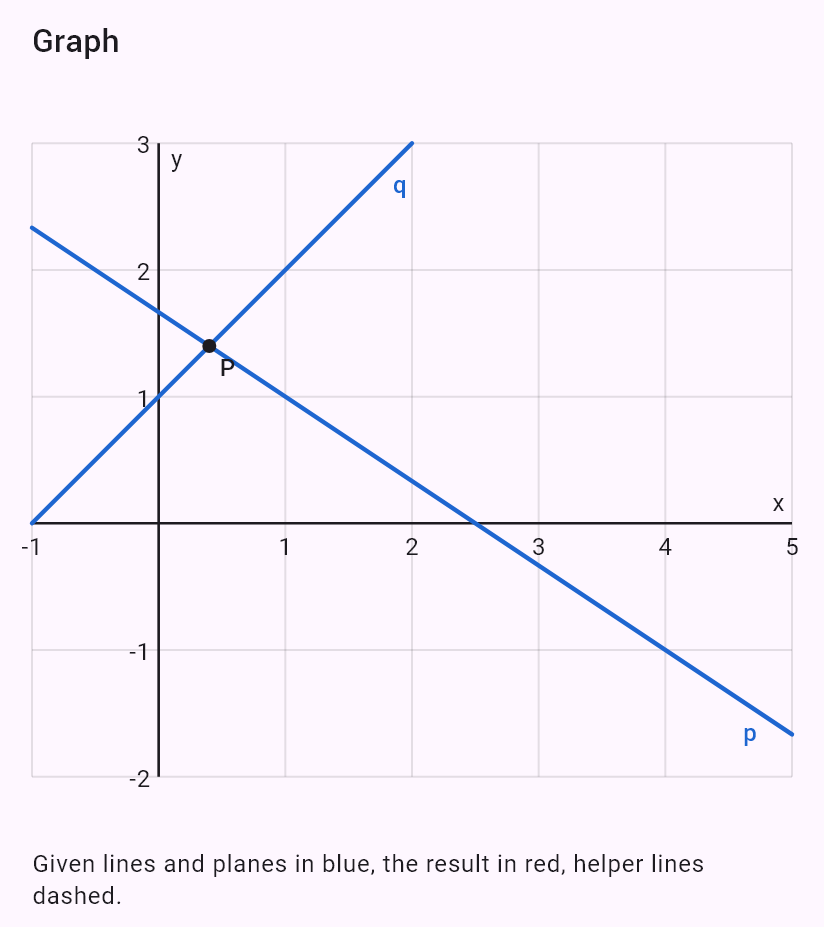
A[3; 4]
p: 3x + 4y - 5 = 0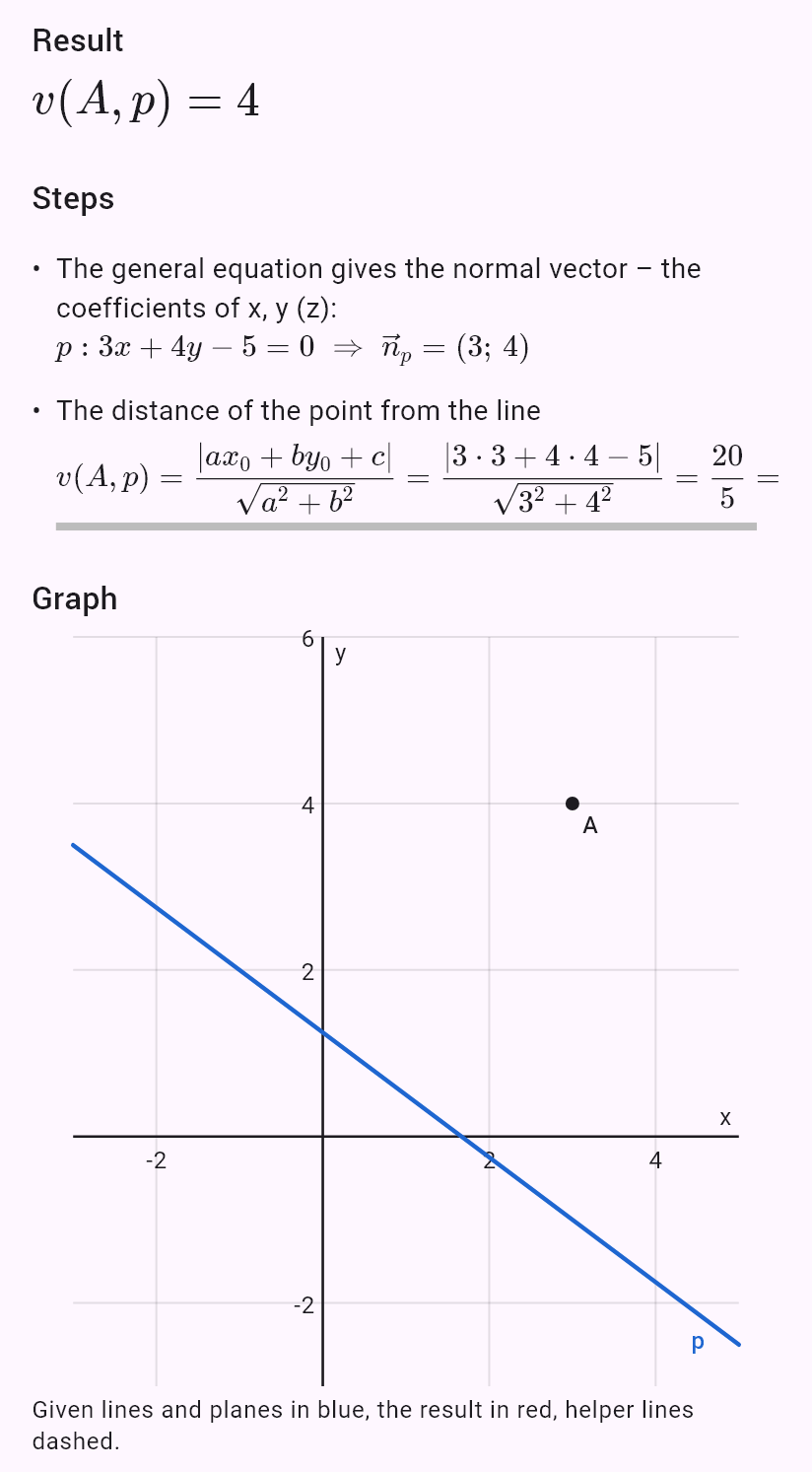
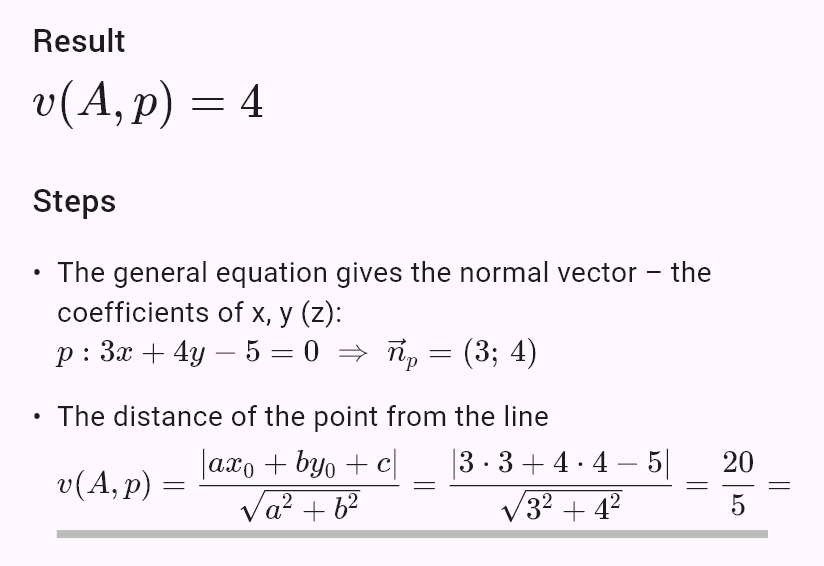
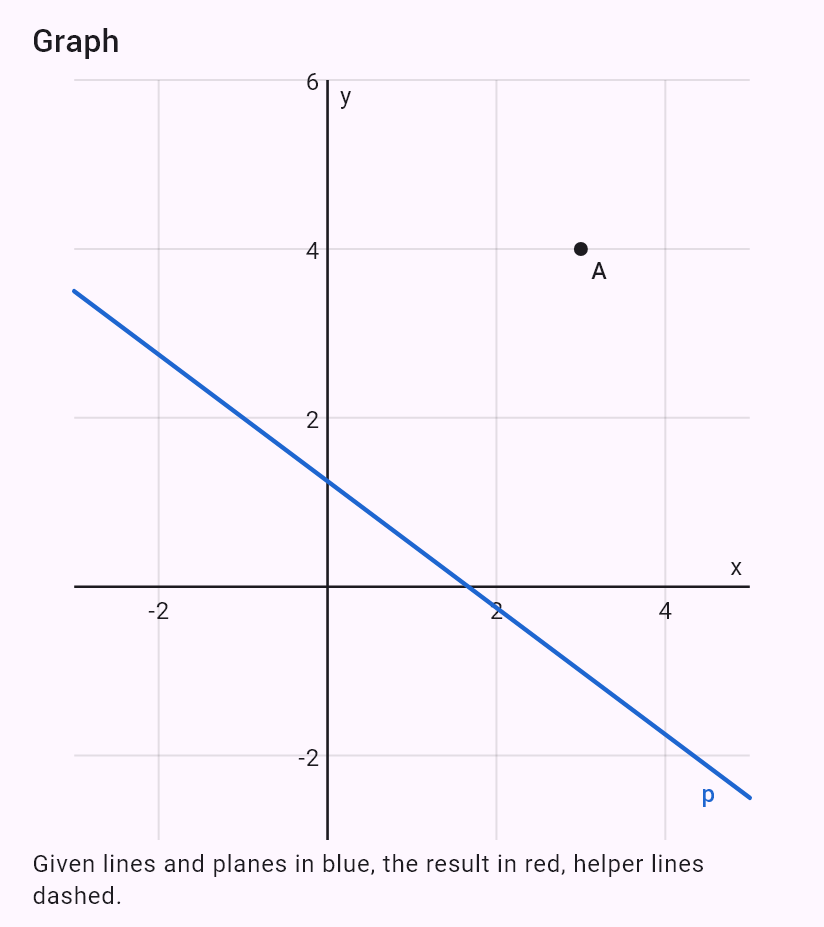
A[3; 4]
p: 3x + 4y - 5 = 0
By the projection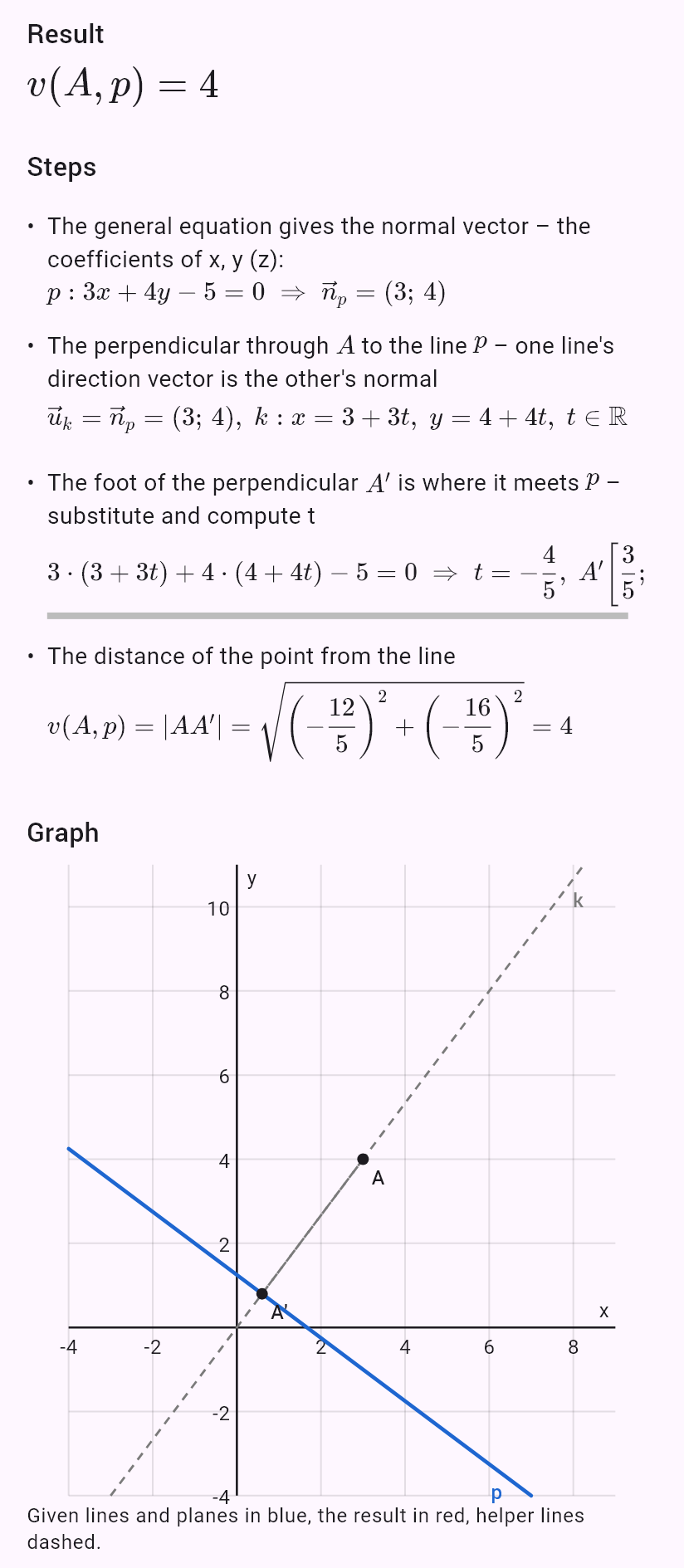
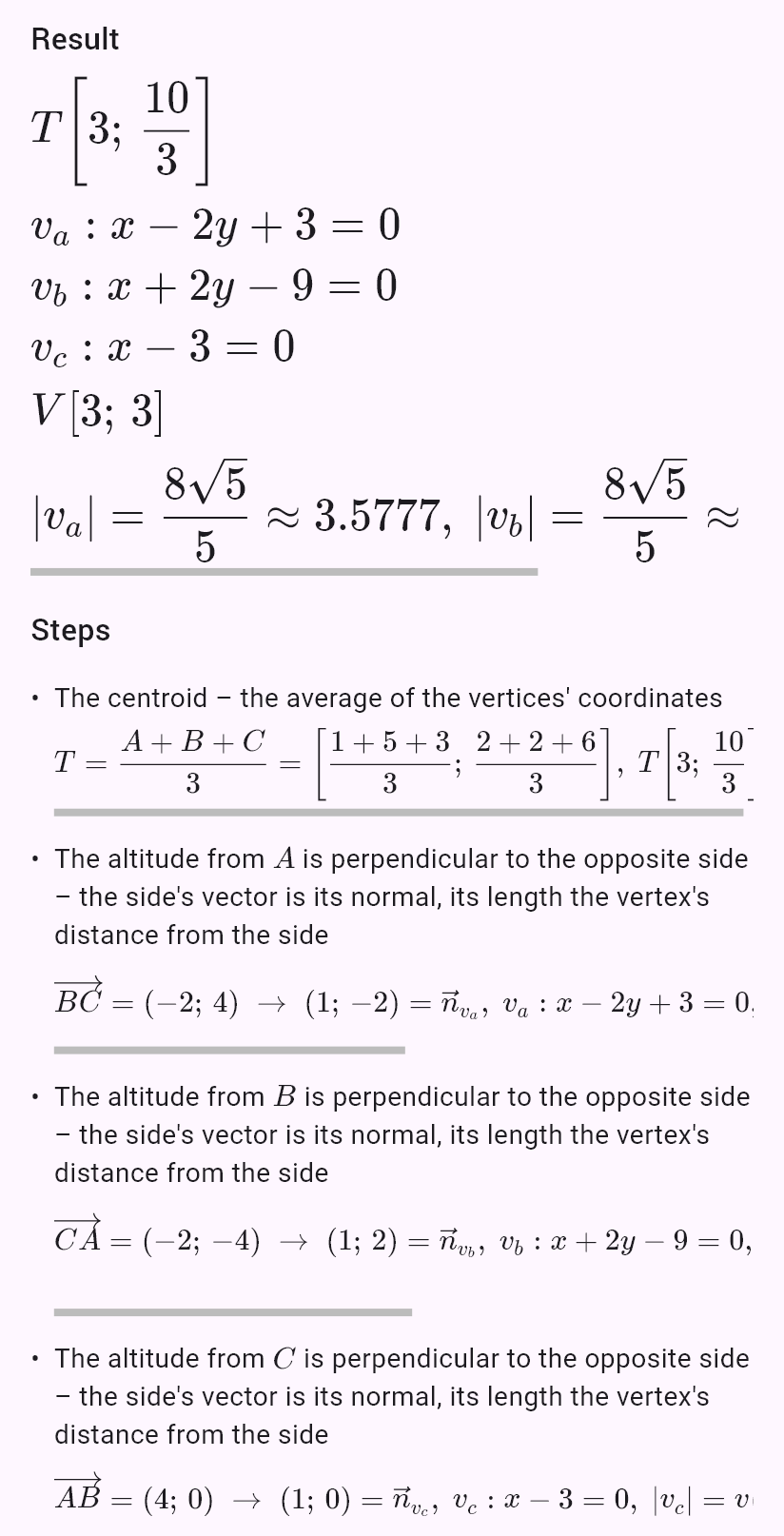
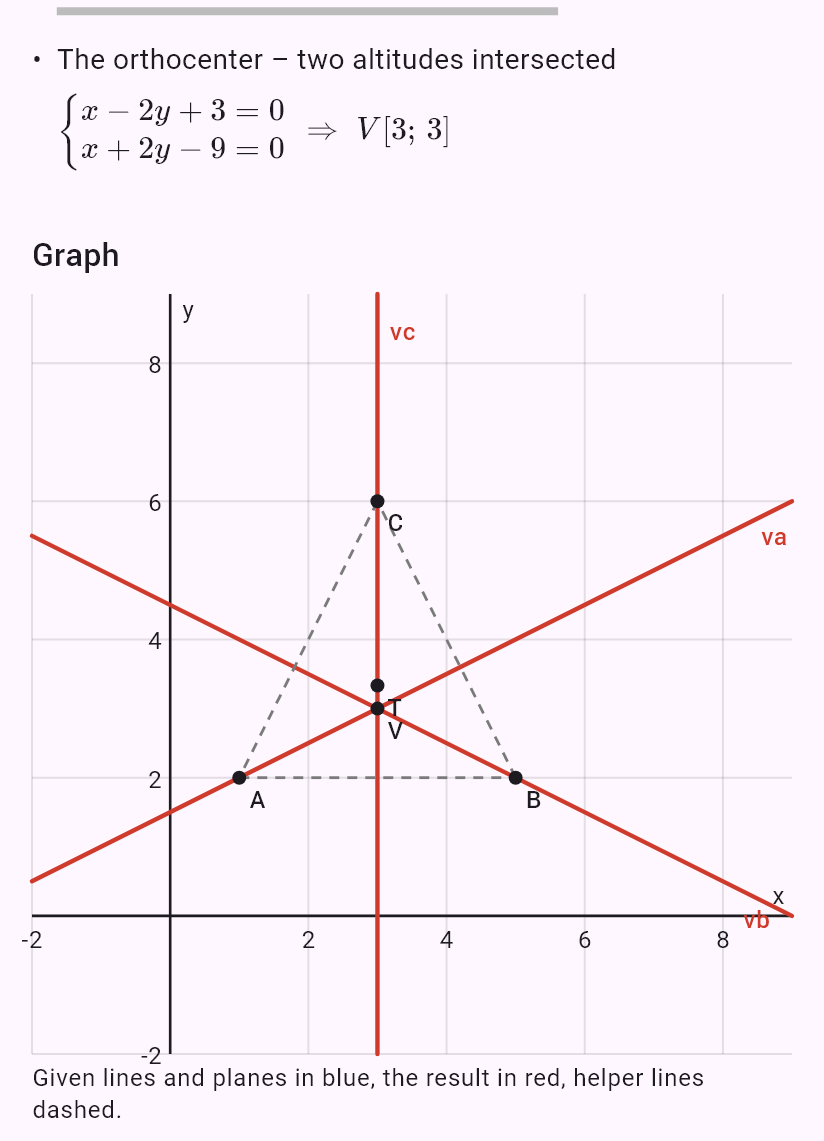
A[1; 2]
B[5; 2]
C[3; 6]
Centroid and altitudes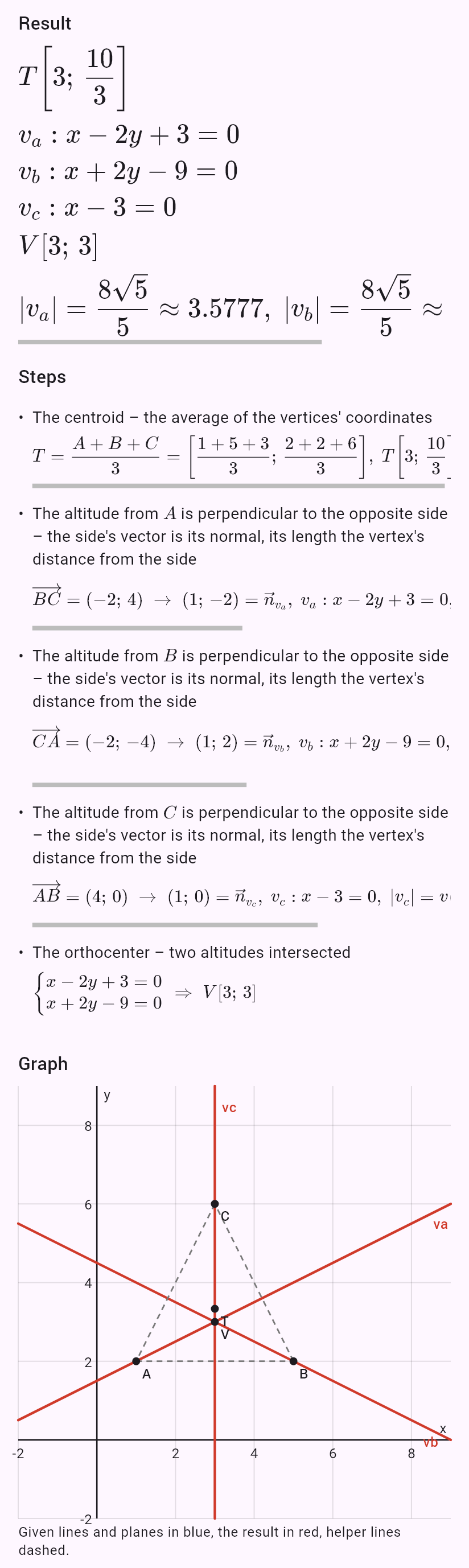
A[1; 2]
p: x - y = 0
Reflection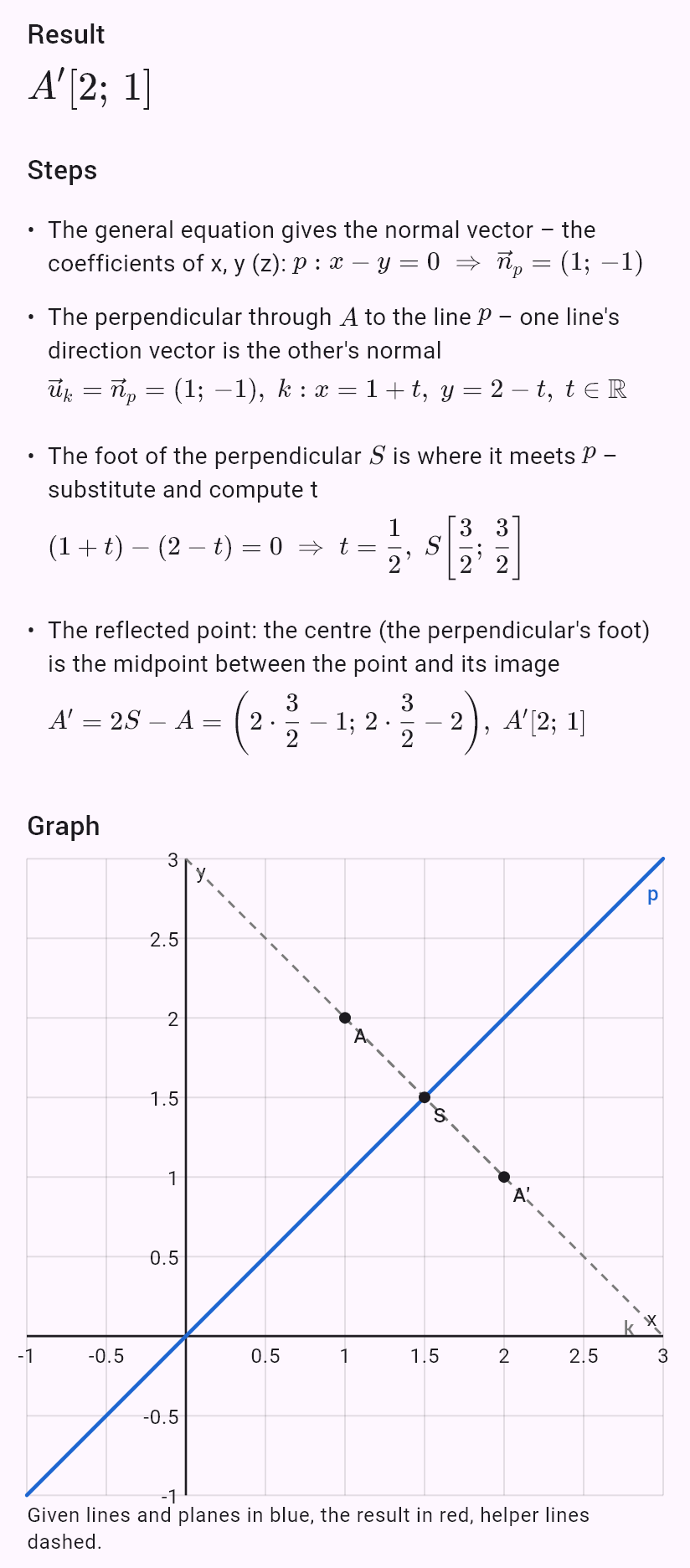
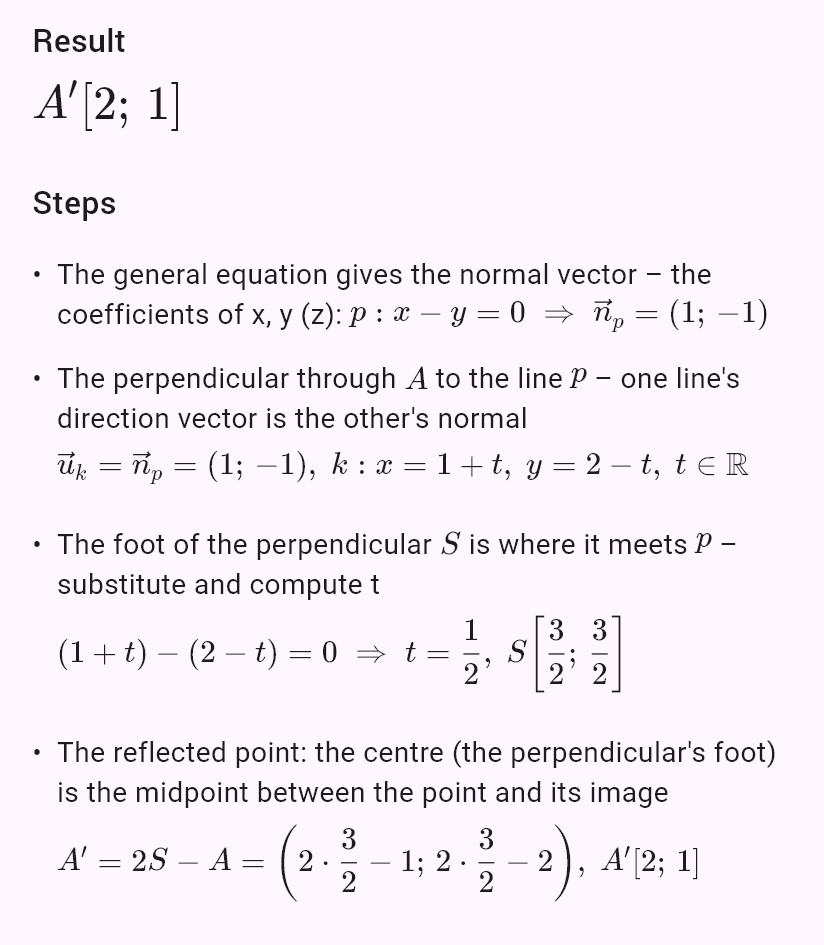
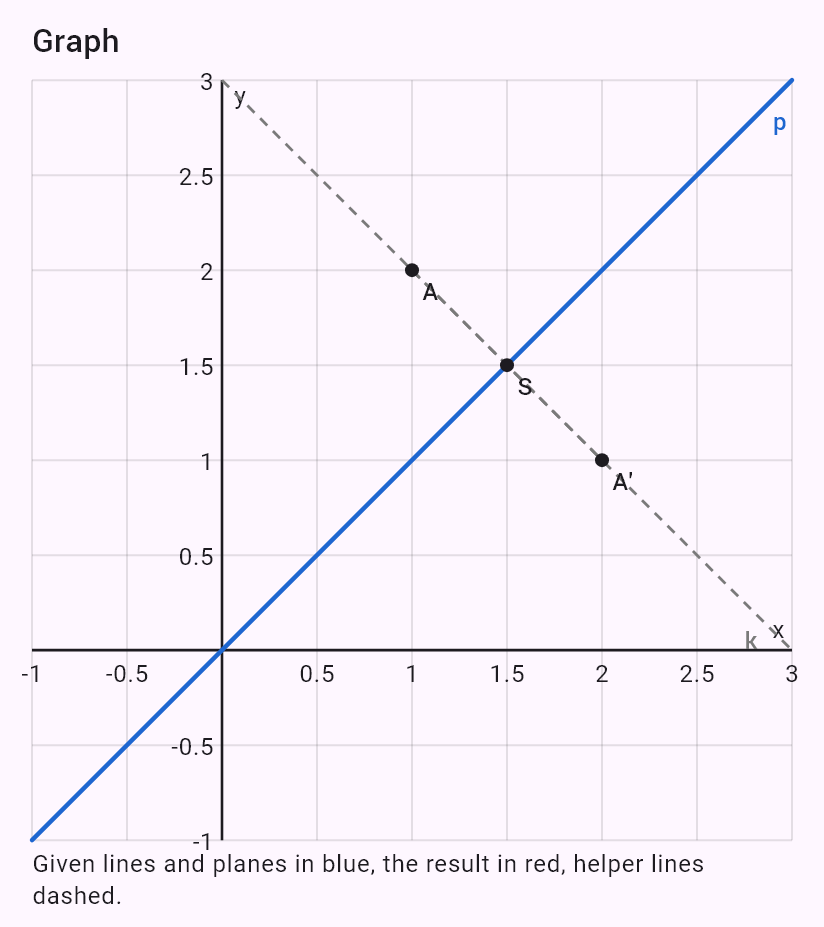
A[1; 2]
B[4; 2]
C[2; 5]
u = (3; -1)
translation(A, B, C, u)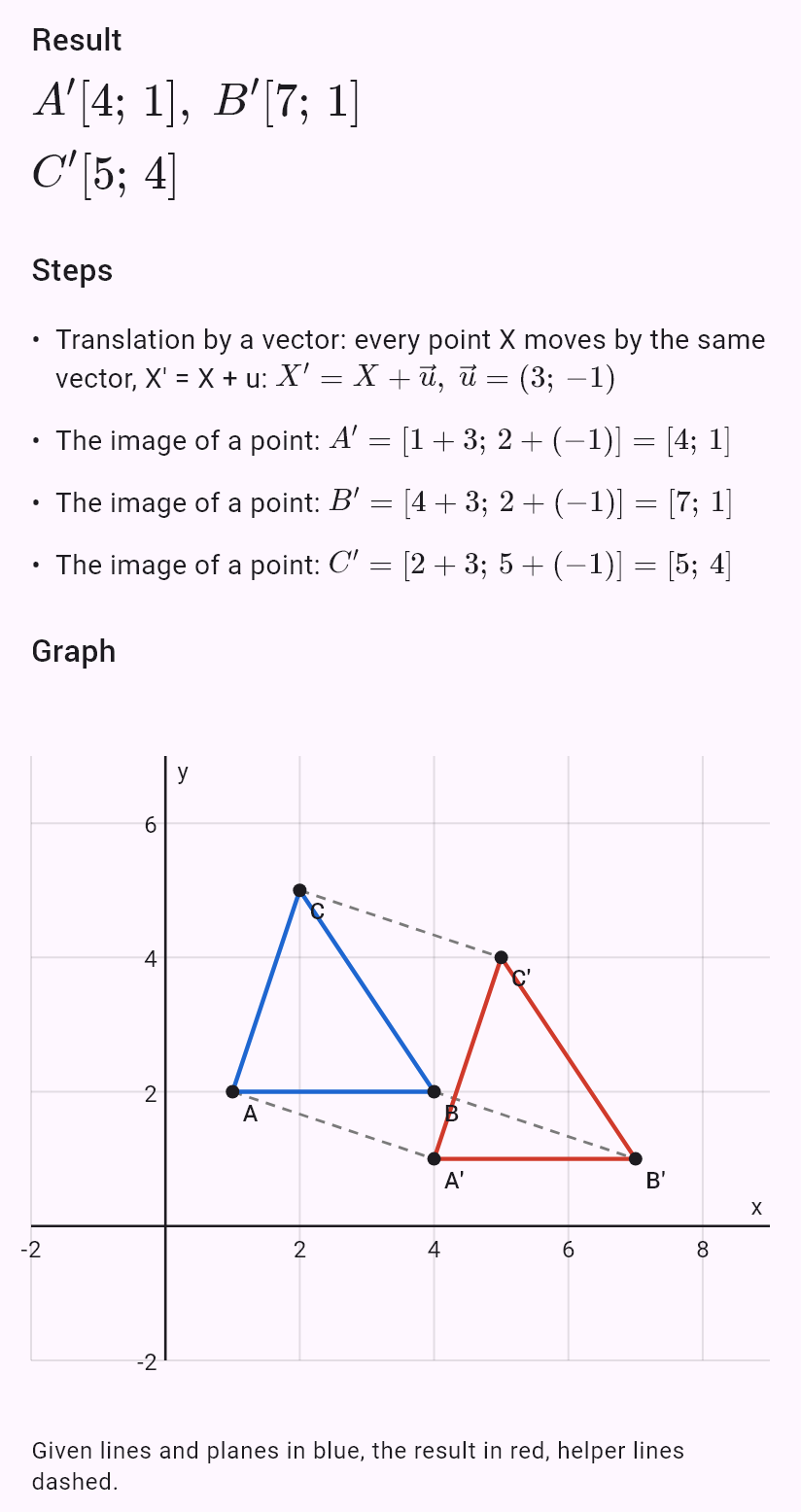
A[3; 1]
B[5; 1]
C[3; 4]
S[1; 1]
rotation(A, B, C, S, 90)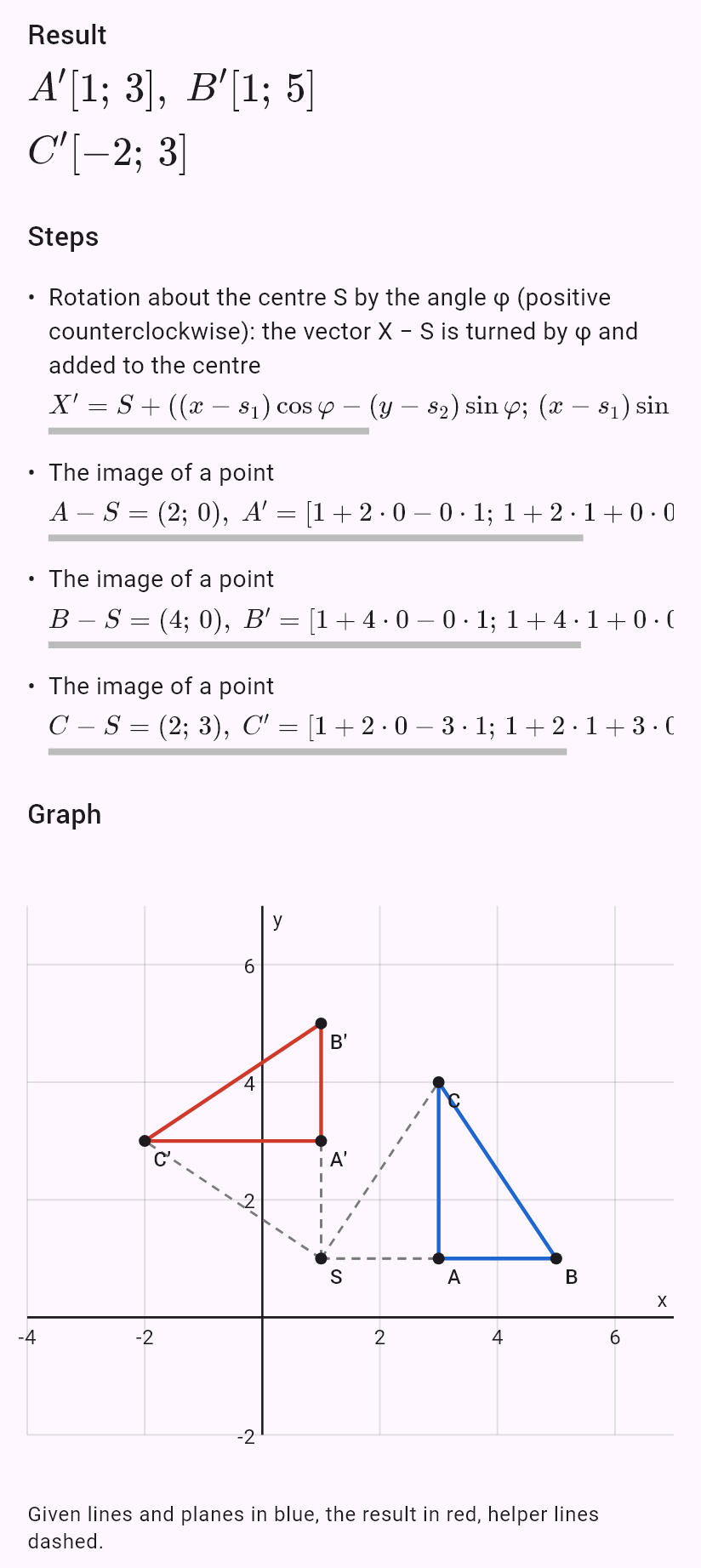
p: x + y - 3 = 0
k: (x - 2)^2 + (y - 1)^2 = 1
S[0; 0]
homothety(p, k, S, 2)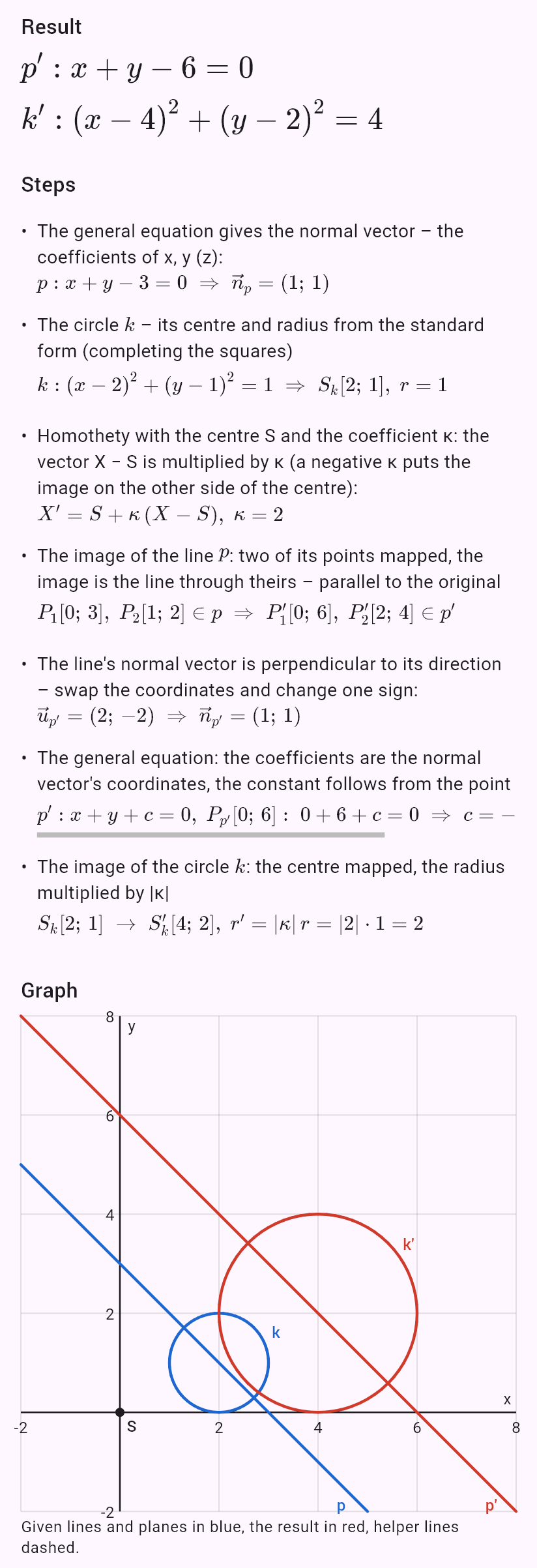
k: (x - 1)^2 + (y - 3)^2 = 4
q: y = x
Reflection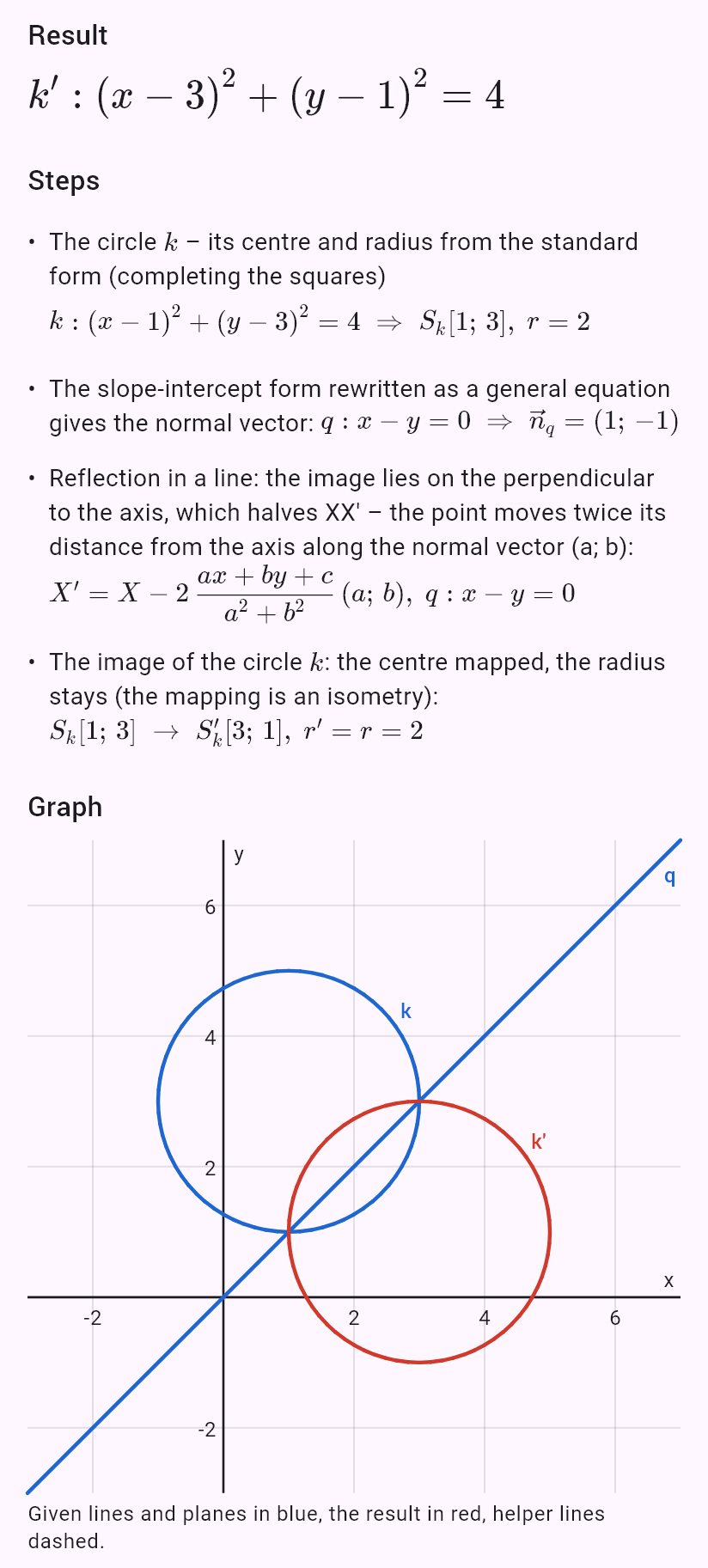
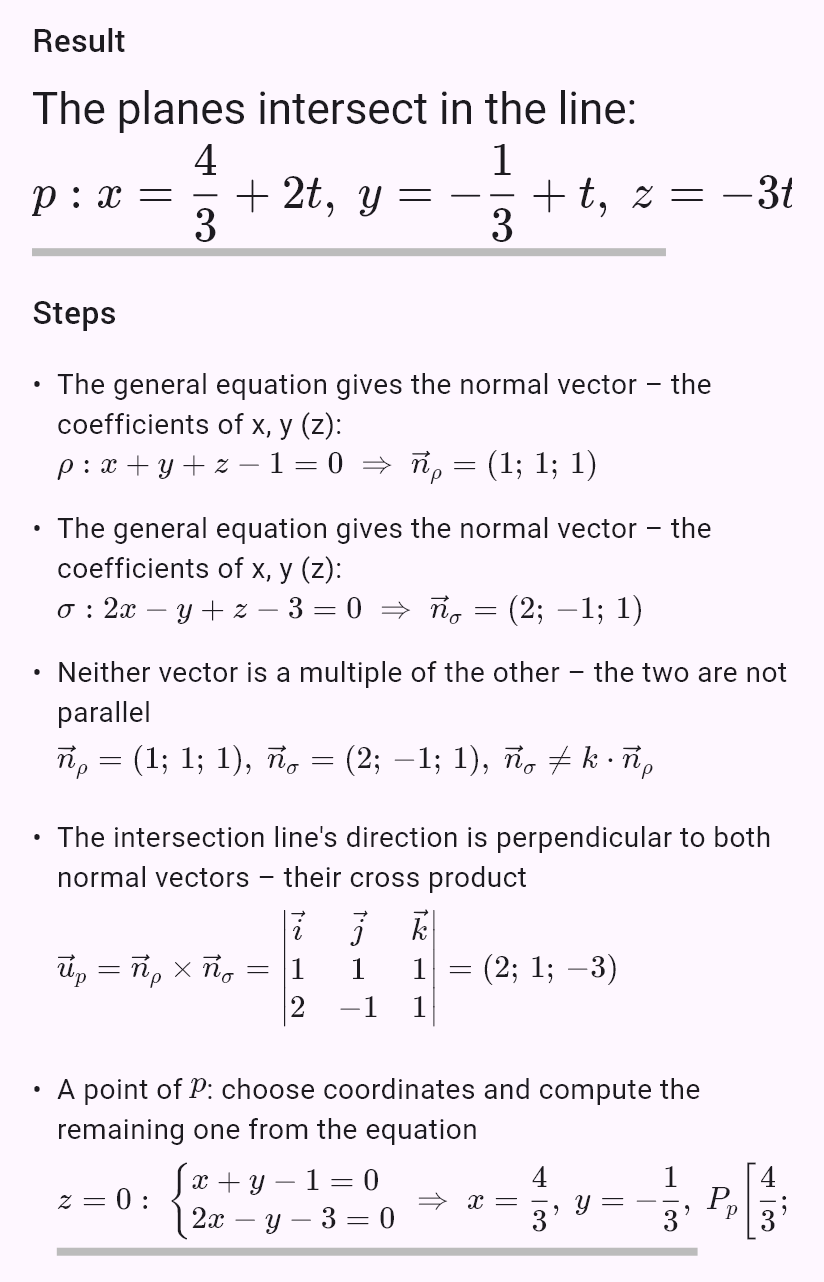
ρ: x + y + z = 1
σ: 2x - y + z = 3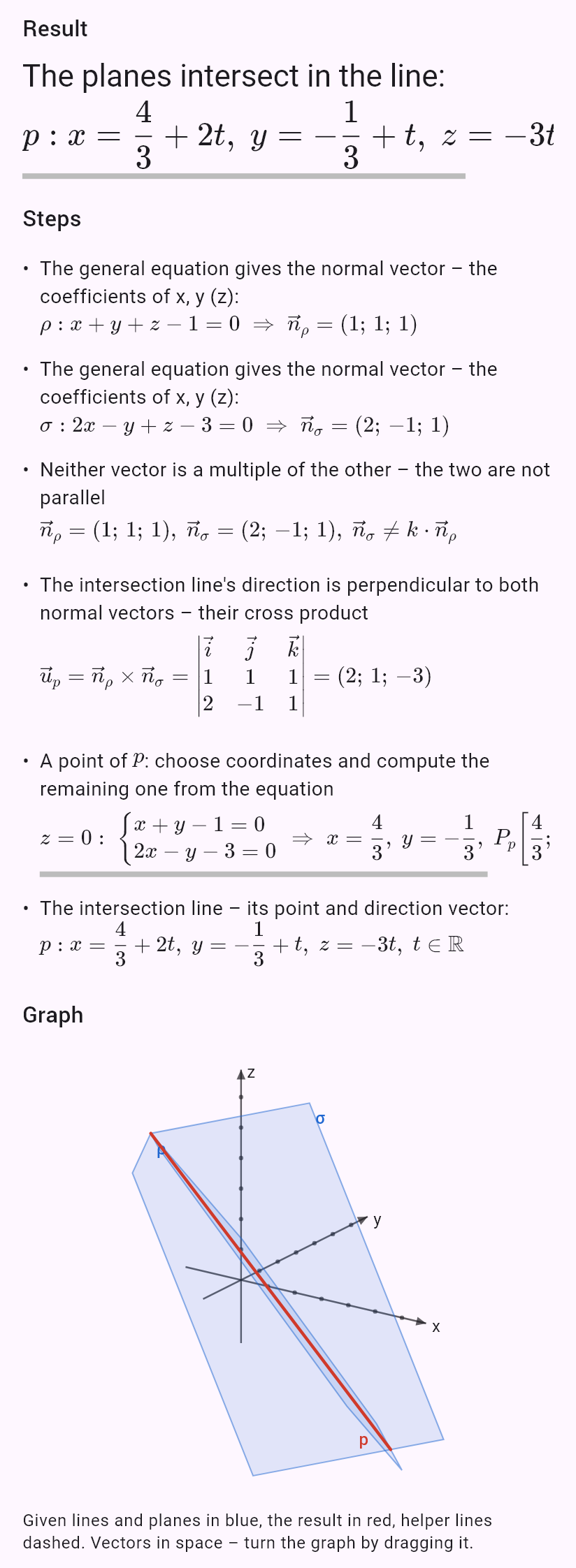
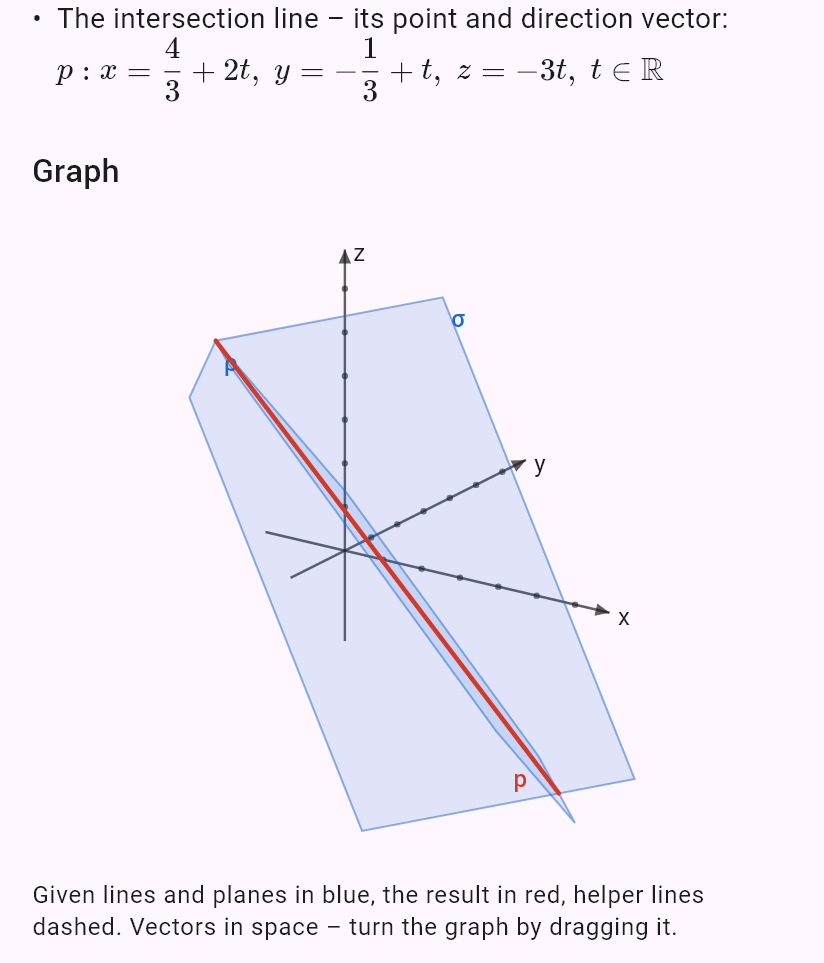
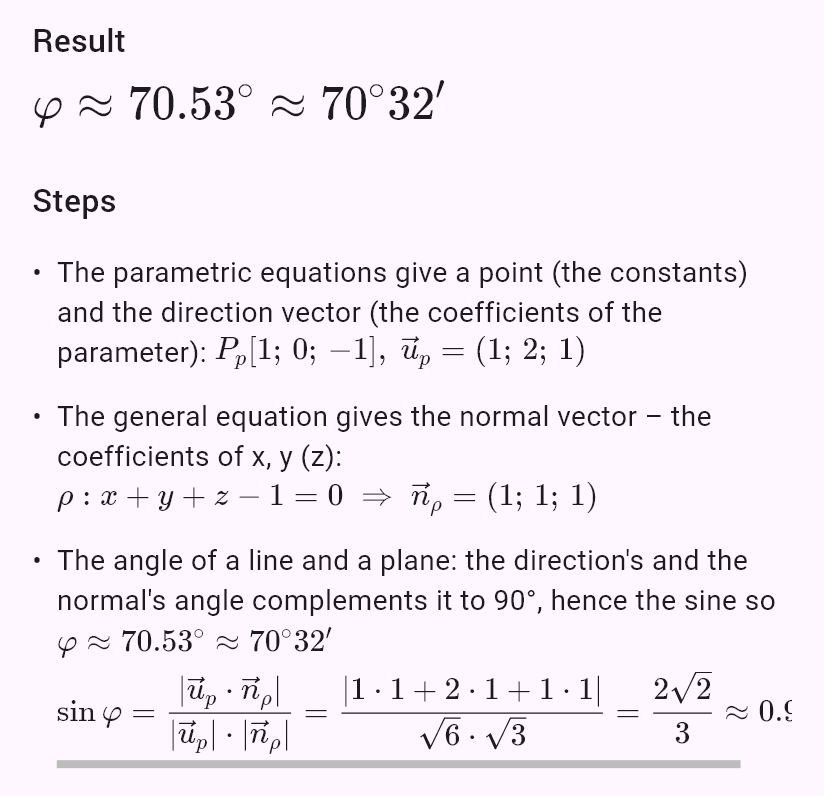
p: x = 1 + t, y = 2t, z = -1 + t
ρ: x + y + z = 1
Angle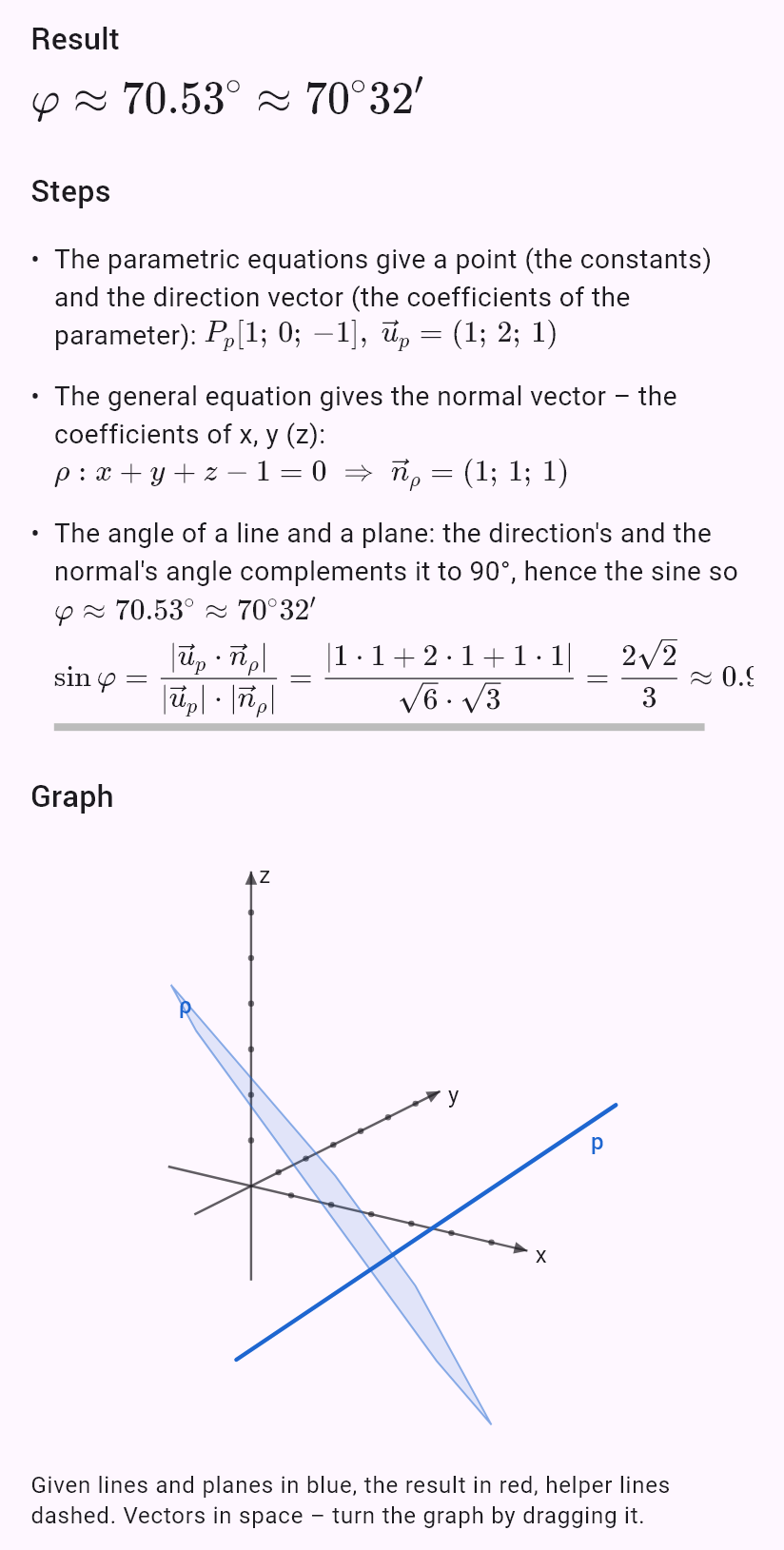
p: x = 1 + t, y = 2 - t, z = 3t
q: x = 2 + s, y = 1 + s, z = 1 - s
Distance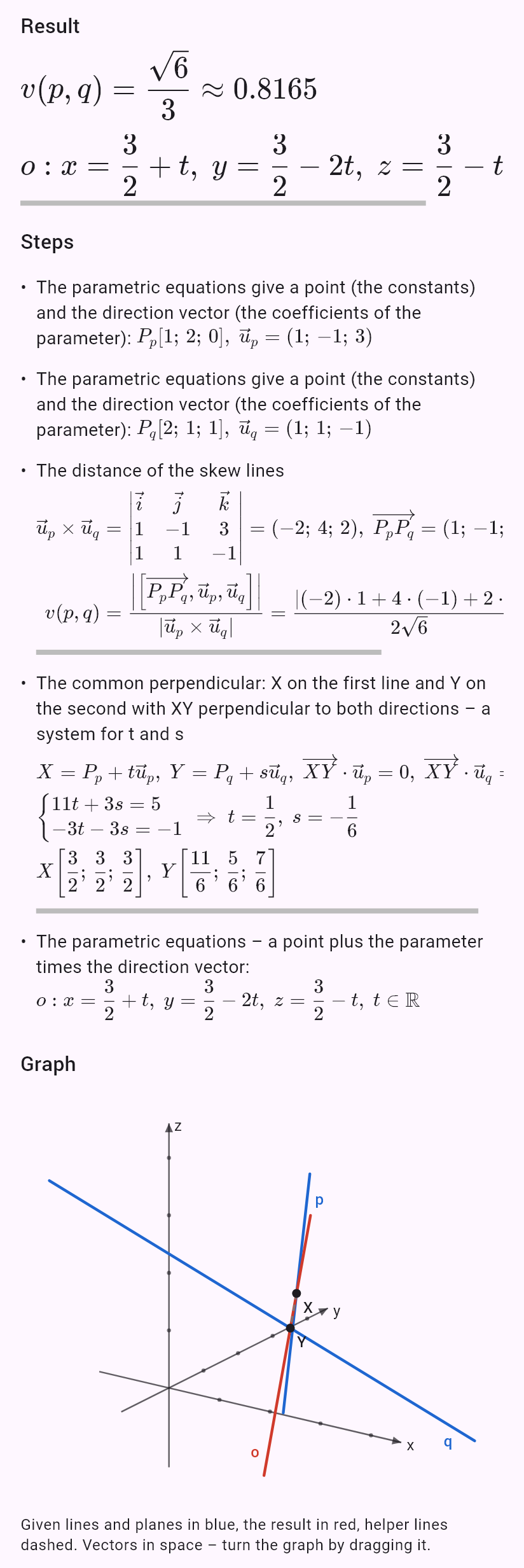
x^2 + y^2 - 4x + 6y - 3 = 0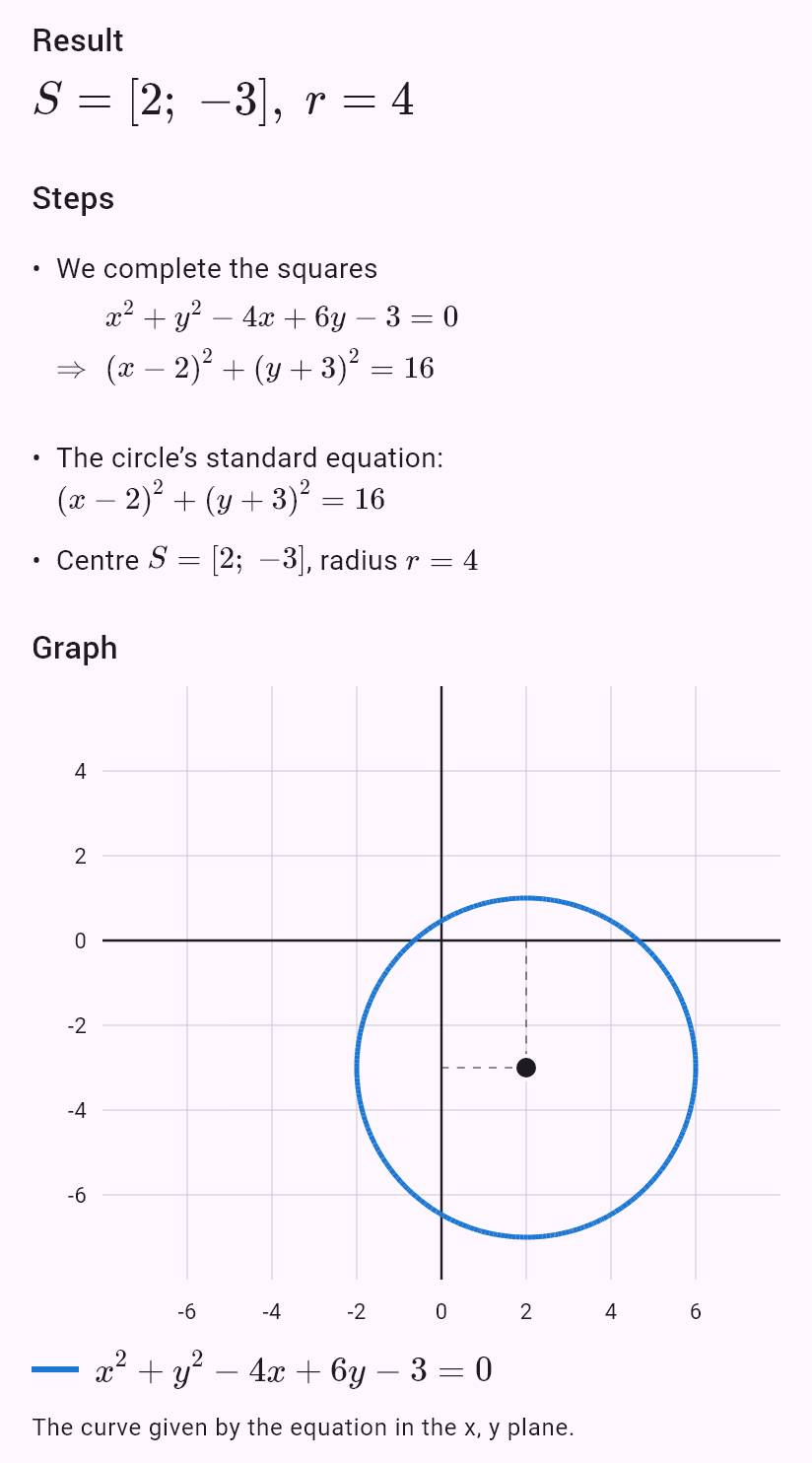
x^2/4 + y^2/9 = 1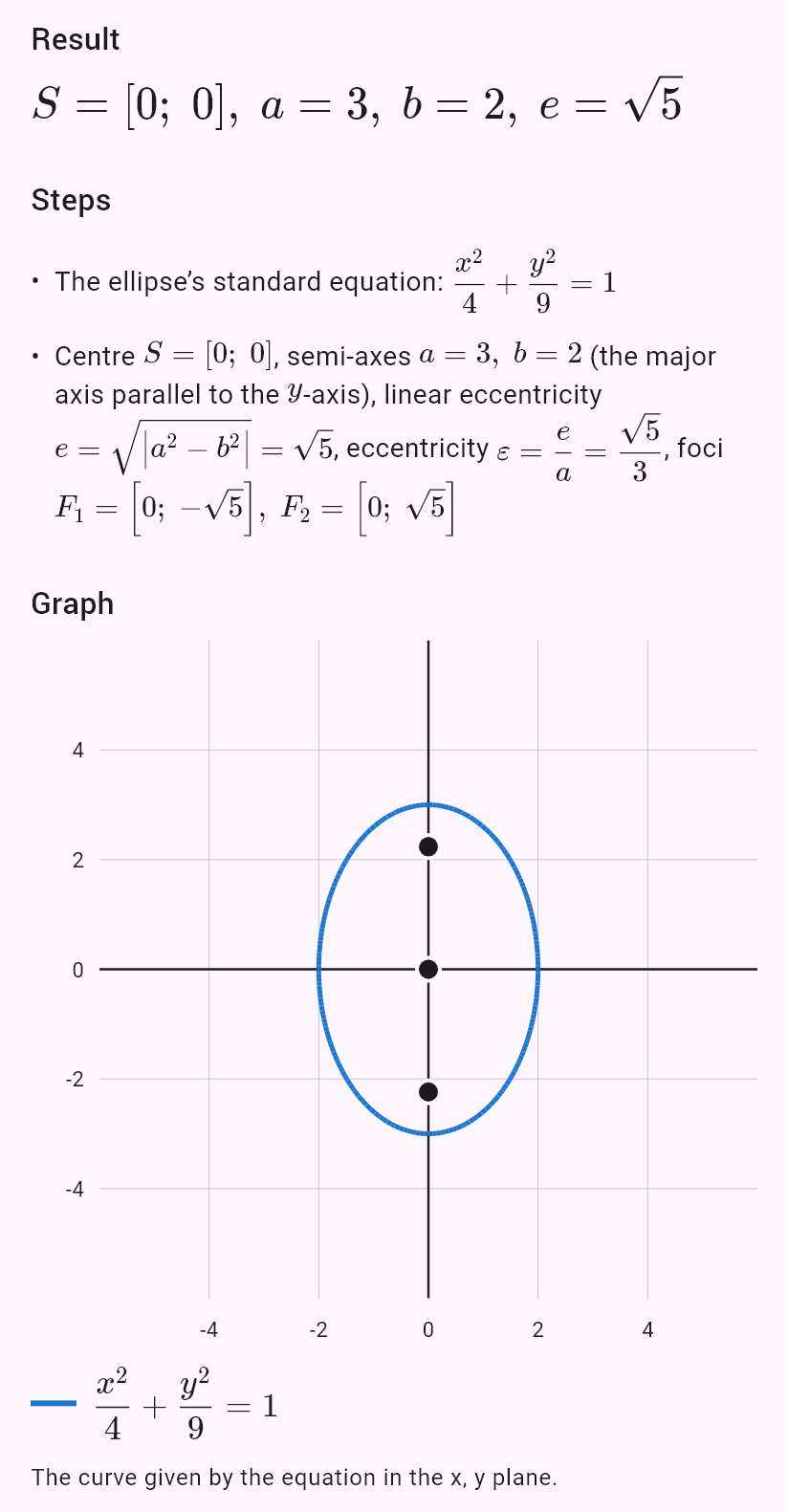
x^2/9 - y^2/16 = 1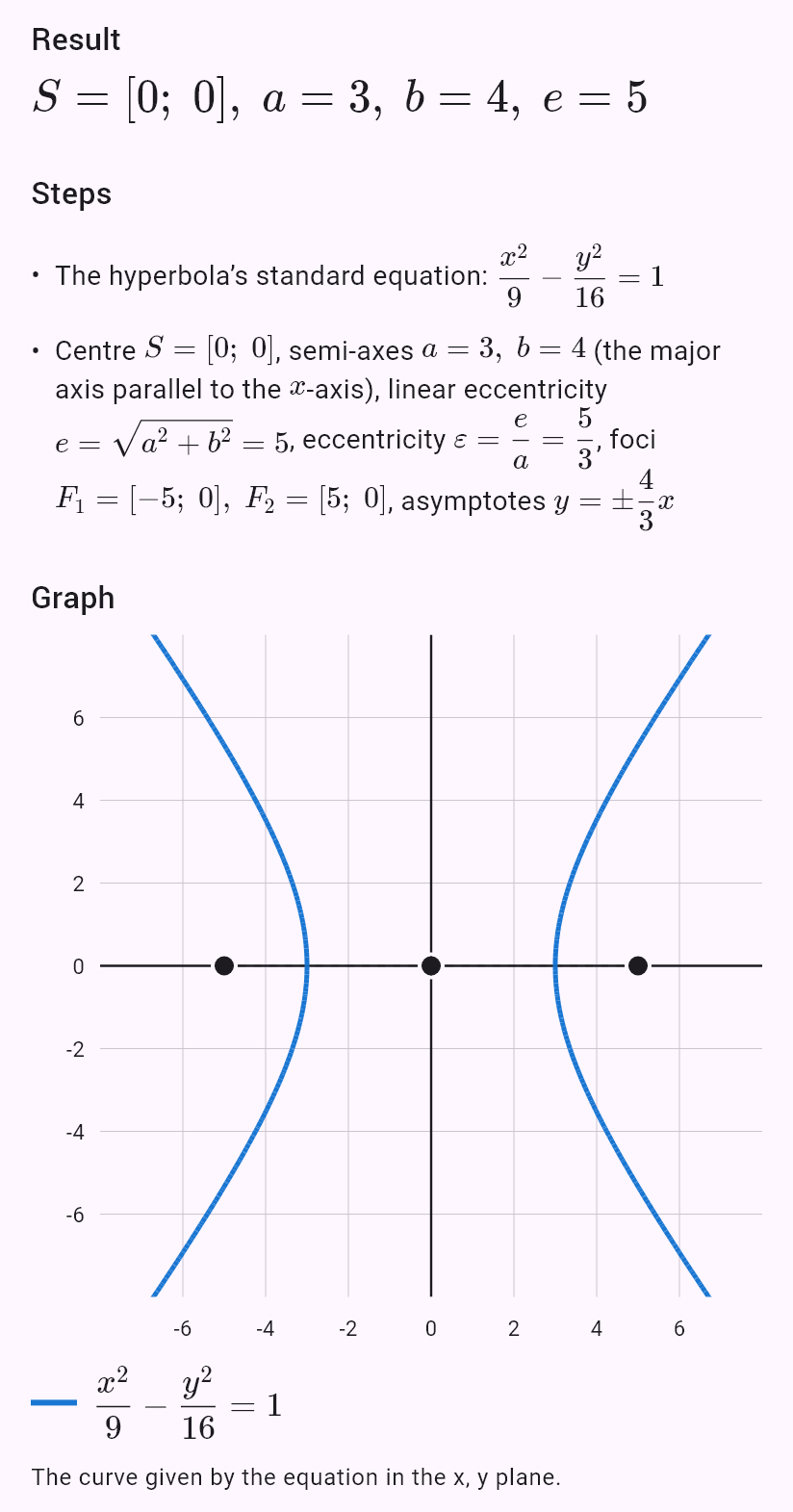
y^2 = 8x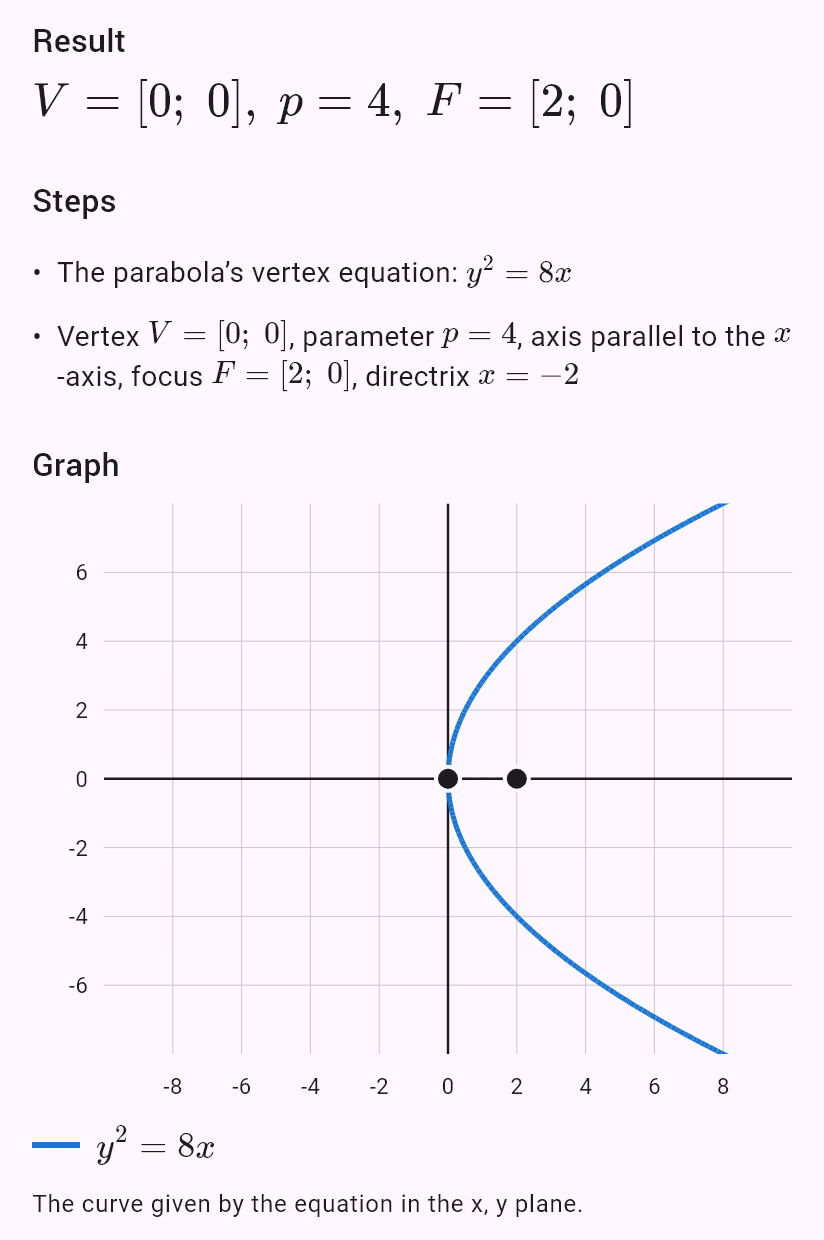
tangent to the circle x^2 + y^2 = 25 at [3; 4]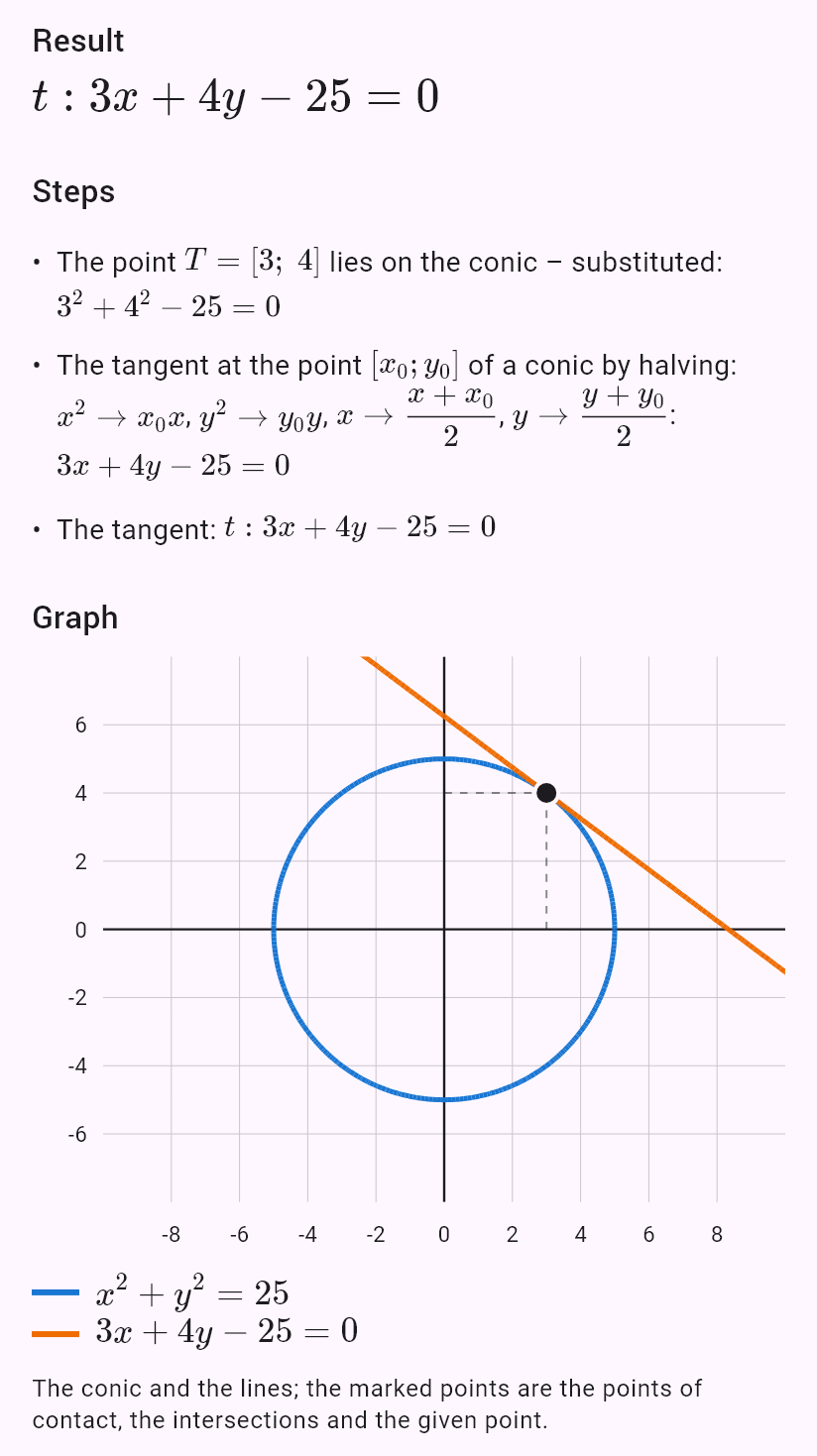
tečny ke kružnici x^2 + y^2 = 25 z bodu [7; 1]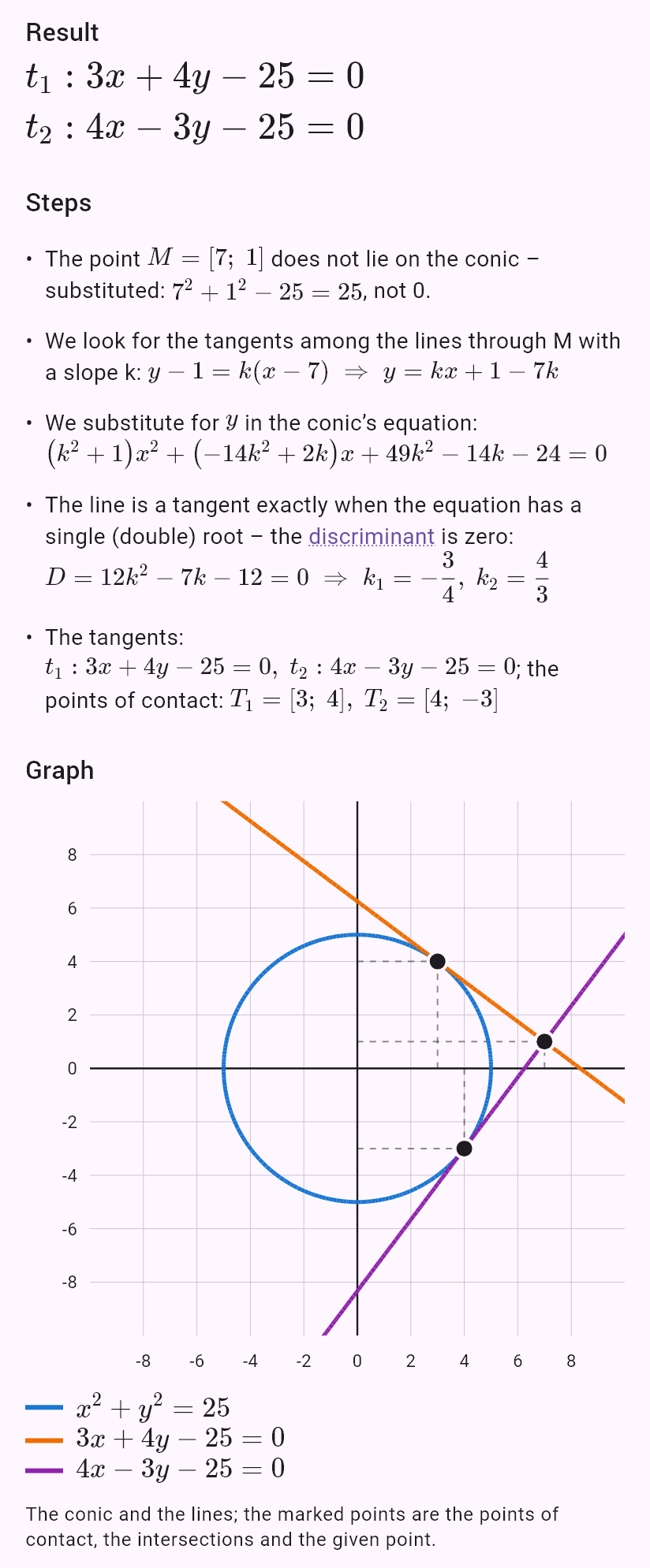
tečny ke kružnici x^2 + y^2 = 25 rovnoběžné s přímkou 3x + 4y = 0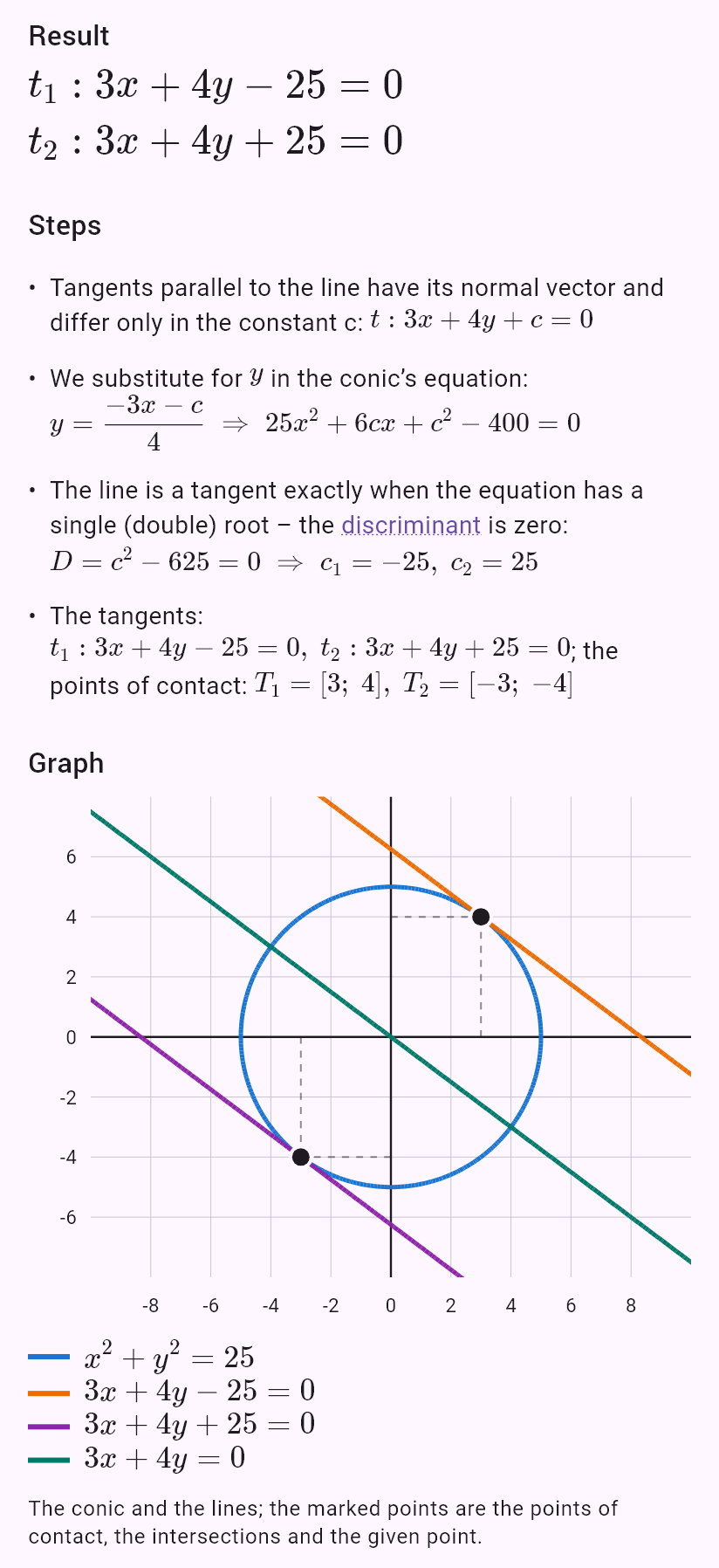
position of x^2/9 + y^2/4 = 1 and y = x + 1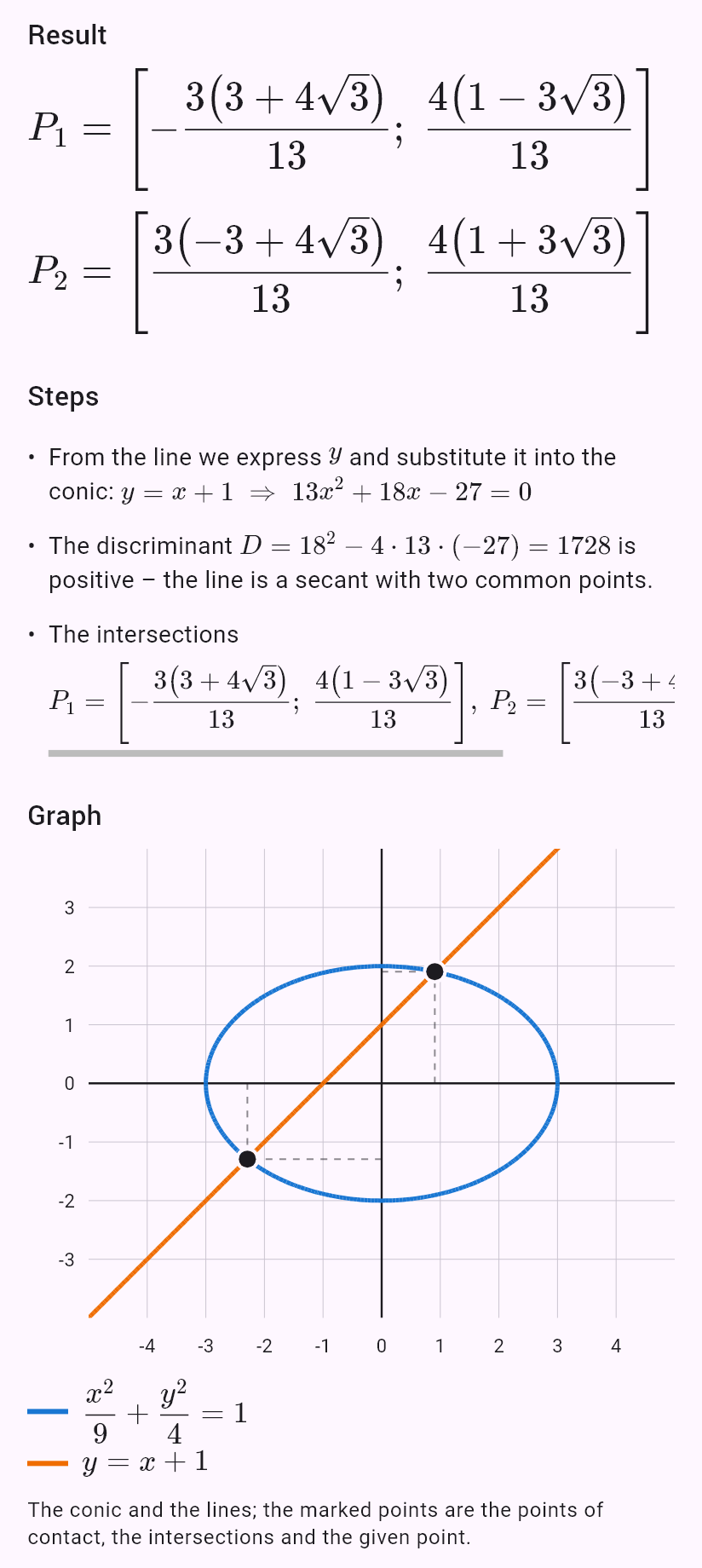
x^2 + y^2 + z^2 - 2x + 4y - 6z - 2 = 0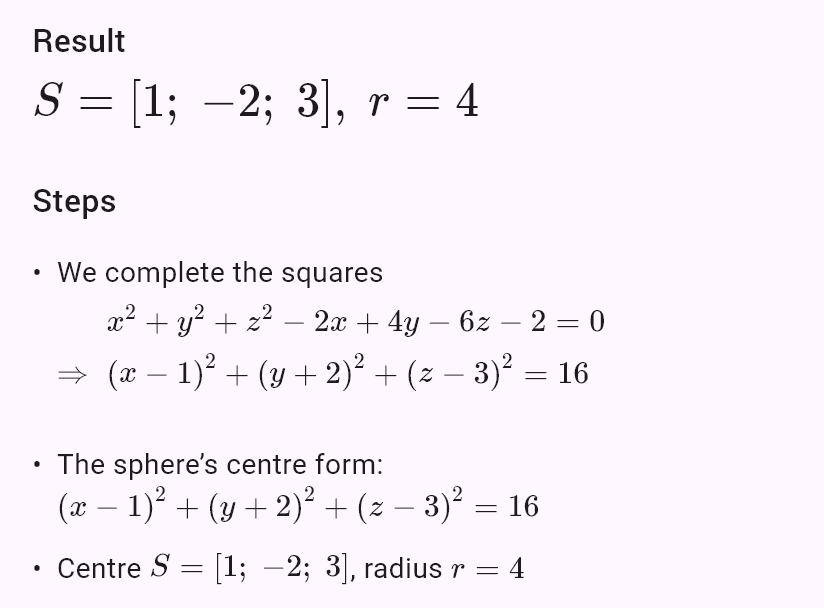
k: x^2 + y^2 + z^2 - 2x + 4y - 6z - 2 = 0
ρ: x + y + z = 1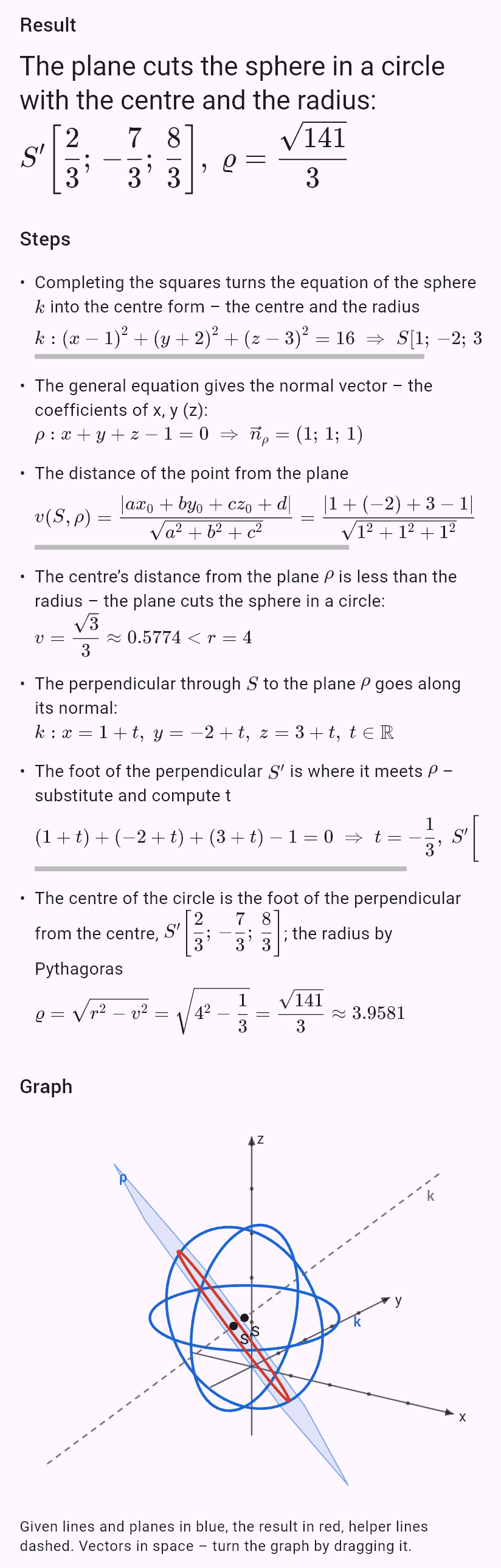
k: x^2 + y^2 + z^2 = 9
p: x = 1 + t, y = 2t, z = -1 + t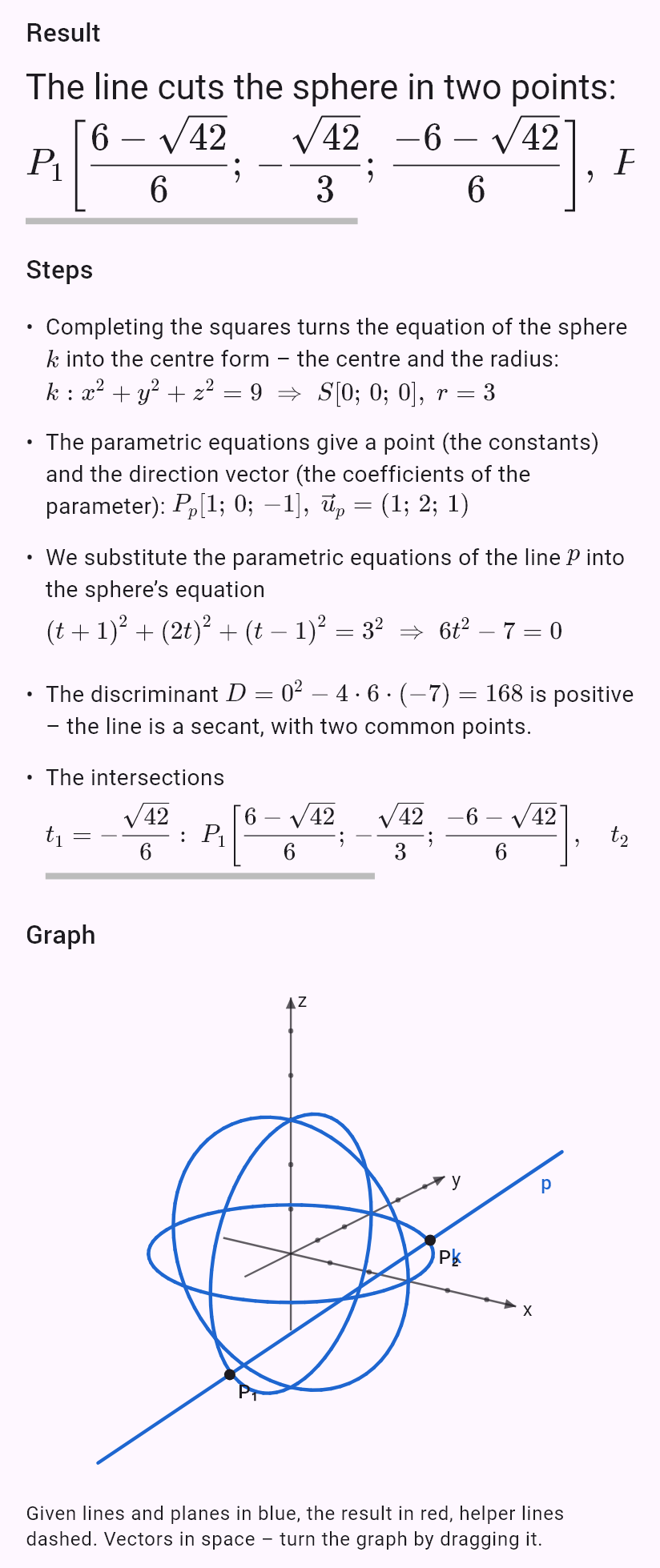
Known limitations
- Coordinates and coefficients are numbers (no parameter); conics only in axial position (no xy term).
- Geometric mappings only in the plane; a circle is only mapped so far (no distance, position or tangents).
- A triangle's altitudes in space by their lengths only, without equations and their intersection.
- A line's or a plane's name is one letter (also with an index) – so “a: 2x + 3 = 5” is read as a line, not an equation.