II. Linear algebra and geometry
22. Vectors
Write a vector with semicolons, each on its own line: u = (1; 2; 3); its name may have an index (F_1 = (3; 4)). Write a point with square brackets: A[1; 2; 3]. Vectors in the plane have two coordinates, in space three.
A single point in the plane is put in its quadrant (or on an axis) by its coordinates' signs and drawn. With two points, beside the distance |AB| there's the “Midpoint” chip – the midpoint's coordinates are the averages of the end points'. Words work too: “midpoint AB, A[1; 2], B[5; 6]”, “distance between A[1; 2] and B[4; 6]”, “quadrant A[3; −2]”.
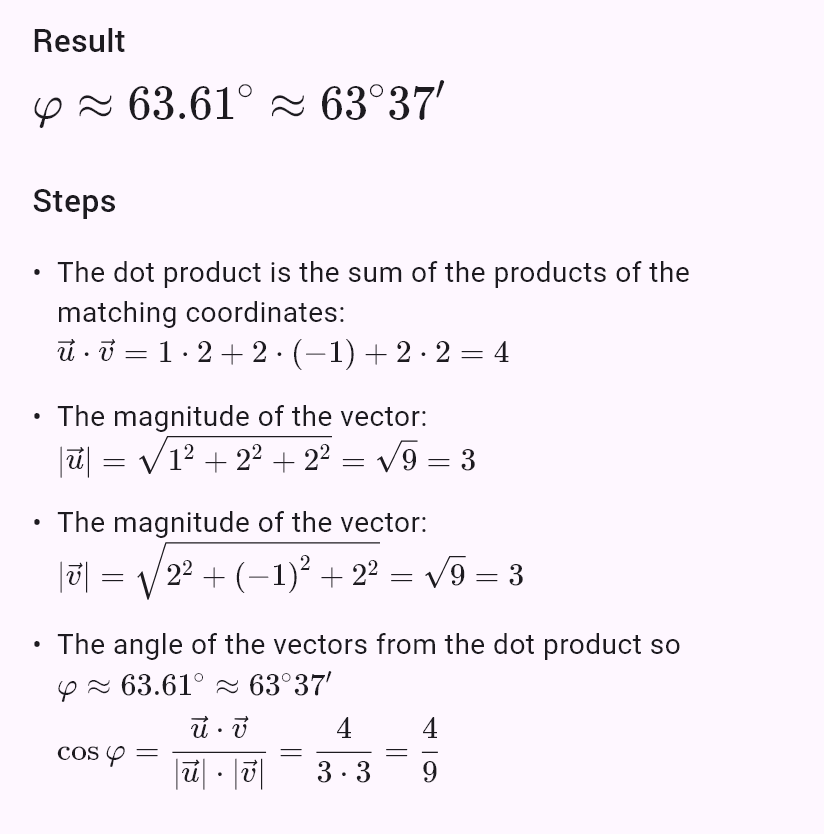
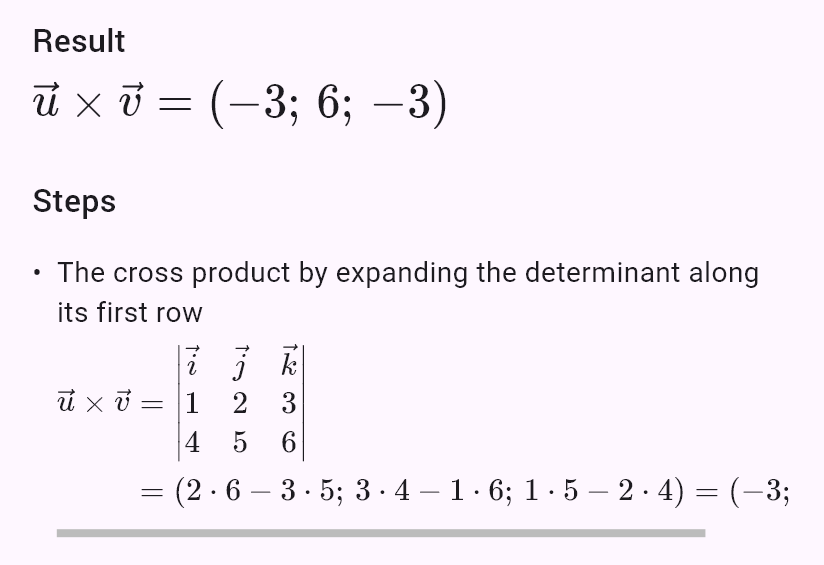
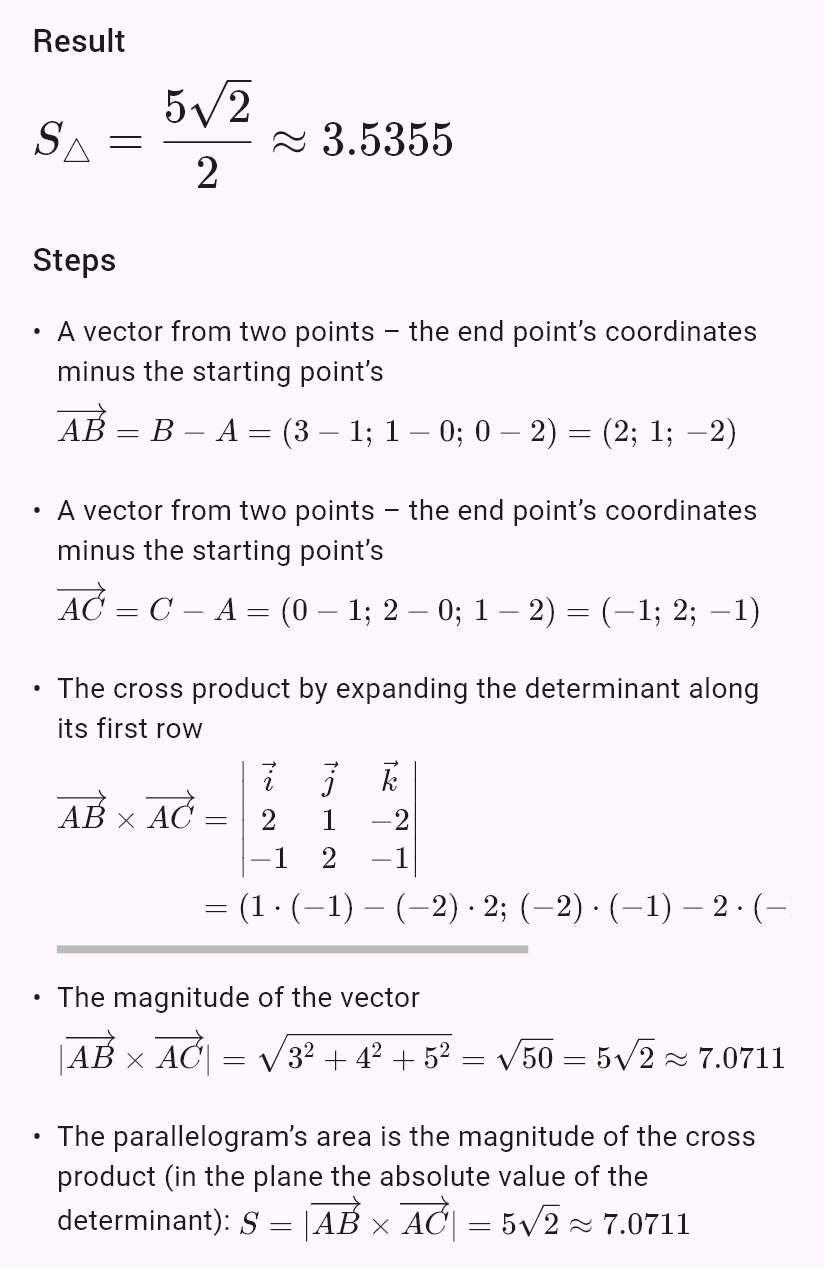
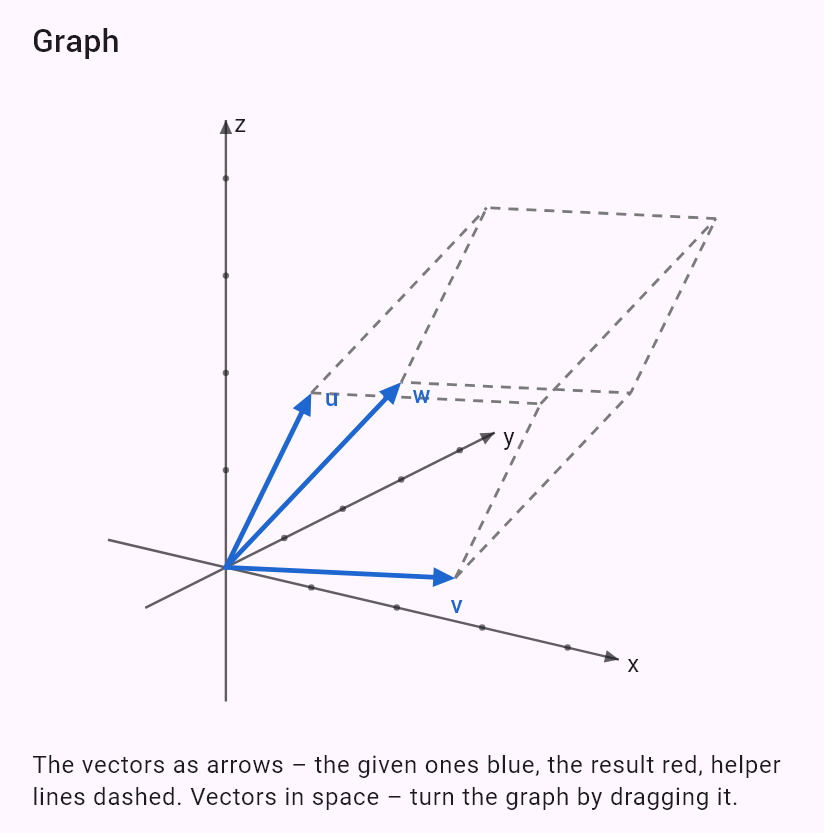
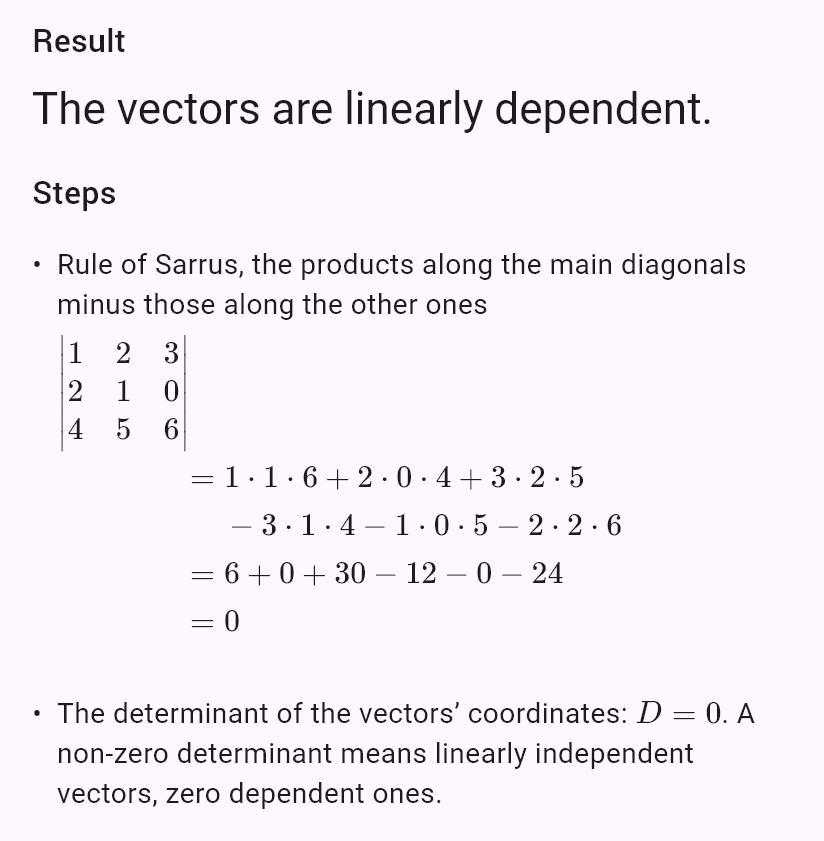
Without a further line the chip says what to compute: the magnitude, the sum (the resultant of forces with its magnitude and direction), the dot product (zero means perpendicular vectors), the angle (from its cosine, exact for the table values, otherwise in degrees and minutes), the cross product (by the determinant with i, j, k), the area of a parallelogram and a triangle, the volume of a parallelepiped and a tetrahedron by the triple product, or linear dependence. For points the app first builds the vectors AB, AC, AD from the first point: two points give the distance, three a triangle, four a tetrahedron.
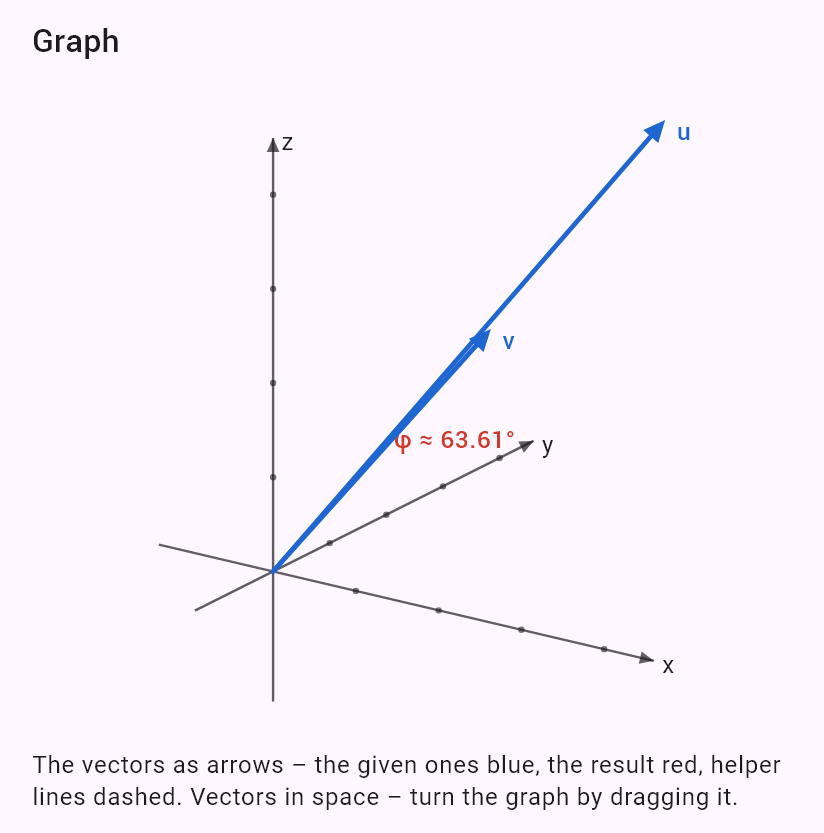
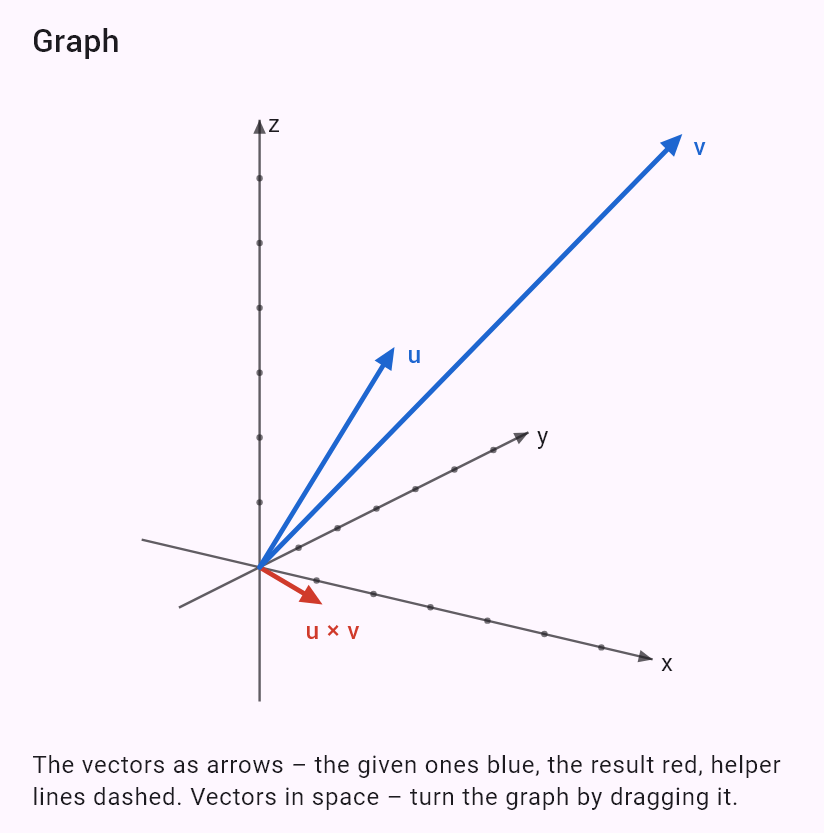
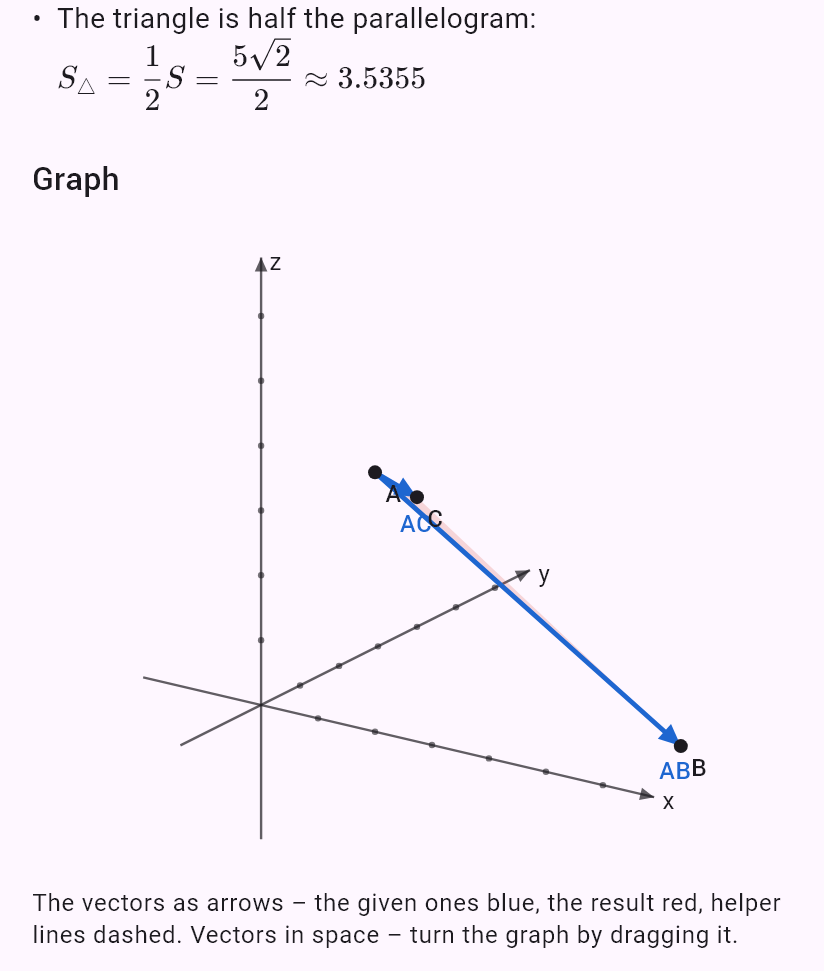
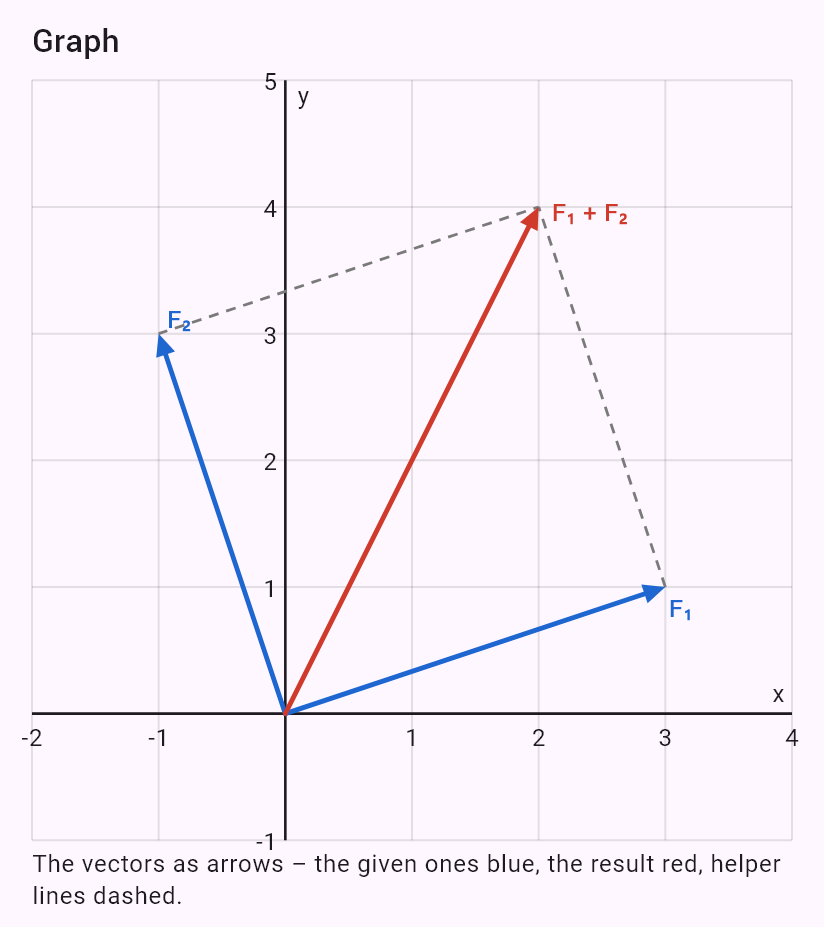
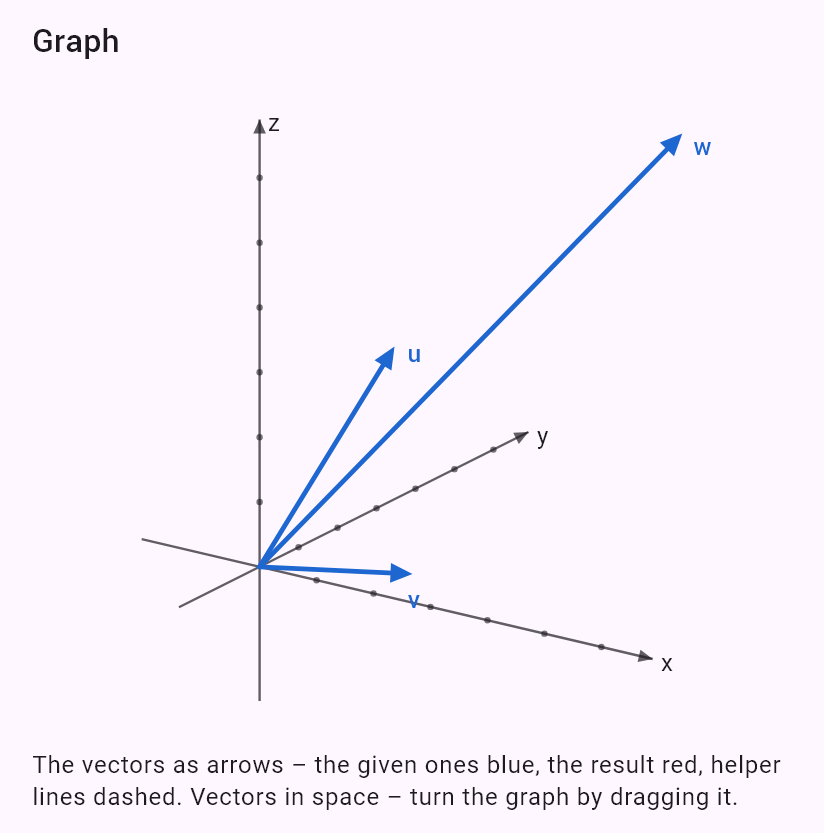
On the last line you can write an expression: u + 2v, u·v (or u*v), u × v, |u|, (u × v)·w, |AB| and the vector AB from two points. The graph shows the vectors as arrows – in the plane with a grid, in space with axes you turn with your finger; an area is shaded and an angle marked by an arc.
How to enter it
u = (1; 2; 3) | A vector with semicolons, each on its own line. |
A[1; 2; 3] | A point with square brackets. |
u + 2v, u·v, u × v, |AB|, (u × v)·w | An expression with vectors on the last line. |
Examples
A[3; -2]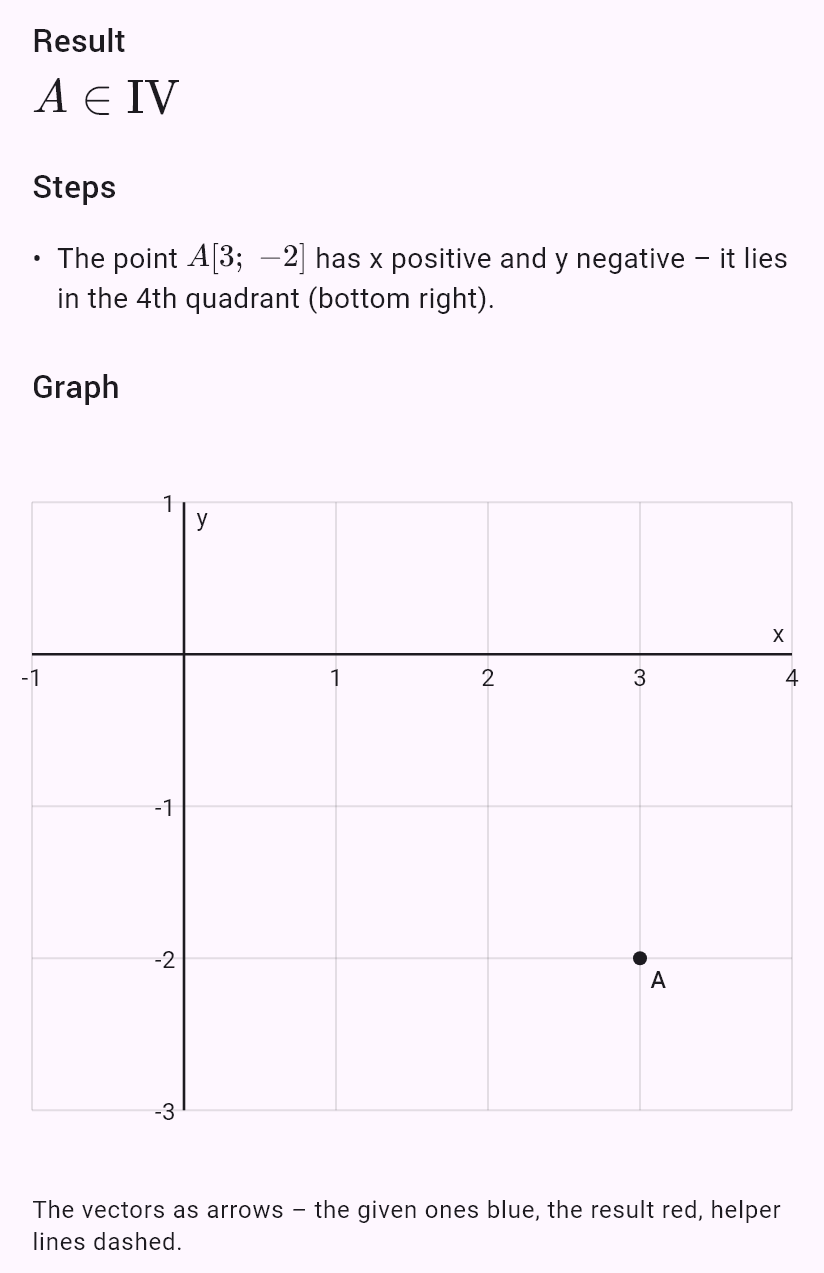
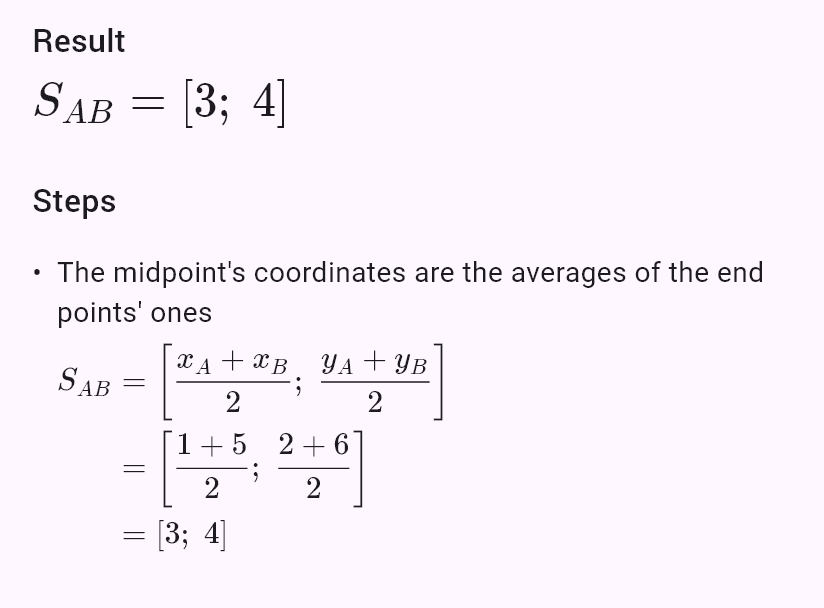
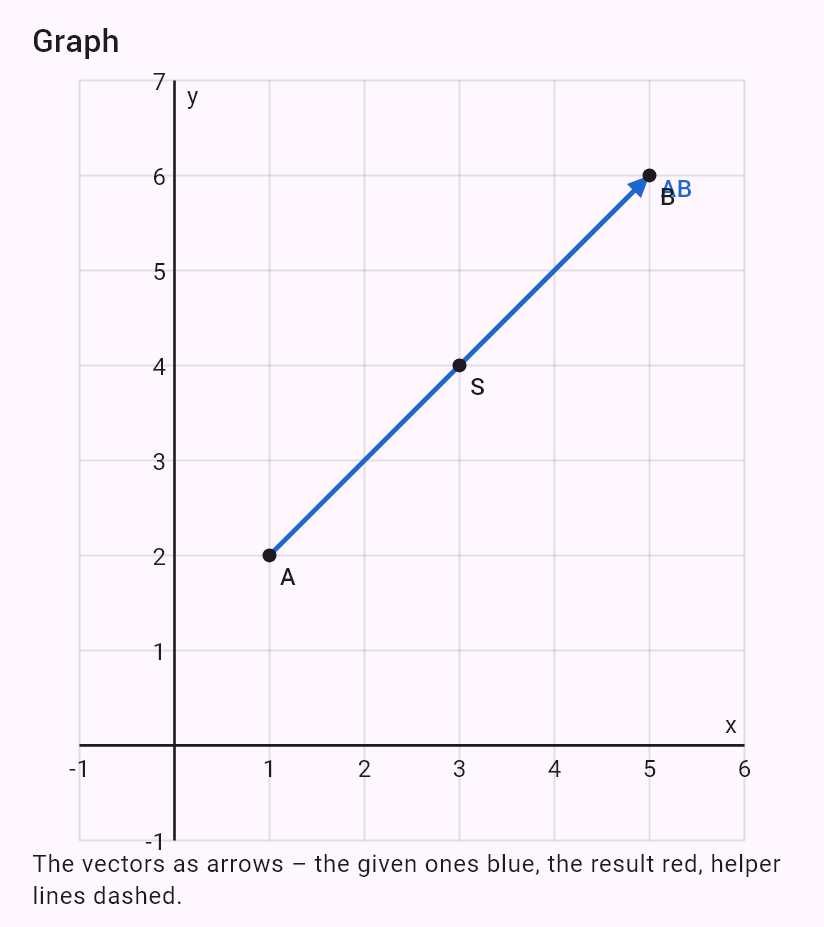
střed AB, A[1; 2], B[5; 6]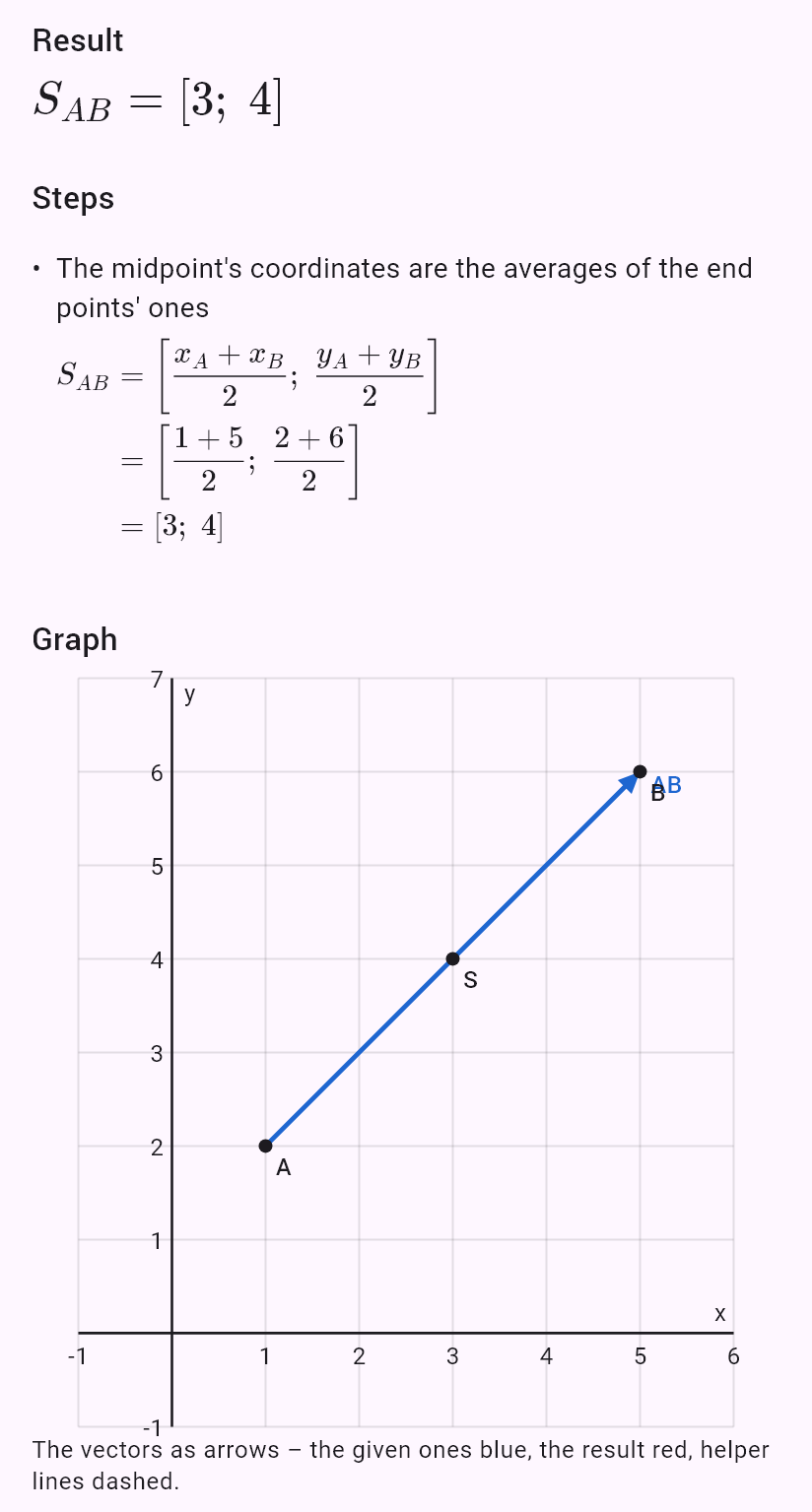
u = (1; 2; 3)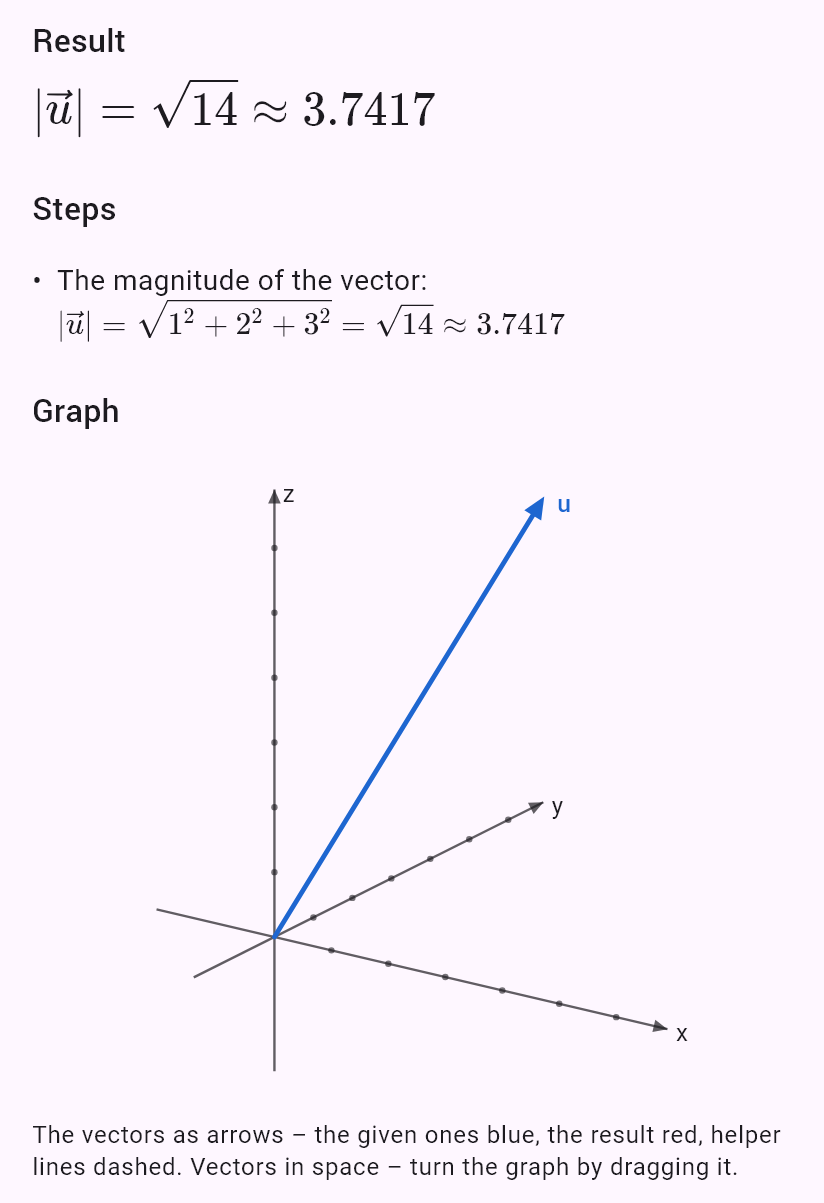
u = (1; 2; 2)
v = (2; -1; 2)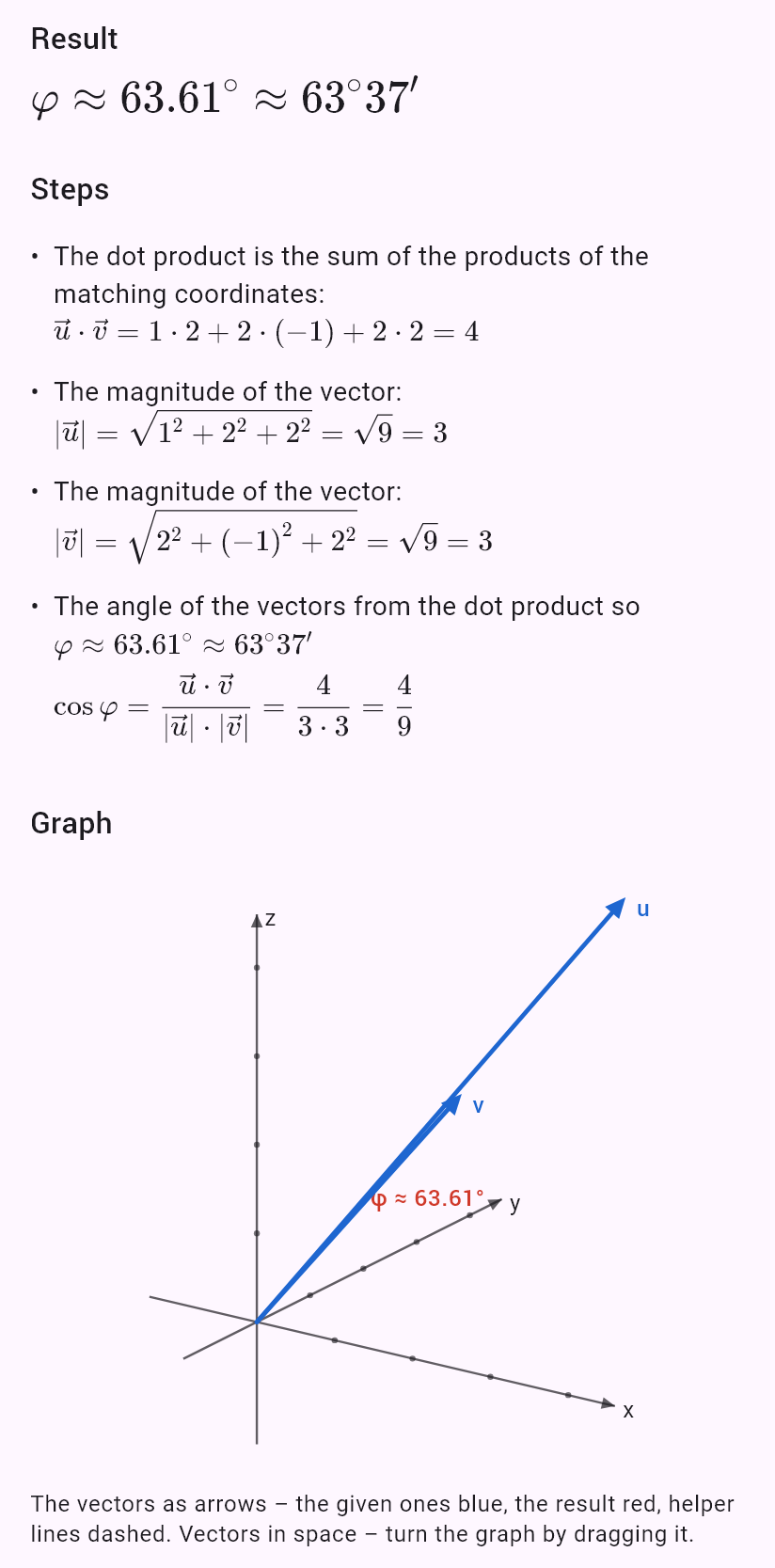
u = (1; 2)
v = (3; 4)
u + 2v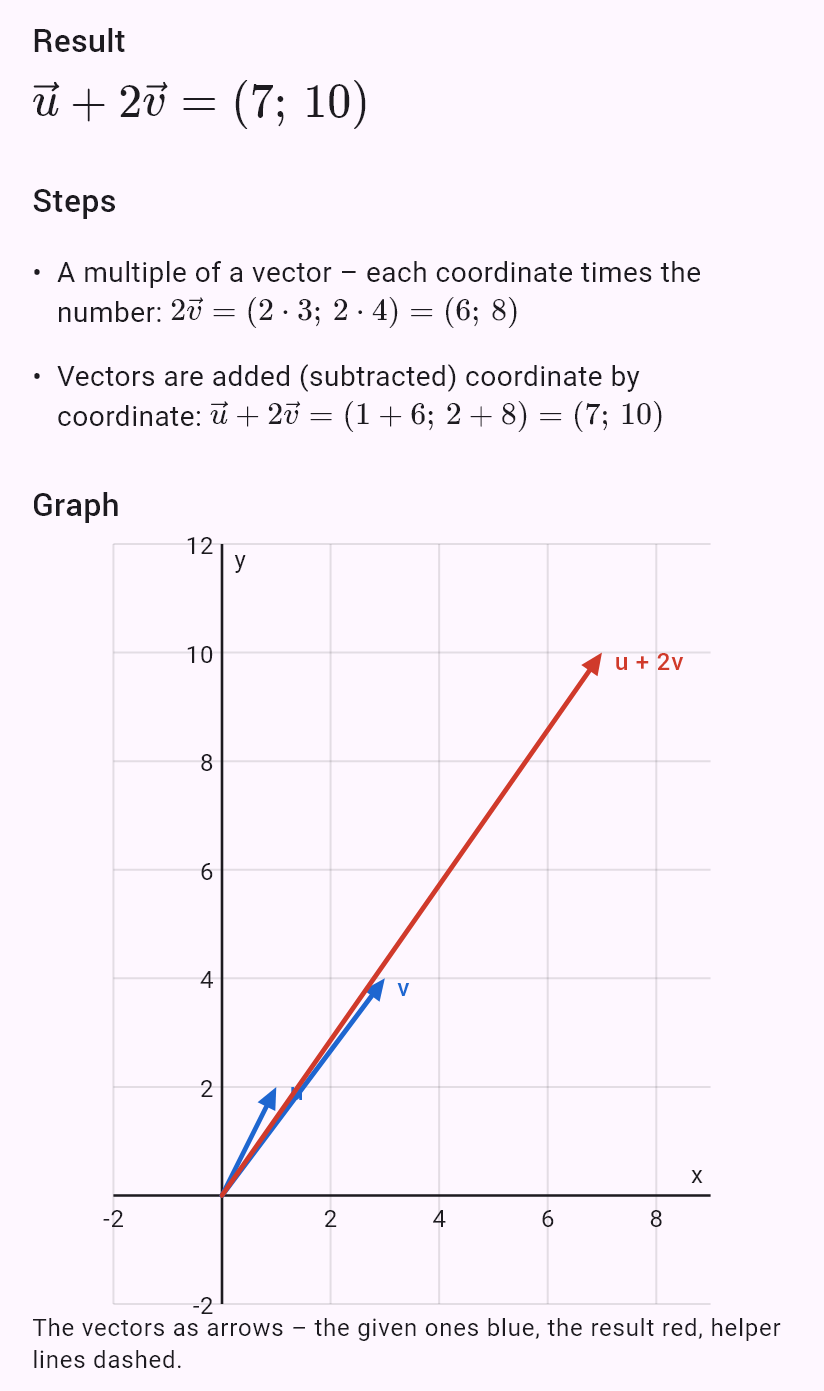
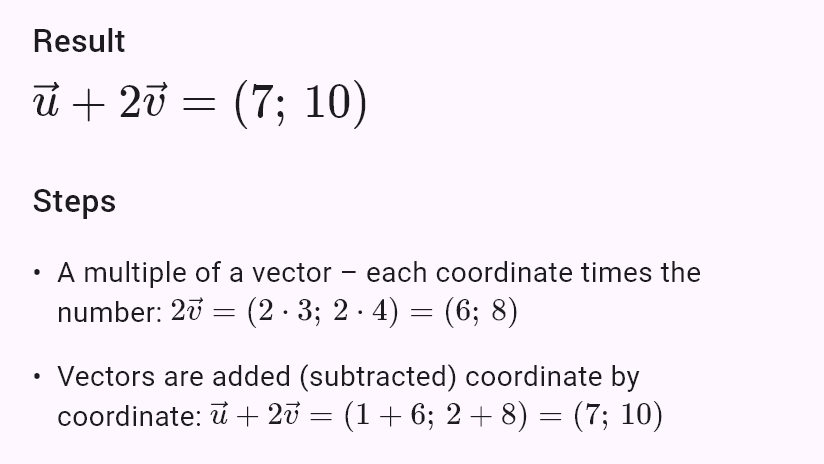
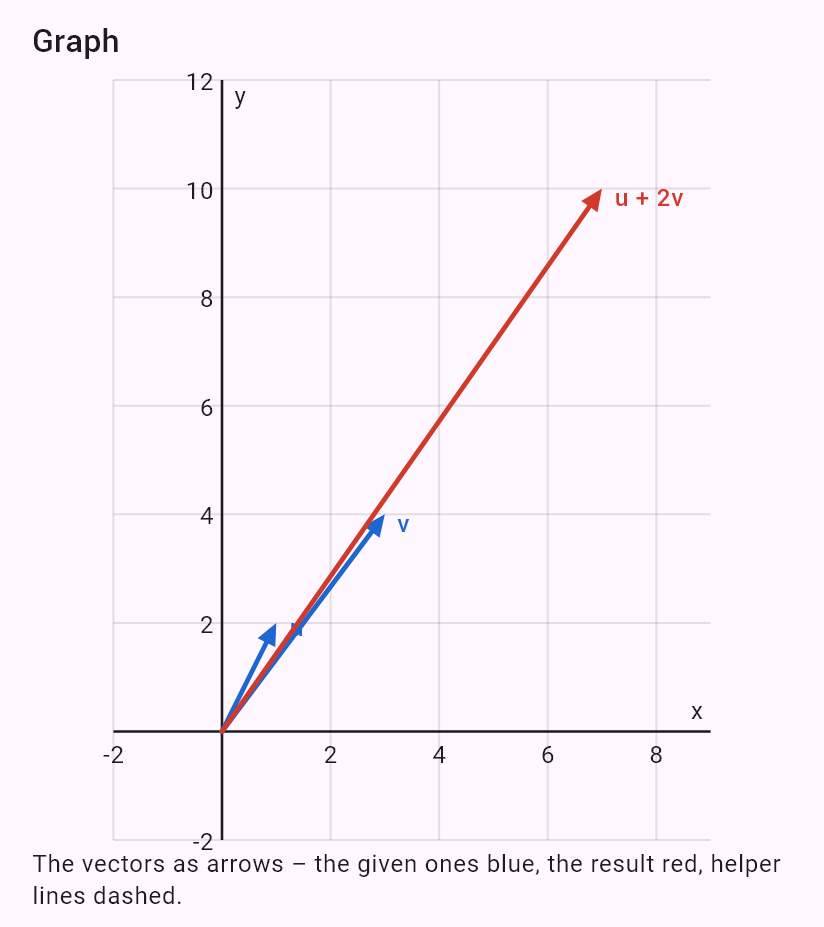
u = (1; 2; 3)
v = (4; 5; 6)
Cross product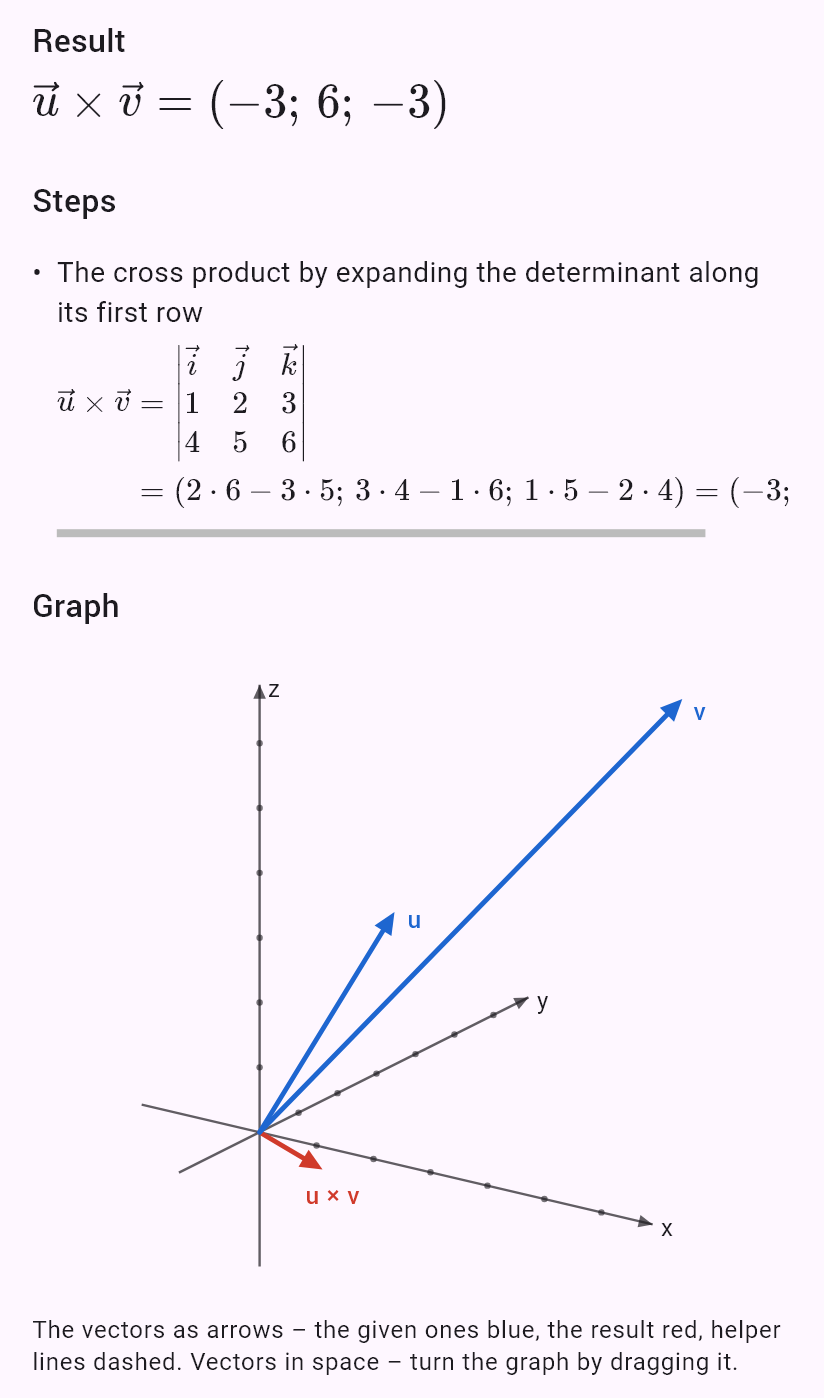
A[1; 0; 2]
B[3; 1; 0]
C[0; 2; 1]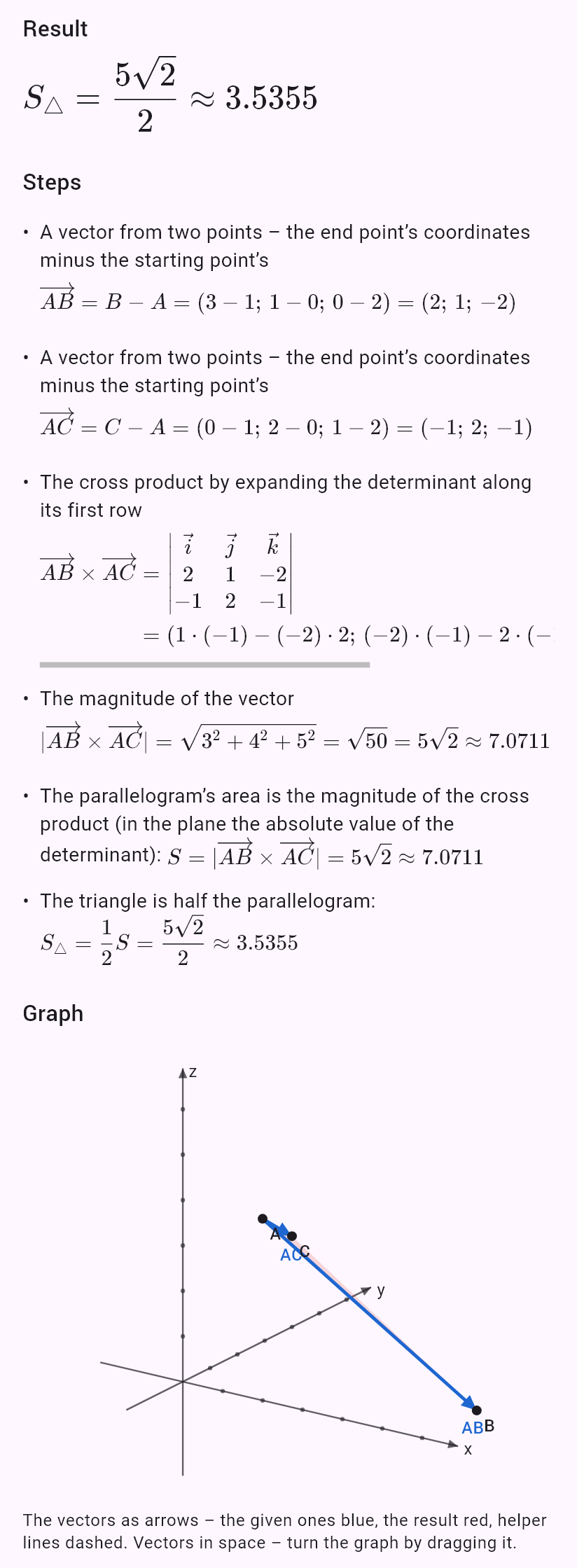
u = (1; 0; 2)
v = (2; 1; 0)
w = (0; 3; 1)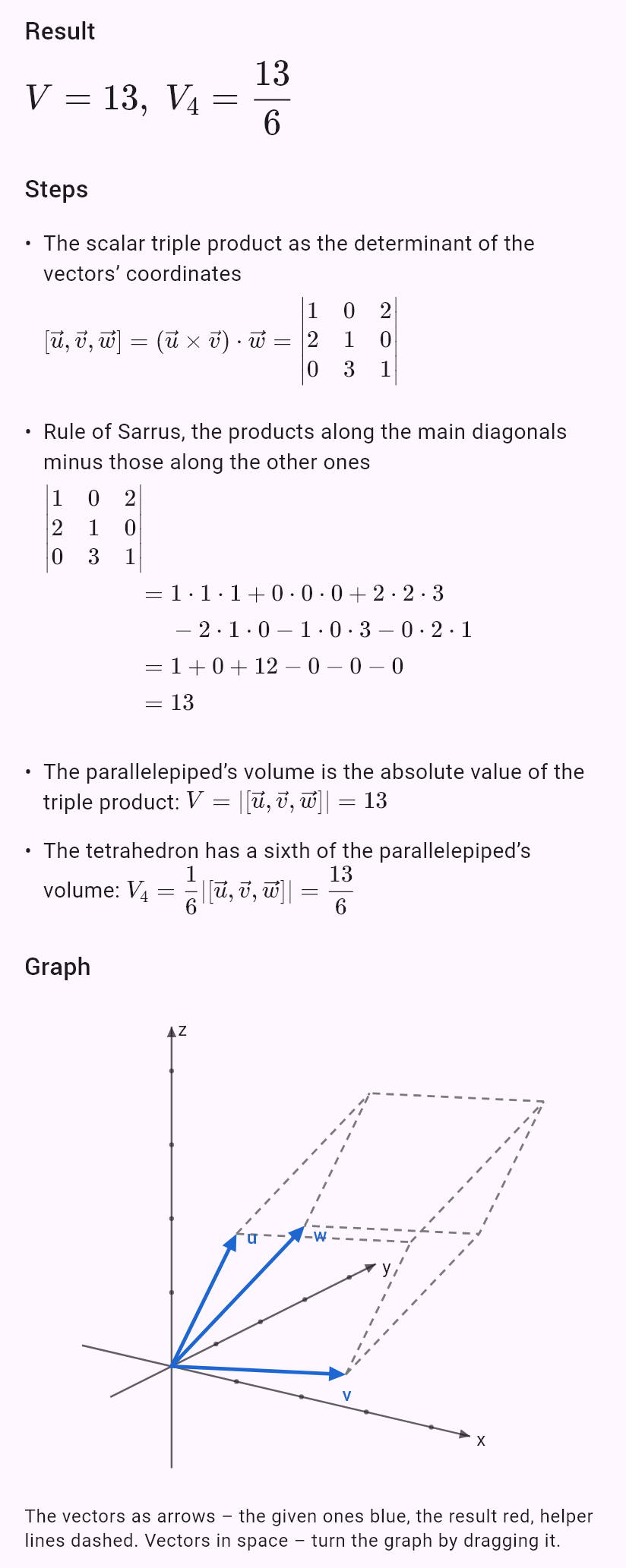
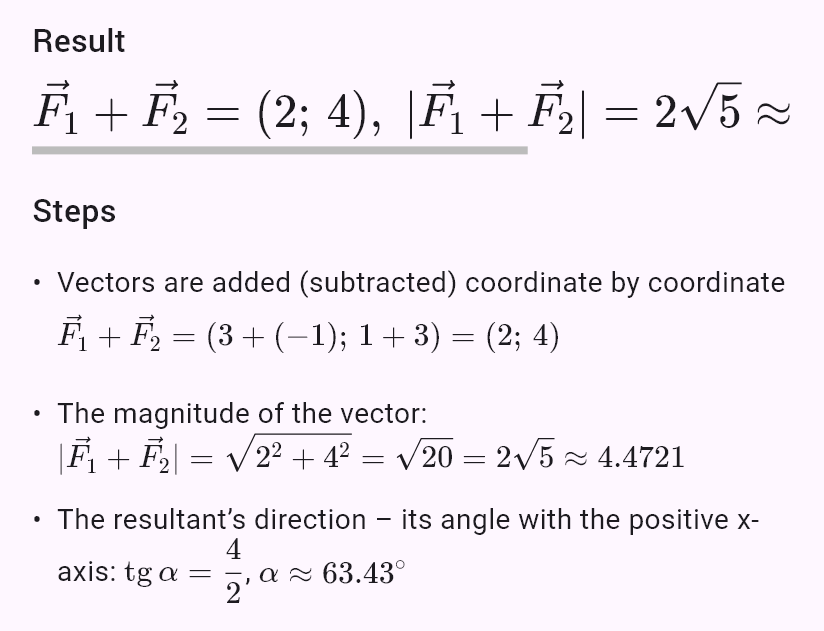
F_1 = (3; 1)
F_2 = (-1; 3)
Sum (resultant)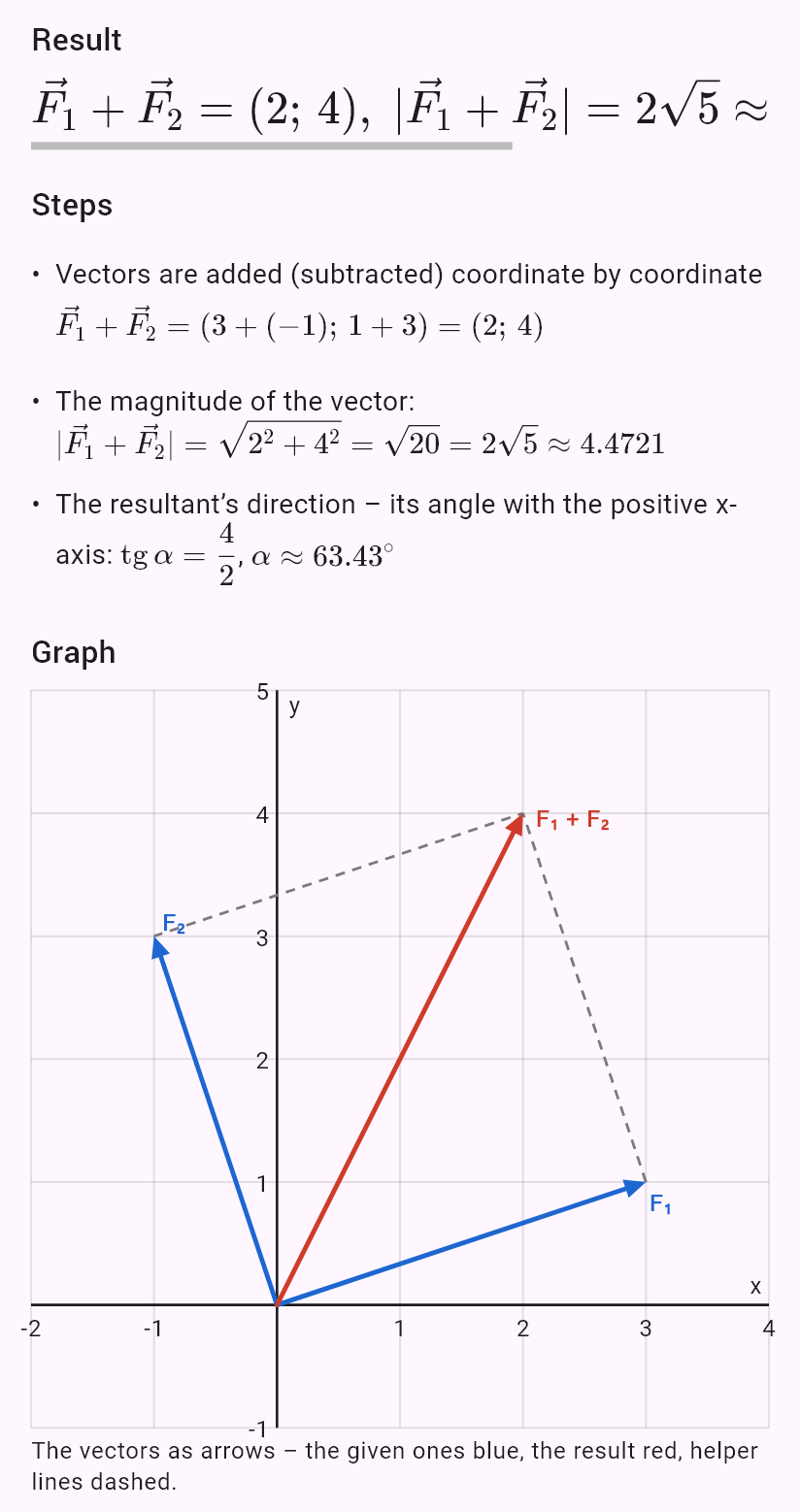
u = (1; 2; 3)
v = (2; 1; 0)
w = (4; 5; 6)
Linear dependence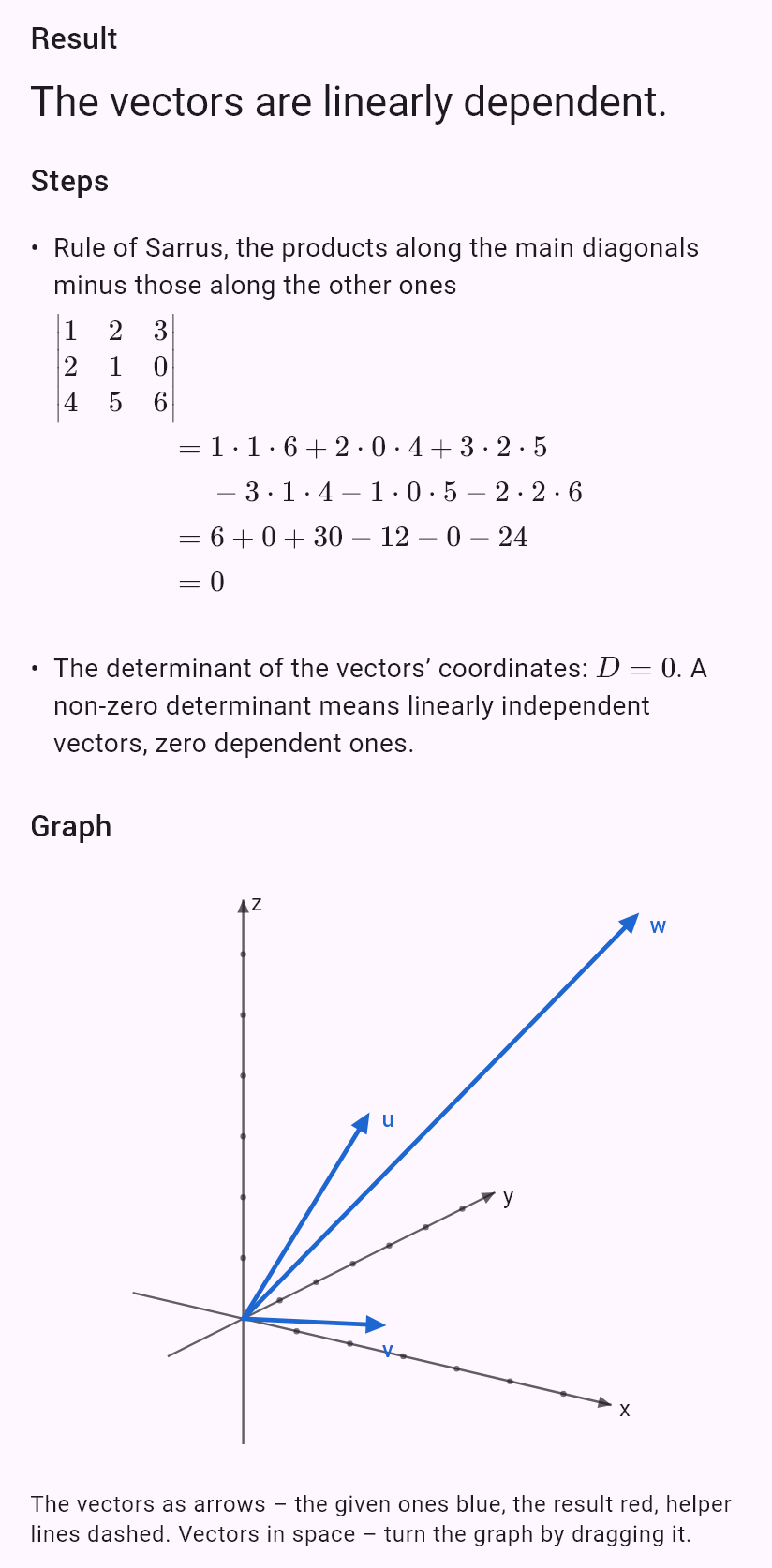
Known limitations
- The coordinates are numbers (no parameter), at most six; the graph only in the plane and in space.