I. Equations, inequalities and expressions
19. Complex numbers
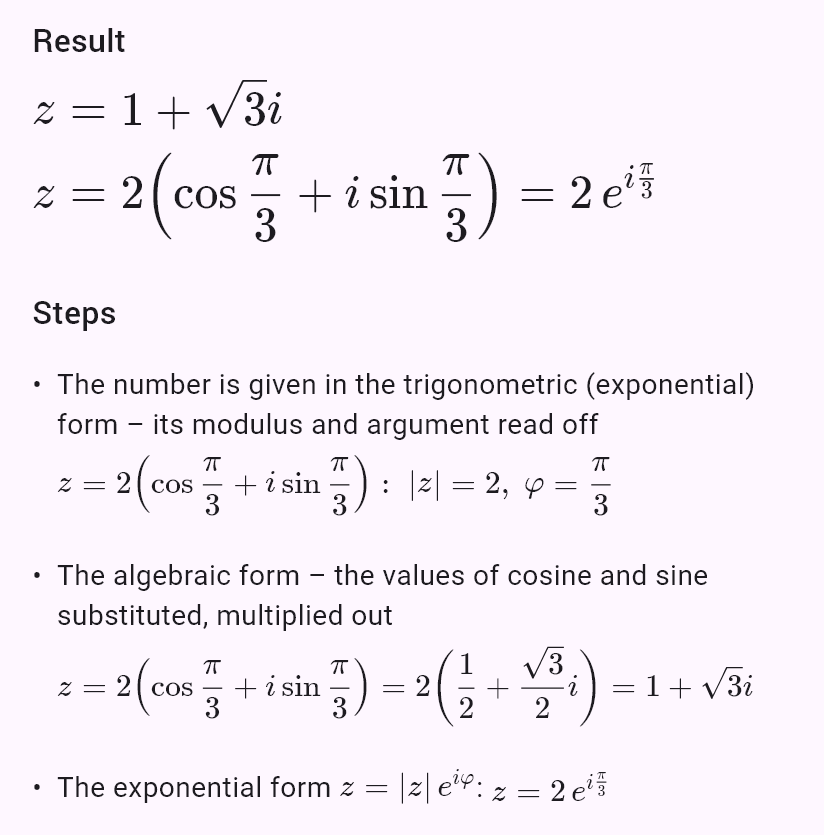
Write a complex number with the imaginary unit i: 1 - i√3 (or 1 - i*sqrt(3)), in the trigonometric form 2(cos(pi/3) + i sin(pi/3)) or cis(pi/3), in the exponential form 3e^(i pi/4); angles may be in degrees too (cos 60° + i sin 60°). Numbers can be named, each on its own line (z_1 = 1 + i), with an expression in their names on the last line (z_1/z_2, z^8).
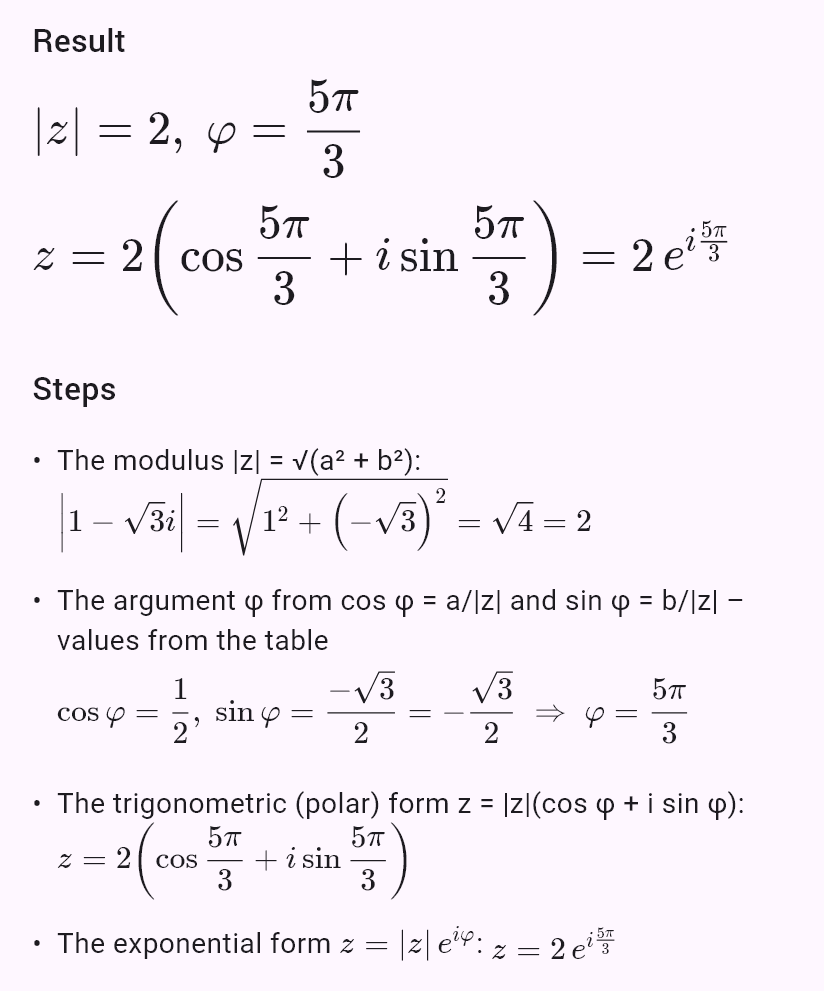
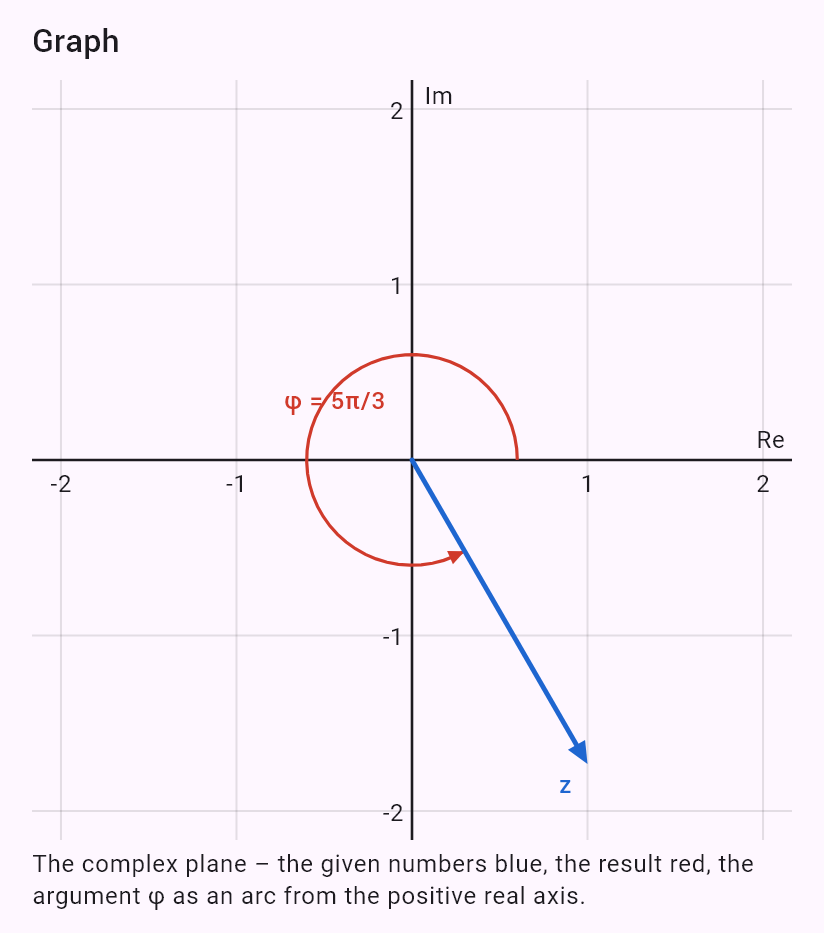
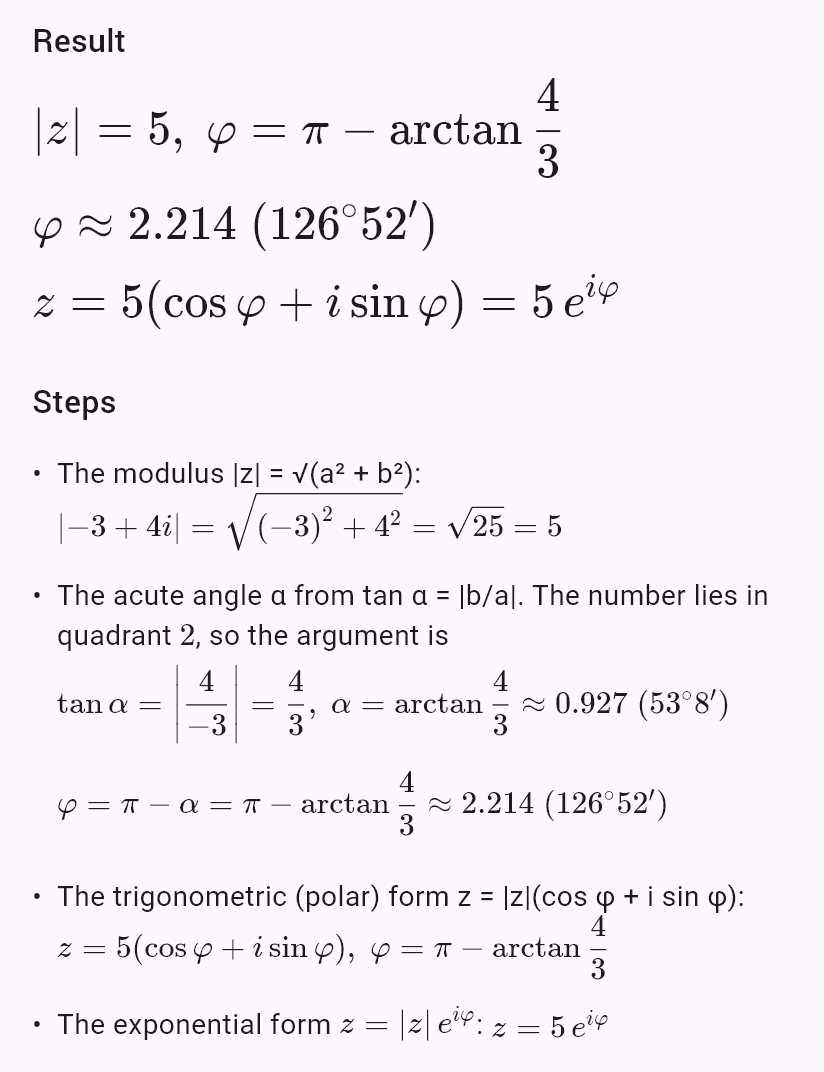
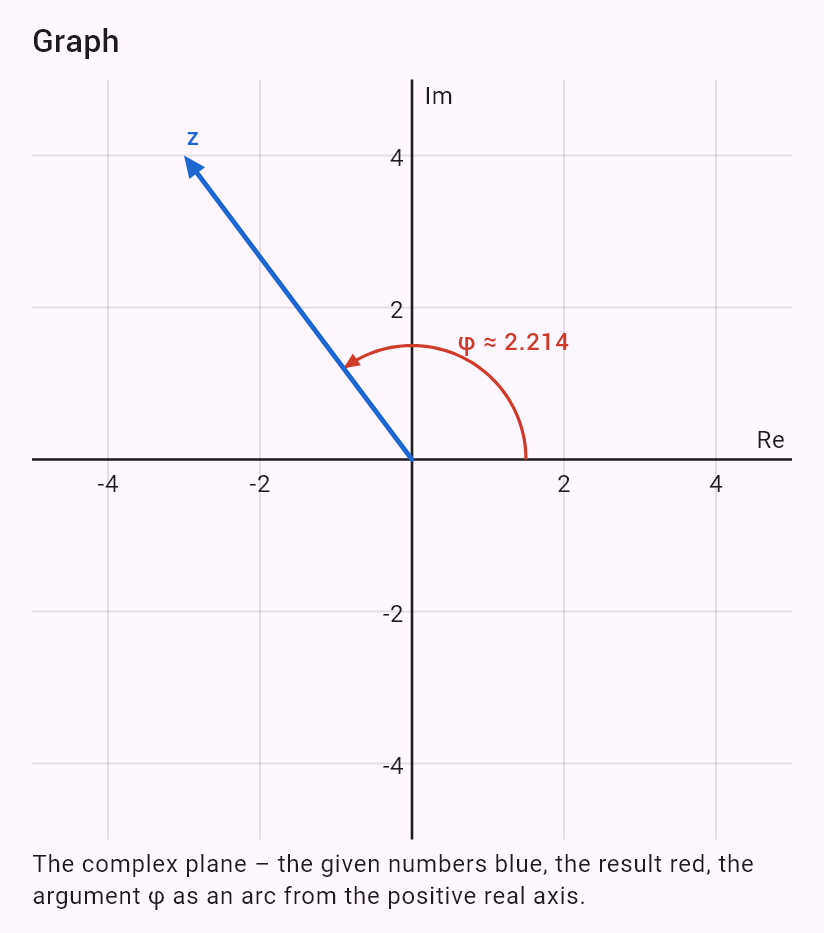
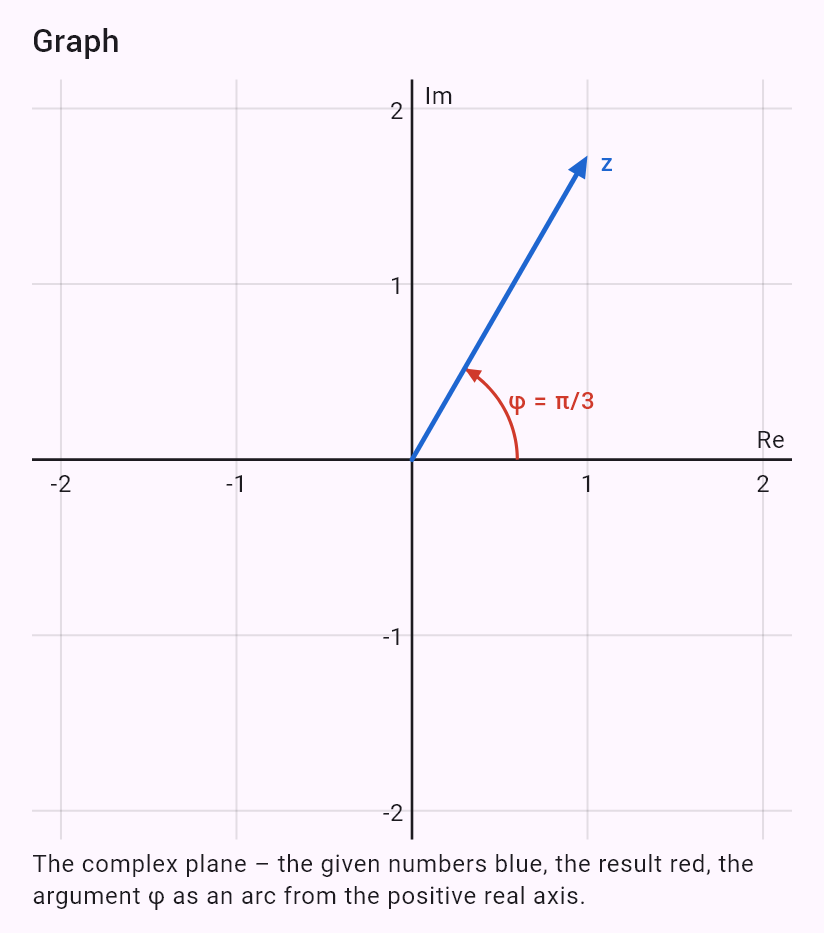
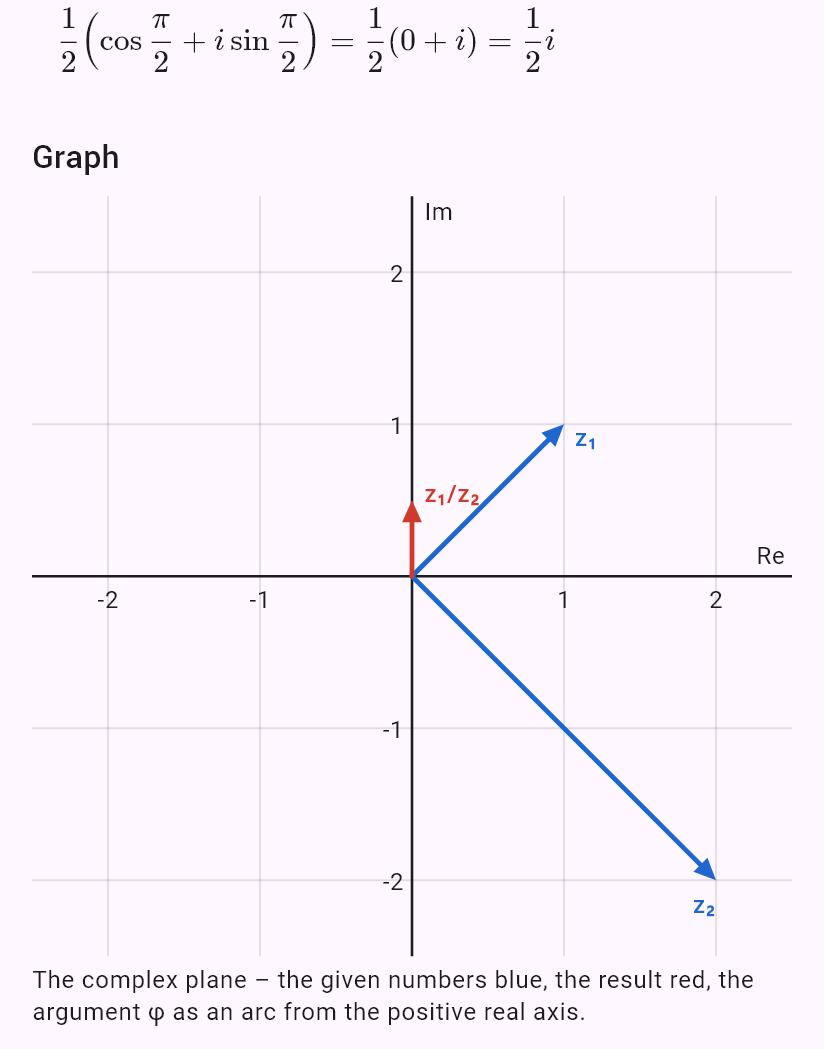
For a single number the app computes the modulus |z| = √(a² + b²) and the argument φ – from the table values of cosine and sine, otherwise by the acute angle from tan α = |b/a| and the quadrant (exactly with arctan and approximately in radians and degrees) – and writes the trigonometric and exponential forms. A number in the trigonometric form is converted to the algebraic one. The argument lies in ⟨0; 2π); the chip “Principal argument” switches it to (−π; π⟩. The graph shows the number in the complex plane as a vector with the argument’s arc.
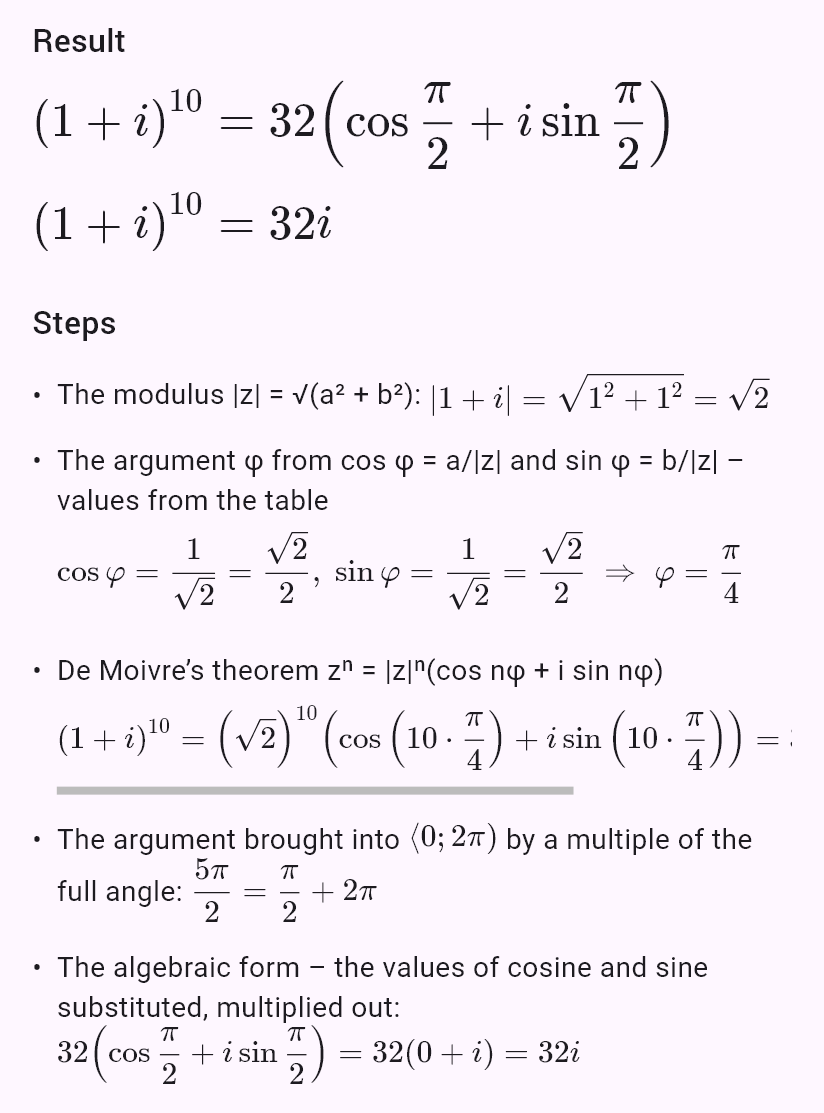
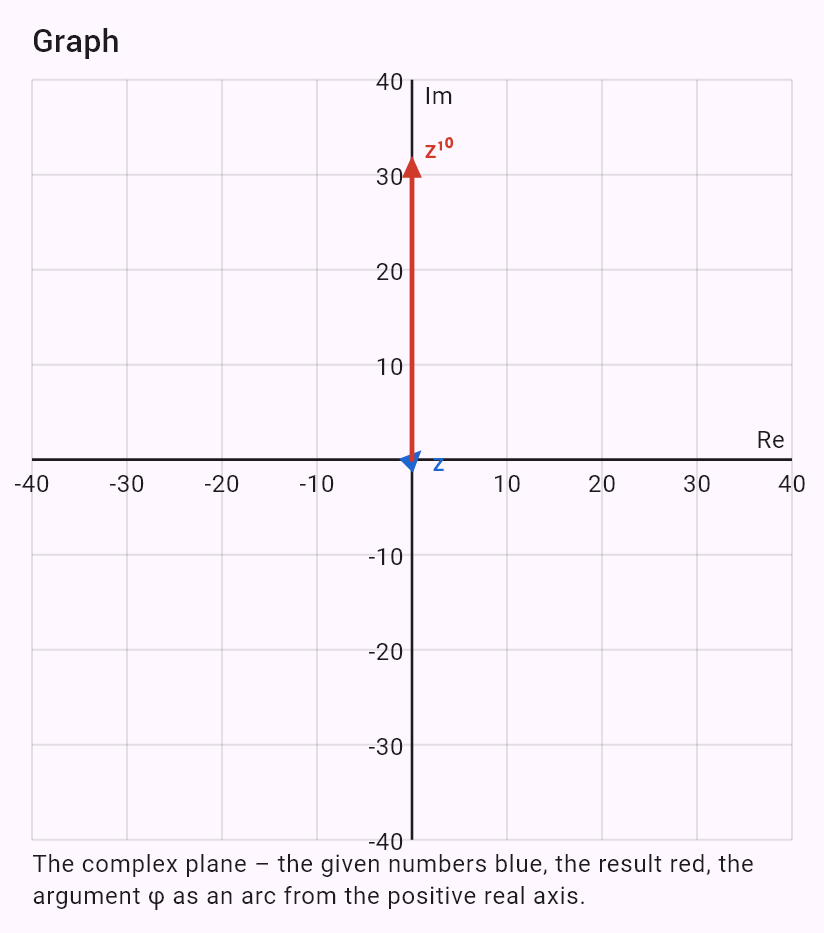
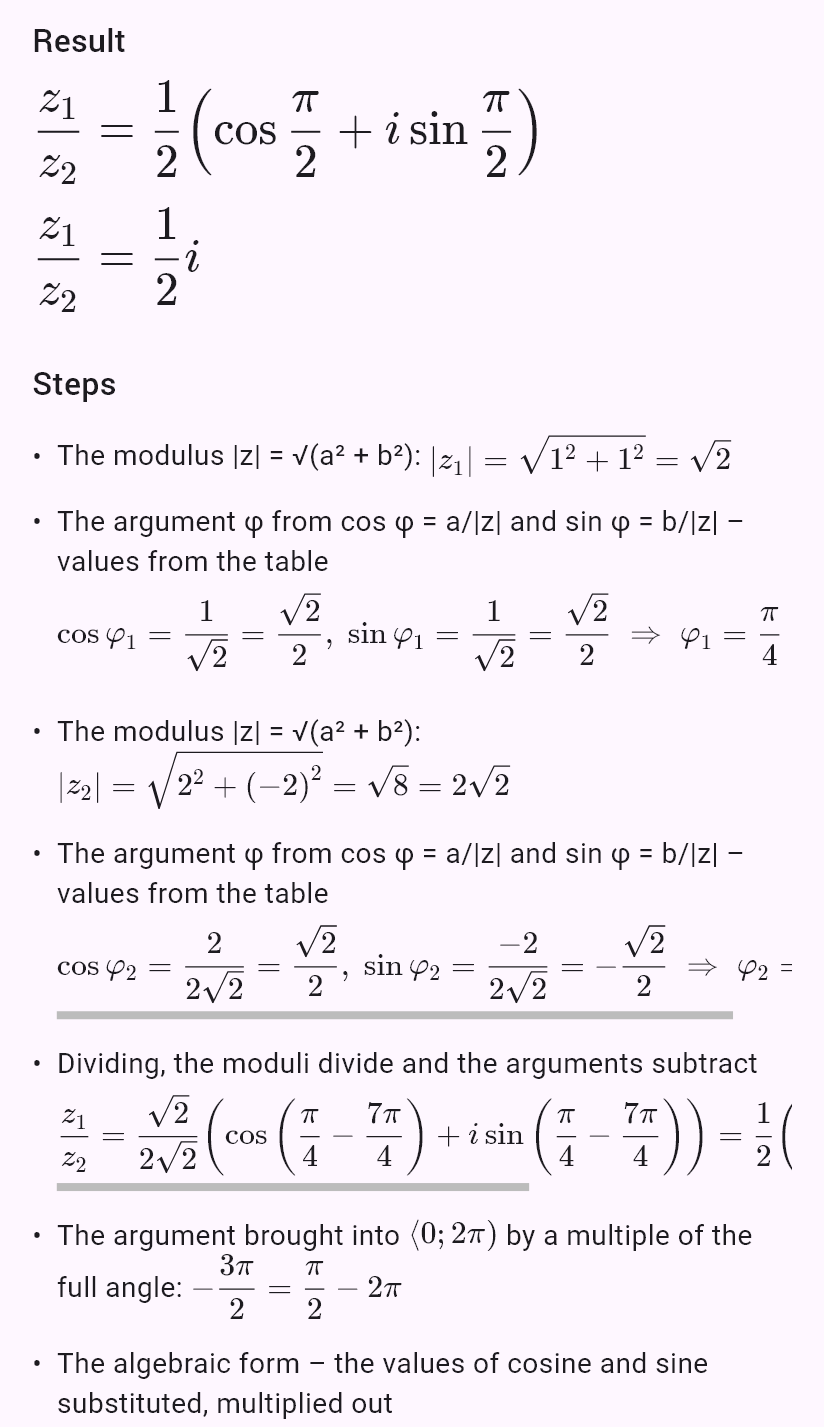
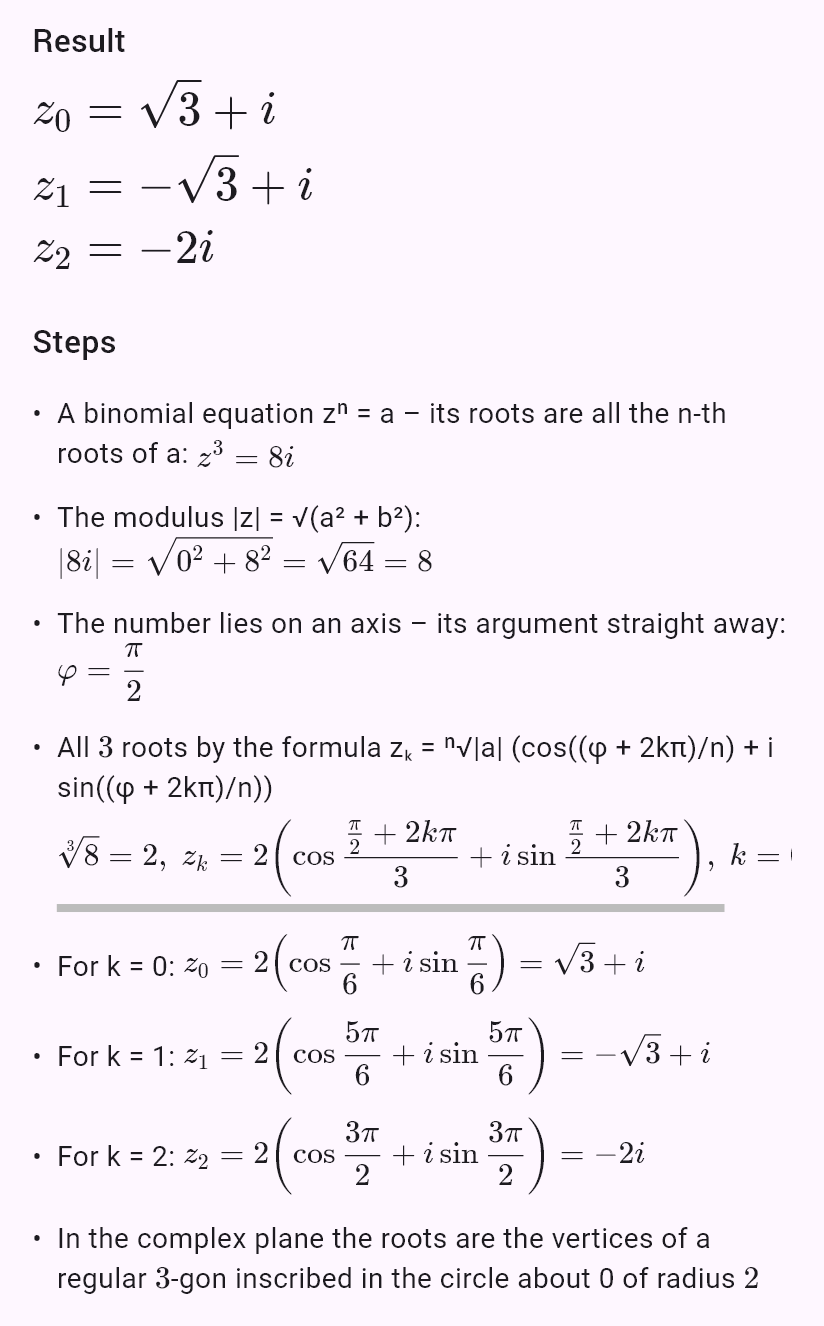
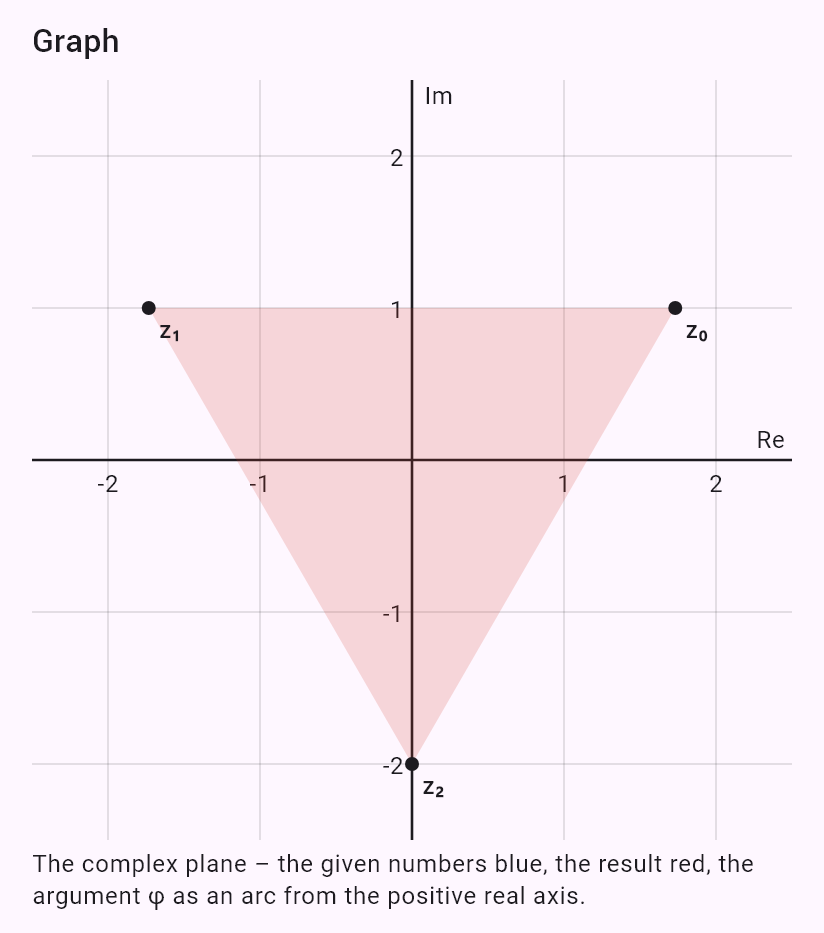
A power such as (1 + i)^10 is computed by de Moivre’s theorem with the argument reduced by multiples of 2π; a product and a quotient by the moduli and arguments. The chips choose “Trigonometric form” (for a power “De Moivre’s theorem”) or “Algebraic form”; dividing algebraic numbers by the conjugate is in the chapter Simplifying expressions. A root root(3, 8i) and a binomial equation z³ = 8i give all n roots by zₖ = ⁿ√|a|(cos((φ + 2kπ)/n) + i sin((φ + 2kπ)/n)); in the graph they are the vertices of a regular n-gon. An equation in the unknown z is solved over the complex numbers straight away; the chip “Solve in:” switches it to ℝ. A quadratic equation with complex coefficients (z² + i = 2z) is solved by completing the square, (z − 1)² = 1 − i, the complex square root found as a + bi by comparing the real and imaginary parts.
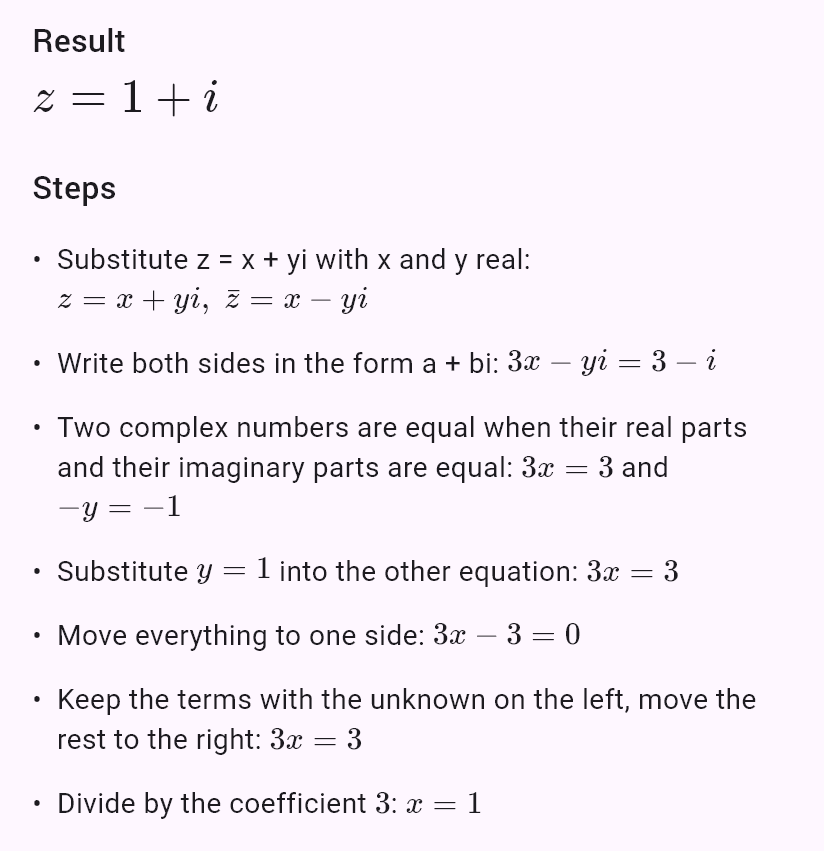
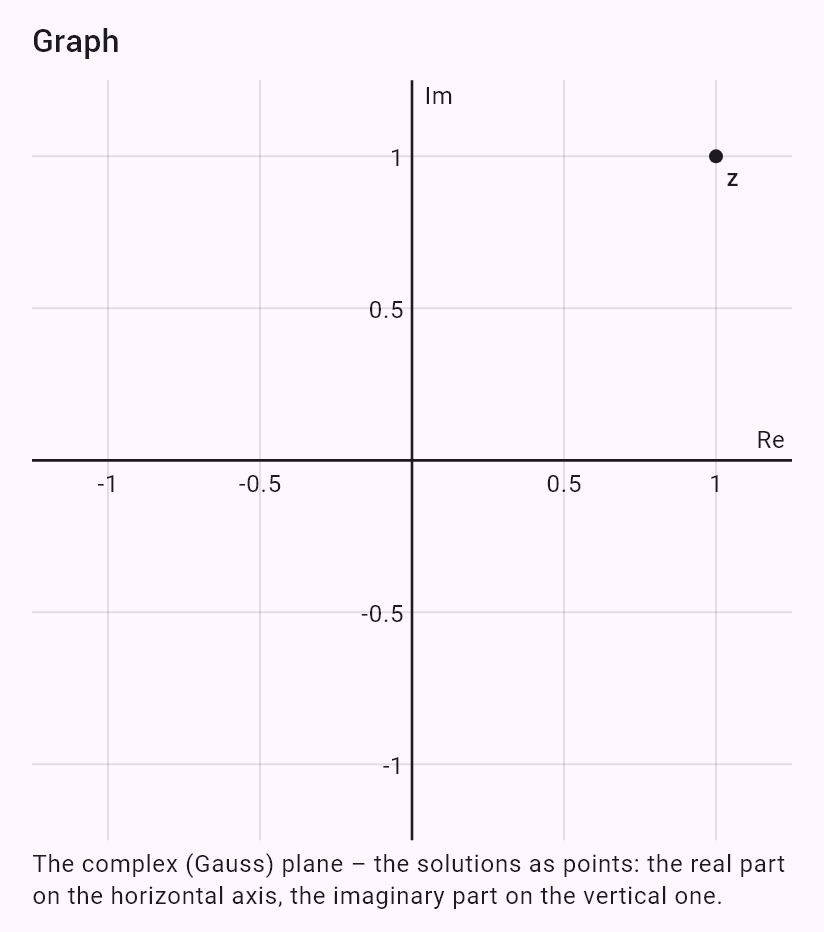
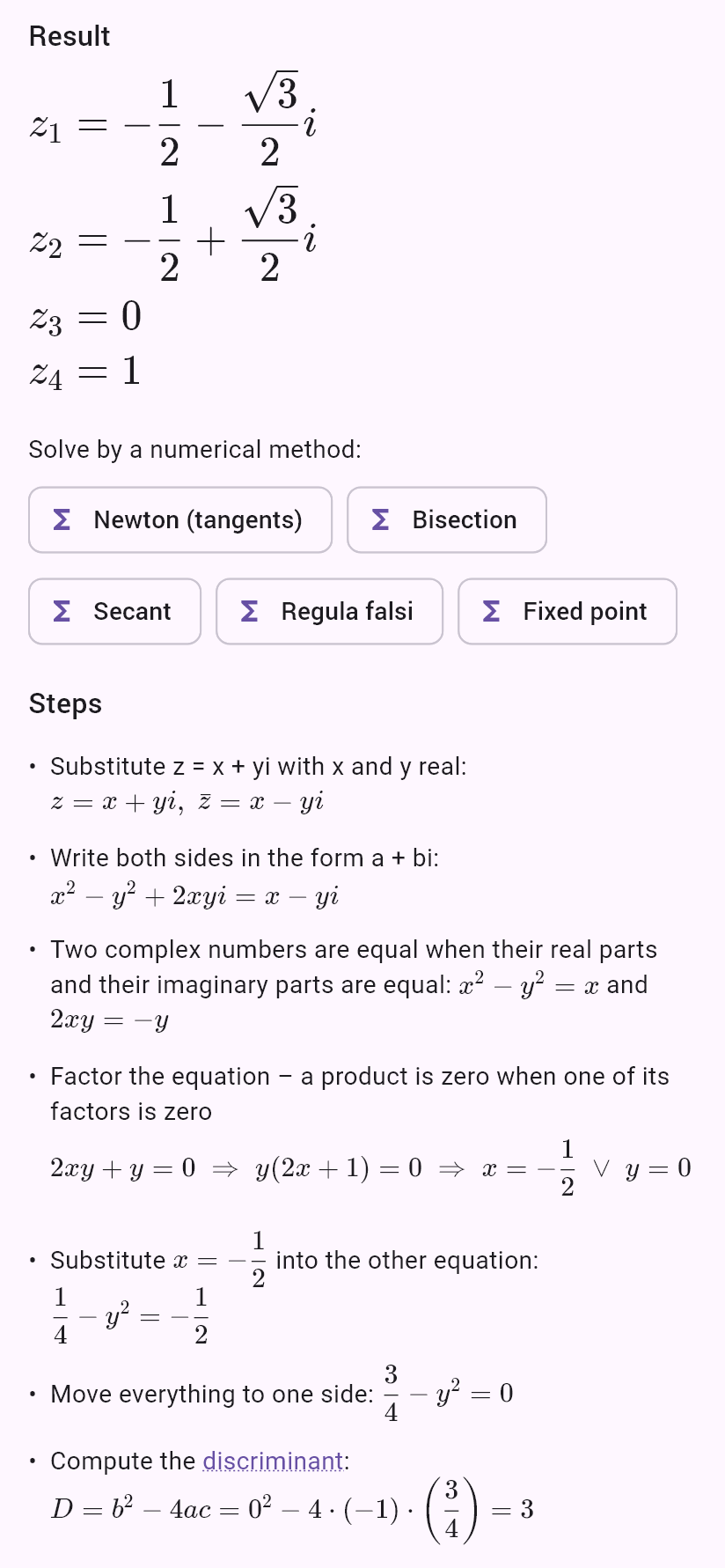
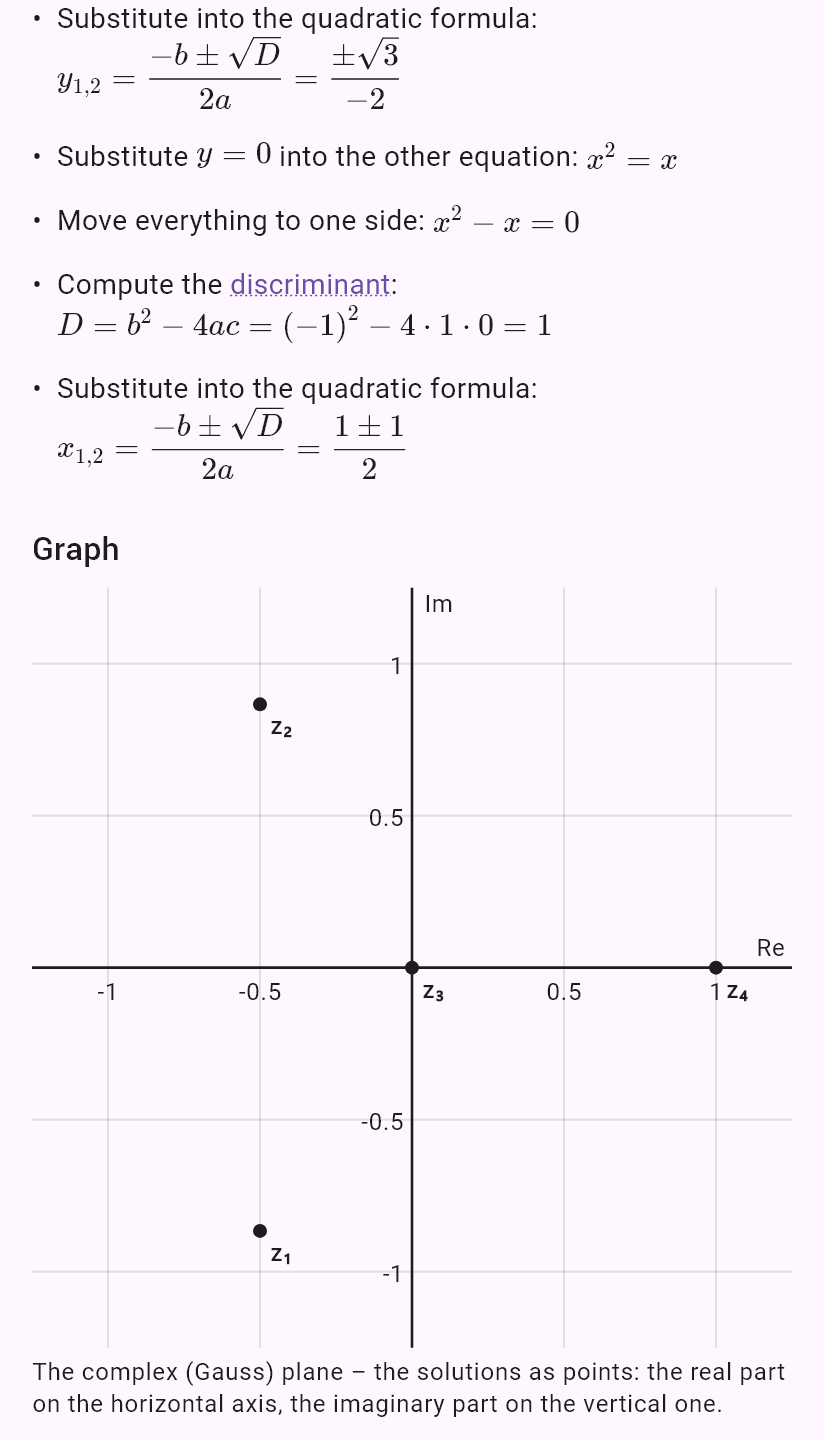
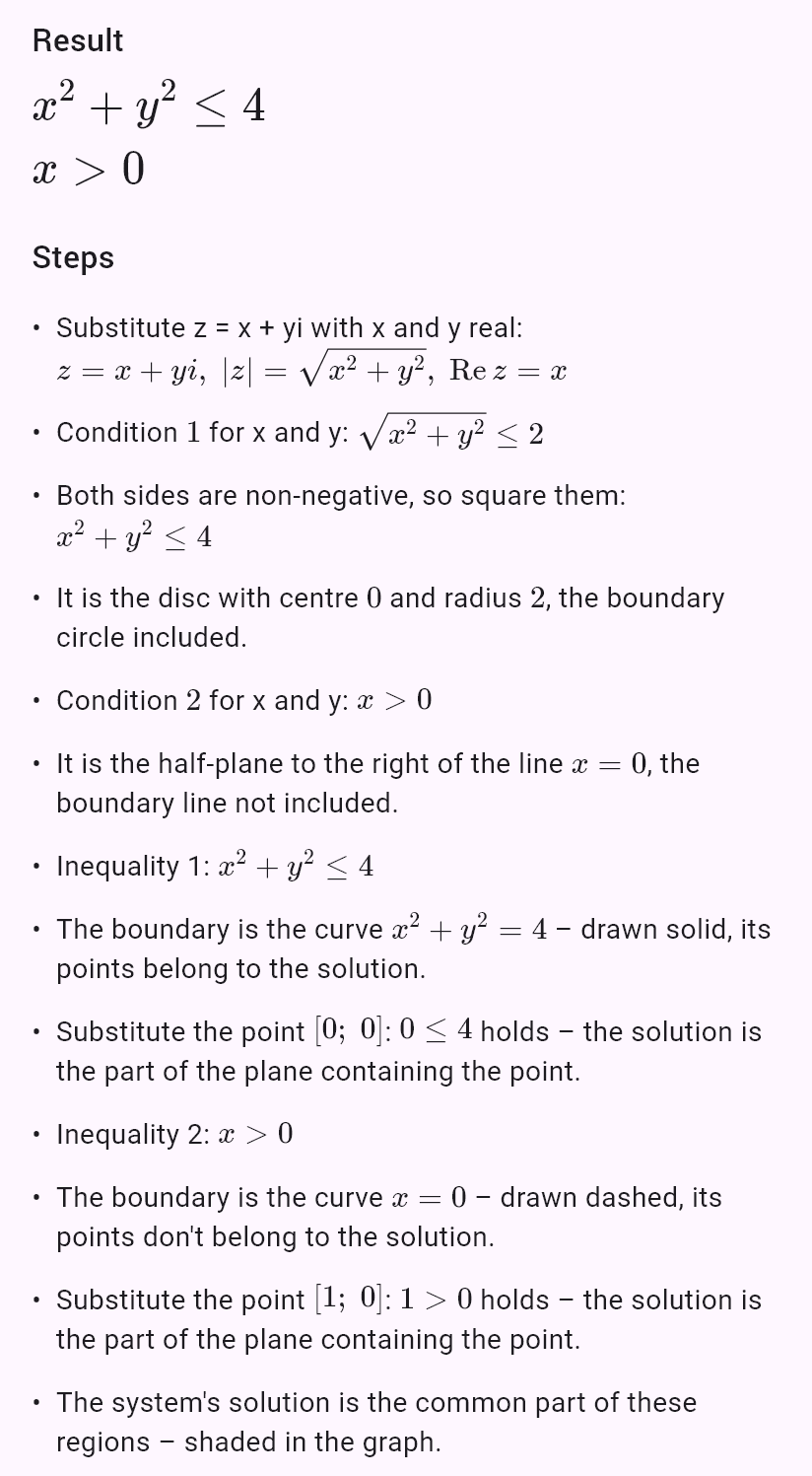
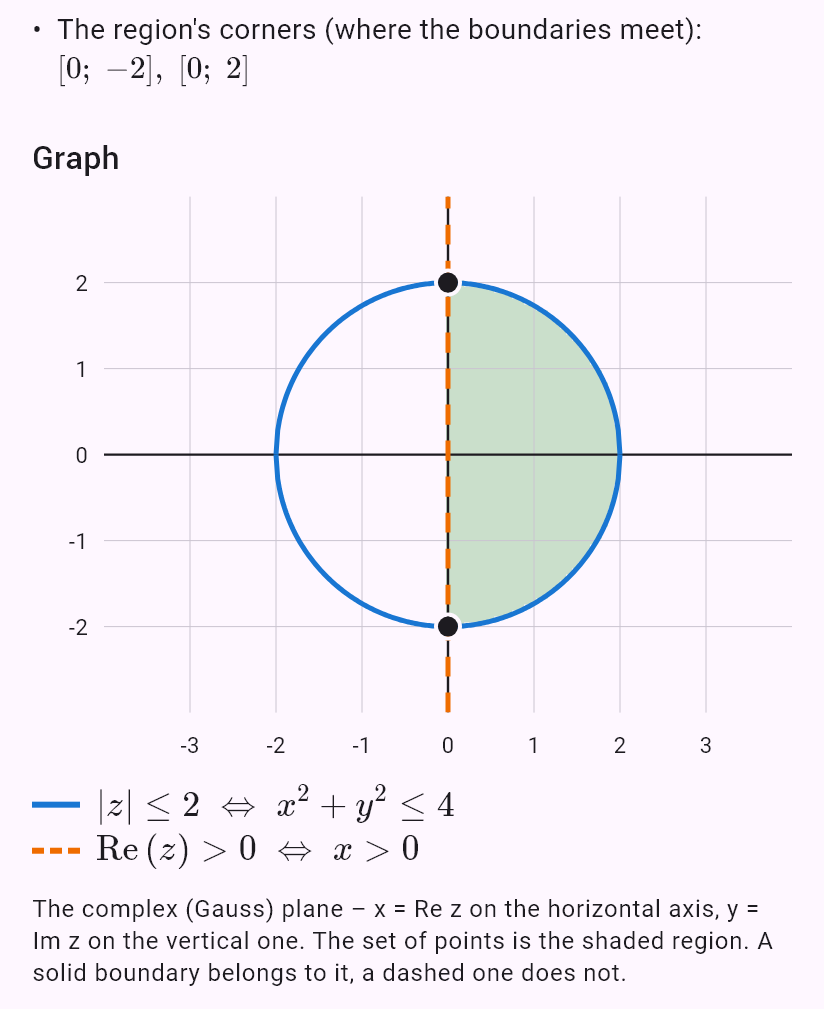
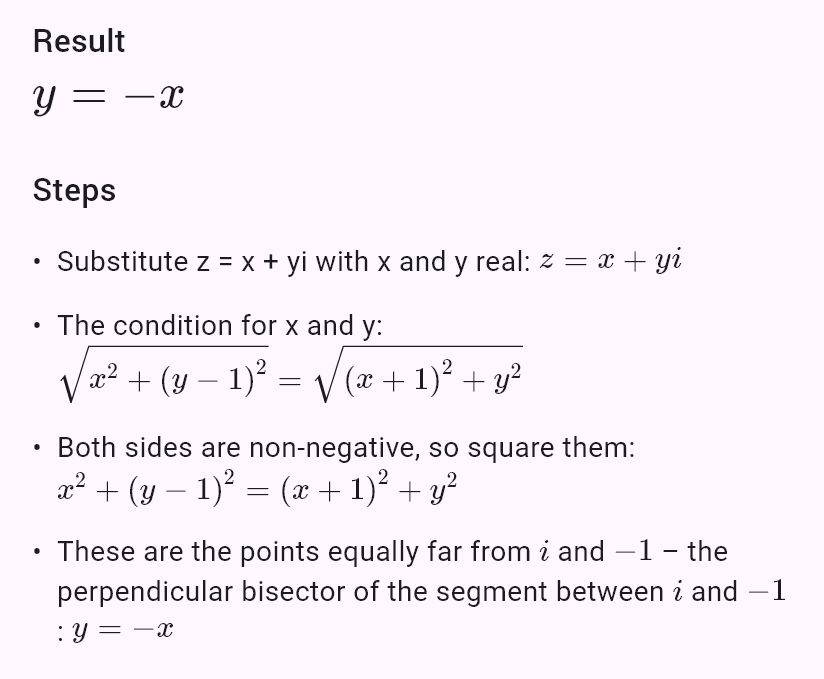
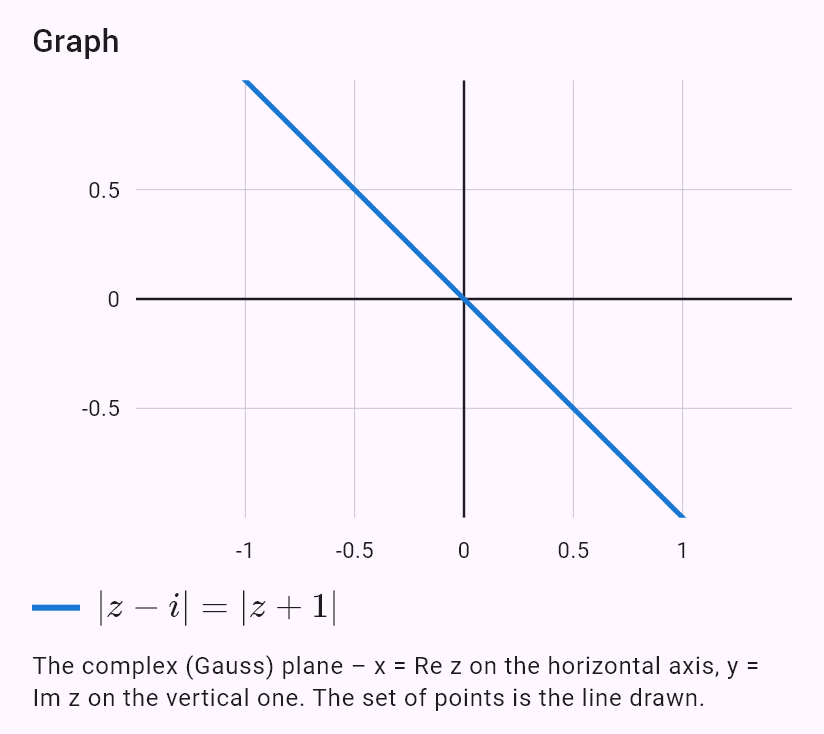
An equation with the conjugate z̄ (the z̄ key types conj(z), a photo gives \bar{z}), with |z|, Re z and Im z is solved by substituting z = x + yi: the app writes both sides as a + bi, compares the real and the imaginary parts and solves the resulting system of two equations in x and y – one equation is solved for a variable and substituted into the other, and if it factors (y(2x + 1) = 0), the solution splits into cases. The solutions are shown as points of the complex plane. If the imaginary parts agree by themselves (|z − 1| = 2, Re z ≥ 1, |z − i| < |z + 1|), the result is a set of points: the app squares the moduli, completes the squares and describes the circle (disc, outside of a circle), line, half-plane or perpendicular bisector. Several conditions, each on its own line or separated by commas (|z| ≤ 2, Re z > 0), and a double inequality (1 < |z − 1| ≤ 2) are drawn as their intersection – a shaded region; a solid boundary belongs to the set, a dashed one does not.
How to enter it
1 - i*sqrt(3) | The algebraic form with the imaginary unit i. |
2(cos(pi/3) + i sin(pi/3)), cis(pi/3) | The trigonometric form, cis φ for short. |
3e^(i pi/4) | The exponential form. |
z_1 = 1 + i ↵ z_2 = 2 - 2i ↵ z_1/z_2 | Named numbers, each on its own line, and an expression in them. |
root(3, 8i), z^3 = 8i | All n-th roots, a binomial equation. |
z + 2conj(z) = 3 - i, Re(z), Im(z) | The conjugate, the real and the imaginary part. |
|z - i| < 3, |z| <= 2 ↵ Re(z) > 0 | A set of points in the complex plane, several conditions line by line. |
Examples
1 - i*sqrt(3)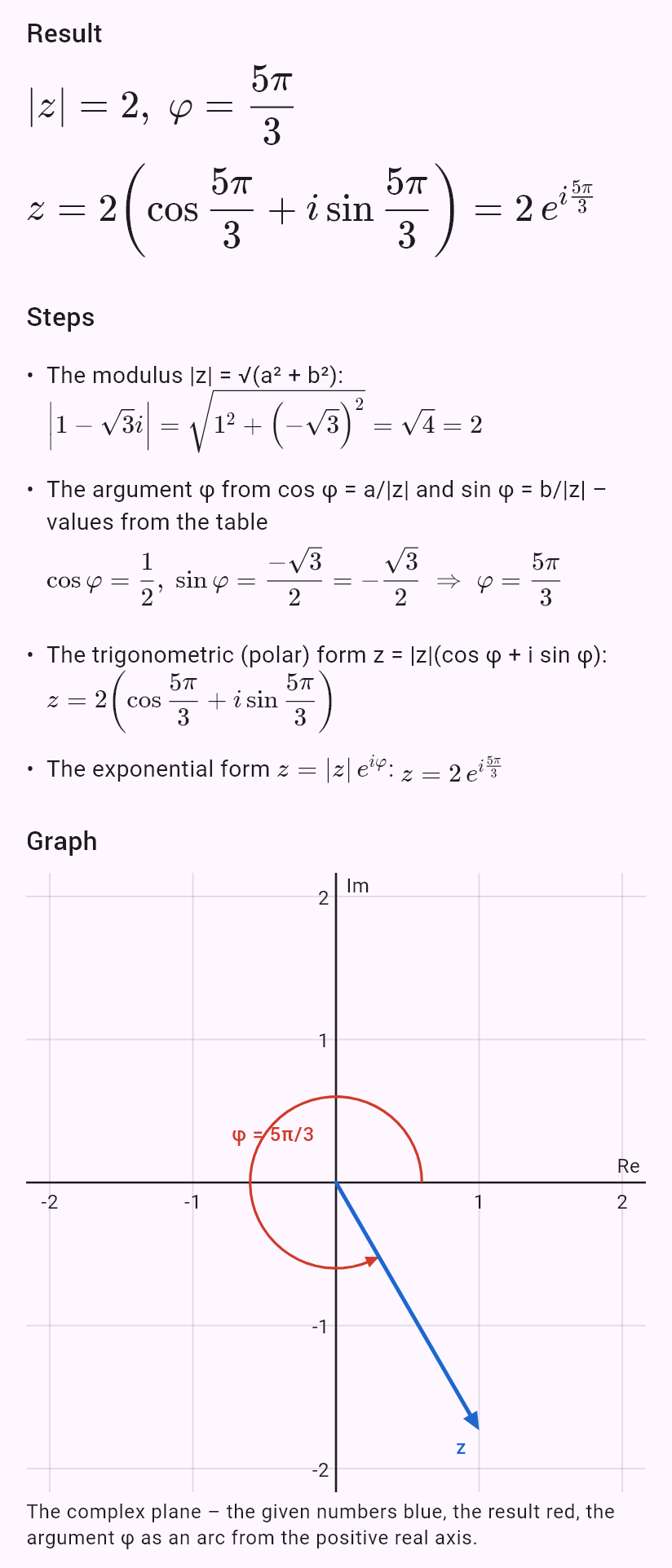
-3 + 4i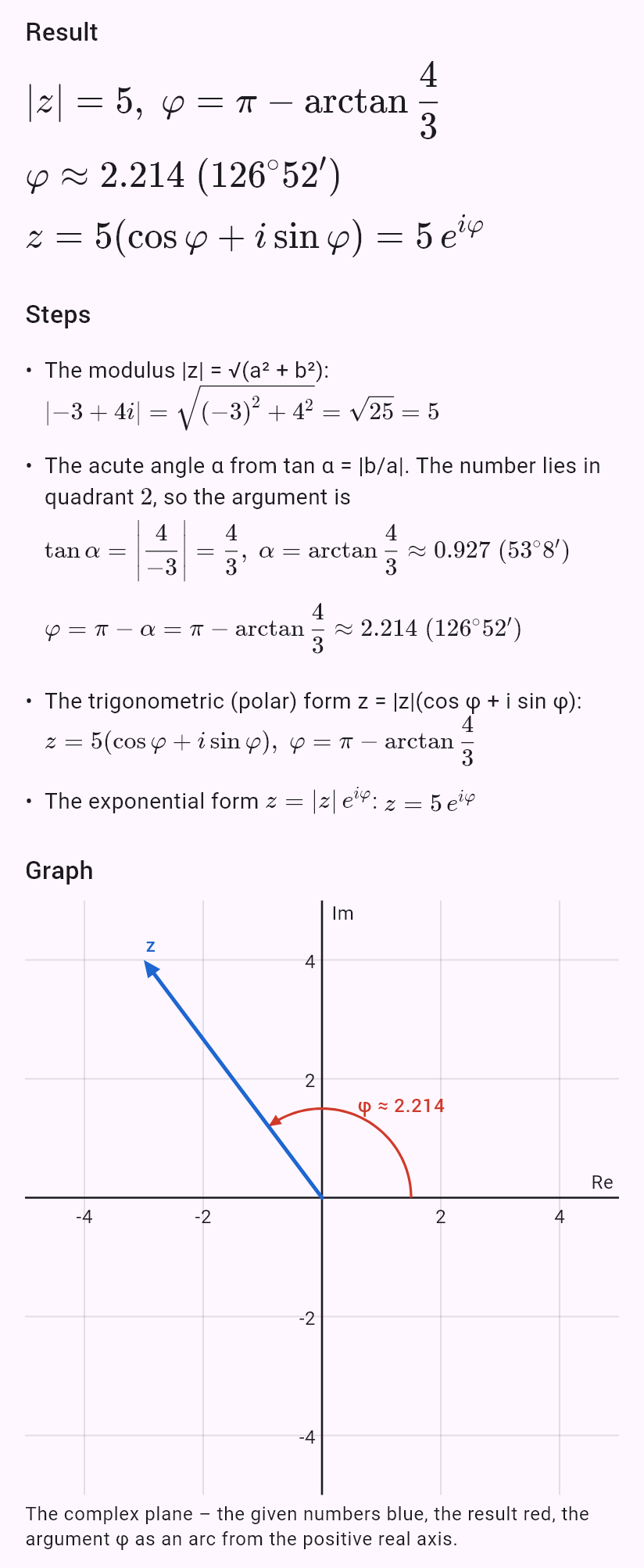
2(cos(pi/3) + i sin(pi/3))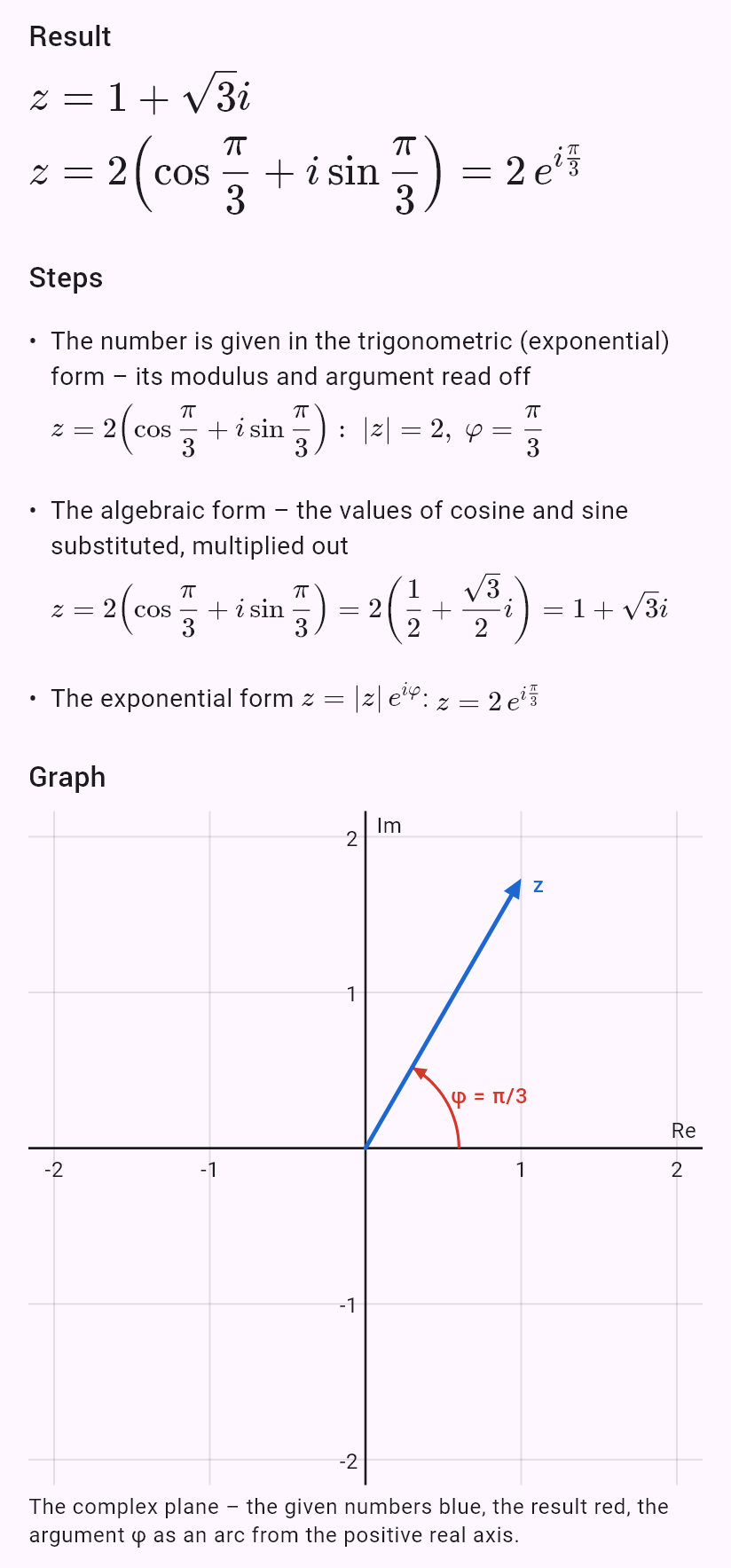
(1 + i)^10 De Moivre’s theorem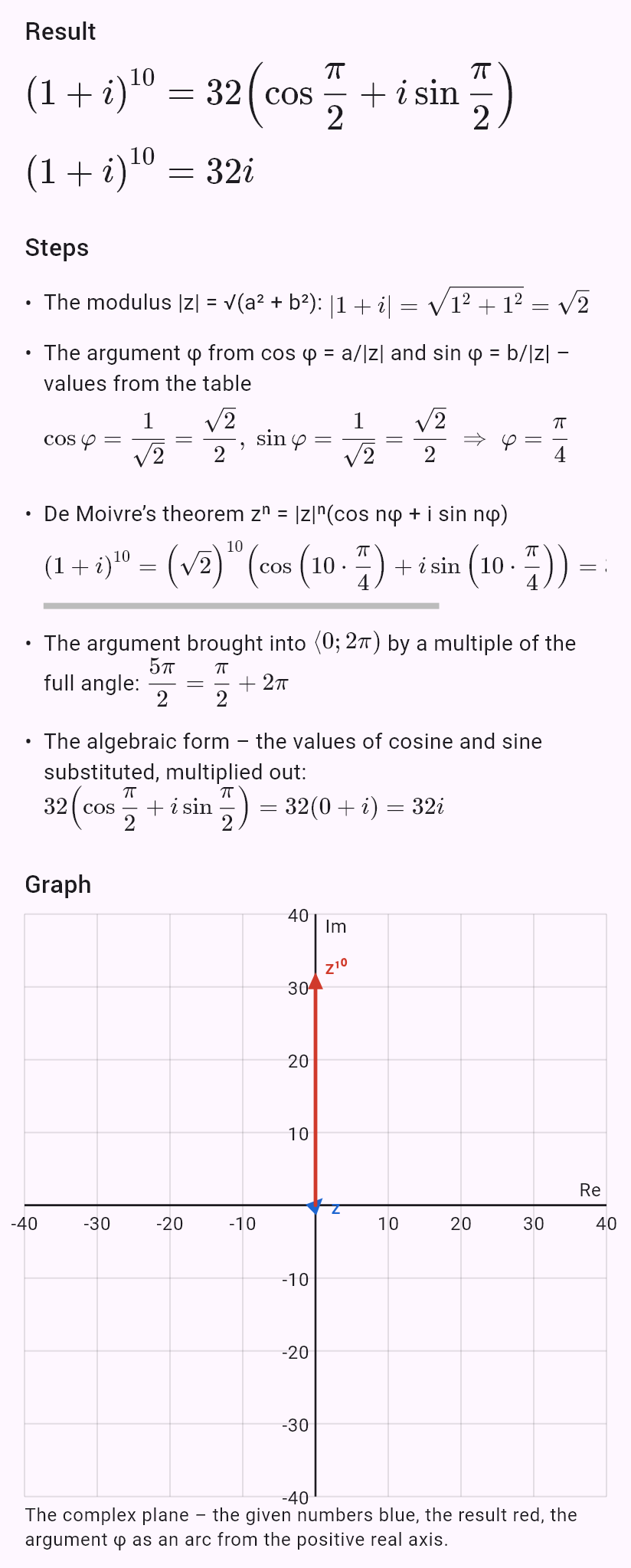
z_1 = 1 + i
z_2 = 2 - 2i
z_1/z_2
Trigonometric form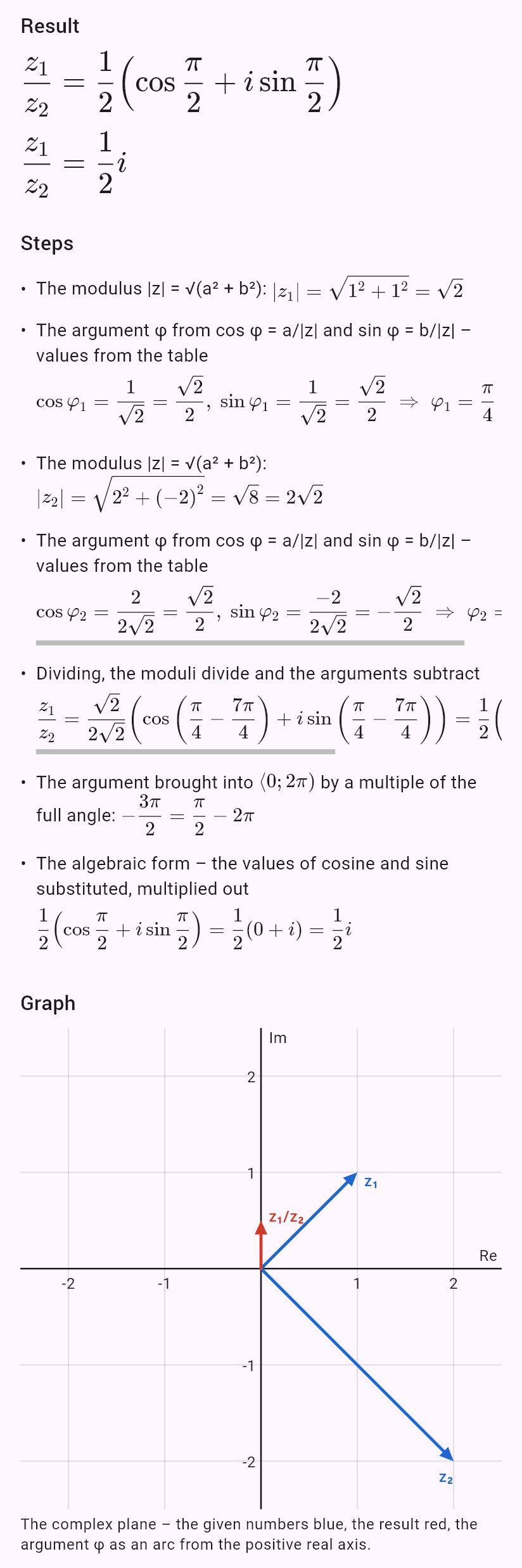
z^3 = 8i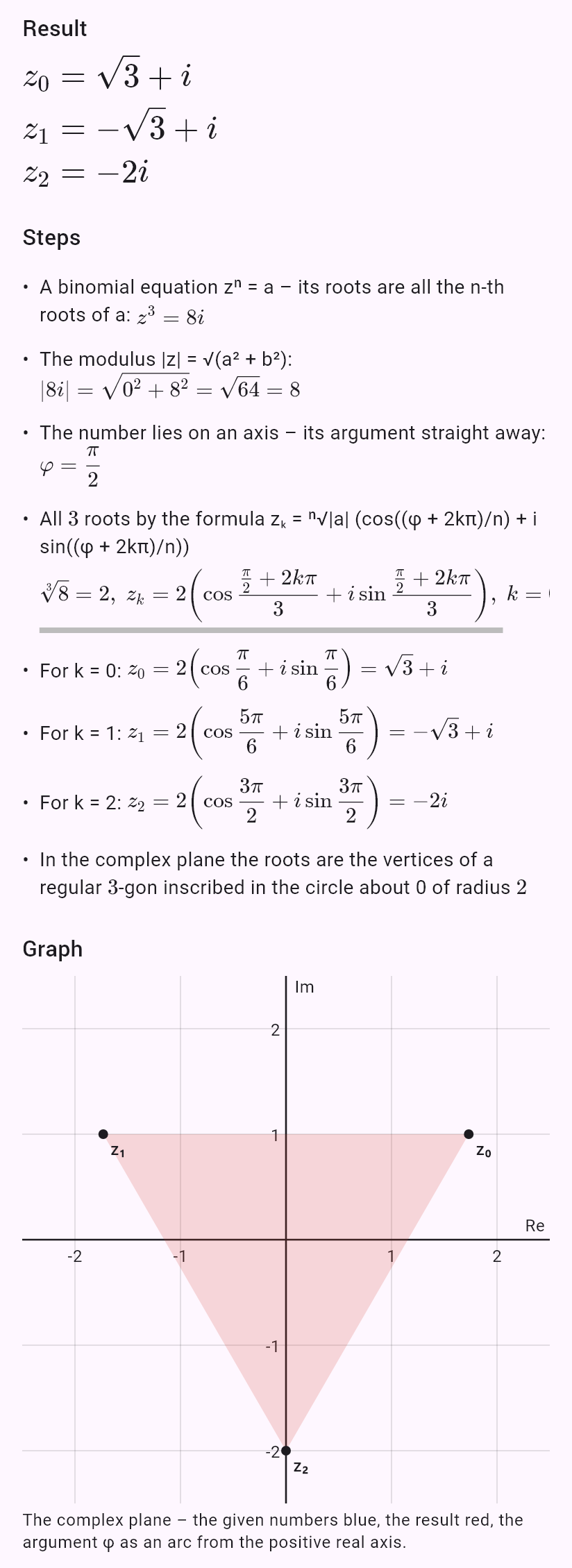
z + 2conj(z) = 3 - i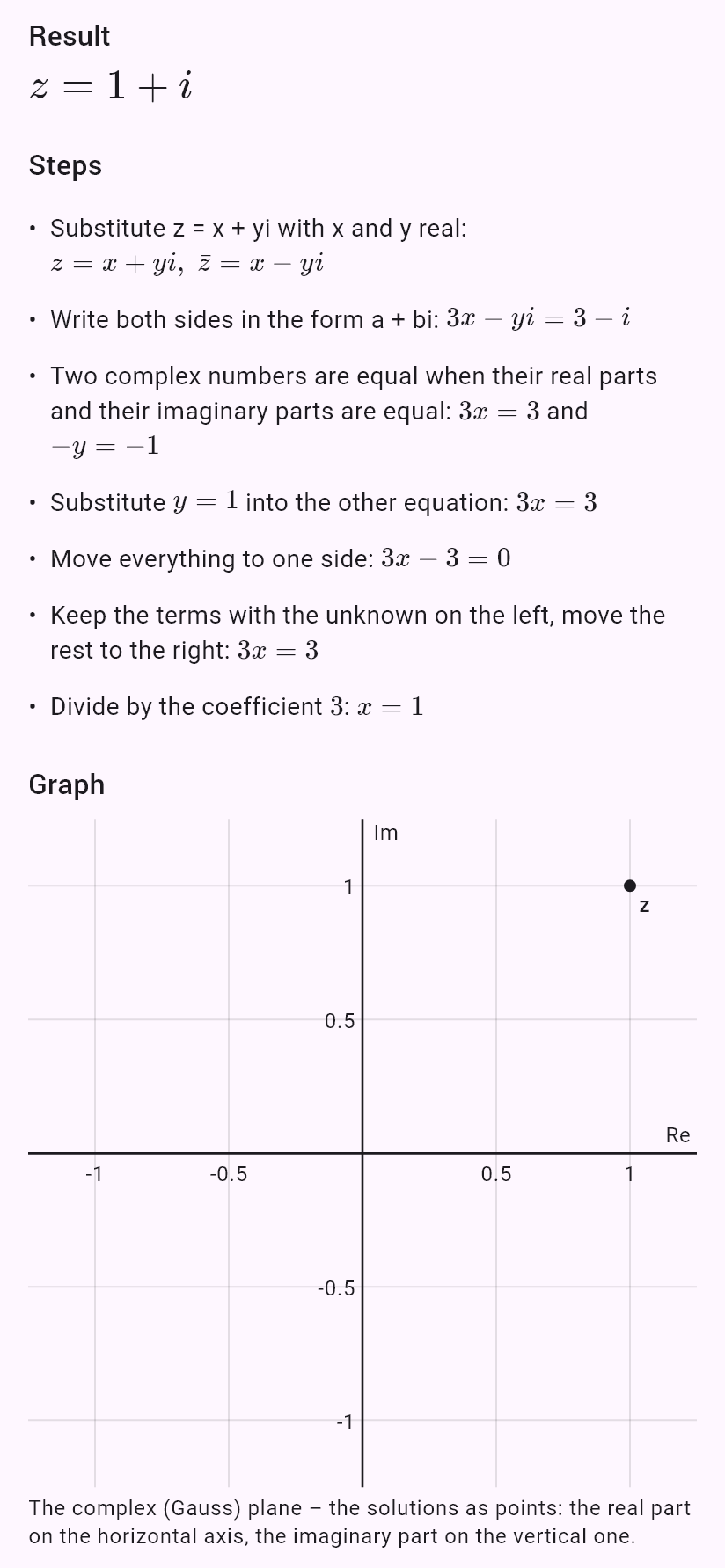
z^2 = conj(z)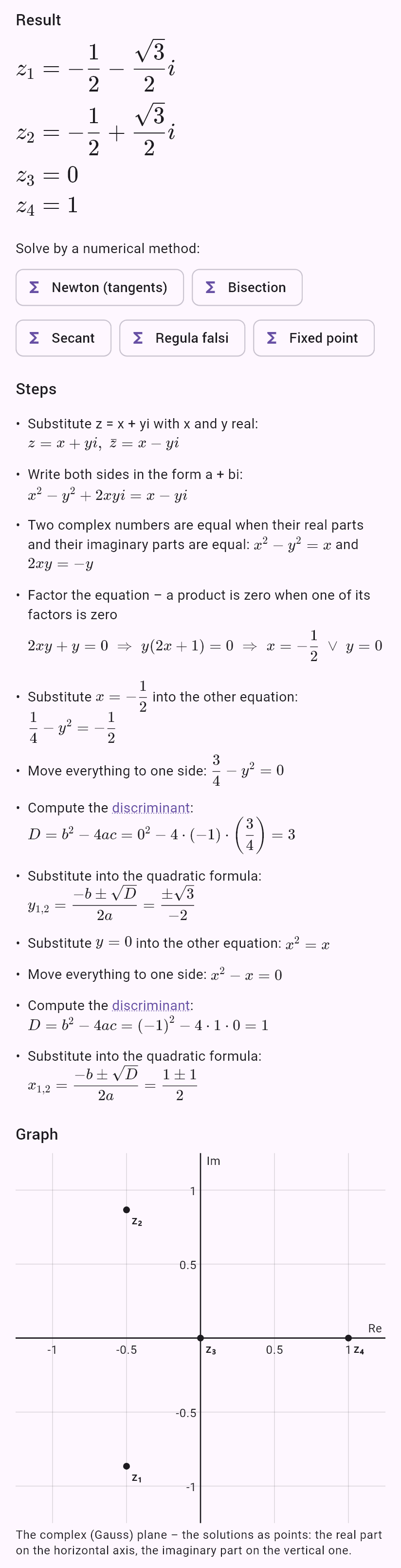
|z| <= 2
Re(z) > 0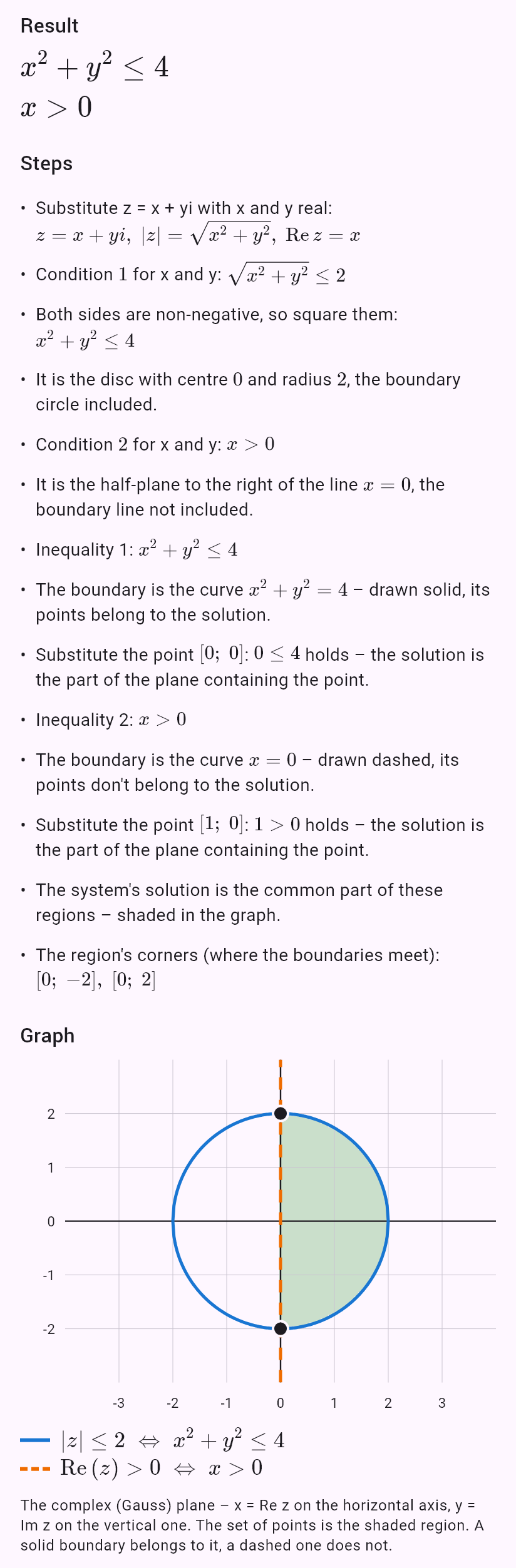
|z - i| = |z + 1|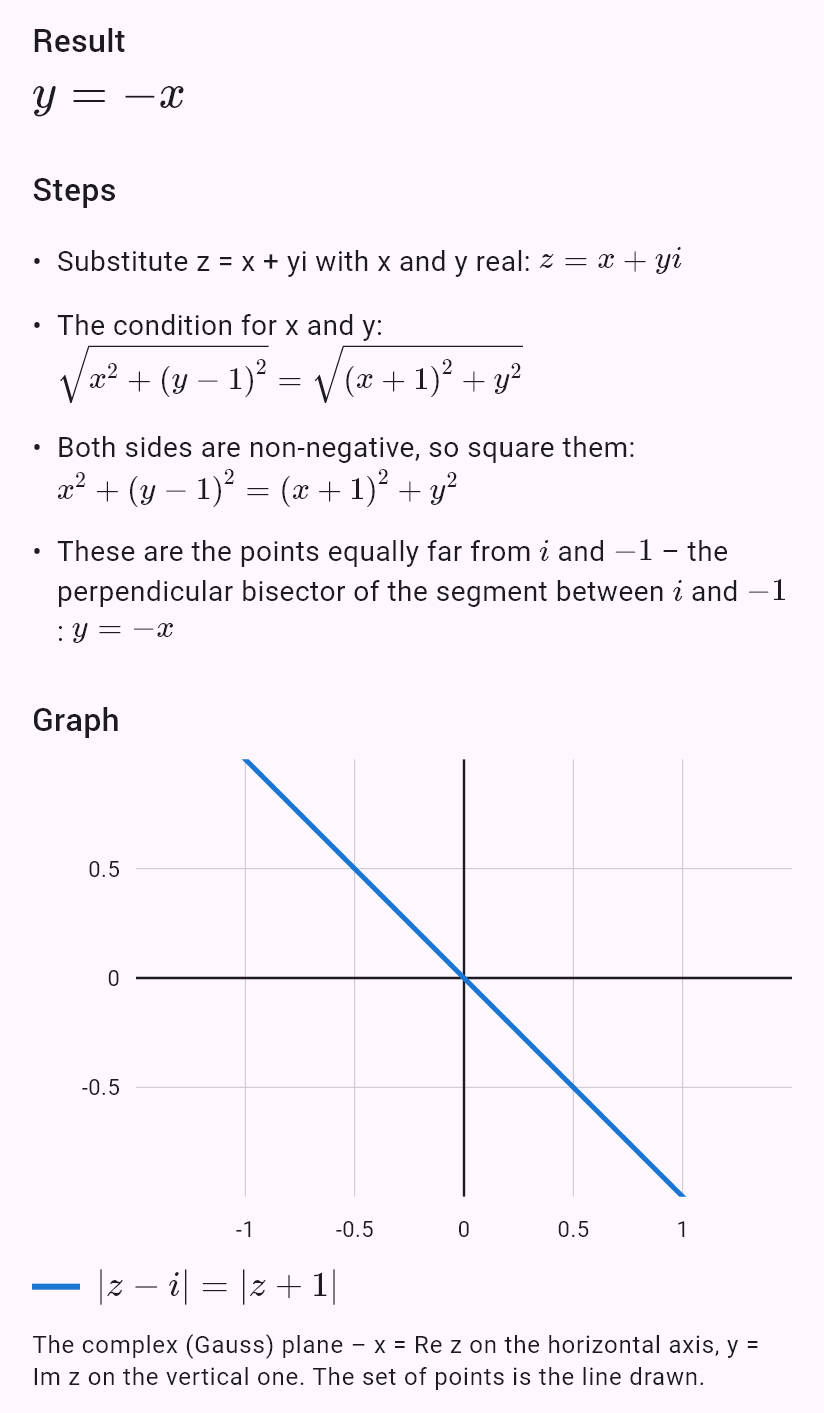
Known limitations
- Roots whose argument is not a table value are given in the trigonometric form and approximately in the algebraic one.
- A set of points is described when it is a circle (disc), a line (half-plane) or a perpendicular bisector; other conics (Im z² = 2) are only drawn and a sum of moduli (|z − 1| + |z + 1| = 4, an ellipse) is not supported yet.
- A system in x and y that cannot be solved by expressing one unknown is solved without steps.