I. Equations, inequalities and expressions
18. Logic and sets
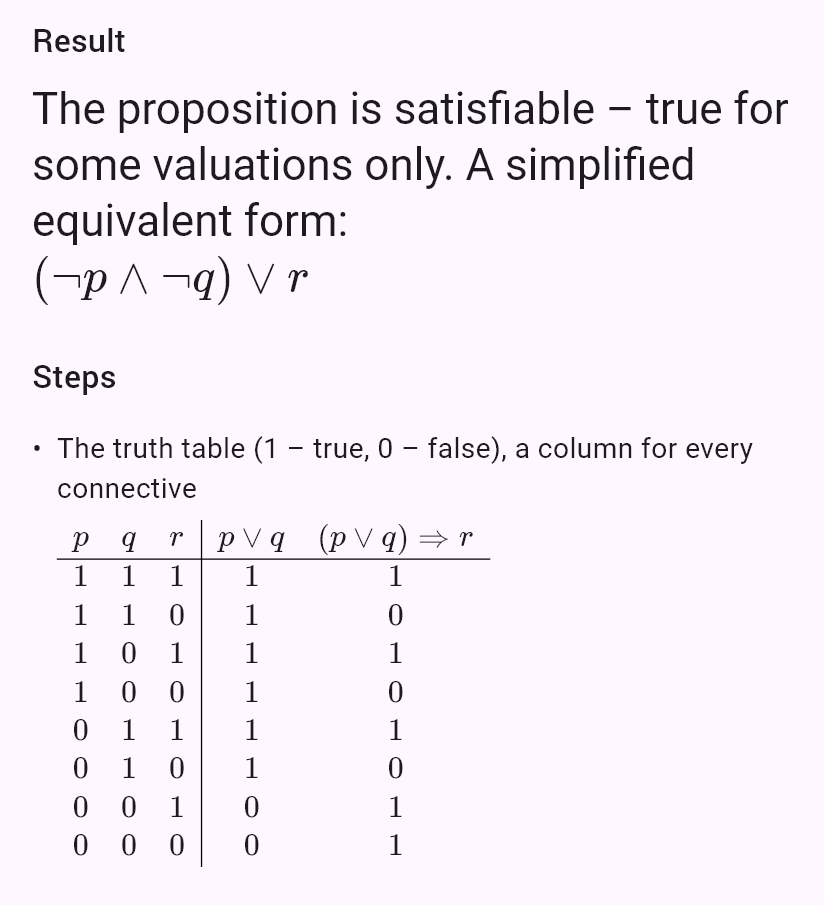
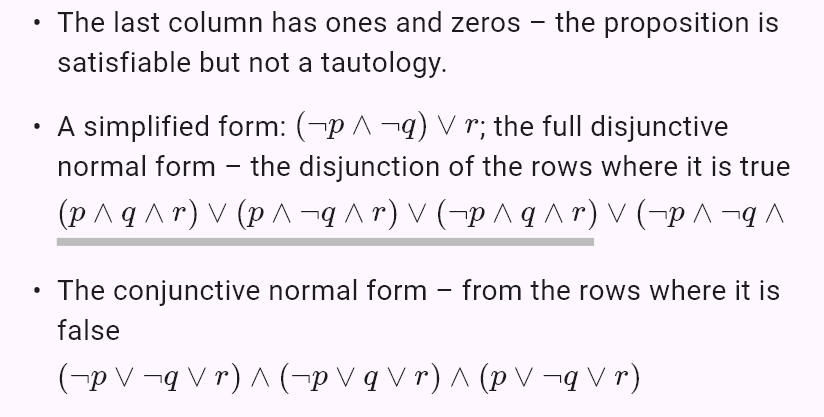
A proposition with the connectives ¬, ∧, ∨, ⇒, ⇔ is evaluated by a truth table – a column for every connective, ones for true – and the app says whether it is a tautology, a contradiction or merely satisfiable; for a satisfiable one it adds the disjunctive and conjunctive normal forms and a simplified form.
With the "Negation" chip the app negates the proposition step by step by De Morgan's laws and the negations of an implication and an equivalence. A proposition with quantifiers (∀x ∈ ℝ: x² ≥ 0) is negated directly – the universal quantifier becomes existential, an inequality the opposite one. For an implication it also offers the contrapositive and the converse.
Sets given by their elements ({1, 2, 3}) or as intervals ((1; 5), ⟨3; 7)) and their union, intersection, difference, complement in the universe U and symmetric difference are computed operation by operation. Listed sets get a Venn diagram with the elements in its regions, intervals the result on the number line.
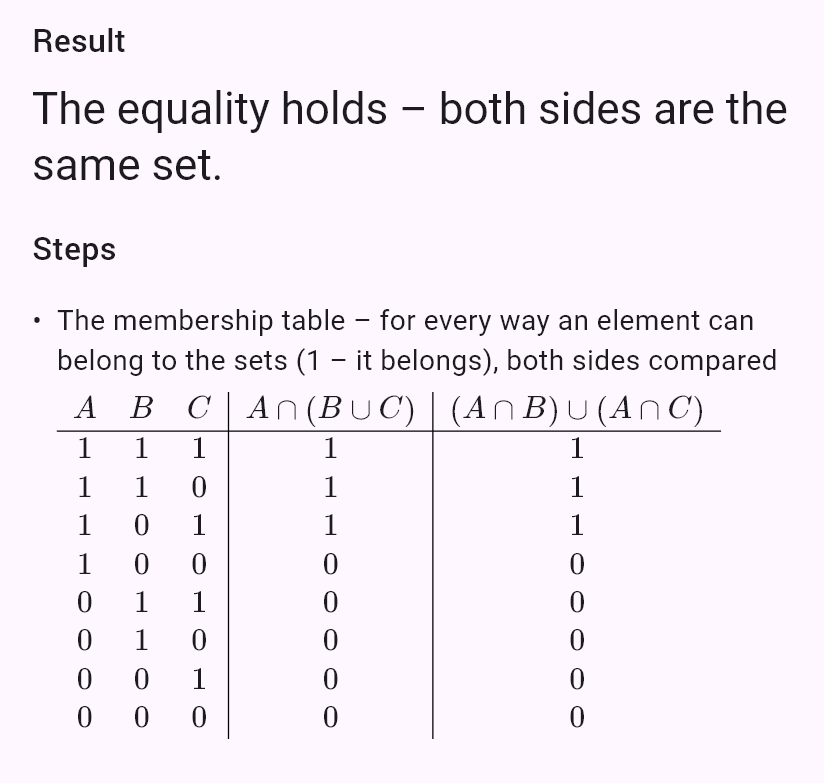
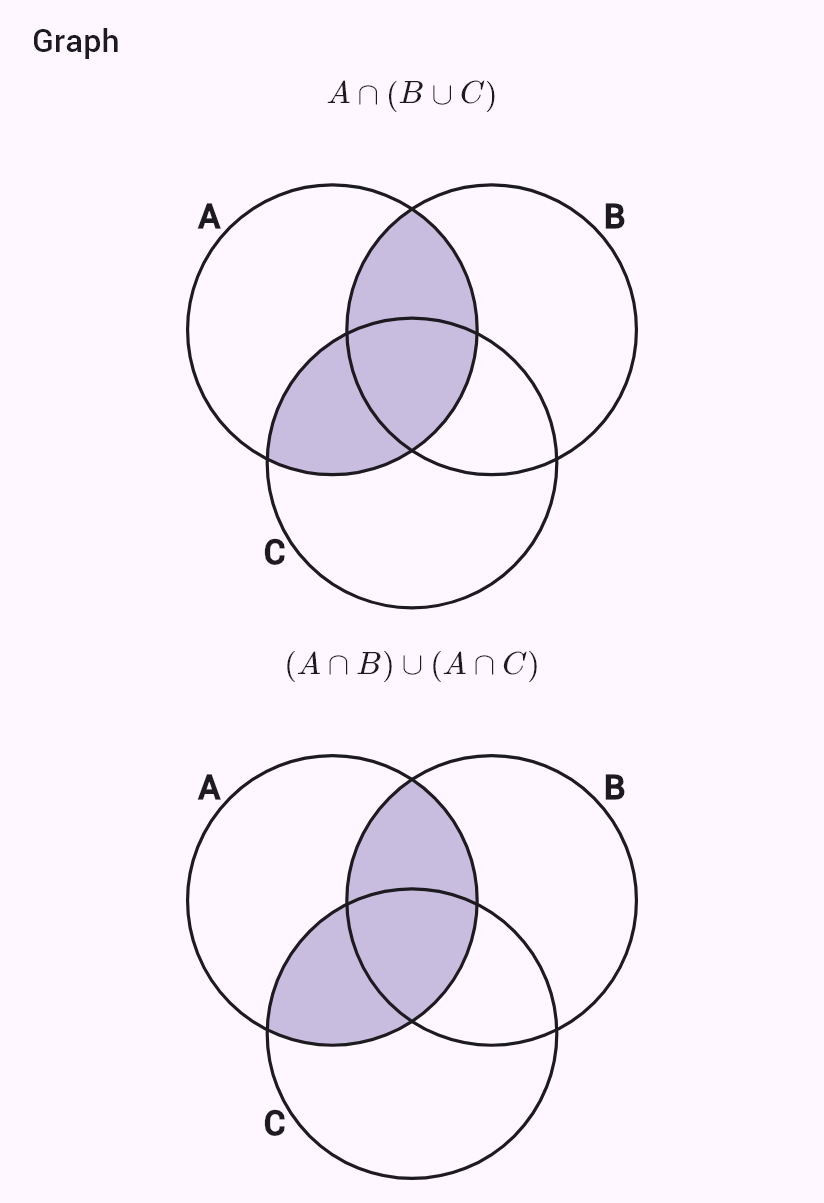
Without elements (A ∩ (B ∪ C) = (A ∩ B) ∪ (A ∩ C)) the app checks an equality of set expressions by a membership table and Venn diagrams of both sides; an expression alone, (A ∖ B) ∪ (B ∖ C), is shaded in a Venn diagram. It also decides whether 3 ∈ A or A ⊆ B holds.
How to enter it
¬p, p ∧ q, p ∨ q, p ⇒ q, p ⇔ q | The connectives from the app's keyboard (the ∧∪ tab) or from a photo (\neg, \wedge, \vee, \Rightarrow, \Leftrightarrow). |
p => q, p <=> q | An implication and an equivalence as arrows from an ordinary keyboard. &, | and ! are not read as connectives – they are the absolute value and the factorial. |
∀x ∈ ℝ: x^2 ≥ 0, ∃x > 0: x^2 < x | Quantifiers with a domain (∈ ℝ) or a condition (> 0), the proposition after a colon. |
negace(p ∧ q), obmena(p ⇒ q), obracena(p ⇒ q) | The task as a word – the negation, the contrapositive and the converse (also negace, obmena, obracena). |
A = {1, 2, 3}, B = (1; 5), U = {1, 2, ..., 10} | A set by its elements (separated by commas, by semicolons with a decimal comma), an interval, the universe U; each definition on its own line or after a comma. |
A ∪ B, A ∩ B, A ∖ B, A', A △ B | The union, intersection, difference (also \), complement A', symmetric difference; the intersection goes before the others. |
3 ∈ A, A ⊆ B | An element of a set and a subset – true or false. |
Examples
(p ⇒ q) ⇔ (¬q ⇒ ¬p)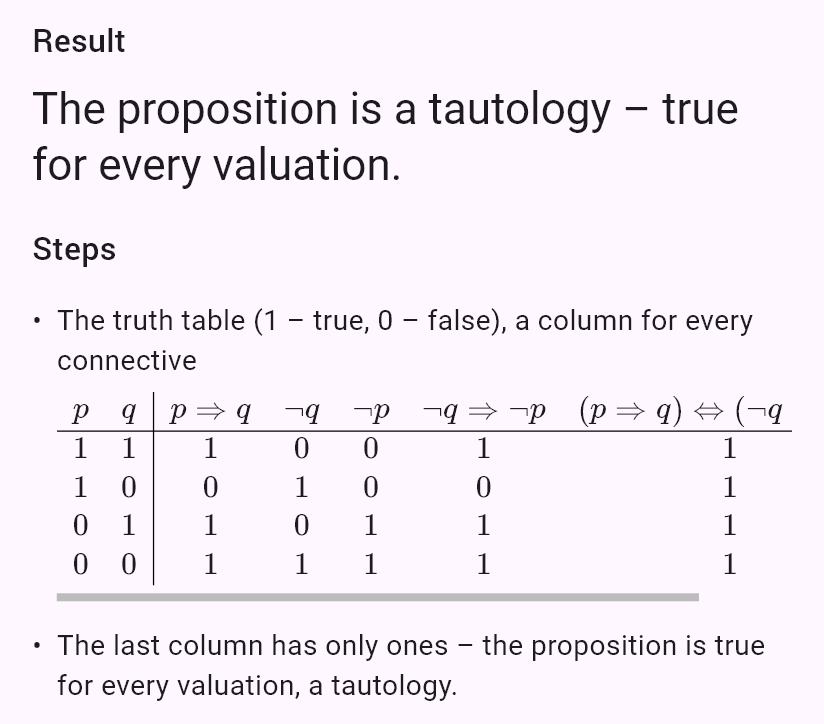
(p ∨ q) ⇒ r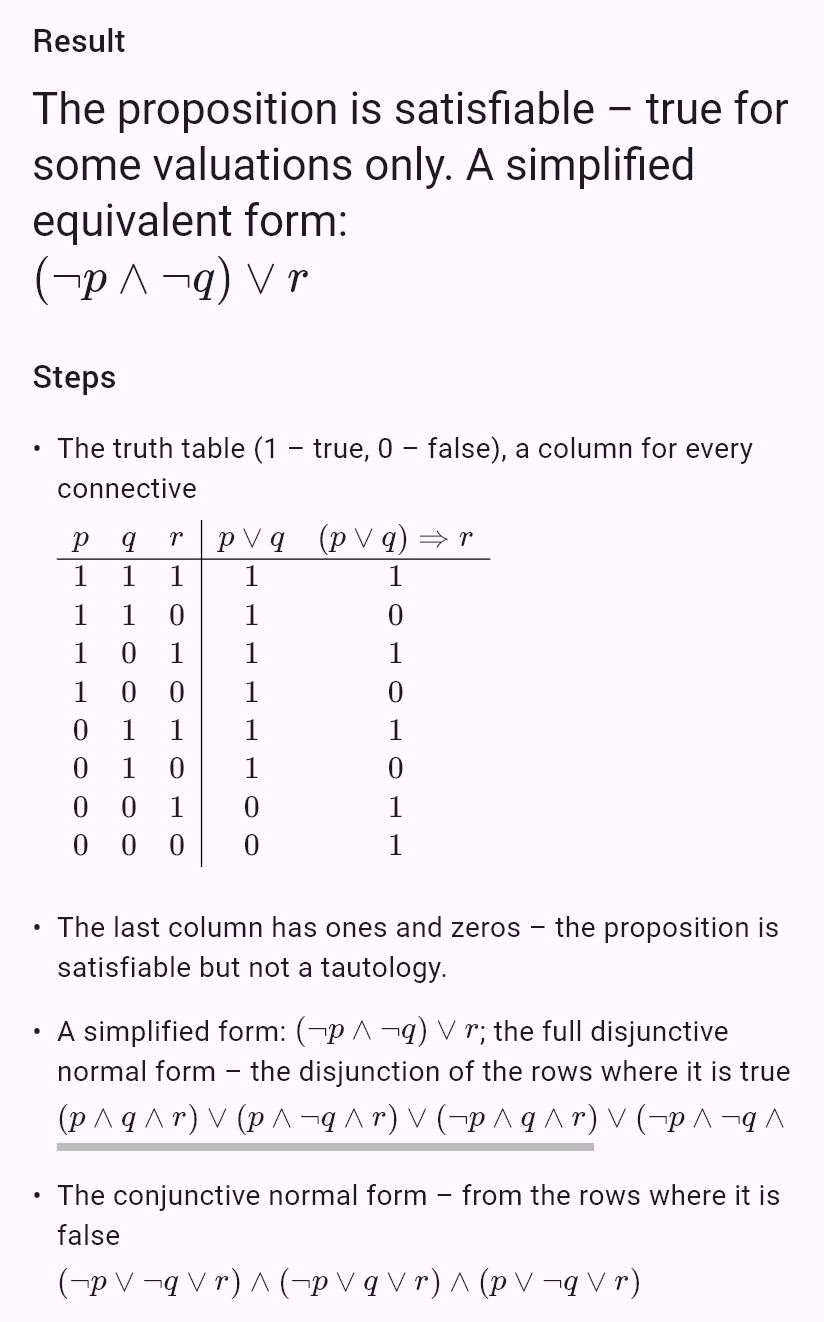
p ∧ (q ⇒ r) Negation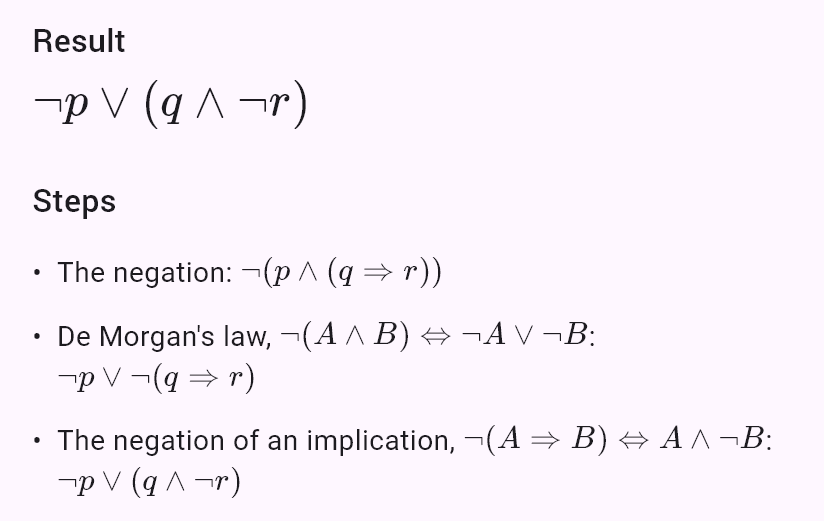
∀x ∈ ℝ: x^2 + 1 > 0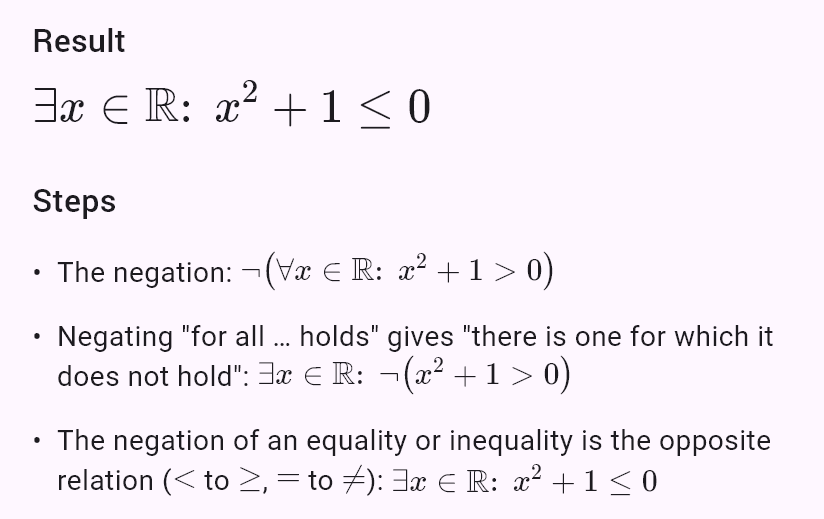
p ⇒ ¬q Contrapositive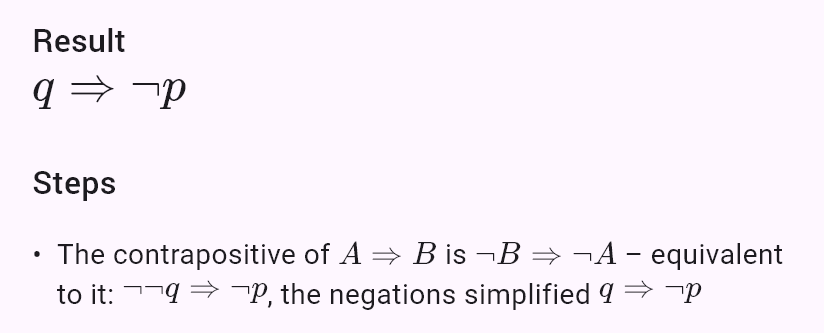
A = {1, 2, 3, 4}, B = {3, 4, 5}, U = {1, 2, ..., 6}, (A ∪ B)'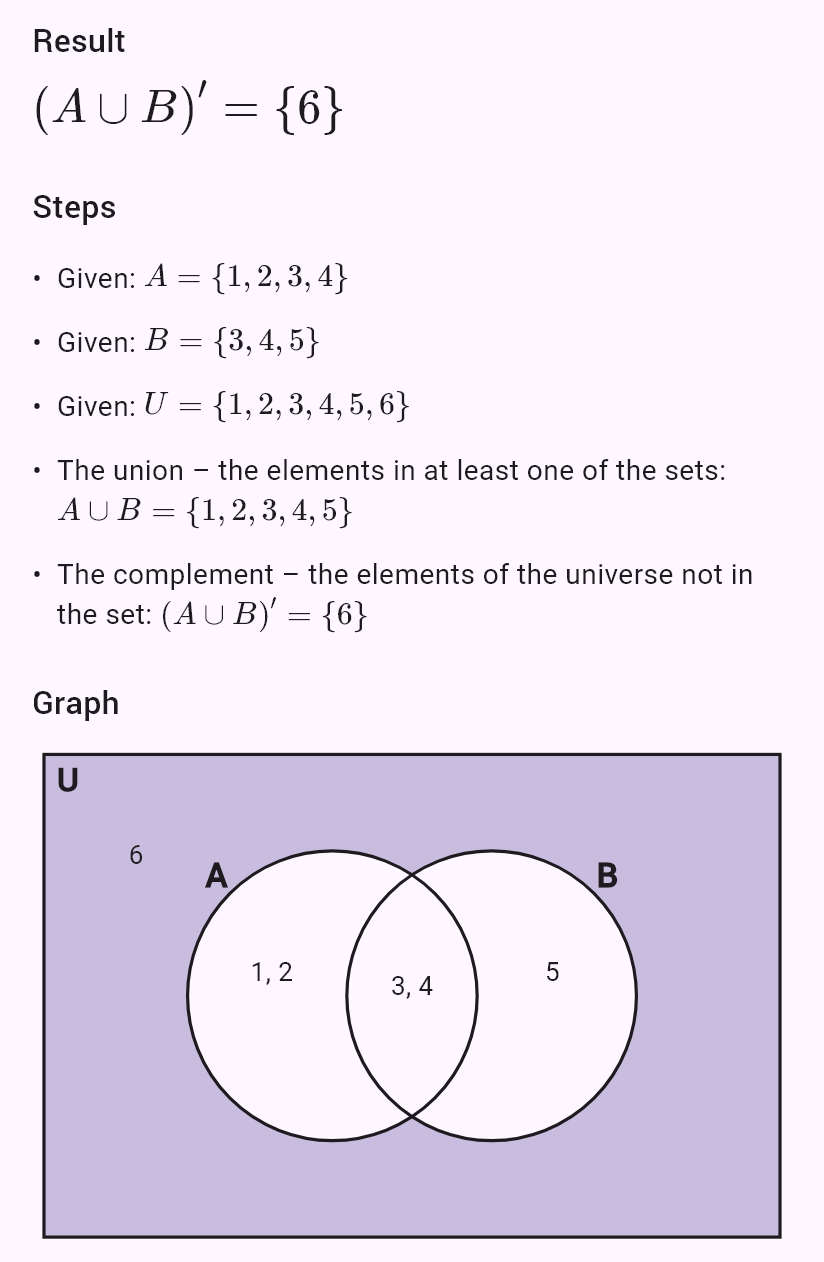
A = (1; 5), B = ⟨3; 7), A ∩ B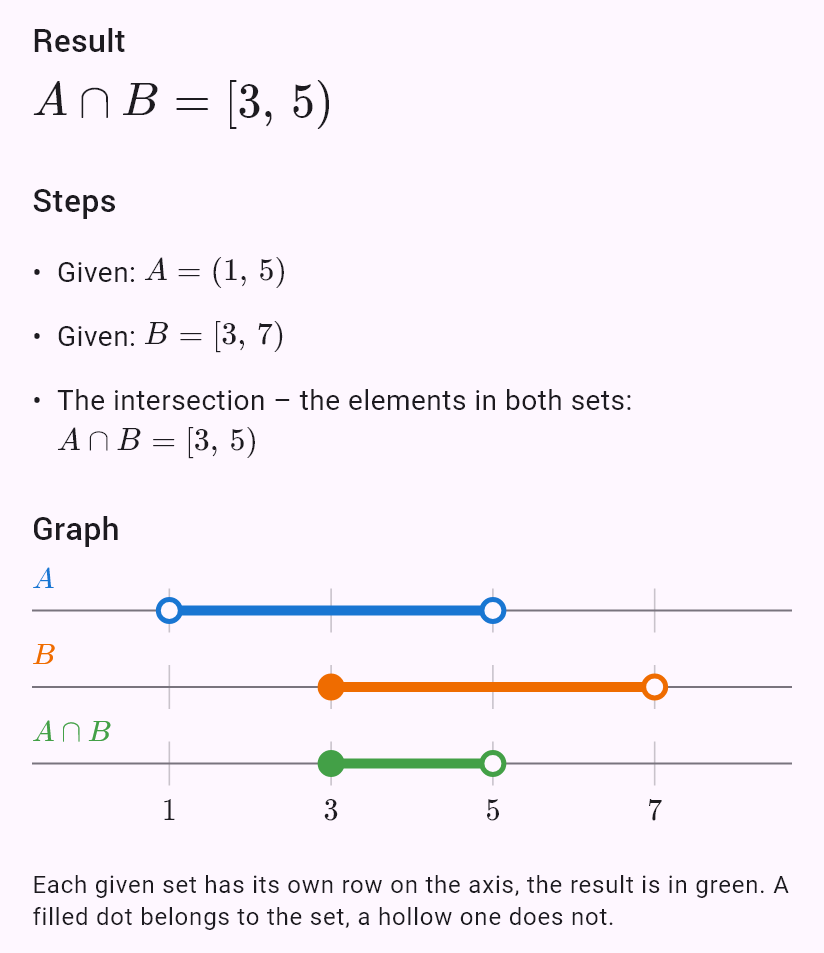
A ∩ (B ∪ C) = (A ∩ B) ∪ (A ∩ C)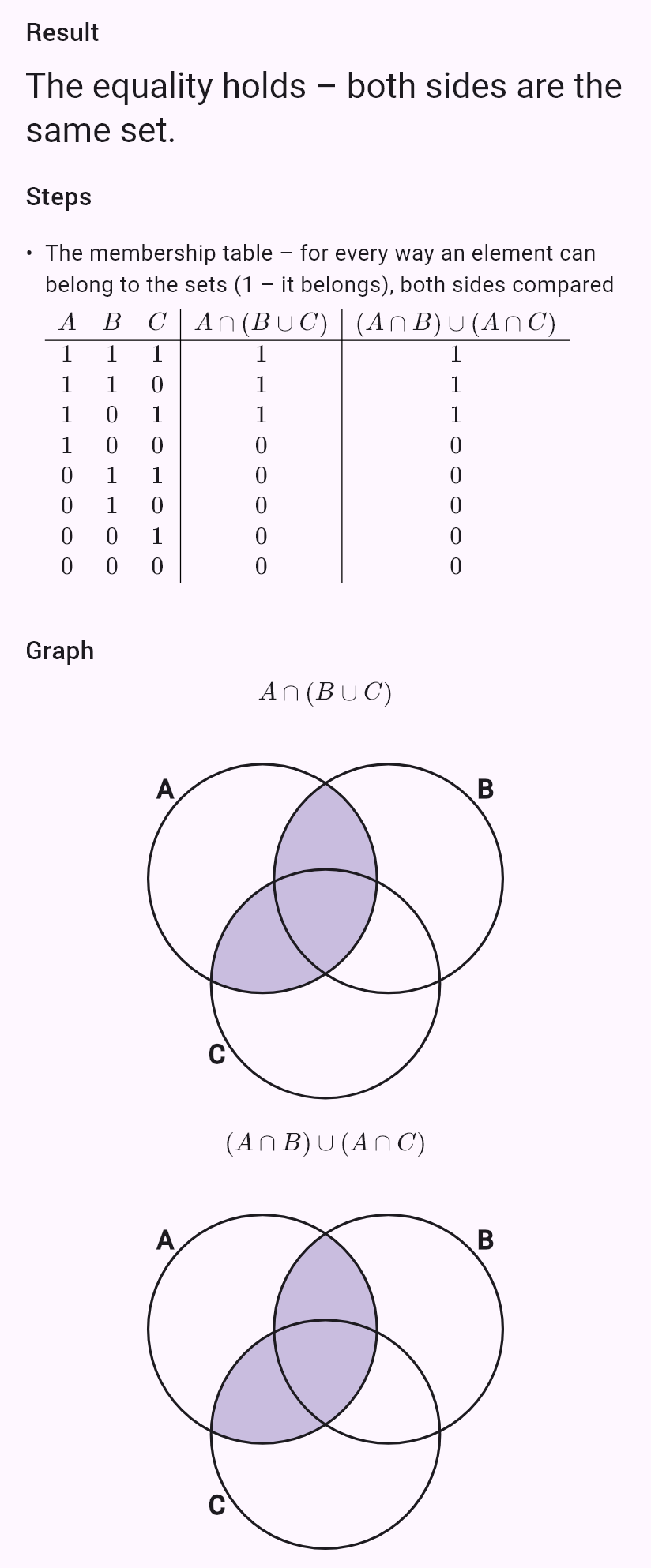
(A ∖ B) ∪ (B ∖ C)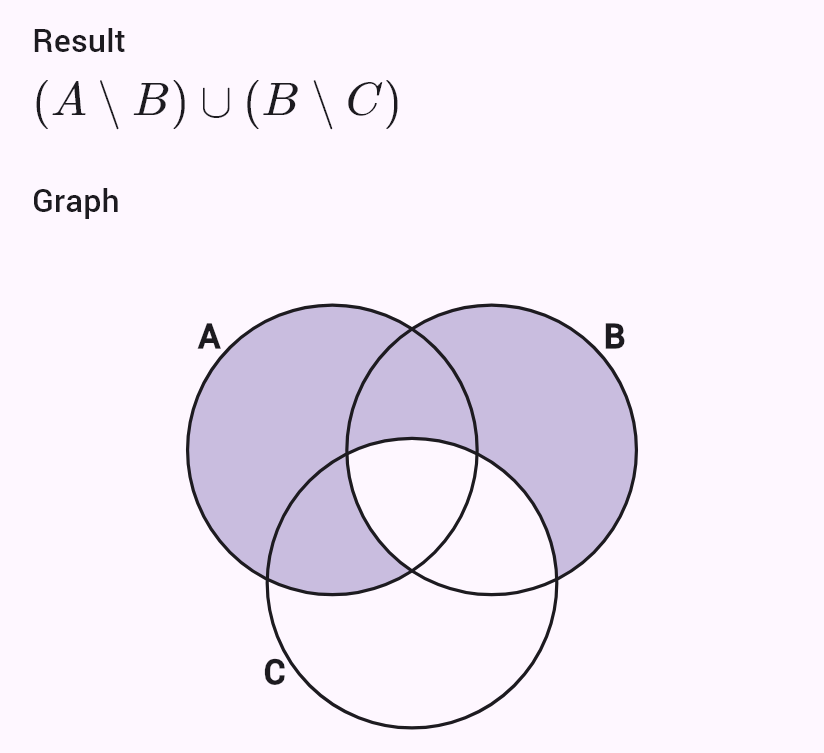
Known limitations
- A truth table for 5 variables at most (32 rows), a Venn diagram for 4 sets at most.
- Sets given by a property ({x ∈ ℝ: x² < 4}) are not read yet – write them as intervals.