II. Linear algebra and geometry
20. Geometry calculations
Perimeters and areas of figures, volumes and surfaces of solids are computed by a form like the other applications (Applications → Geometry): pick the figure and what you are looking for, and enter the dimensions with their units. Figures: square, rectangle, triangle (a side and its height, or three sides – Heron's formula), parallelogram, rhombus, trapezoid, regular polygon, circle, annulus, arc and sector, the Pythagorean theorem and similar triangles; solids: cube, cuboid, prism, cylinder, square pyramid, cone and sphere.
The working writes the formula, substitutes and computes; when an intermediate value is needed (a cone's slant height, a pyramid's slant height), it comes first. It works the other way too – the radius from the area, the edge from the volume, a leg from the hypotenuse. The result is exact with π and roots and approximate (25π cm² ≈ 78.54 cm²). Units are converted (cm to dm, dm³ to litres).
Examples
model(circle; find=S[cm2]; r=5[cm])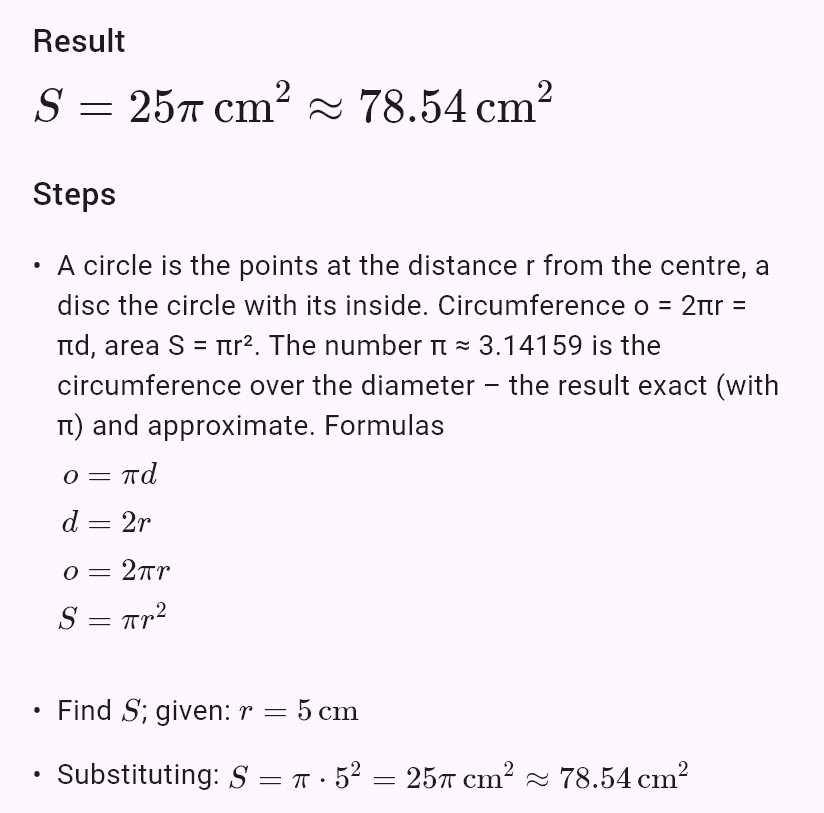
model(circle; find=r[cm]; S=50[cm2])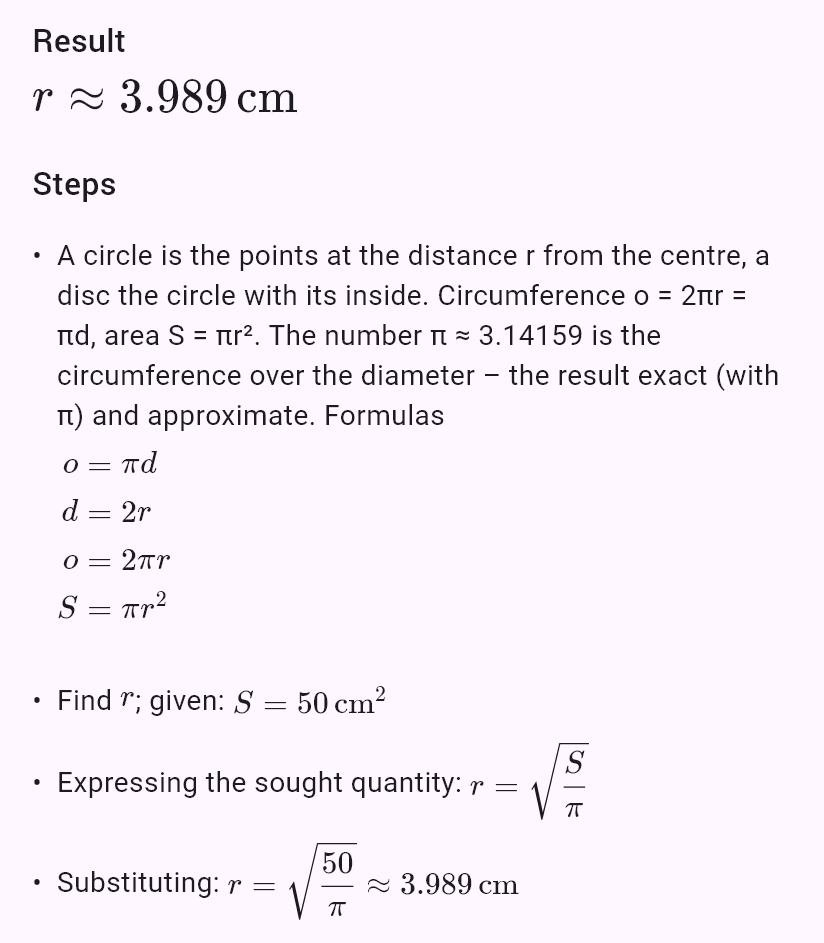
model(triangle; find=S[cm2]; a=3[cm]; b=4[cm]; c=5[cm]; input=sides)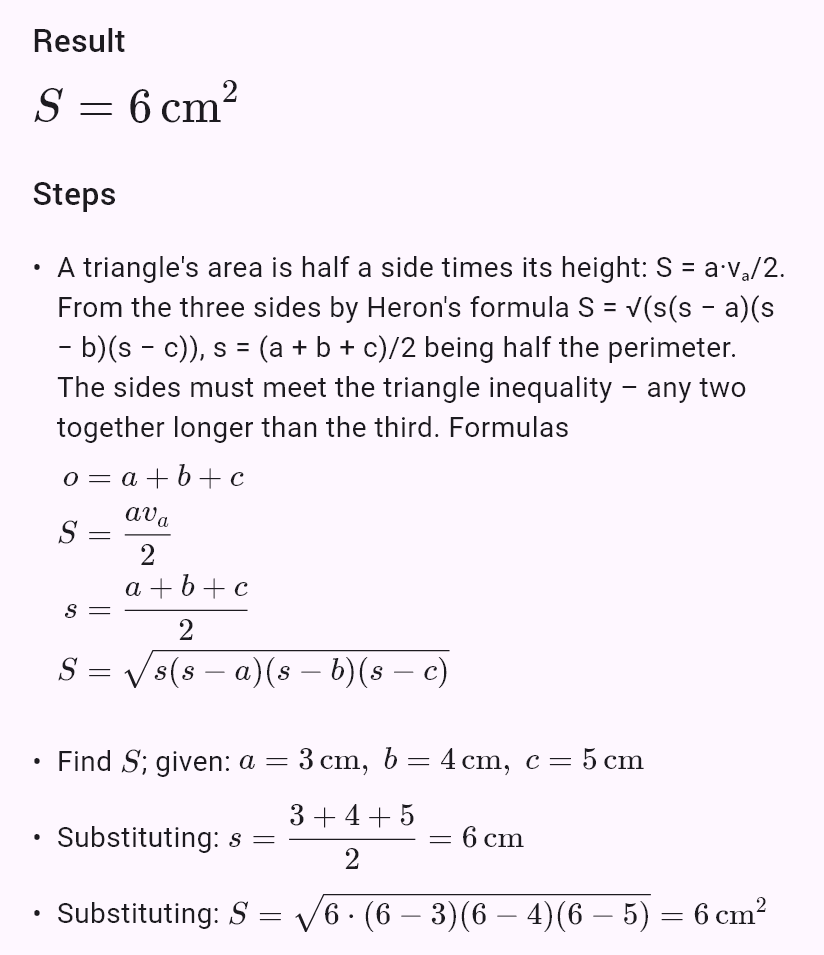
model(pythagoras; find=b[cm]; a=5[cm]; c=13[cm])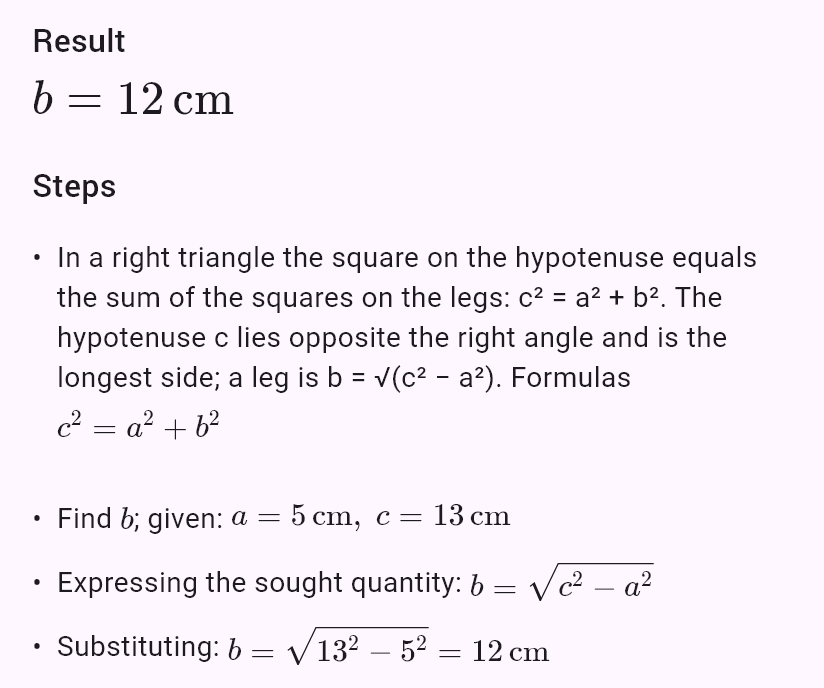
model(cone; find=S[cm2]; r=3[cm]; v=4[cm])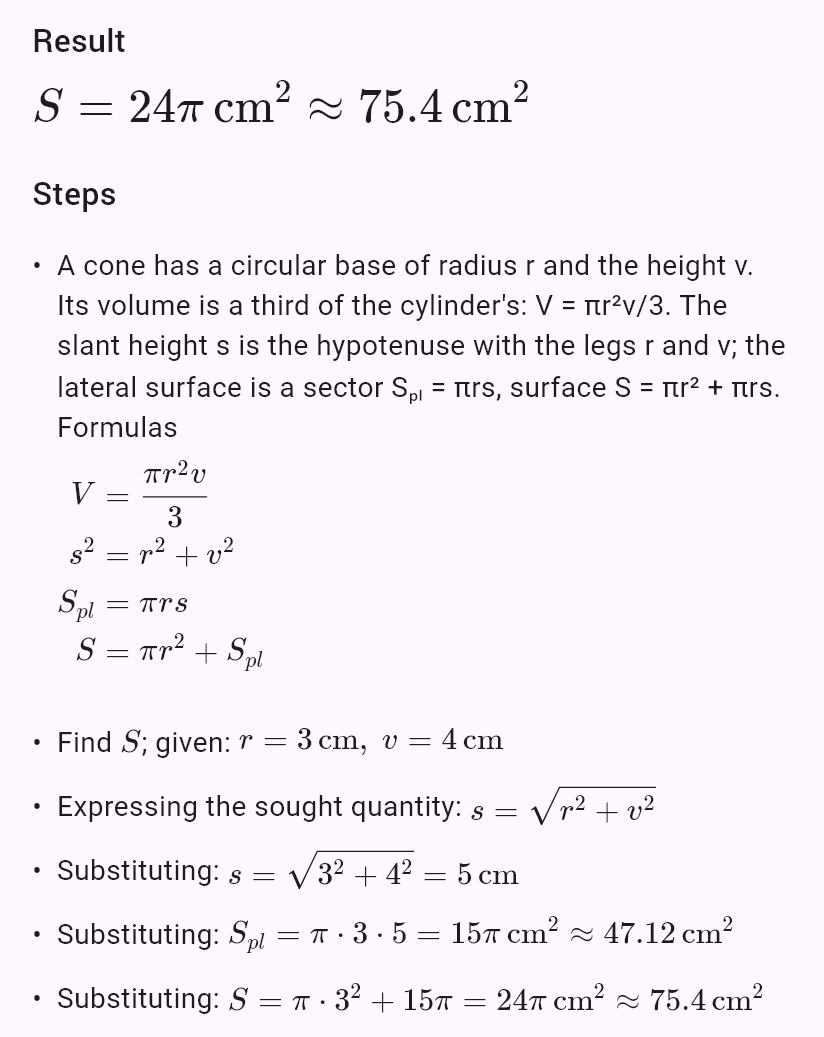
model(cube; find=V[l]; a=10[cm])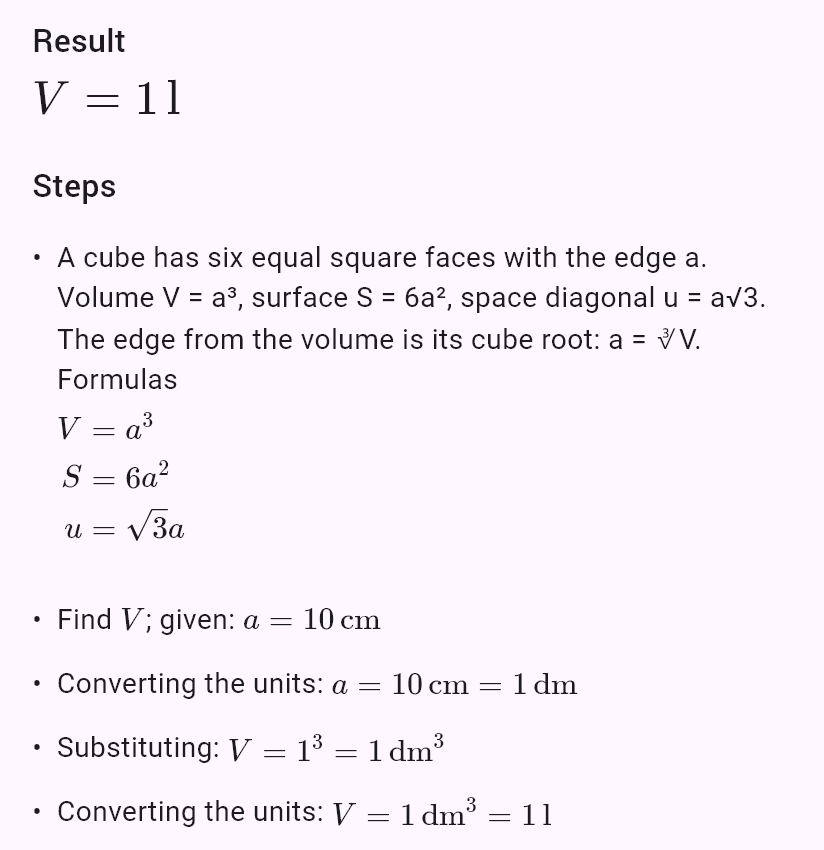
Known limitations
- A sketch of the figure with its dimensions is still missing.