VI. Applications: physics and engineering

44. Statics and strength of materials

The Statics form (Applications, field Engineering) has three modes. A beam lies on the x axis from 0 to L and is supported by a pin, a roller or a fixed support; you can load it by vertical and inclined forces, moments and a distributed load - uniform, triangular or trapezoidal. Several forces go in one field separated by spaces, their positions and angles in the same order. Inner hinges make a [[gerberBeam|Gerber beam]].

The steps start with a [[freeBody|free-body diagram]]: the reactions replace the supports and the rank of the equations of equilibrium shows the [[staticDeterminacy|static determinacy]]. When the beam is statically indeterminate or improperly supported, the app says so with the degree of indeterminacy. The equations are solved one at a time - always the one with a single unknown left (a moment about a support, for a Gerber beam the part beyond a hinge first) - and an equation not used serves as a check.

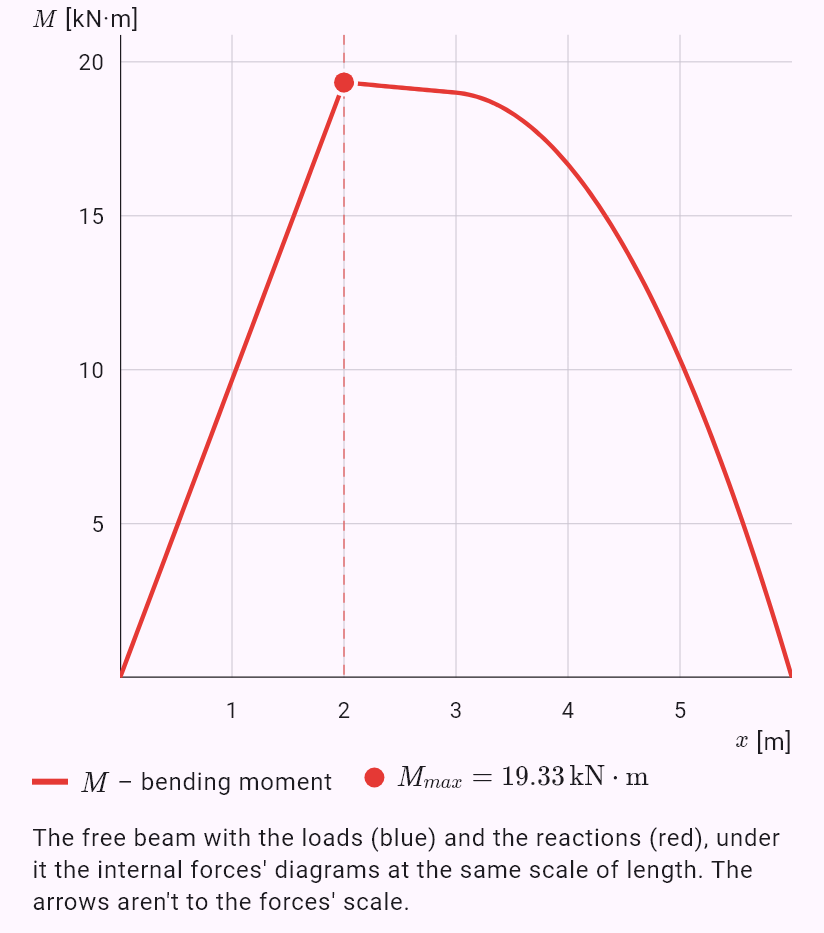
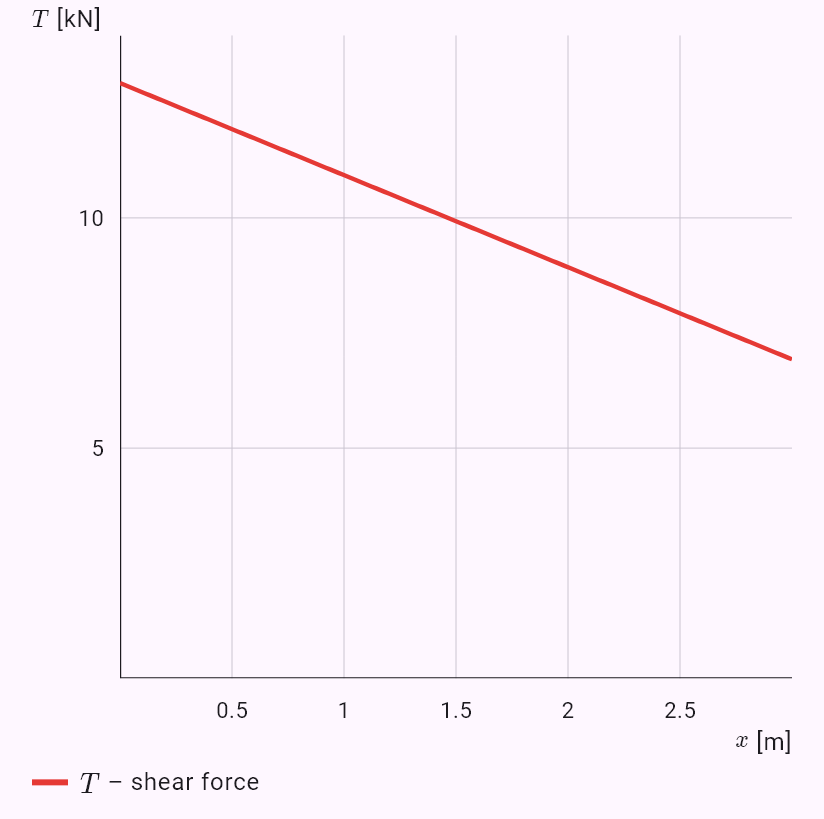
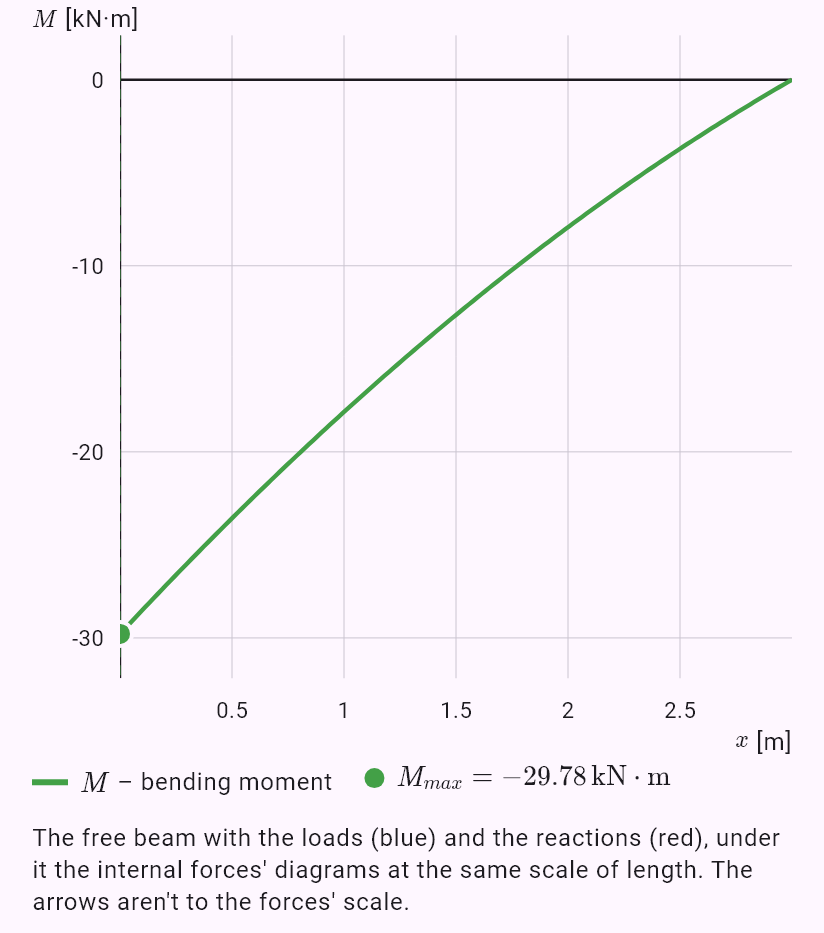
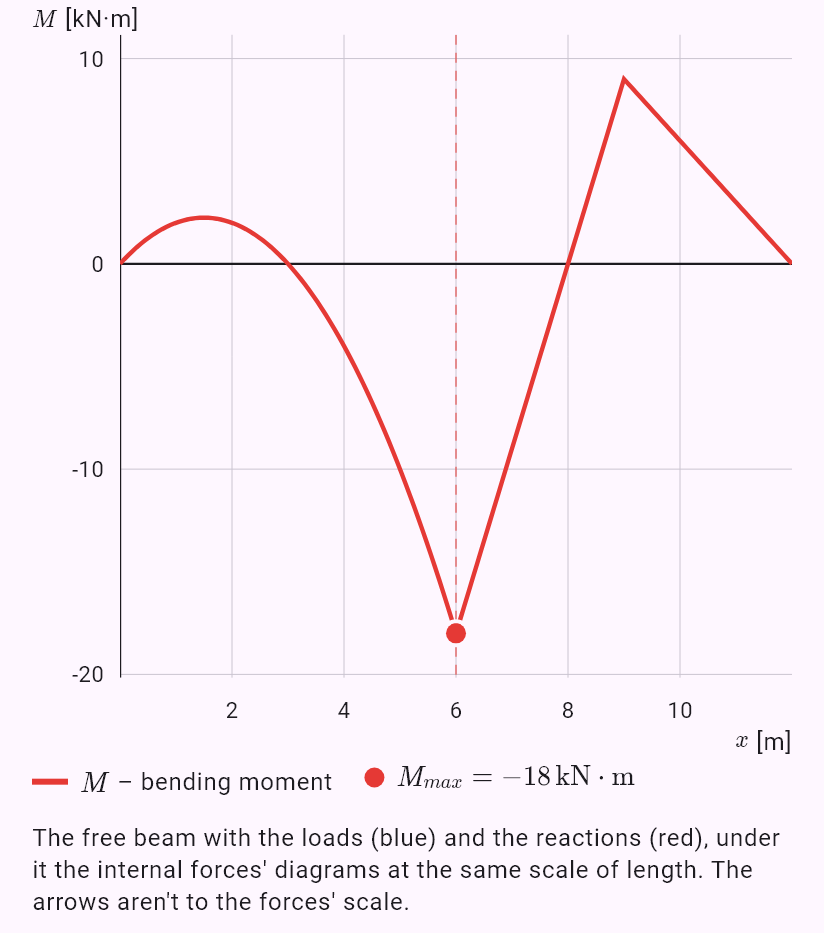
The app lists the internal forces N, T and M piece by piece between the notable points and finds the greatest bending moment by [[schwedlerTheorem|Schwedler's theorem]]: where the shear force is zero or where it jumps. Under the sketch of the beam with its loads and reactions there are the diagrams of N, T and M at the same scale of length.

The mode Body in the plane computes the reactions of a body given by its supports' points and the forces' points of application - a ladder against a wall, for example. For a roller you choose the reaction's direction by the angle β.

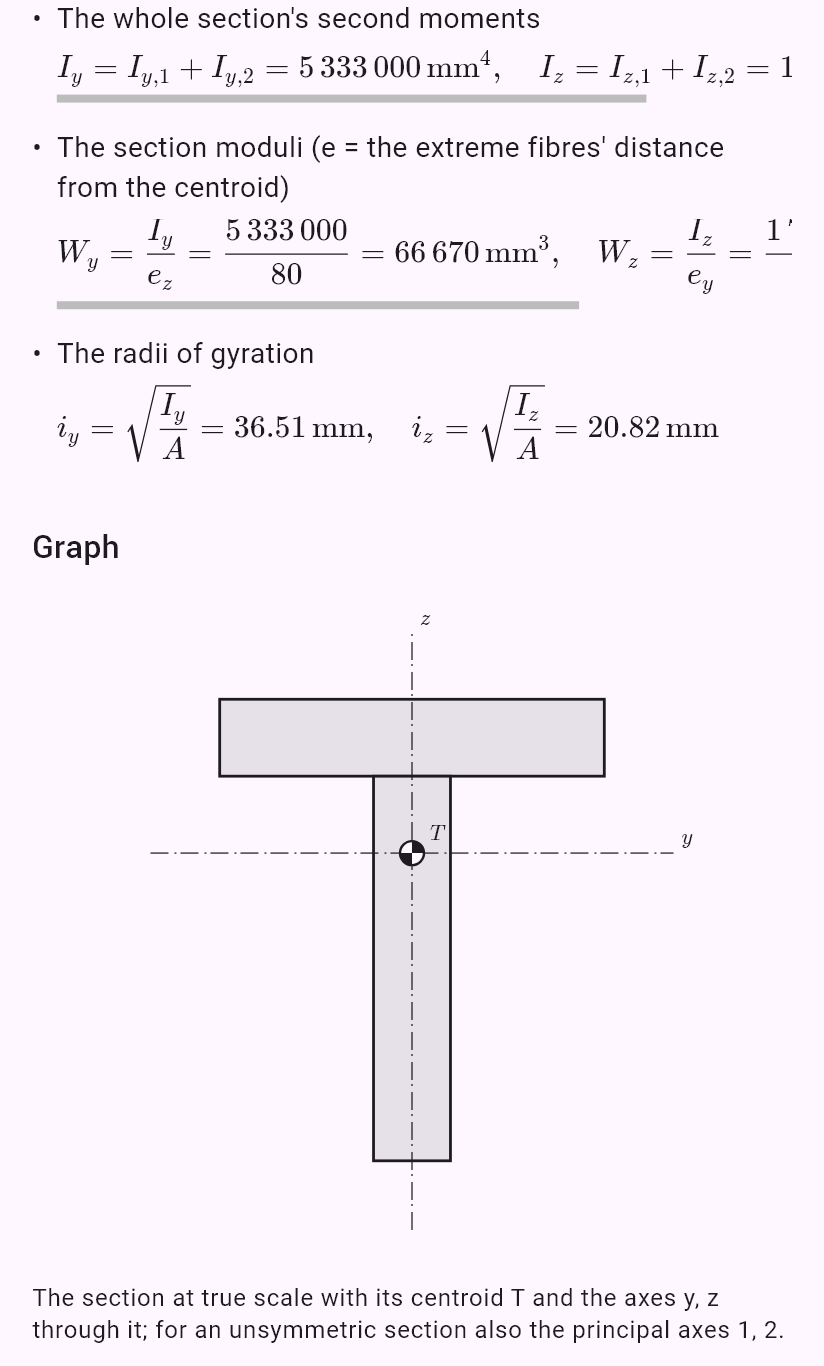
The cross-section's properties are the area, the [[centroid|centroid]], the second moments by the [[parallelAxisTheorem|parallel axis theorem]], the [[sectionModulus|section moduli]] and for an unsymmetric section also the [[principalAxes|principal axes]] - for a rectangle, a tube, T, I, U, L profiles and a section composed of rectangles and circles with holes. The picture shows the section at true scale with its centroid and axes. The rolled profiles' fillets are neglected.

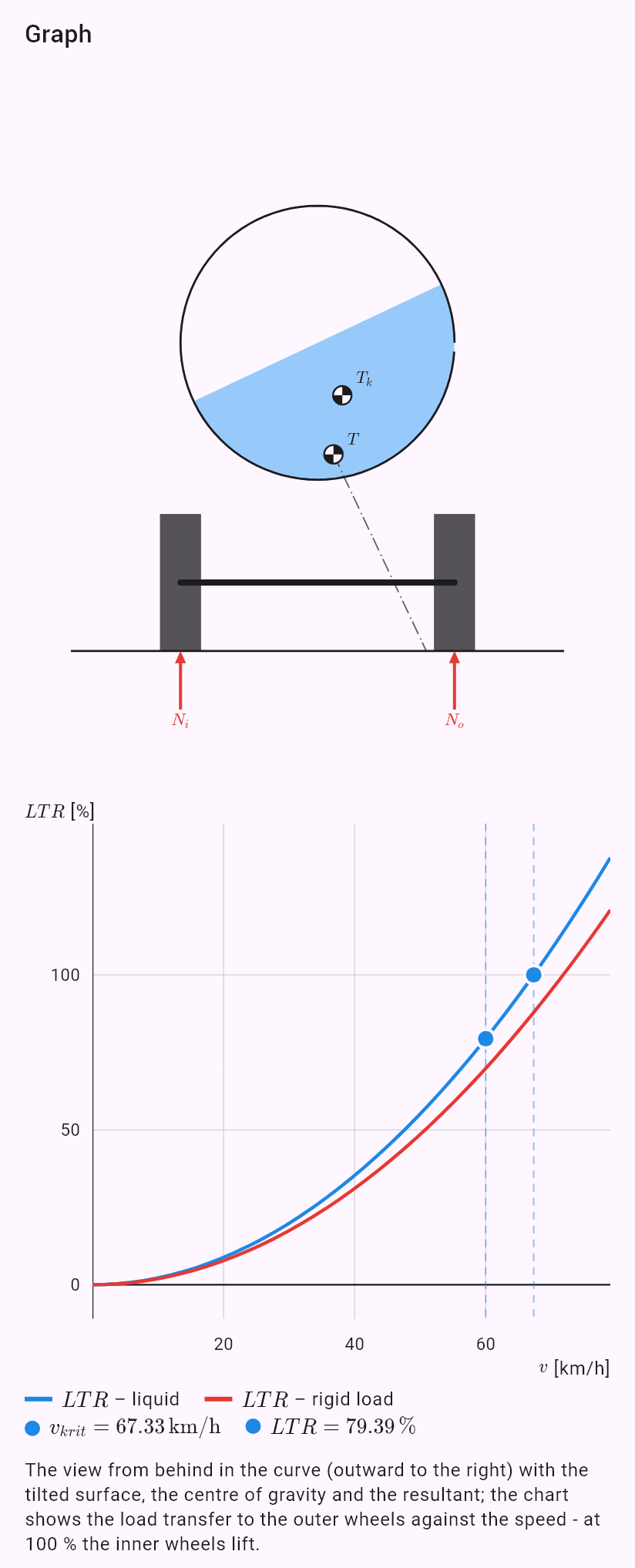
The form Tanker with a liquid computes a partly filled tanker braking, speeding up and in a curve. The surface tilts perpendicular to the resultant of gravity and the inertial force (tan θ = a/g), the liquid's centre of gravity moves and with it the whole's. The axle loads are the reactions of a beam on two supports; in a curve the app computes the [[loadTransferRatio|load transfer]] to the outer wheels and the critical speed at which the tanker tips over - compared with a rigid load, with the natural frequency of the [[sloshing|sloshing]] too. An interactive demo is at mathtrace.app under "Try it yourself".

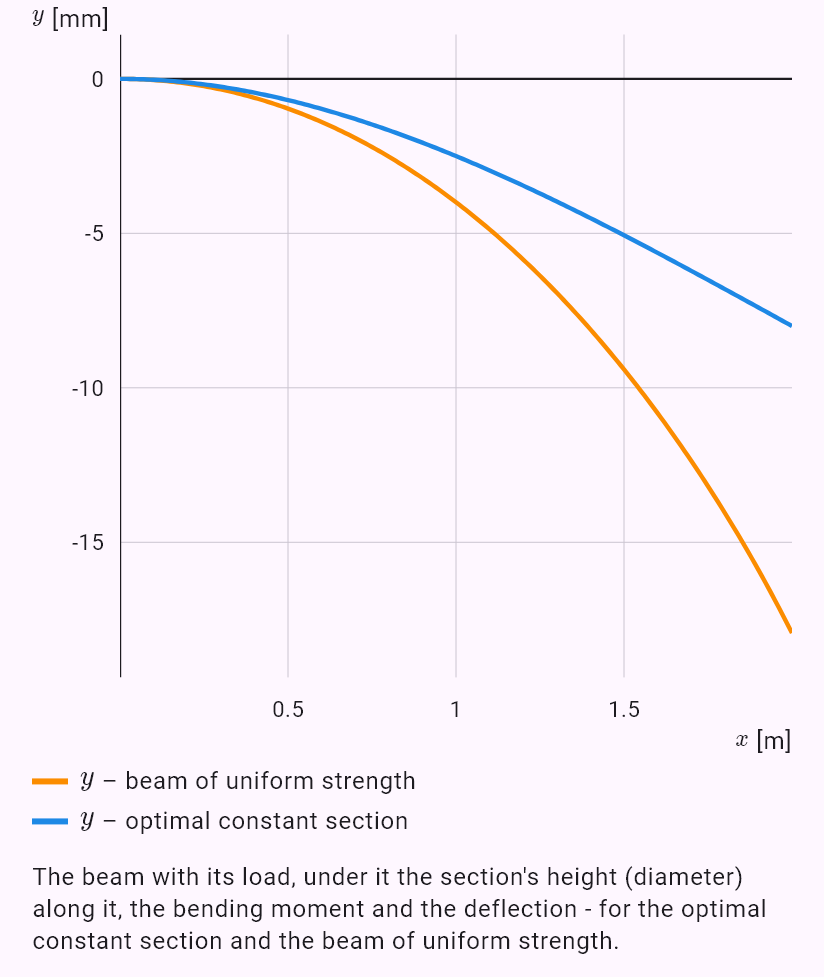
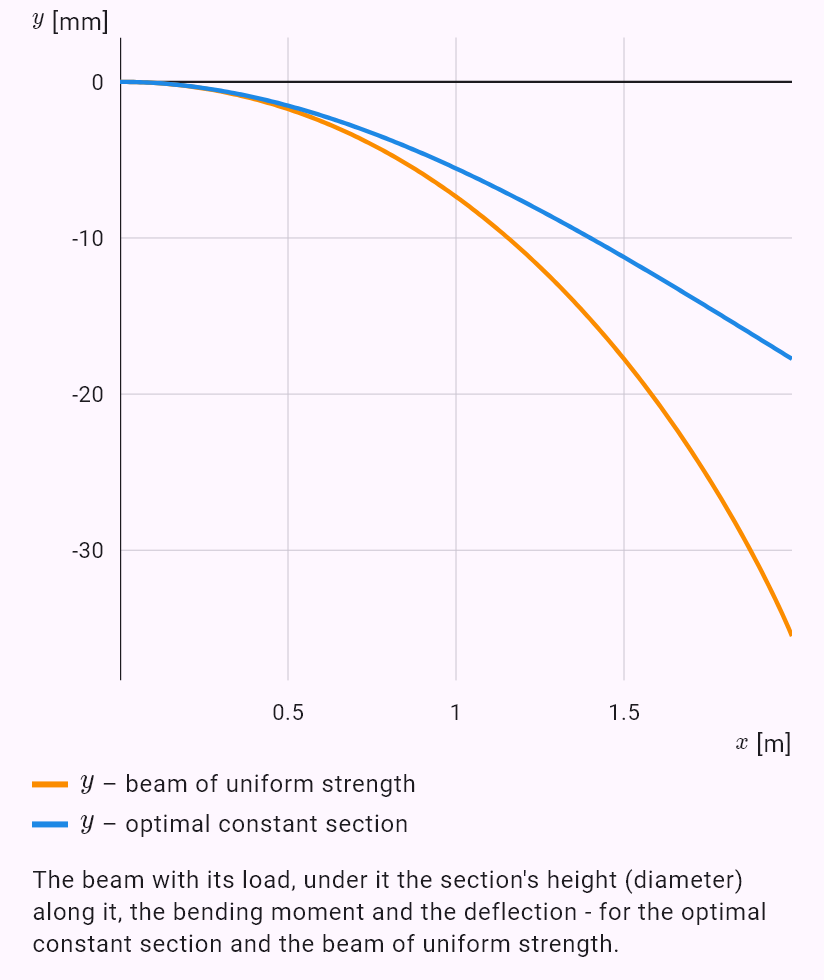
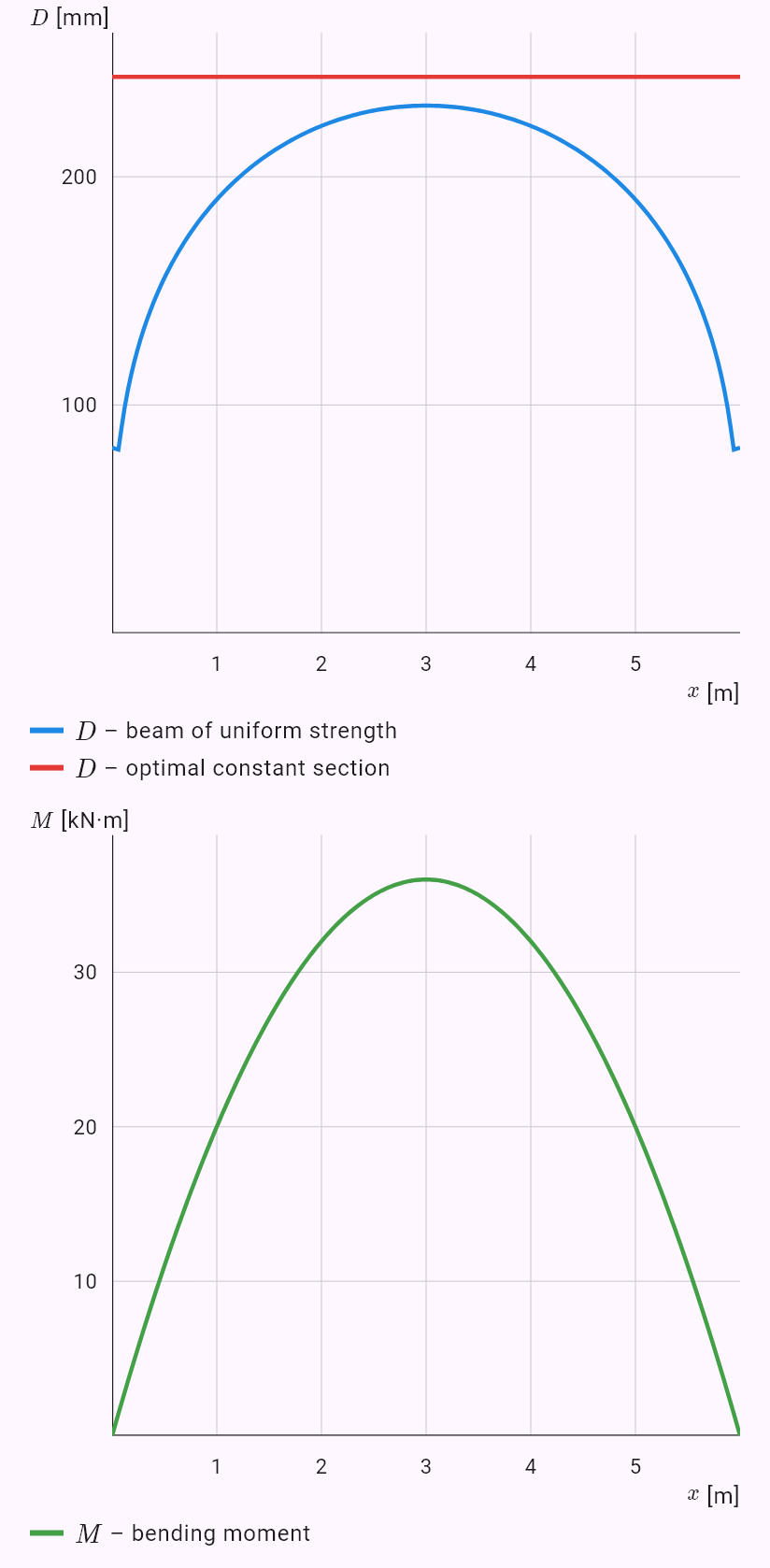
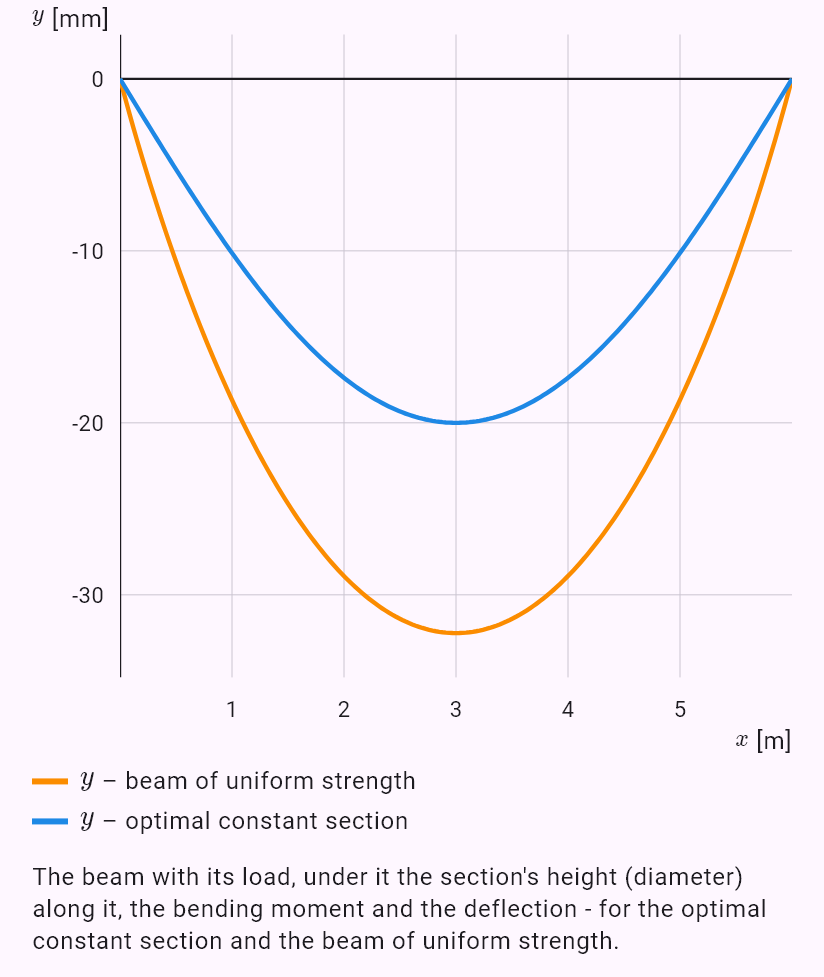
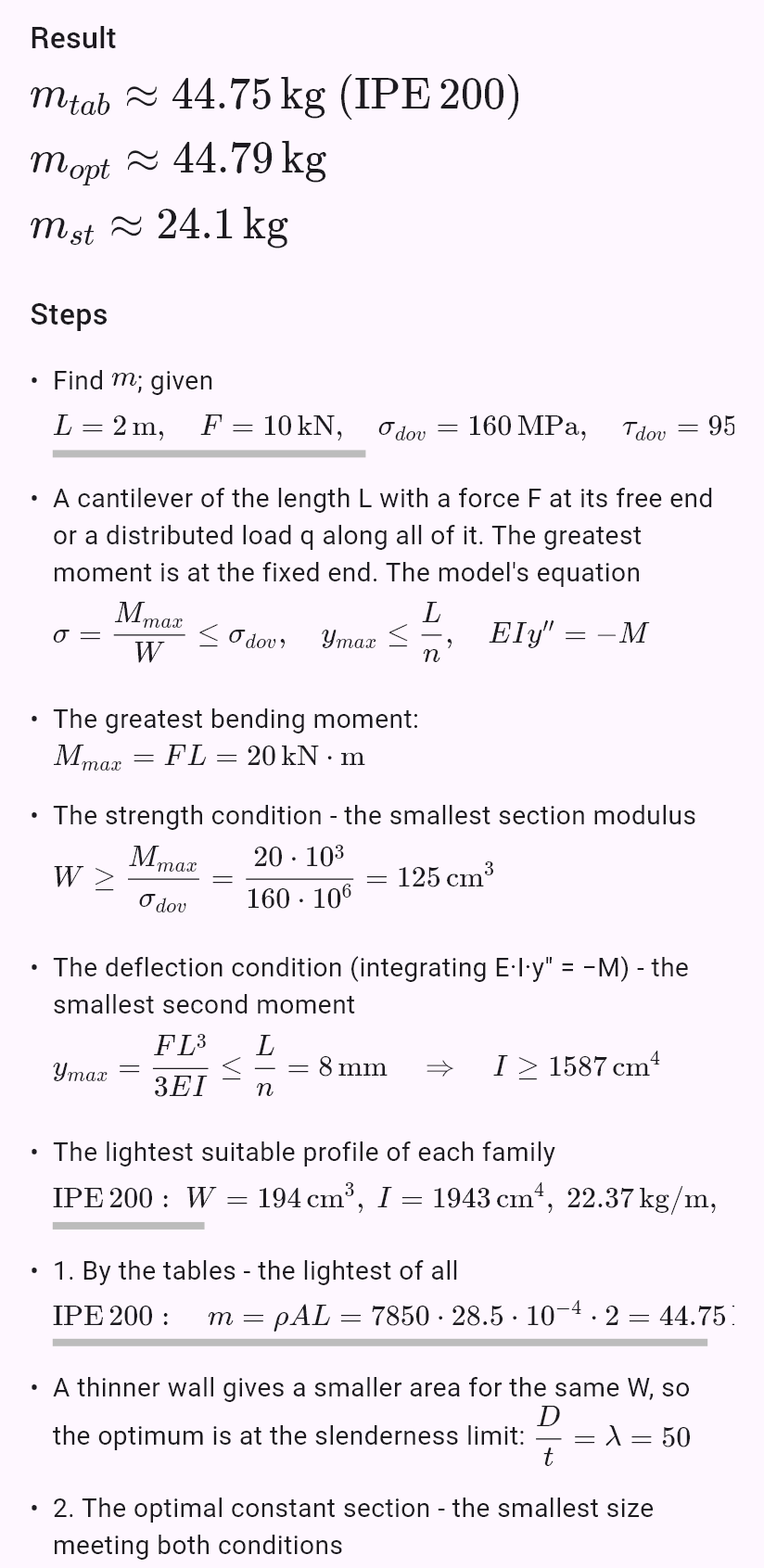
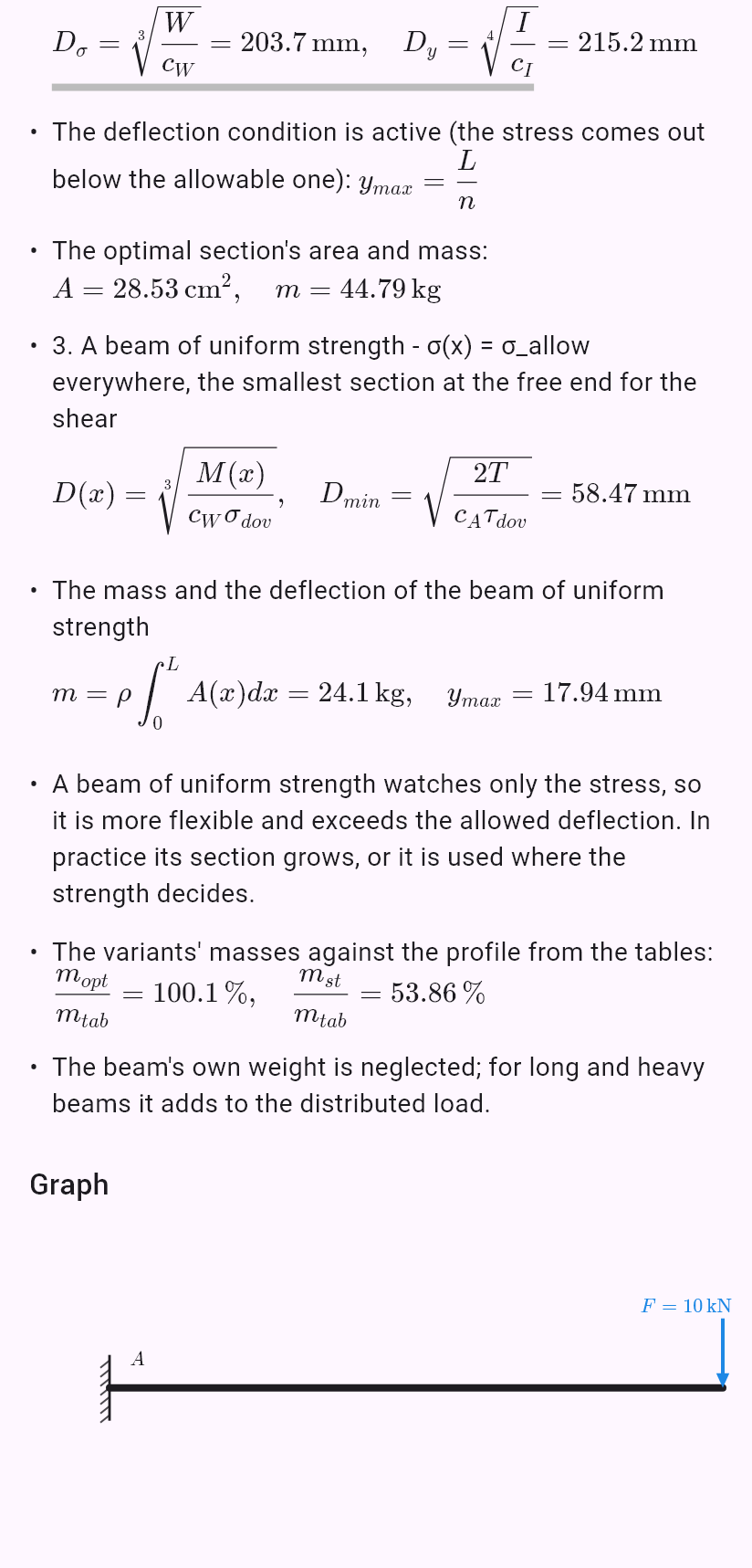
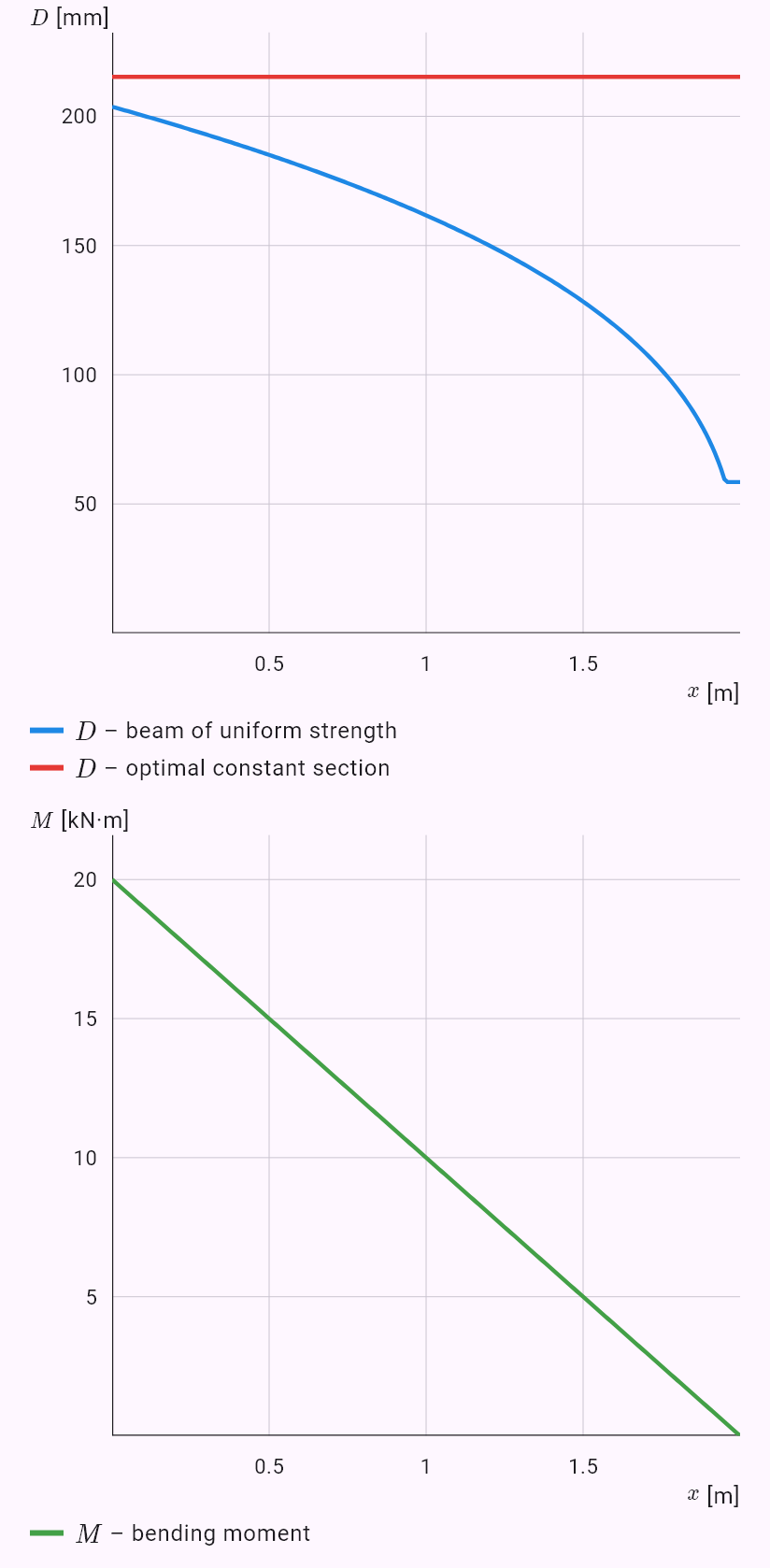
The form Beam design compares three variants of a beam in bending: the lightest standard profile from the tables (IPE, HEB, round and rectangular tubes), the optimal constant section of a chosen shape (a rectangle, a circle, a tube with a limited wall slenderness) and a [[uniformStrengthBeam|beam of uniform strength]]. It watches the strength, the allowed deflection L/n and the shear at the free end; the steps show which condition is [[activeConstraint|active]] and the chart the section, the moment and the deflection along the beam. The inspiration was a thesis in optimization: an arm designed by optimization came out much lighter than one from the tables.

Examples

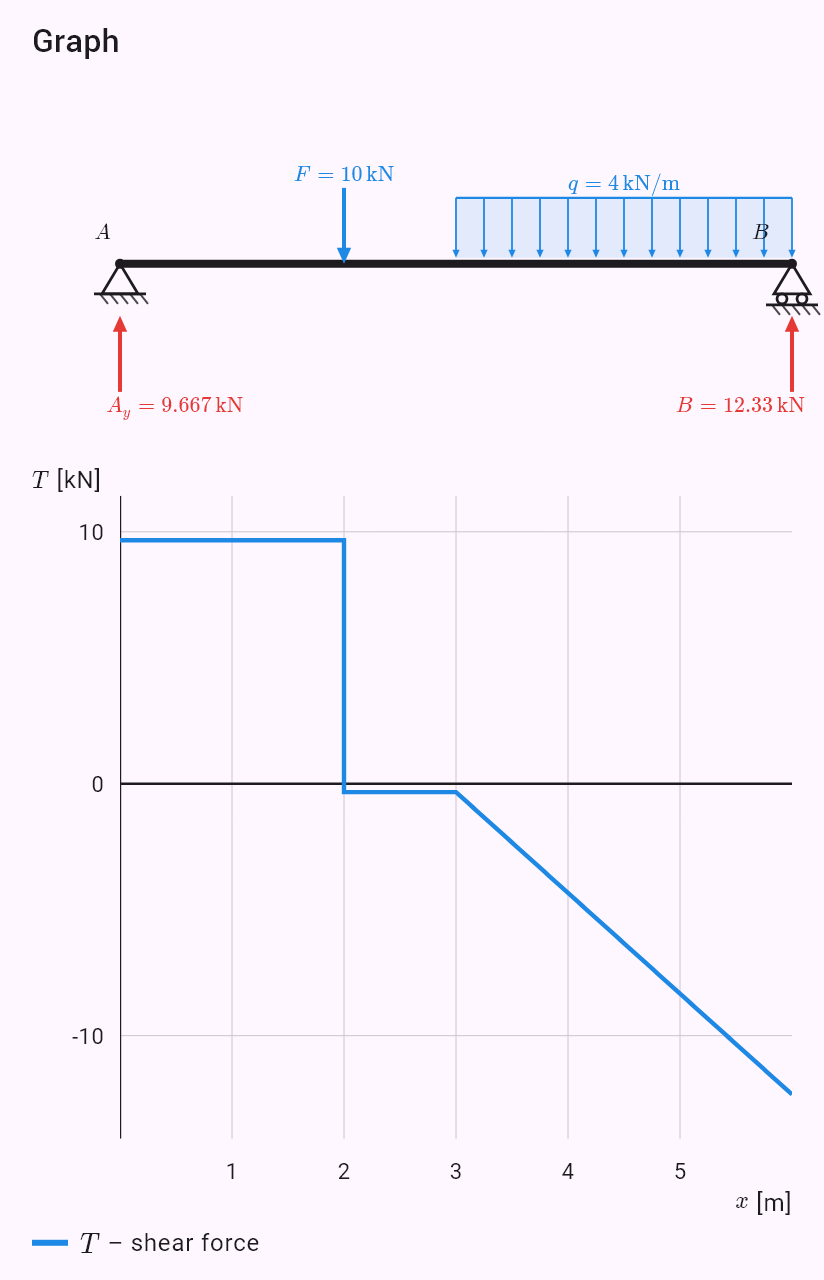
A simply supported beam with a force and a distributed load on part of it: the reactions, the pieces and the greatest moment.
Input: model(statics; mode=beam; find=Mmax[kNm]; L=6[m]; supA=pin; supB=roller; F=10[kN]; xF=2[m]; q=4[kN_m]; qa=3[m]; qb=6[m])

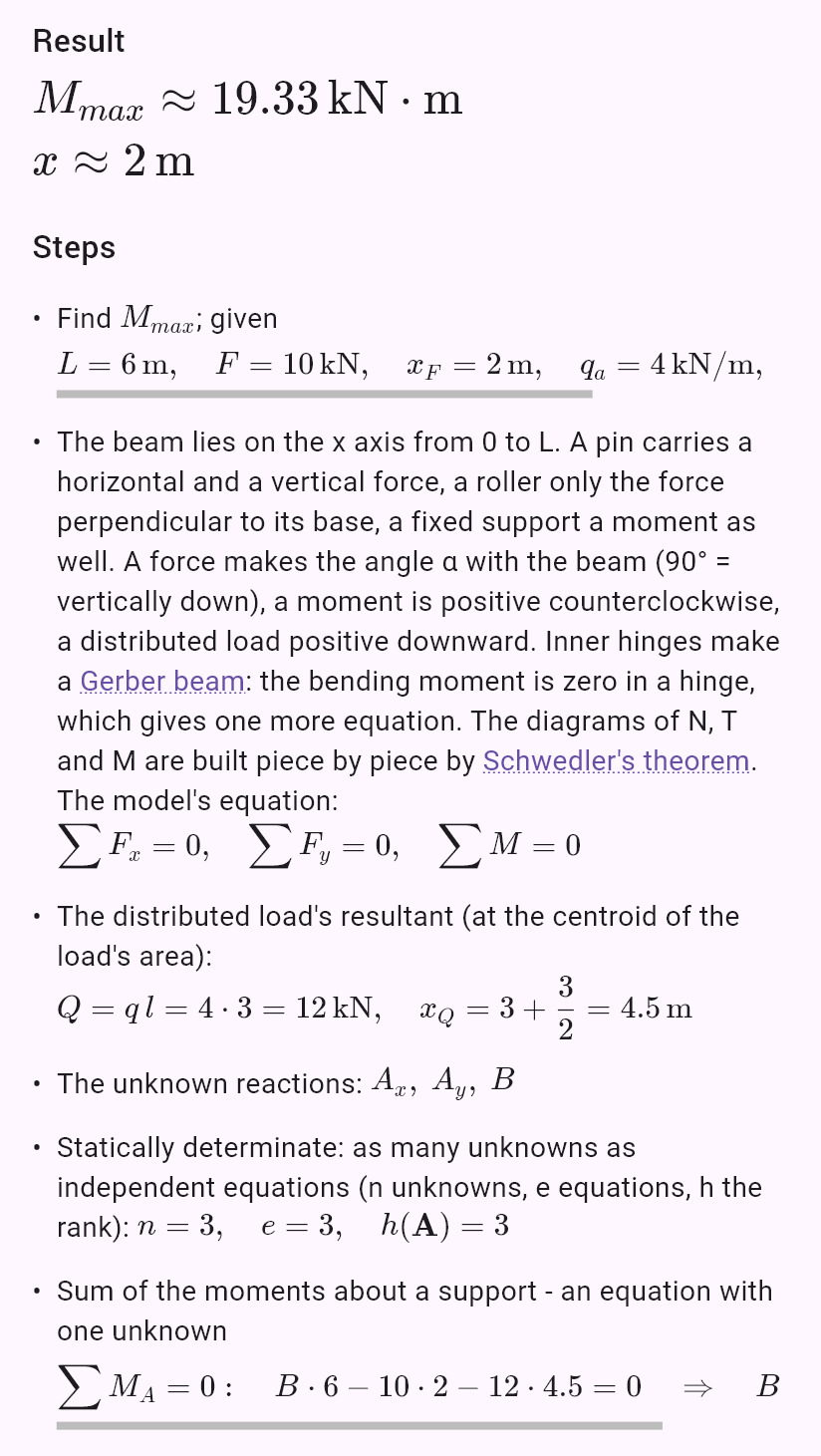
model(statics; mode=beam; find=Mmax[kNm]; L=6[m]; supA=pin; supB=roller; F=10[kN]; xF=2[m]; q=4[kN_m]; qa=3[m]; qb=6[m])
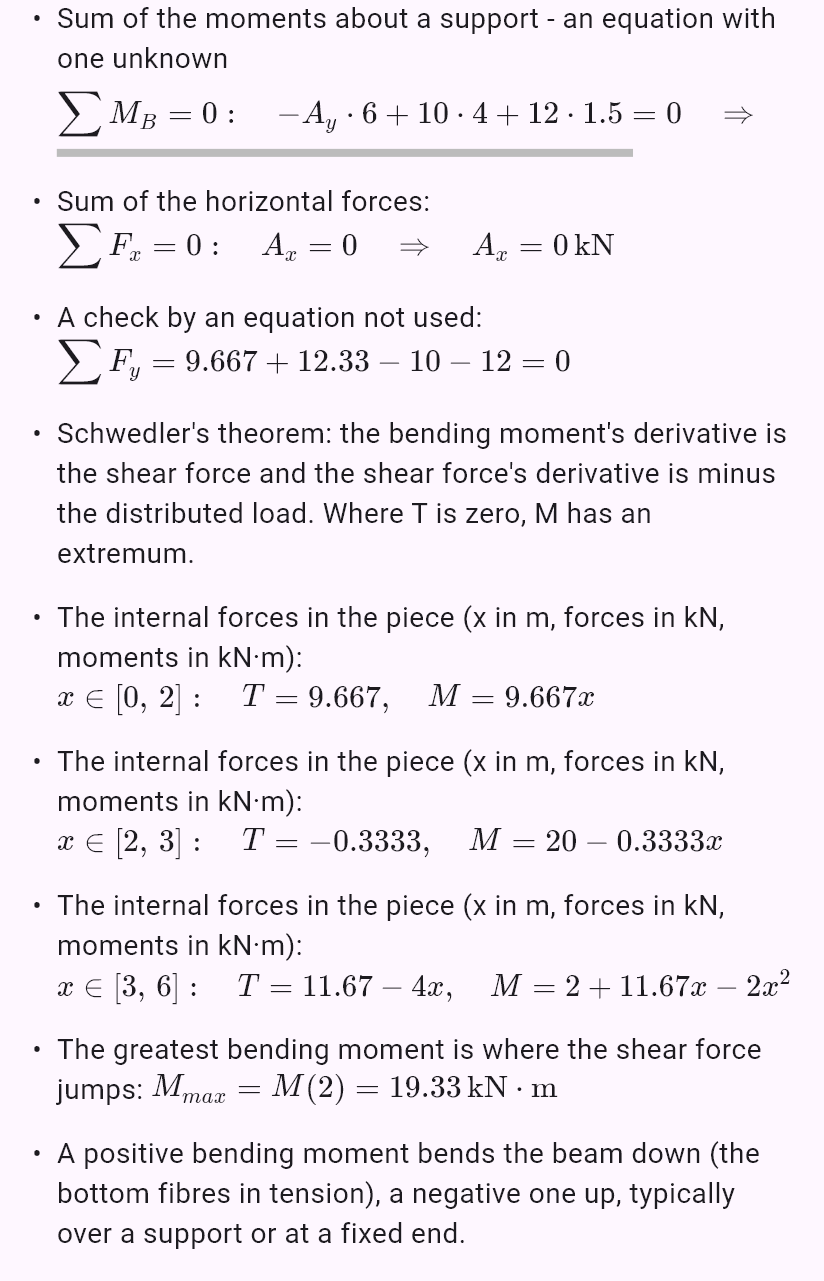
model(statics; mode=beam; find=Mmax[kNm]; L=6[m]; supA=pin; supB=roller; F=10[kN]; xF=2[m]; q=4[kN_m]; qa=3[m]; qb=6[m])model(statics; mode=beam; find=Mmax[kNm]; L=6[m]; supA=pin; supB=roller; F=10[kN]; xF=2[m]; q=4[kN_m]; qa=3[m]; qb=6[m])model(statics; mode=beam; find=Mmax[kNm]; L=6[m]; supA=pin; supB=roller; F=10[kN]; xF=2[m]; q=4[kN_m]; qa=3[m]; qb=6[m])model(statics; mode=beam; find=Mmax[kNm]; L=6[m]; supA=pin; supB=roller; F=10[kN]; xF=2[m]; q=4[kN_m]; qa=3[m]; qb=6[m])
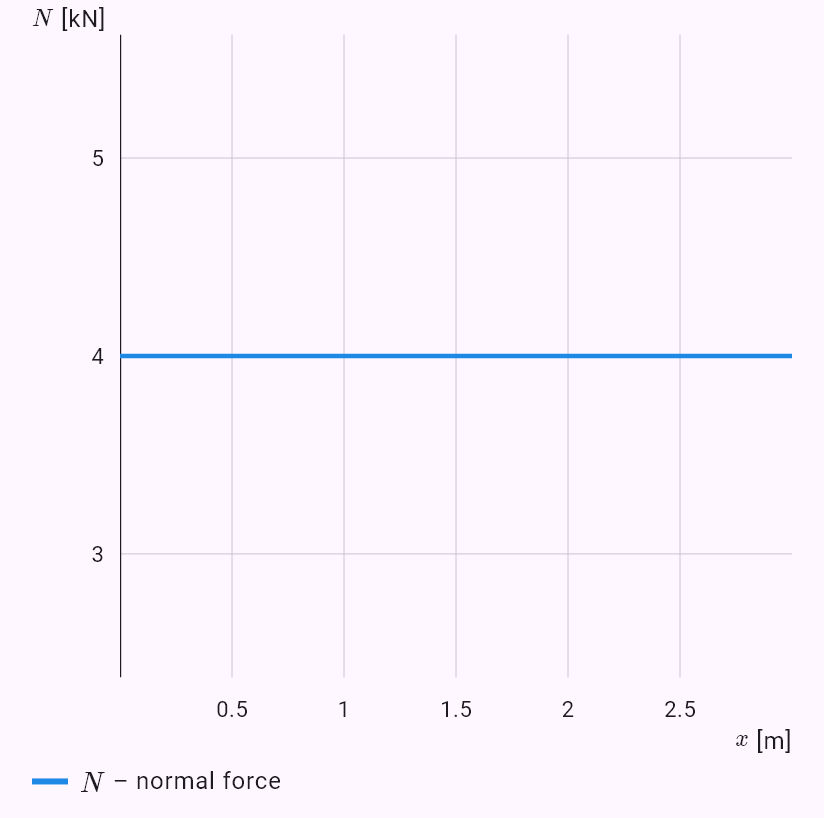
A cantilever with an inclined force at its end and a uniform load: the horizontal and vertical reactions and the fixed end's moment.
Input: model(statics; mode=beam; find=R[kN]; L=3[m]; supA=fixed; supB=none; F=8[kN]; xF=3[m]; aF=60[deg]; q=2[kN_m])

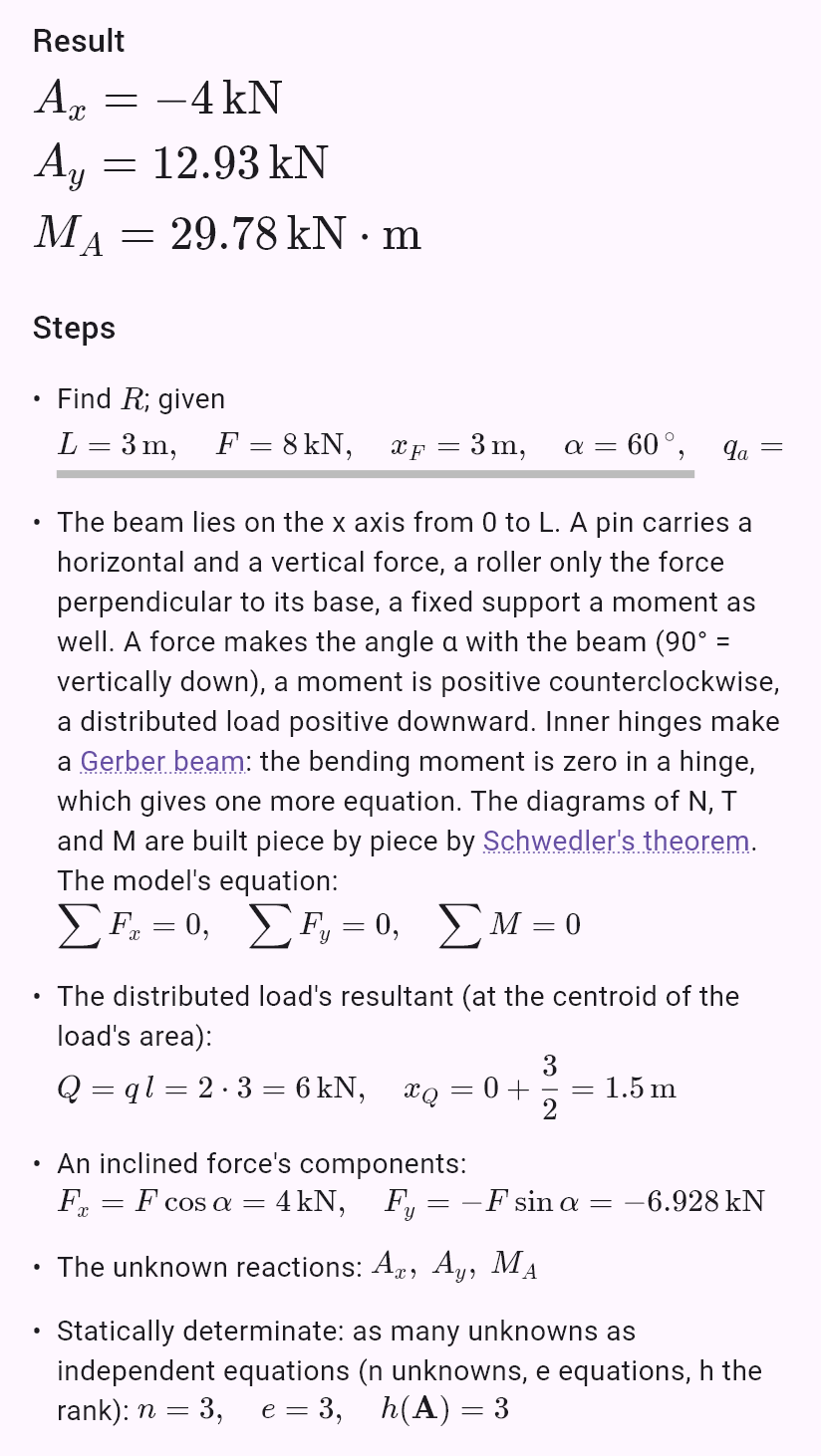
model(statics; mode=beam; find=R[kN]; L=3[m]; supA=fixed; supB=none; F=8[kN]; xF=3[m]; aF=60[deg]; q=2[kN_m])
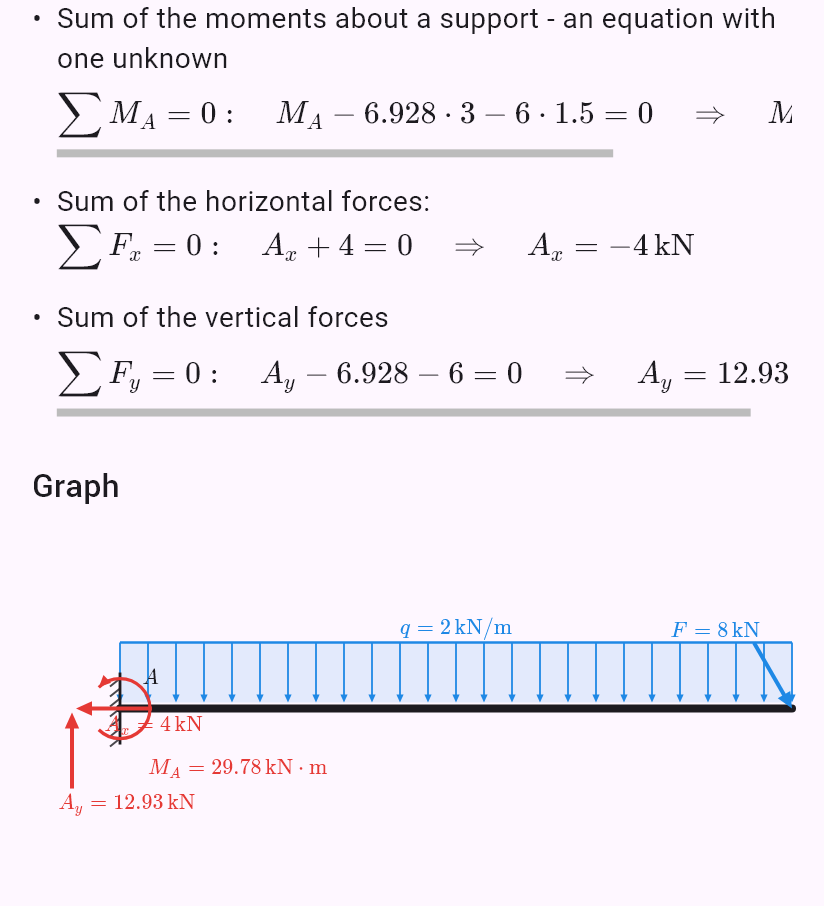
model(statics; mode=beam; find=R[kN]; L=3[m]; supA=fixed; supB=none; F=8[kN]; xF=3[m]; aF=60[deg]; q=2[kN_m])model(statics; mode=beam; find=R[kN]; L=3[m]; supA=fixed; supB=none; F=8[kN]; xF=3[m]; aF=60[deg]; q=2[kN_m])model(statics; mode=beam; find=R[kN]; L=3[m]; supA=fixed; supB=none; F=8[kN]; xF=3[m]; aF=60[deg]; q=2[kN_m])model(statics; mode=beam; find=R[kN]; L=3[m]; supA=fixed; supB=none; F=8[kN]; xF=3[m]; aF=60[deg]; q=2[kN_m])model(statics; mode=beam; find=R[kN]; L=3[m]; supA=fixed; supB=none; F=8[kN]; xF=3[m]; aF=60[deg]; q=2[kN_m])
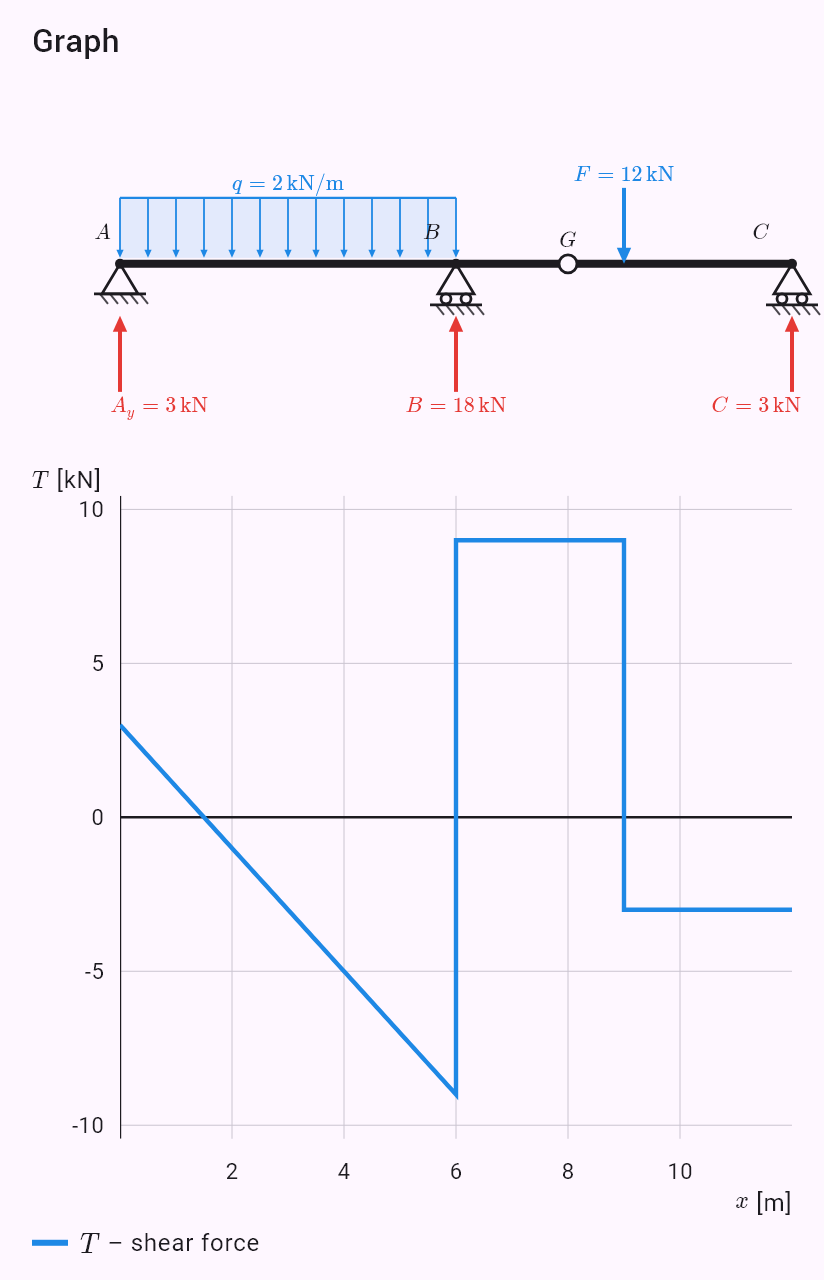
A Gerber beam on three supports with a hinge: the calculation starts with the part beyond the hinge.
Input: model(statics; mode=beam; find=Mmax[kNm]; L=12[m]; supA=pin; supB=roller; xB=6[m]; xs=12[m]; xh=8[m]; F=12[kN]; xF=9[m]; q=2[kN_m]; qa=0[m]; qb=6[m])

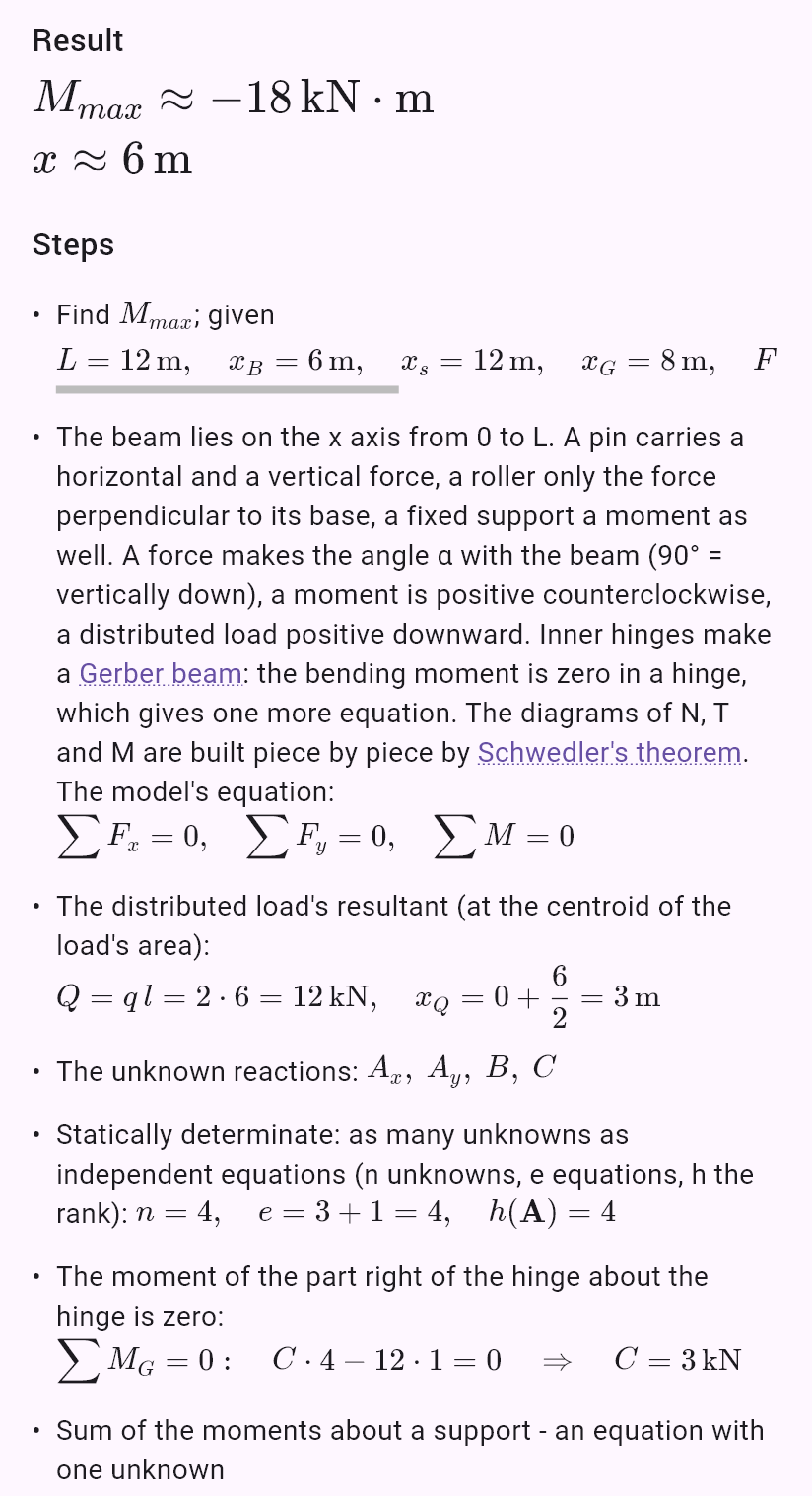
model(statics; mode=beam; find=Mmax[kNm]; L=12[m]; supA=pin; supB=roller; xB=6[m]; xs=12[m]; xh=8[m]; F=12[kN]; xF=9[m]; q=2[kN_m]; qa=0[m]; qb=6[m])
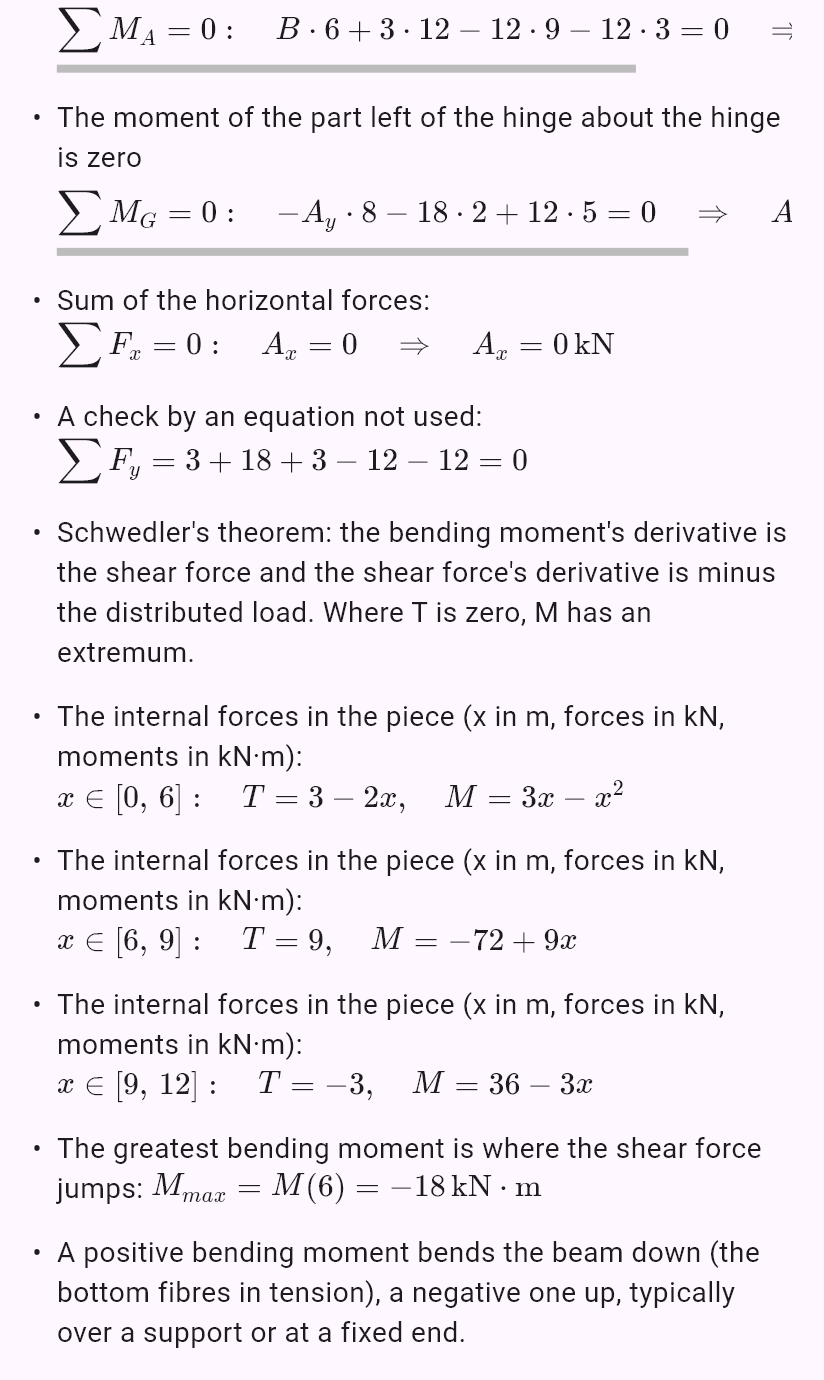
model(statics; mode=beam; find=Mmax[kNm]; L=12[m]; supA=pin; supB=roller; xB=6[m]; xs=12[m]; xh=8[m]; F=12[kN]; xF=9[m]; q=2[kN_m]; qa=0[m]; qb=6[m])model(statics; mode=beam; find=Mmax[kNm]; L=12[m]; supA=pin; supB=roller; xB=6[m]; xs=12[m]; xh=8[m]; F=12[kN]; xF=9[m]; q=2[kN_m]; qa=0[m]; qb=6[m])model(statics; mode=beam; find=Mmax[kNm]; L=12[m]; supA=pin; supB=roller; xB=6[m]; xs=12[m]; xh=8[m]; F=12[kN]; xF=9[m]; q=2[kN_m]; qa=0[m]; qb=6[m])model(statics; mode=beam; find=Mmax[kNm]; L=12[m]; supA=pin; supB=roller; xB=6[m]; xs=12[m]; xh=8[m]; F=12[kN]; xF=9[m]; q=2[kN_m]; qa=0[m]; qb=6[m])
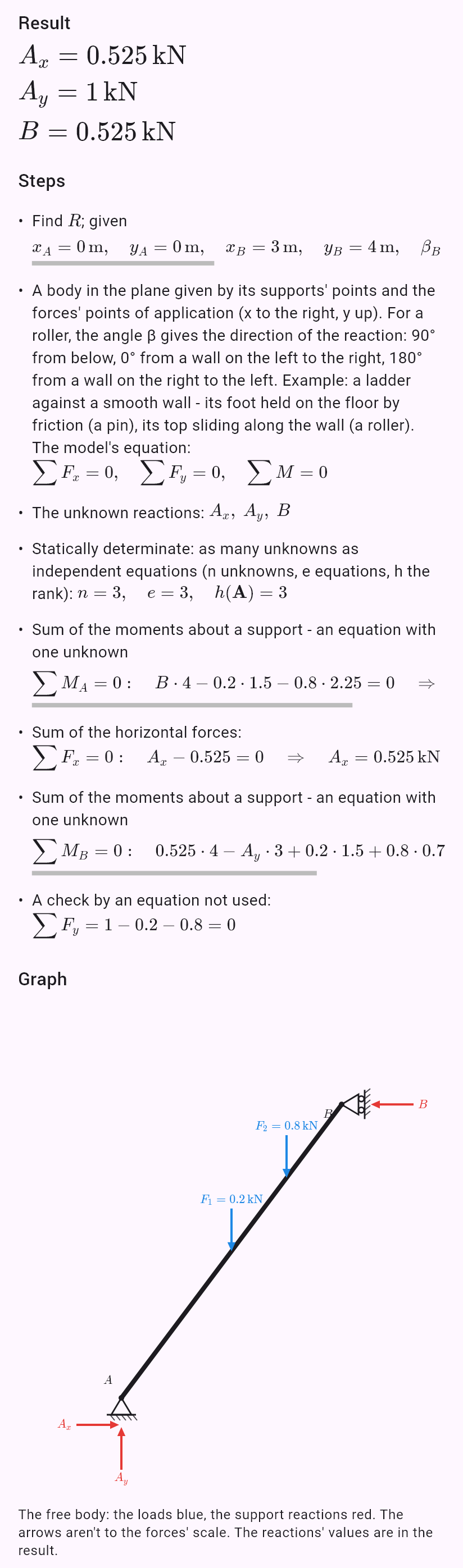
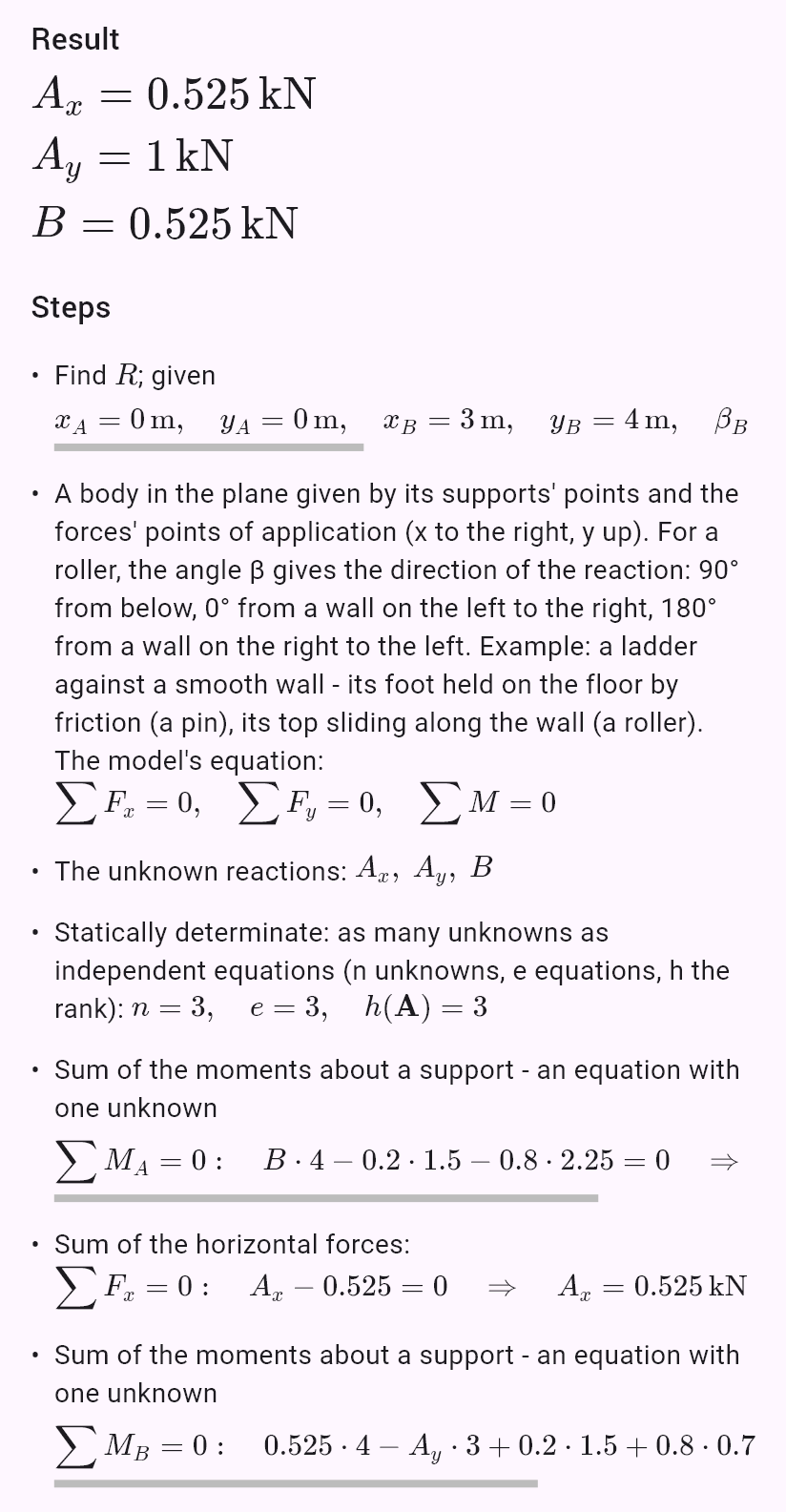
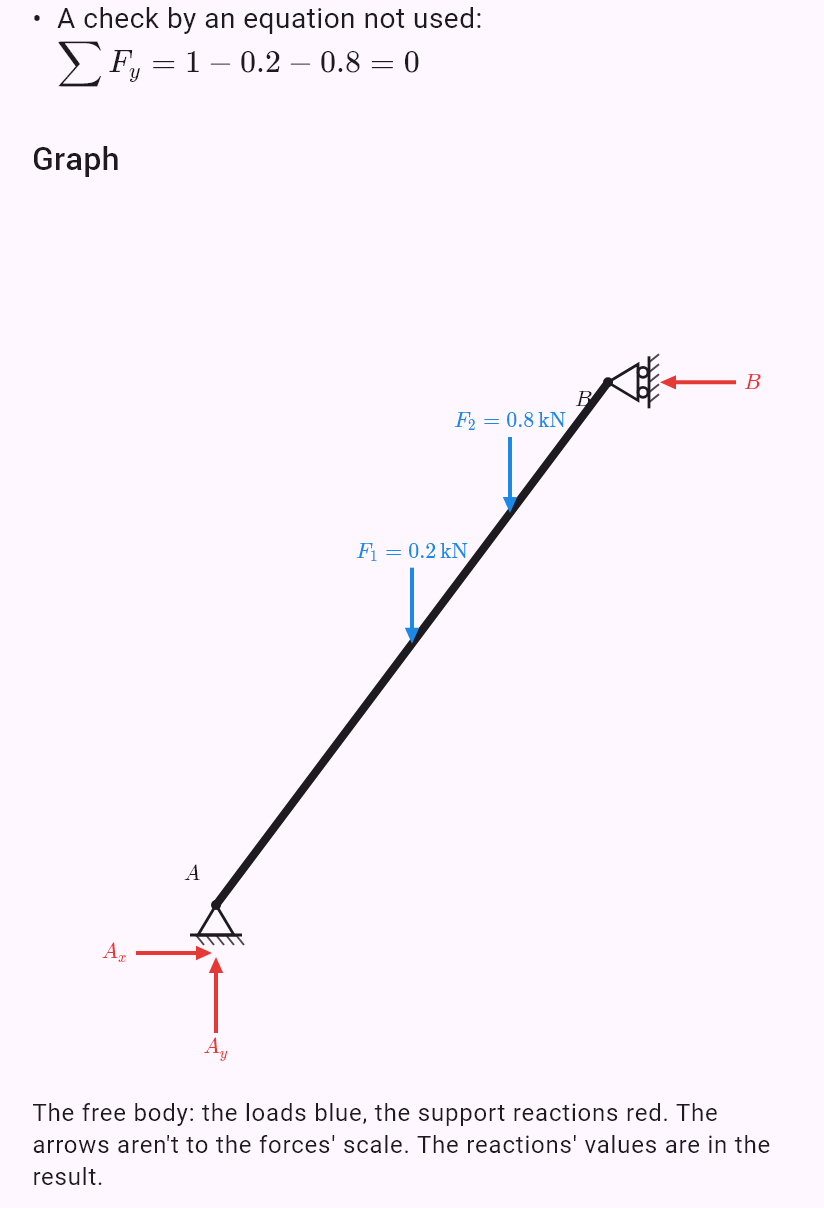
A ladder against a smooth wall with the ladder's and a person's weight: the reactions on the ground and on the wall.
Input: model(statics; mode=body; find=R[kN]; supA=pin; Ax=0[m]; Ay=0[m]; supB=roller; Bx=3[m]; By=4[m]; Ba=180[deg]; P=0.2 0.8[kN]; Px=1.5 2.25[m]; Py=2 3[m])
model(statics; mode=body; find=R[kN]; supA=pin; Ax=0[m]; Ay=0[m]; supB=roller; Bx=3[m]; By=4[m]; Ba=180[deg]; P=0.2 0.8[kN]; Px=1.5 2.25[m]; Py=2 3[m])
model(statics; mode=body; find=R[kN]; supA=pin; Ax=0[m]; Ay=0[m]; supB=roller; Bx=3[m]; By=4[m]; Ba=180[deg]; P=0.2 0.8[kN]; Px=1.5 2.25[m]; Py=2 3[m])model(statics; mode=body; find=R[kN]; supA=pin; Ax=0[m]; Ay=0[m]; supB=roller; Bx=3[m]; By=4[m]; Ba=180[deg]; P=0.2 0.8[kN]; Px=1.5 2.25[m]; Py=2 3[m])
A fixed support with a roller is once statically indeterminate.
Input: model(statics; mode=beam; find=R[kN]; L=5[m]; supA=fixed; supB=roller; F=10[kN]; xF=2[m])
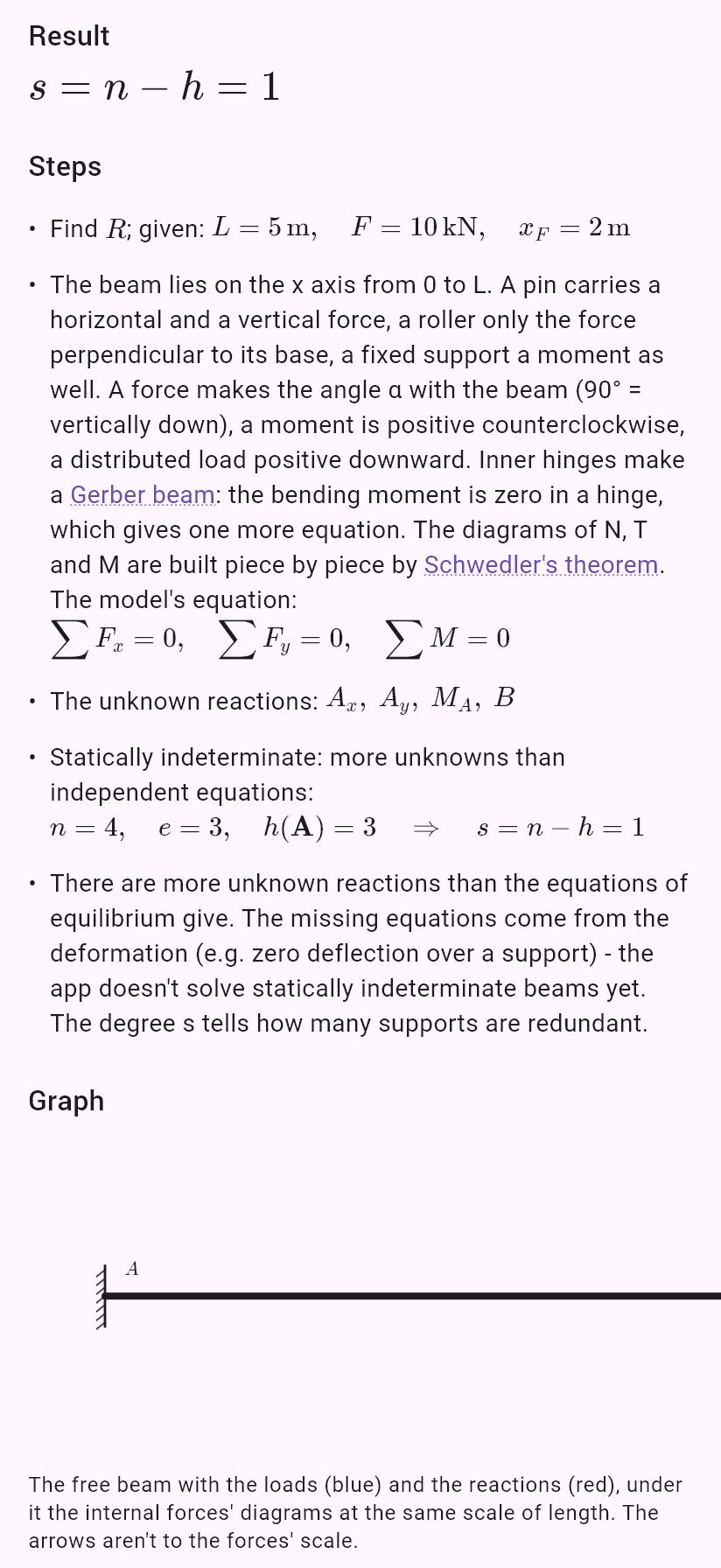
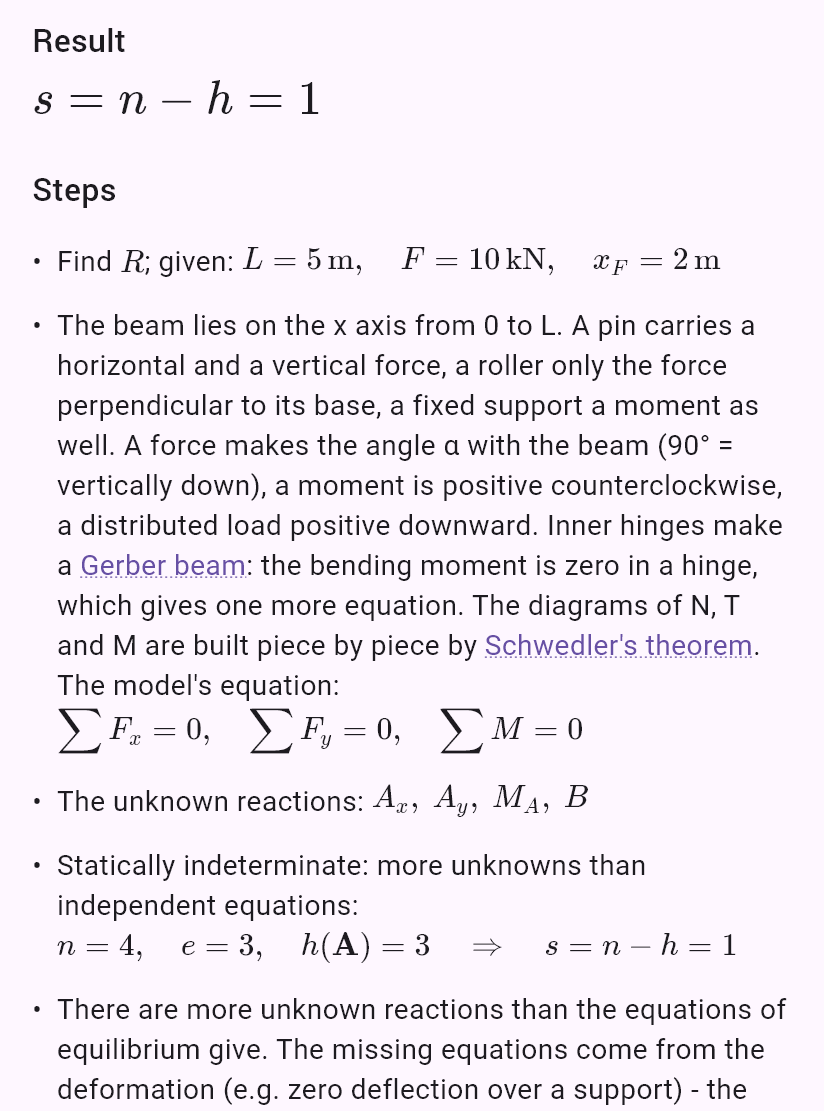
model(statics; mode=beam; find=R[kN]; L=5[m]; supA=fixed; supB=roller; F=10[kN]; xF=2[m])
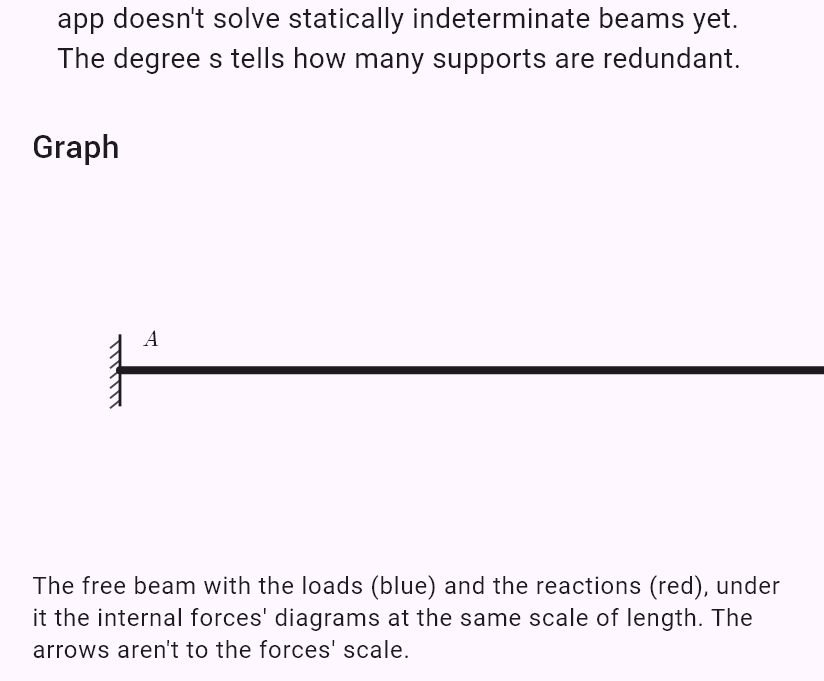
model(statics; mode=beam; find=R[kN]; L=5[m]; supA=fixed; supB=roller; F=10[kN]; xF=2[m])model(statics; mode=beam; find=R[kN]; L=5[m]; supA=fixed; supB=roller; F=10[kN]; xF=2[m])
A T section: the centroid, the second moment and the section modulus.
Input: model(statics; mode=section; shape=T; find=Wy[mm3]; b=100[mm]; h=120[mm]; tf=20[mm]; tw=20[mm])
model(statics; mode=section; shape=T; find=Wy[mm3]; b=100[mm]; h=120[mm]; tf=20[mm]; tw=20[mm])
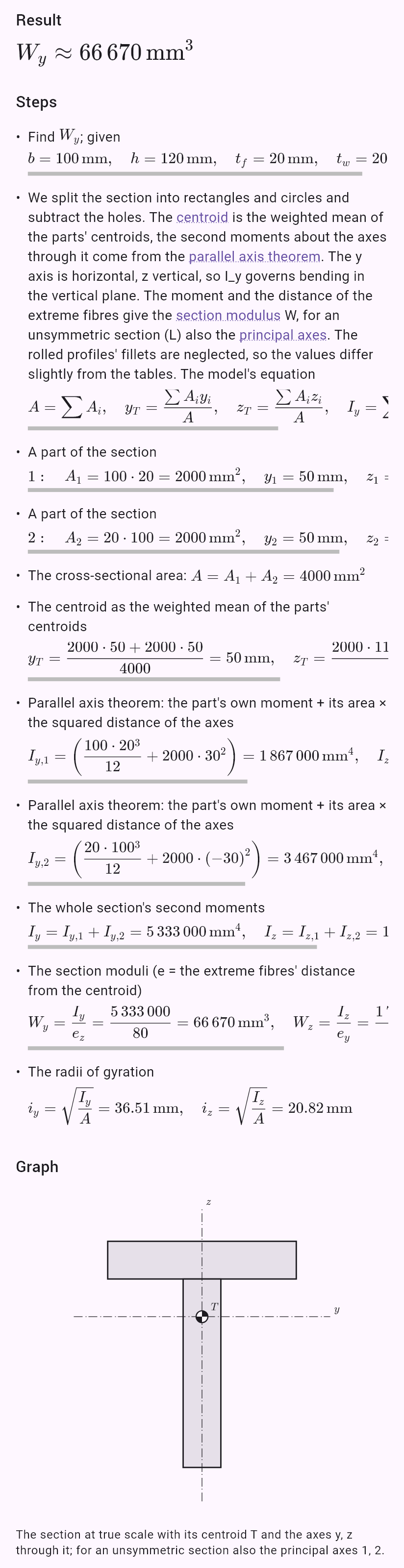
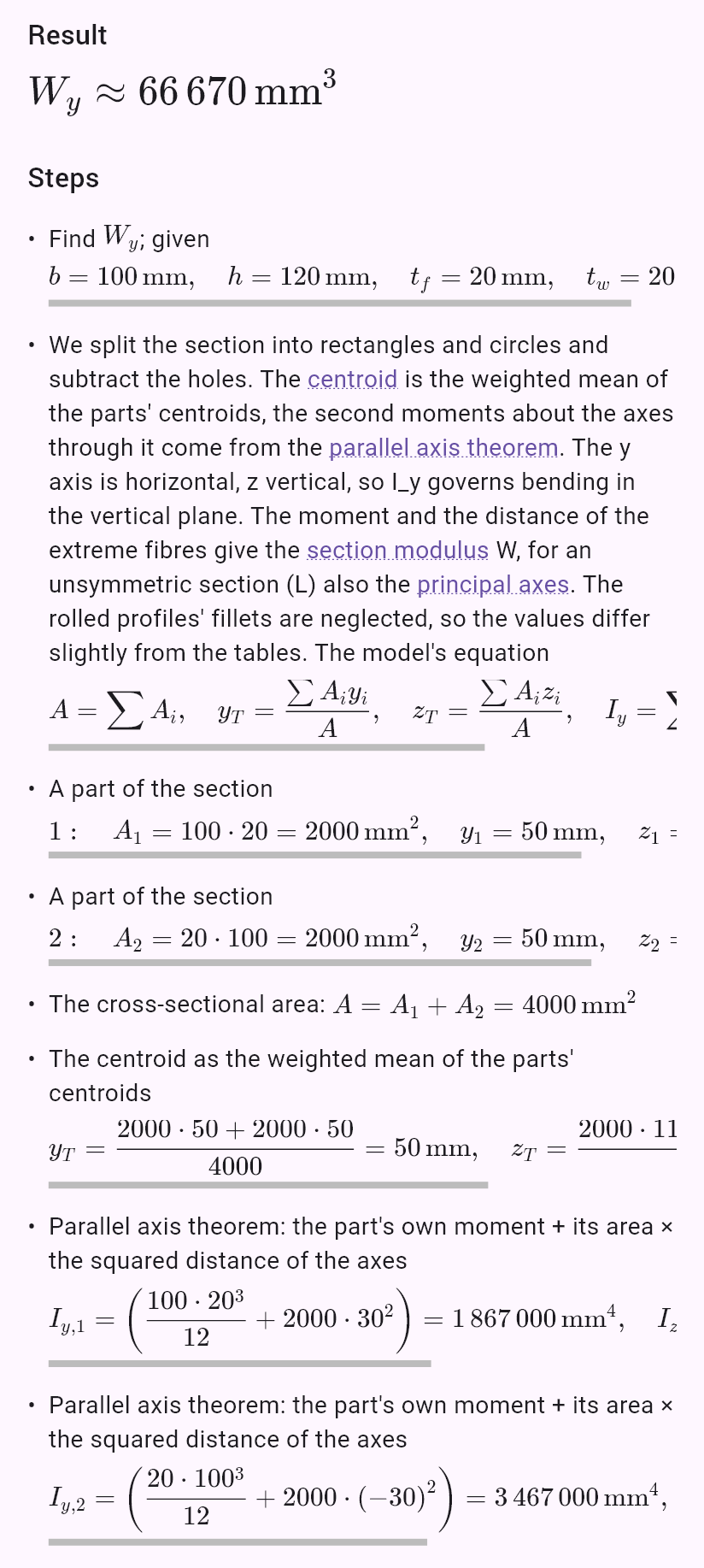
model(statics; mode=section; shape=T; find=Wy[mm3]; b=100[mm]; h=120[mm]; tf=20[mm]; tw=20[mm])model(statics; mode=section; shape=T; find=Wy[mm3]; b=100[mm]; h=120[mm]; tf=20[mm]; tw=20[mm])
An equal-leg angle L: the product of inertia and the principal axes at 45°.
Input: model(statics; mode=section; shape=L; find=I1[mm4]; b=100[mm]; h=100[mm]; t=10[mm])
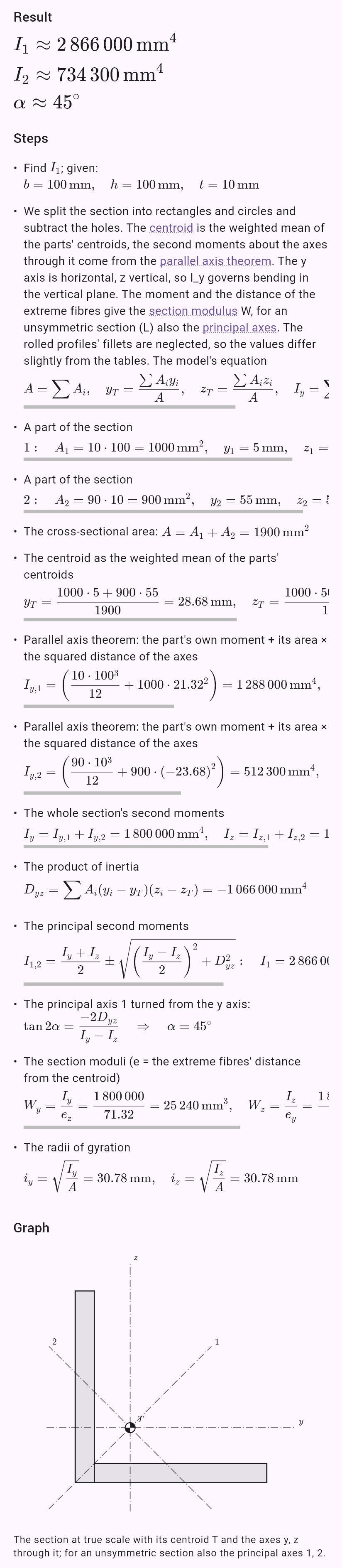
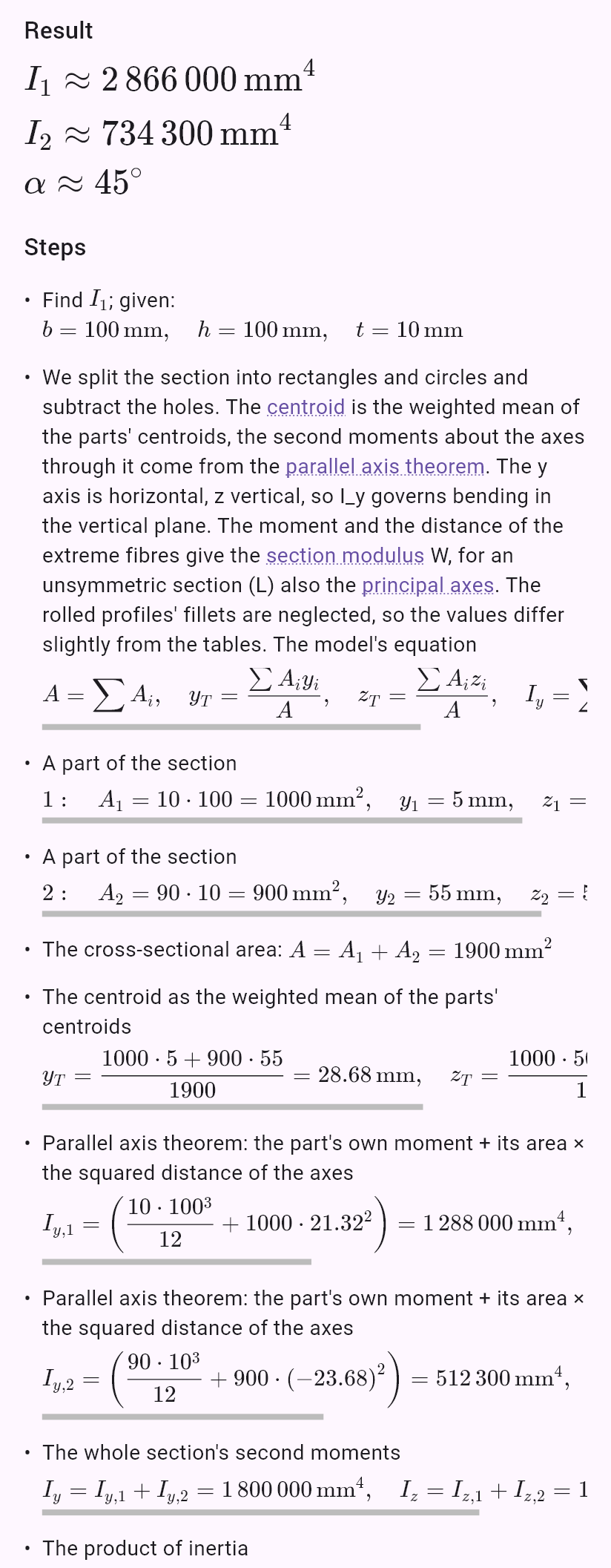
model(statics; mode=section; shape=L; find=I1[mm4]; b=100[mm]; h=100[mm]; t=10[mm])
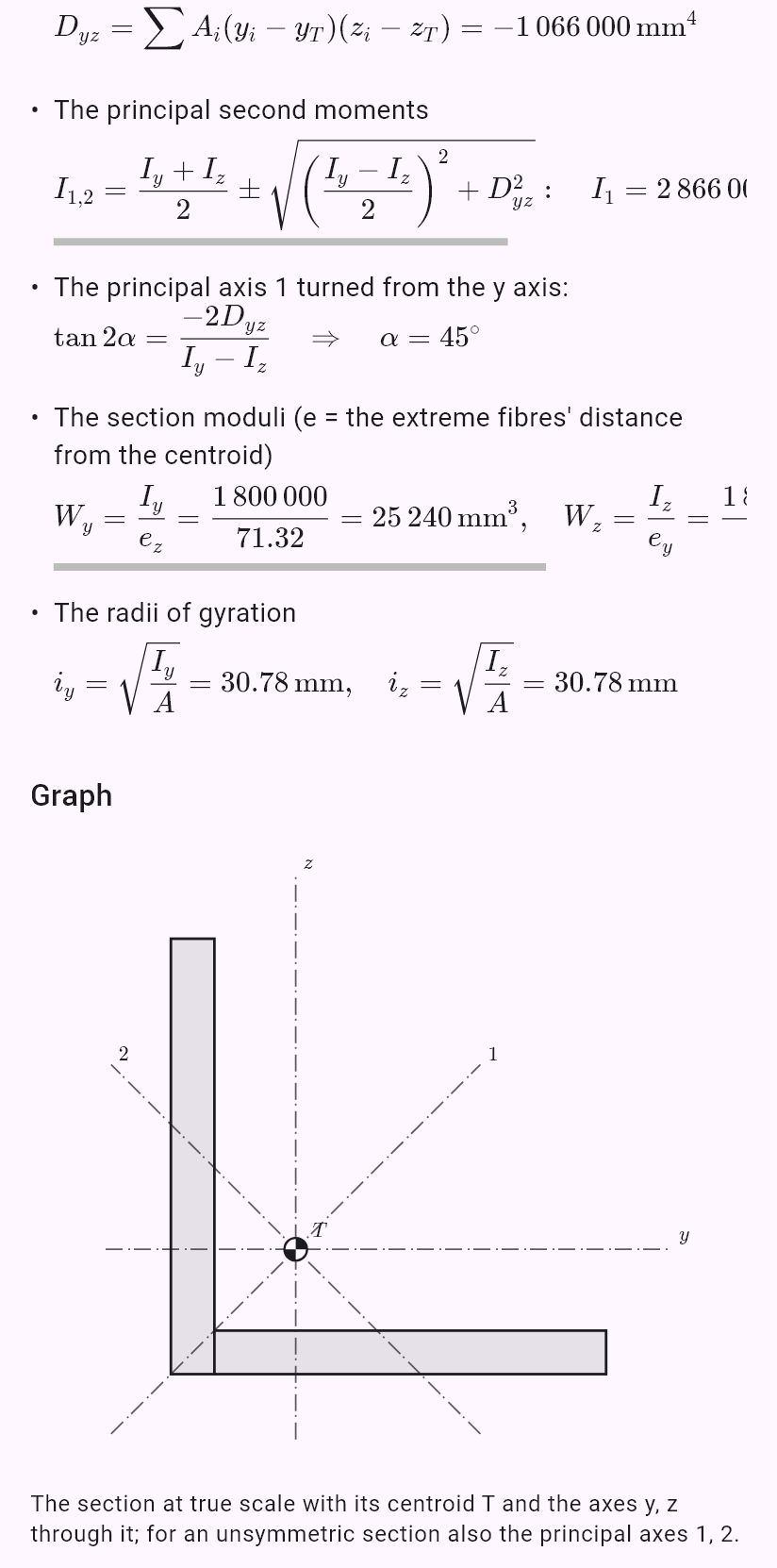
model(statics; mode=section; shape=L; find=I1[mm4]; b=100[mm]; h=100[mm]; t=10[mm])model(statics; mode=section; shape=L; find=I1[mm4]; b=100[mm]; h=100[mm]; t=10[mm])
A plate with an off-centre round hole: a composite section and the shifted centroid.
Input: model(statics; mode=section; shape=composite; find=Iy[mm4]; rb=200[mm]; rh=100[mm]; ry=0[mm]; rz=0[mm]; hd=40[mm]; hcy=60[mm]; hcz=60[mm])
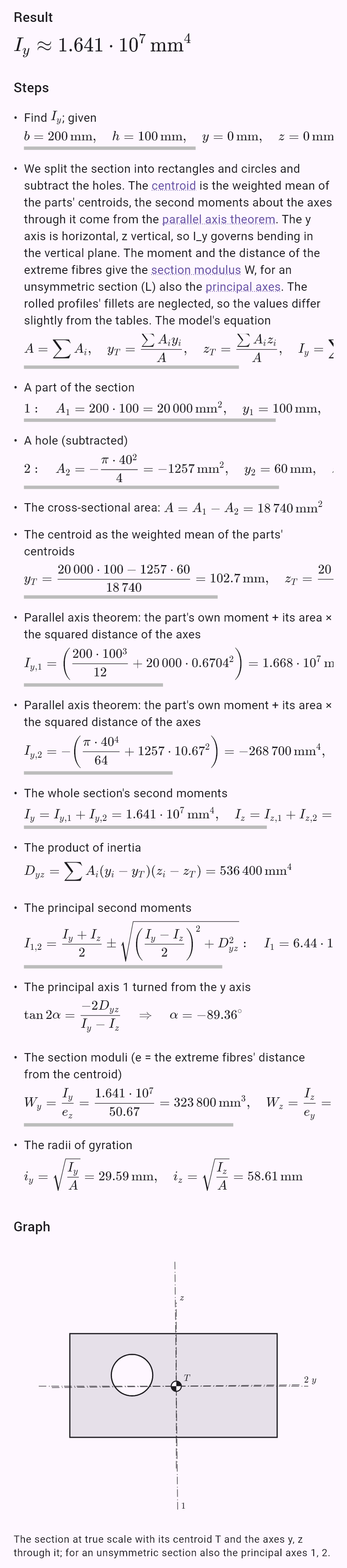
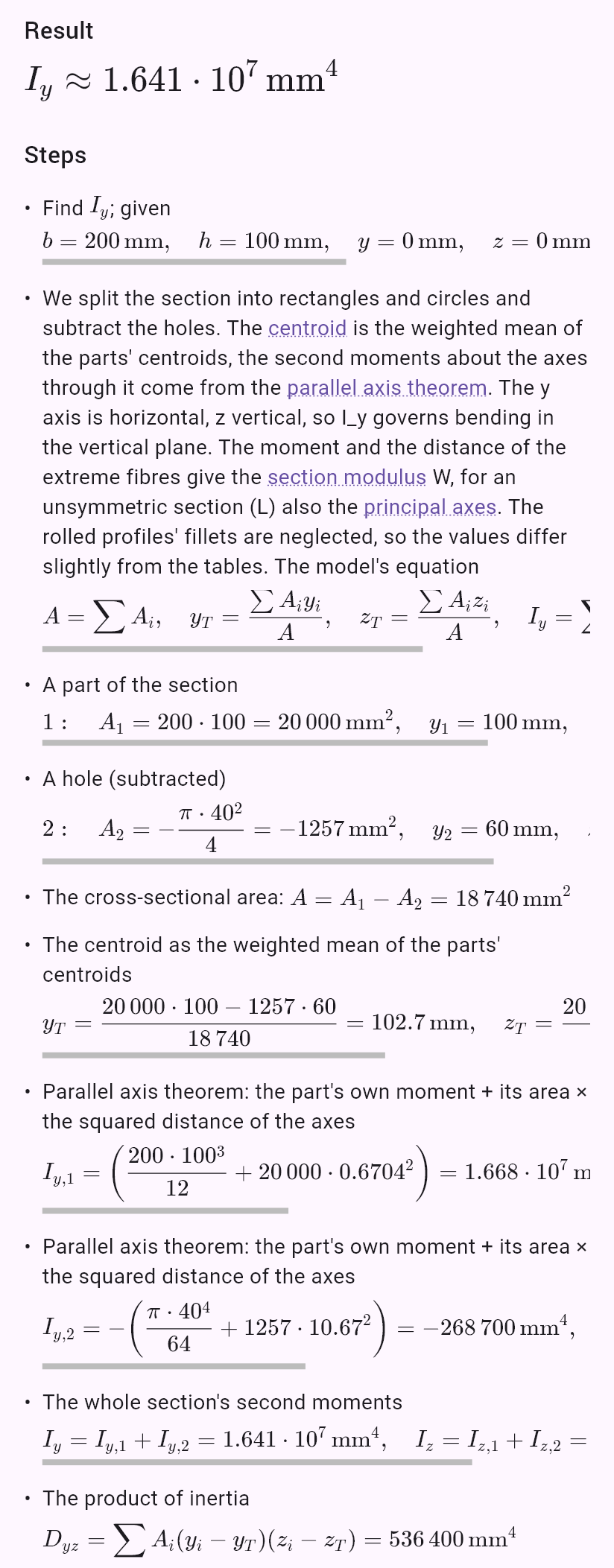
model(statics; mode=section; shape=composite; find=Iy[mm4]; rb=200[mm]; rh=100[mm]; ry=0[mm]; rz=0[mm]; hd=40[mm]; hcy=60[mm]; hcz=60[mm])
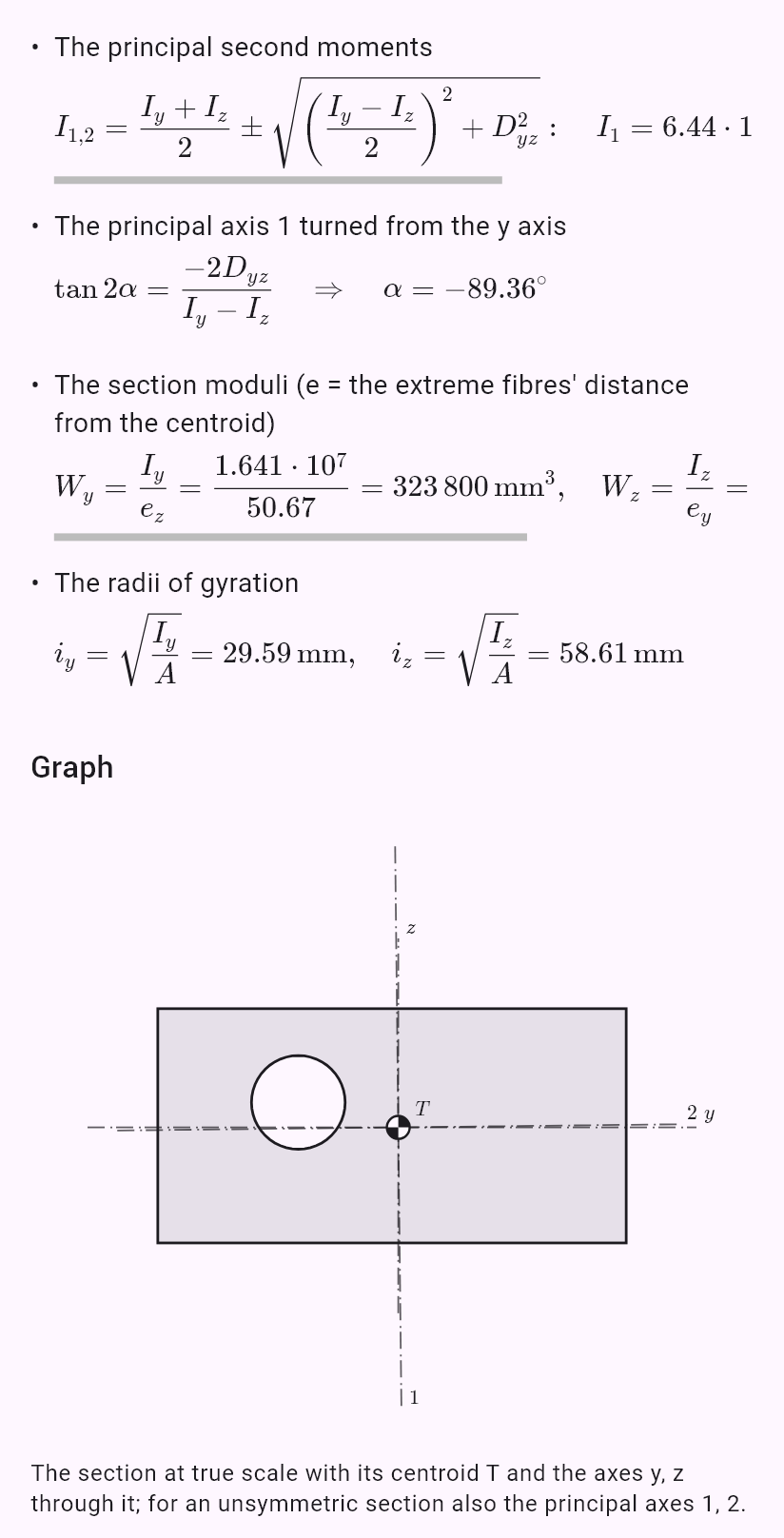
model(statics; mode=section; shape=composite; find=Iy[mm4]; rb=200[mm]; rh=100[mm]; ry=0[mm]; rz=0[mm]; hd=40[mm]; hcy=60[mm]; hcz=60[mm])model(statics; mode=section; shape=composite; find=Iy[mm4]; rb=200[mm]; rh=100[mm]; ry=0[mm]; rz=0[mm]; hd=40[mm]; hcy=60[mm]; hcz=60[mm])
A tanker half full of water braking at 5 m/s²: the front axle carries tens of per cent more.
Input: model(tanker; mode=brake; find=Nf[kN]; shape=cylinder; liquid=water; f=50[pct]; a=5[m_s2]; rho=1000[kg_m3]; Lt=8[m]; W=2[m]; H=2[m]; xt=0.6[m]; zt=1.25[m]; M=14[t]; xM=6.4[m]; zM=1.05[m]; xr=2.65[m]; xf=9.9[m])
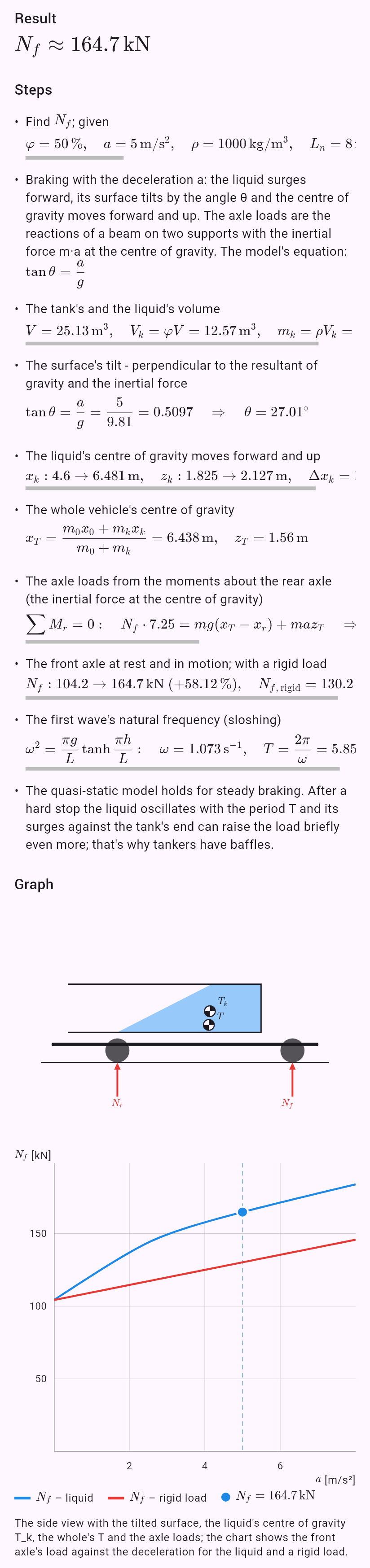
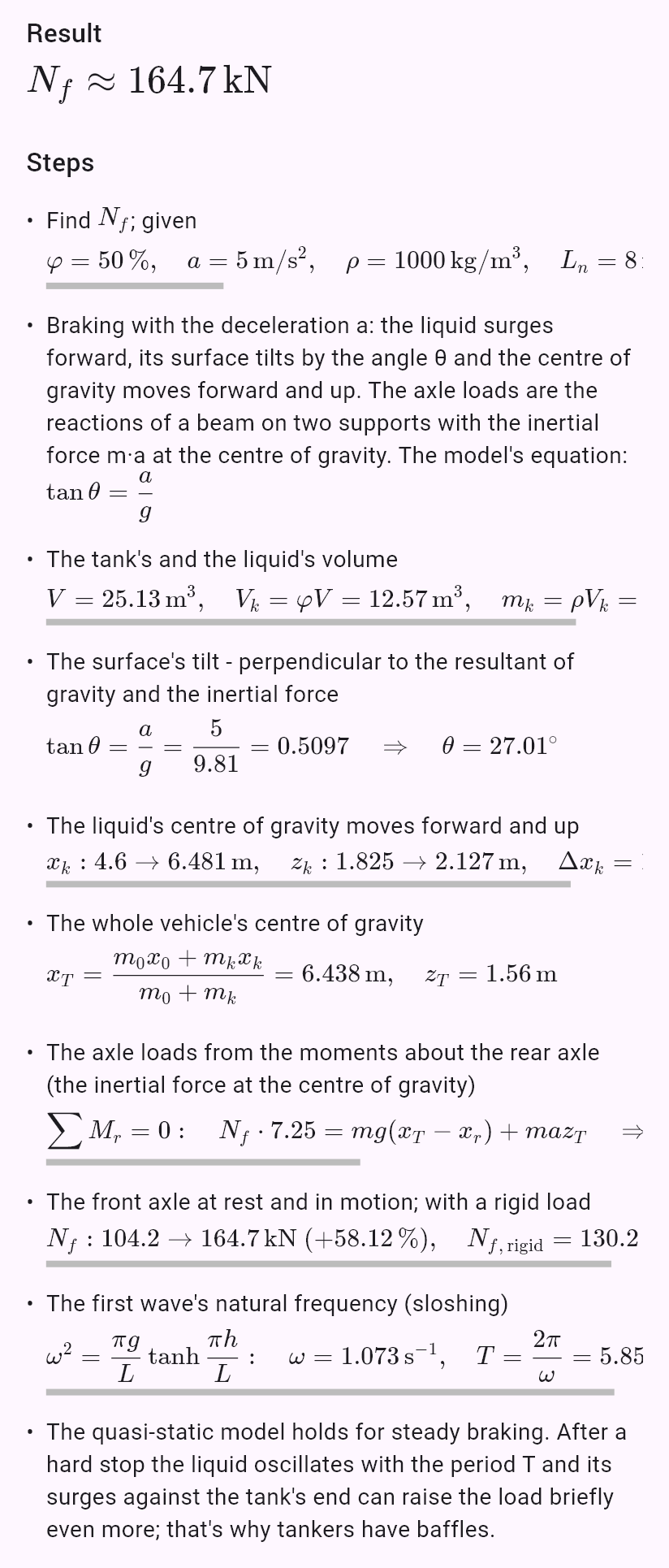
model(tanker; mode=brake; find=Nf[kN]; shape=cylinder; liquid=water; f=50[pct]; a=5[m_s2]; rho=1000[kg_m3]; Lt=8[m]; W=2[m]; H=2[m]; xt=0.6[m]; zt=1.25[m]; M=14[t]; xM=6.4[m]; zM=1.05[m]; xr=2.65[m]; xf=9.9[m])
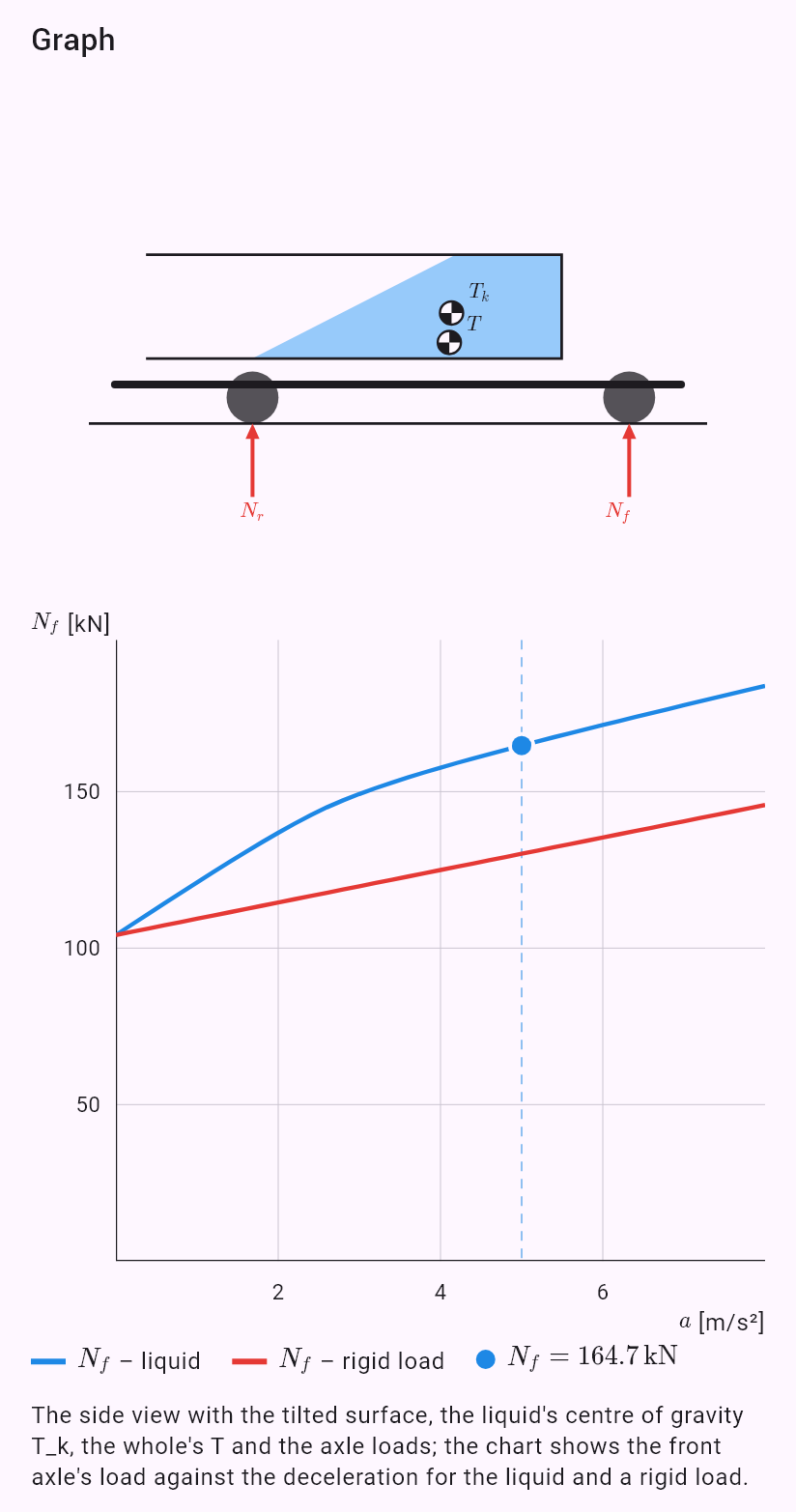
model(tanker; mode=brake; find=Nf[kN]; shape=cylinder; liquid=water; f=50[pct]; a=5[m_s2]; rho=1000[kg_m3]; Lt=8[m]; W=2[m]; H=2[m]; xt=0.6[m]; zt=1.25[m]; M=14[t]; xM=6.4[m]; zM=1.05[m]; xr=2.65[m]; xf=9.9[m])model(tanker; mode=brake; find=Nf[kN]; shape=cylinder; liquid=water; f=50[pct]; a=5[m_s2]; rho=1000[kg_m3]; Lt=8[m]; W=2[m]; H=2[m]; xt=0.6[m]; zt=1.25[m]; M=14[t]; xM=6.4[m]; zM=1.05[m]; xr=2.65[m]; xf=9.9[m])

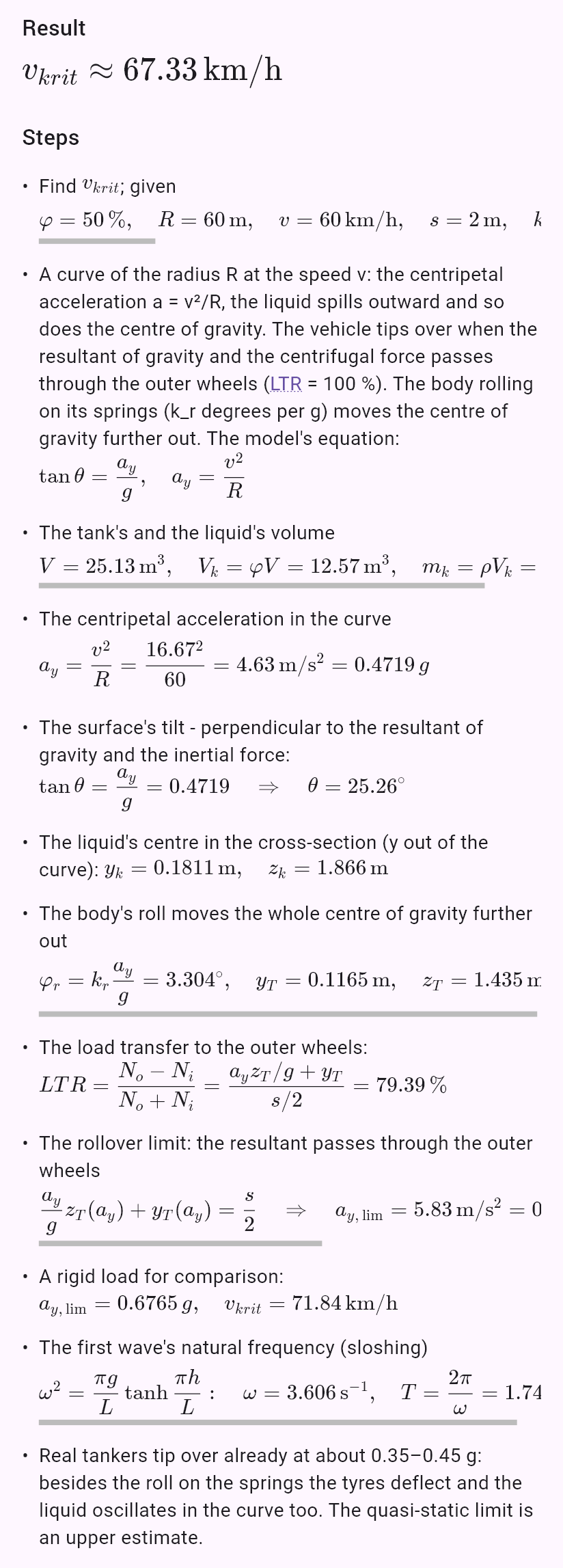
The same tanker in a curve of R = 60 m: the critical speed with the liquid and with a rigid load.
Input: model(tanker; mode=curve; find=vcrit[km_h]; shape=cylinder; liquid=water; f=50[pct]; R=60[m]; v=60[km_h]; tw=2[m]; k=7[deg]; zr=0.9[m]; rho=1000[kg_m3]; Lt=8[m]; W=2[m]; H=2[m]; xt=0.6[m]; zt=1.25[m]; M=14[t]; xM=6.4[m]; zM=1.05[m]; xr=2.65[m]; xf=9.9[m])
model(tanker; mode=curve; find=vcrit[km_h]; shape=cylinder; liquid=water; f=50[pct]; R=60[m]; v=60[km_h]; tw=2[m]; k=7[deg]; zr=0.9[m]; rho=1000[kg_m3]; Lt=8[m]; W=2[m]; H=2[m]; xt=0.6[m]; zt=1.25[m]; M=14[t]; xM=6.4[m]; zM=1.05[m]; xr=2.65[m]; xf=9.9[m])
model(tanker; mode=curve; find=vcrit[km_h]; shape=cylinder; liquid=water; f=50[pct]; R=60[m]; v=60[km_h]; tw=2[m]; k=7[deg]; zr=0.9[m]; rho=1000[kg_m3]; Lt=8[m]; W=2[m]; H=2[m]; xt=0.6[m]; zt=1.25[m]; M=14[t]; xM=6.4[m]; zM=1.05[m]; xr=2.65[m]; xf=9.9[m])model(tanker; mode=curve; find=vcrit[km_h]; shape=cylinder; liquid=water; f=50[pct]; R=60[m]; v=60[km_h]; tw=2[m]; k=7[deg]; zr=0.9[m]; rho=1000[kg_m3]; Lt=8[m]; W=2[m]; H=2[m]; xt=0.6[m]; zt=1.25[m]; M=14[t]; xM=6.4[m]; zM=1.05[m]; xr=2.65[m]; xf=9.9[m])
A 2 m cantilever with a 10 kN force: IPE 200 from the tables, the optimal tube and a tube of uniform strength.
Input: model(beamdesign; find=m[kg]; support=cantilever; load=force; shape=tube; material=s235; L=2[m]; F=10[kN]; sigma=160[MPa]; tau=95[MPa]; E=210[GPa]; rho=7850[kg_m3]; n=250; lambda=50)

model(beamdesign; find=m[kg]; support=cantilever; load=force; shape=tube; material=s235; L=2[m]; F=10[kN]; sigma=160[MPa]; tau=95[MPa]; E=210[GPa]; rho=7850[kg_m3]; n=250; lambda=50)
model(beamdesign; find=m[kg]; support=cantilever; load=force; shape=tube; material=s235; L=2[m]; F=10[kN]; sigma=160[MPa]; tau=95[MPa]; E=210[GPa]; rho=7850[kg_m3]; n=250; lambda=50)model(beamdesign; find=m[kg]; support=cantilever; load=force; shape=tube; material=s235; L=2[m]; F=10[kN]; sigma=160[MPa]; tau=95[MPa]; E=210[GPa]; rho=7850[kg_m3]; n=250; lambda=50)model(beamdesign; find=m[kg]; support=cantilever; load=force; shape=tube; material=s235; L=2[m]; F=10[kN]; sigma=160[MPa]; tau=95[MPa]; E=210[GPa]; rho=7850[kg_m3]; n=250; lambda=50)model(beamdesign; find=m[kg]; support=cantilever; load=force; shape=tube; material=s235; L=2[m]; F=10[kN]; sigma=160[MPa]; tau=95[MPa]; E=210[GPa]; rho=7850[kg_m3]; n=250; lambda=50)
A rectangle of uniform strength of constant width: its height a parabola along the beam, a third less material.
Input: model(beamdesign; find=m[kg]; support=cantilever; load=force; shape=rect; material=s235; L=2[m]; F=10[kN]; sigma=160[MPa]; tau=95[MPa]; E=210[GPa]; rho=7850[kg_m3]; n=50; k=2)

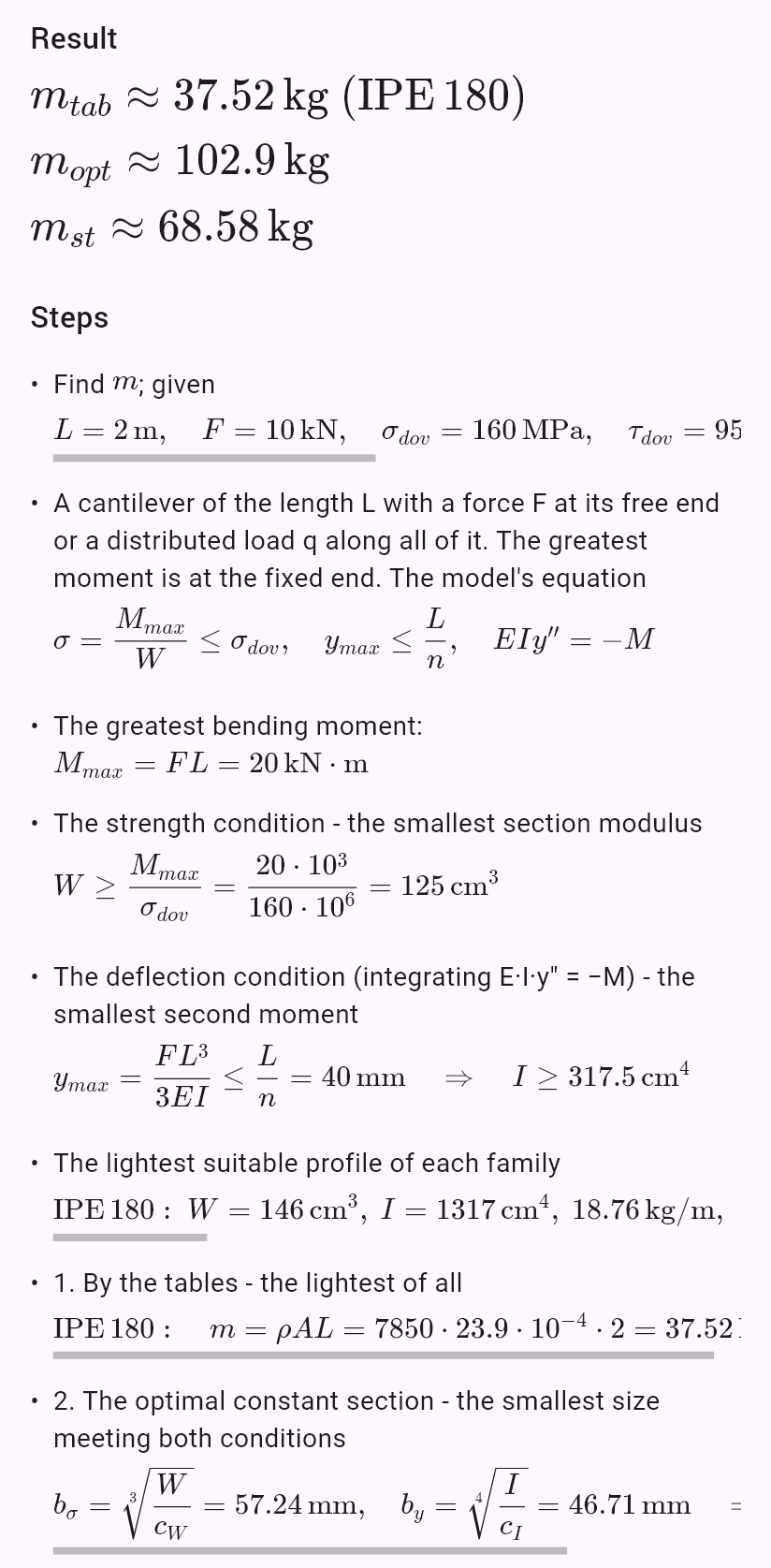
model(beamdesign; find=m[kg]; support=cantilever; load=force; shape=rect; material=s235; L=2[m]; F=10[kN]; sigma=160[MPa]; tau=95[MPa]; E=210[GPa]; rho=7850[kg_m3]; n=50; k=2)
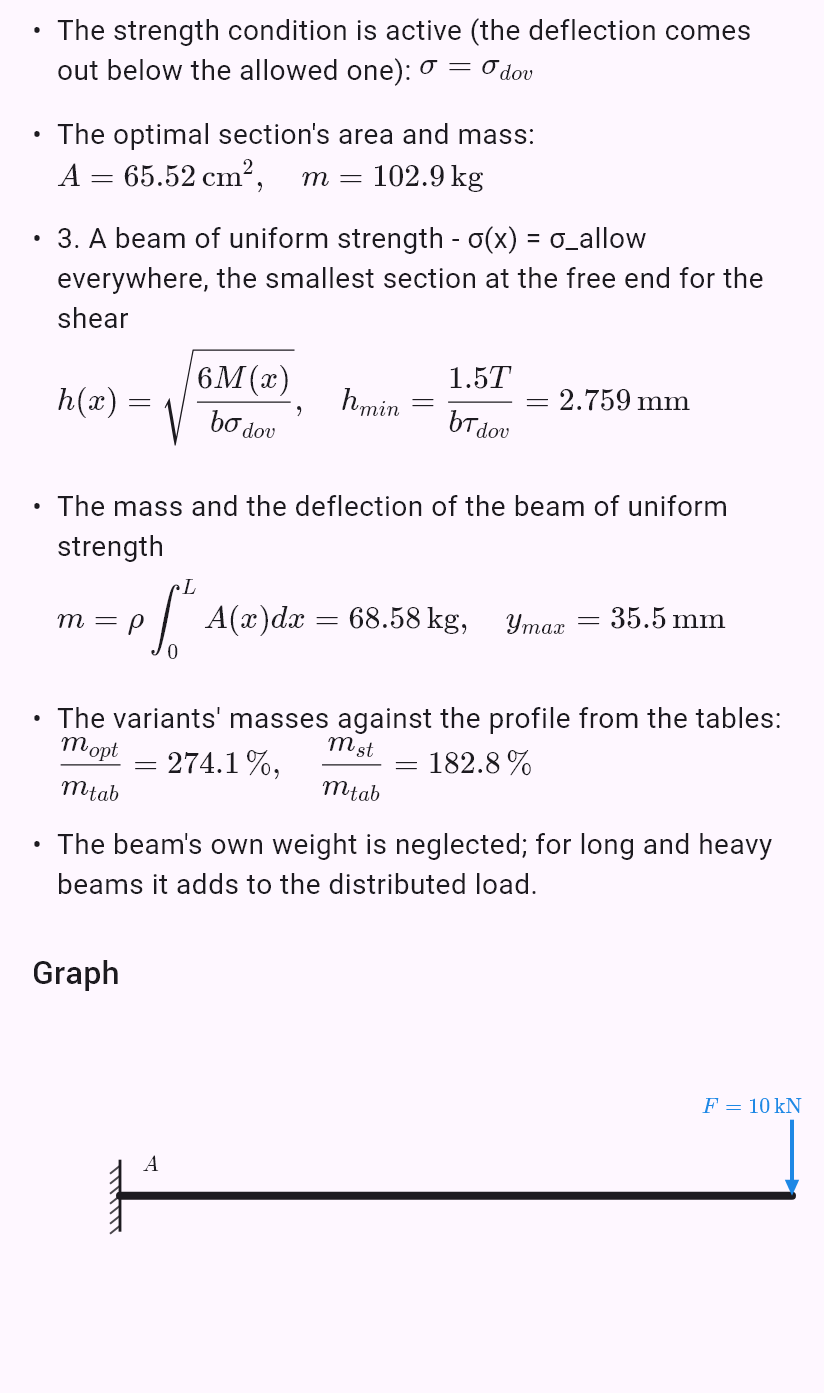
model(beamdesign; find=m[kg]; support=cantilever; load=force; shape=rect; material=s235; L=2[m]; F=10[kN]; sigma=160[MPa]; tau=95[MPa]; E=210[GPa]; rho=7850[kg_m3]; n=50; k=2)model(beamdesign; find=m[kg]; support=cantilever; load=force; shape=rect; material=s235; L=2[m]; F=10[kN]; sigma=160[MPa]; tau=95[MPa]; E=210[GPa]; rho=7850[kg_m3]; n=50; k=2)model(beamdesign; find=m[kg]; support=cantilever; load=force; shape=rect; material=s235; L=2[m]; F=10[kN]; sigma=160[MPa]; tau=95[MPa]; E=210[GPa]; rho=7850[kg_m3]; n=50; k=2)model(beamdesign; find=m[kg]; support=cantilever; load=force; shape=rect; material=s235; L=2[m]; F=10[kN]; sigma=160[MPa]; tau=95[MPa]; E=210[GPa]; rho=7850[kg_m3]; n=50; k=2)
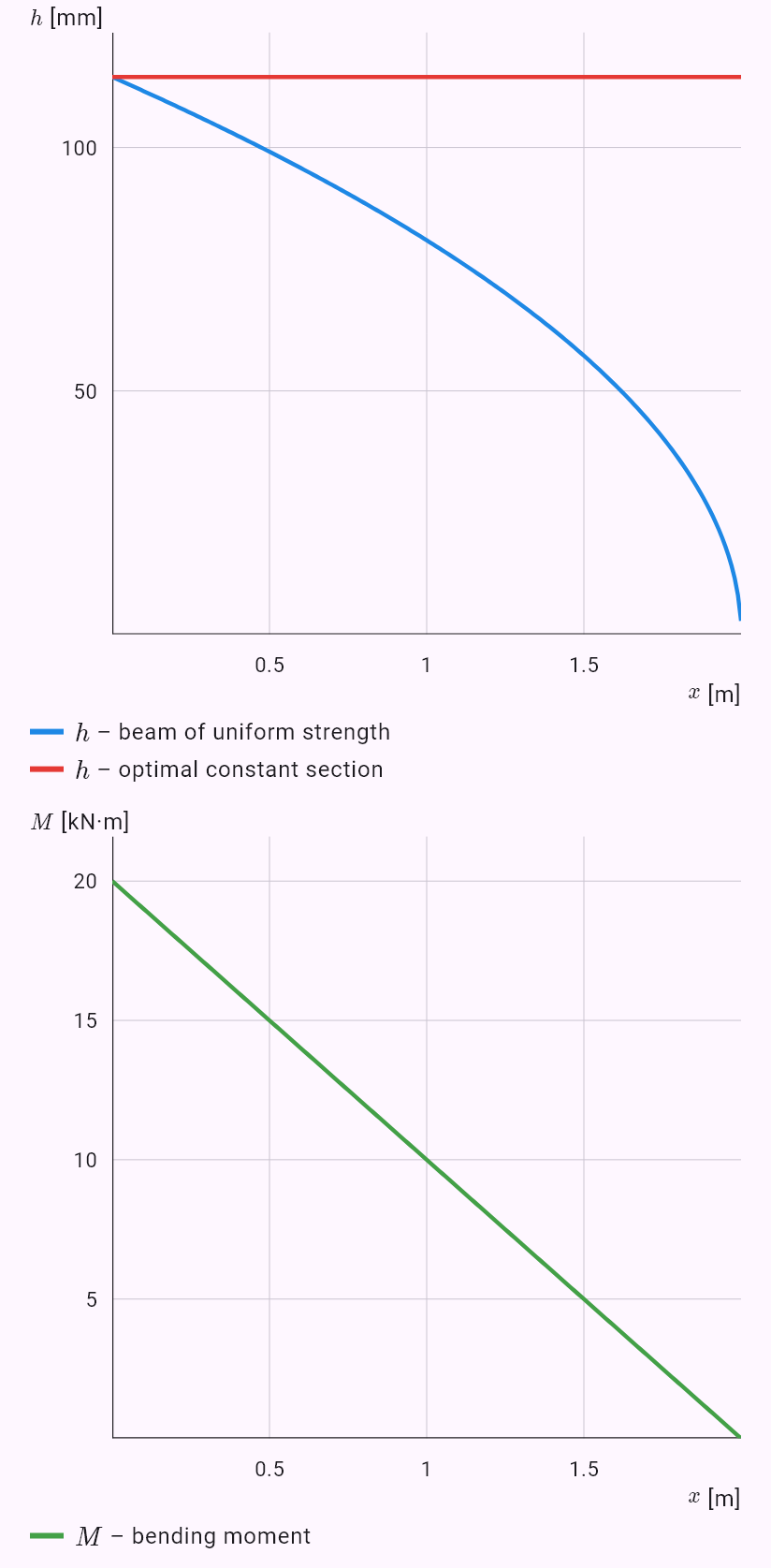
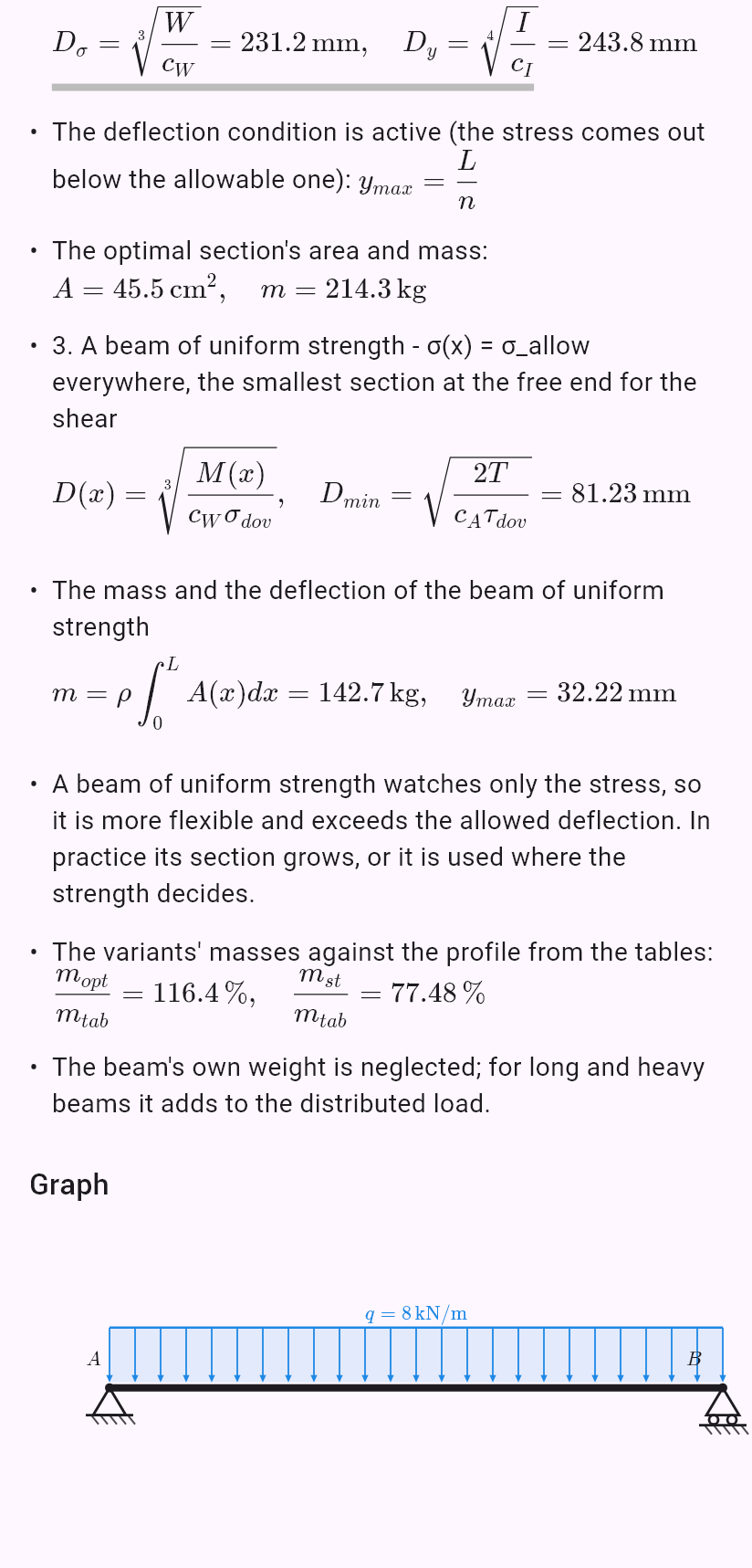
A 6 m simply supported beam with a distributed load: the deflection decides.
Input: model(beamdesign; find=m[kg]; support=simple; load=uniform; shape=tube; material=s235; L=6[m]; q=8[kN_m]; sigma=160[MPa]; tau=95[MPa]; E=210[GPa]; rho=7850[kg_m3]; n=300; lambda=40)

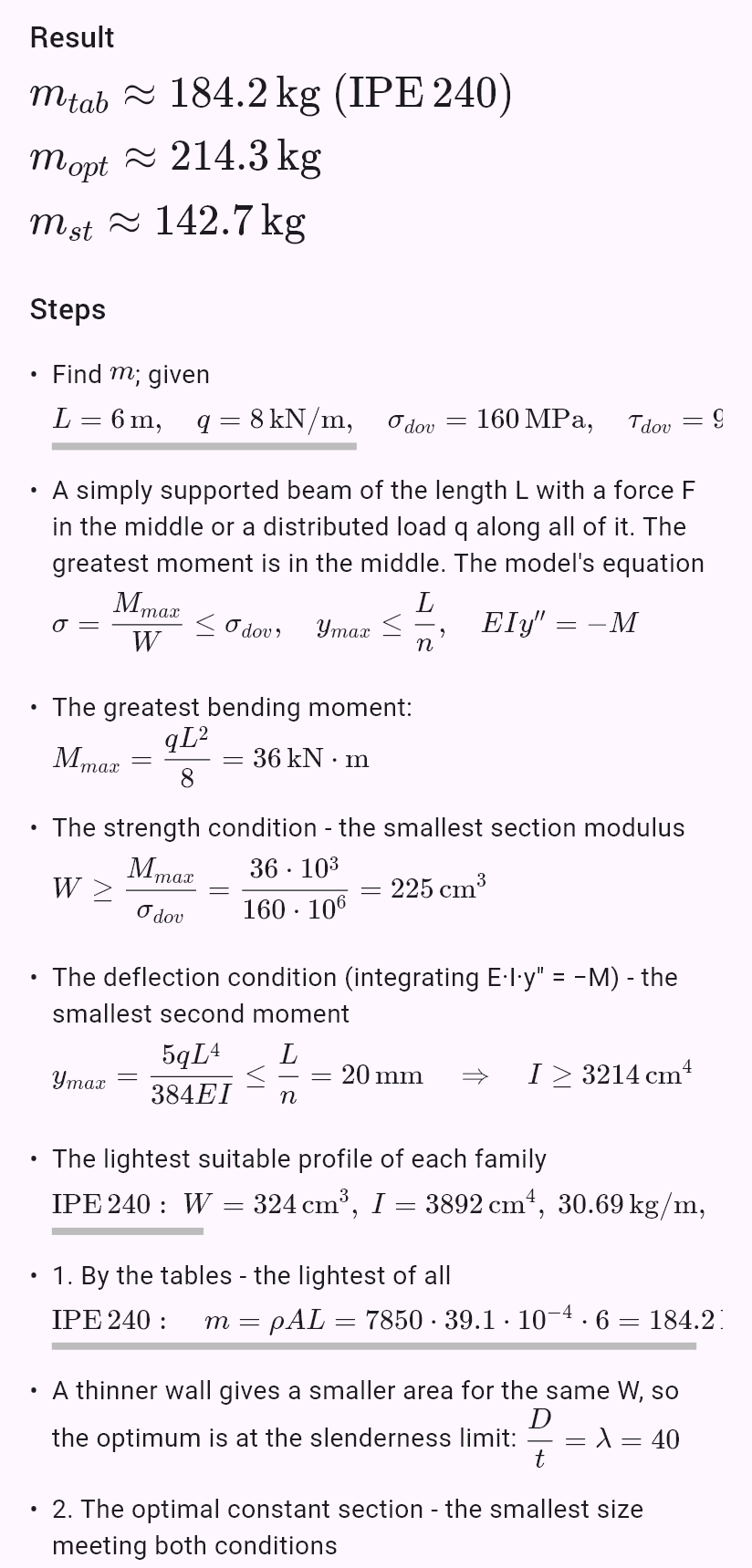
model(beamdesign; find=m[kg]; support=simple; load=uniform; shape=tube; material=s235; L=6[m]; q=8[kN_m]; sigma=160[MPa]; tau=95[MPa]; E=210[GPa]; rho=7850[kg_m3]; n=300; lambda=40)
model(beamdesign; find=m[kg]; support=simple; load=uniform; shape=tube; material=s235; L=6[m]; q=8[kN_m]; sigma=160[MPa]; tau=95[MPa]; E=210[GPa]; rho=7850[kg_m3]; n=300; lambda=40)model(beamdesign; find=m[kg]; support=simple; load=uniform; shape=tube; material=s235; L=6[m]; q=8[kN_m]; sigma=160[MPa]; tau=95[MPa]; E=210[GPa]; rho=7850[kg_m3]; n=300; lambda=40)model(beamdesign; find=m[kg]; support=simple; load=uniform; shape=tube; material=s235; L=6[m]; q=8[kN_m]; sigma=160[MPa]; tau=95[MPa]; E=210[GPa]; rho=7850[kg_m3]; n=300; lambda=40)model(beamdesign; find=m[kg]; support=simple; load=uniform; shape=tube; material=s235; L=6[m]; q=8[kN_m]; sigma=160[MPa]; tau=95[MPa]; E=210[GPa]; rho=7850[kg_m3]; n=300; lambda=40)