Limits
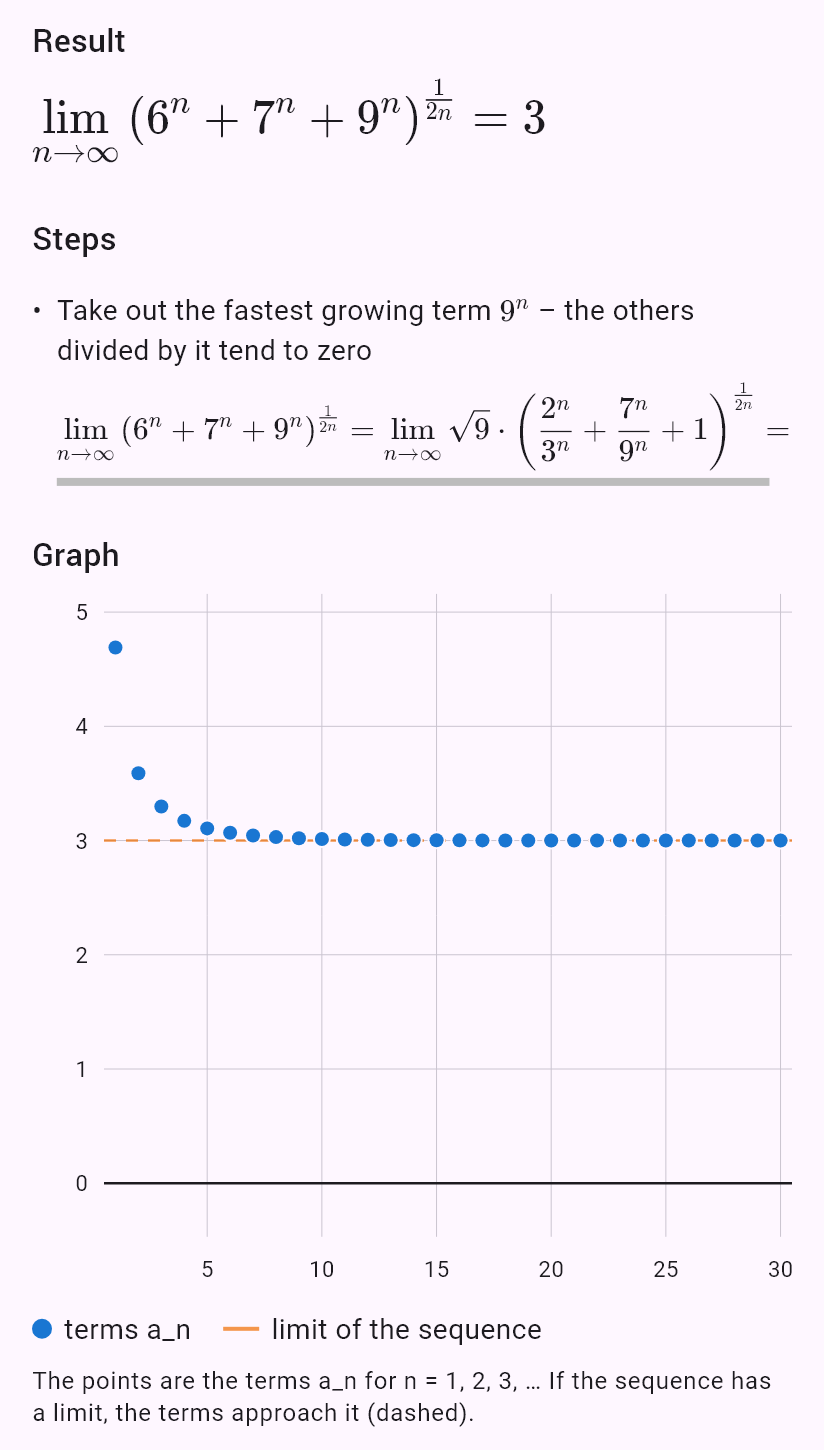
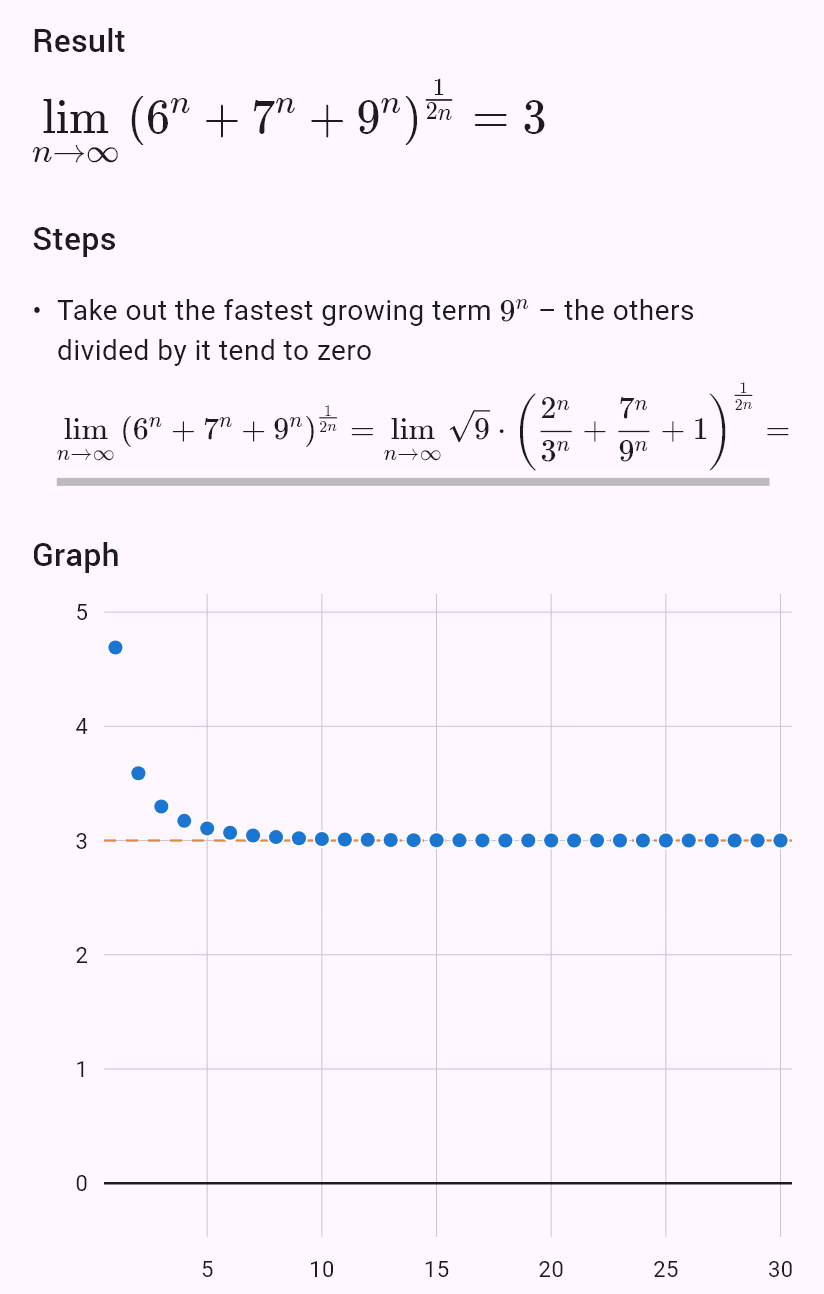
MathSolver computes the limit of a function of one variable at a point, at infinity, and one-sided limits, and proceeds as at school: first it tries to substitute into the function. The limit of a sequence (n → ∞) works the same way – the form 1^∞ too, or a sum of powers with the fastest growing term taken out.
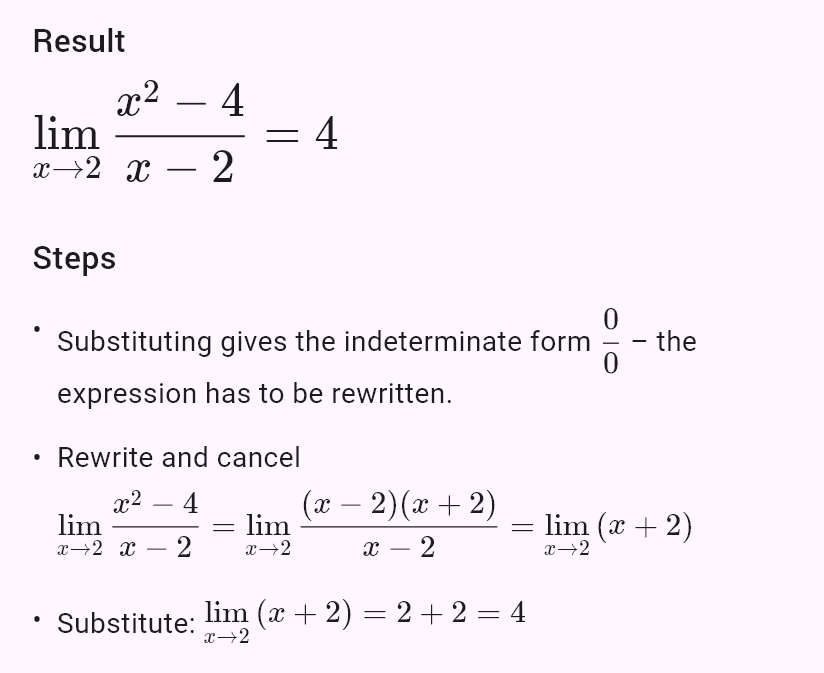
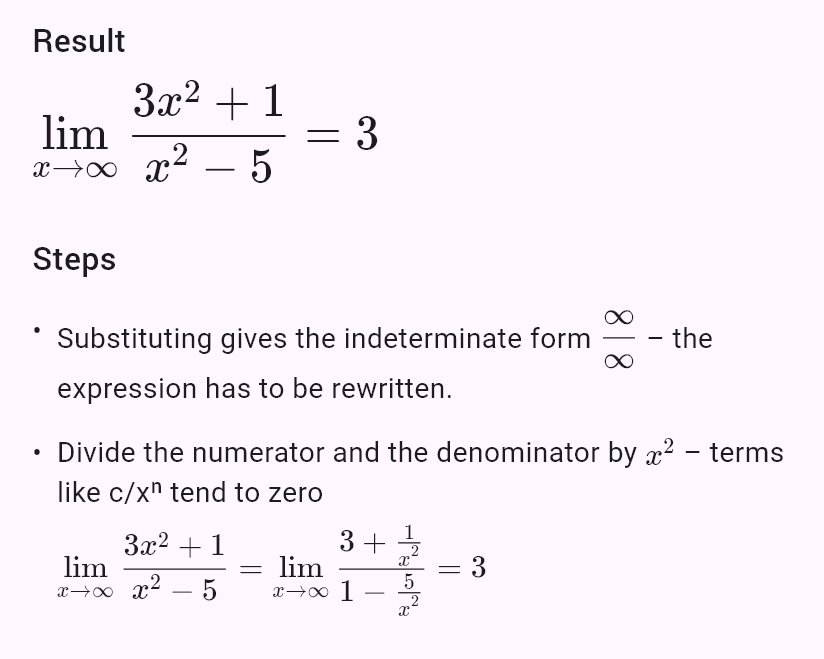
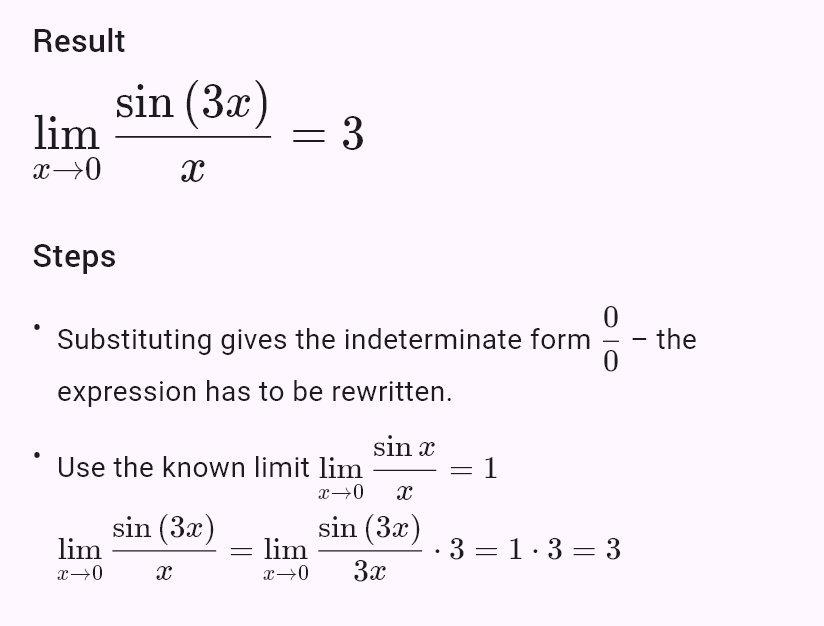
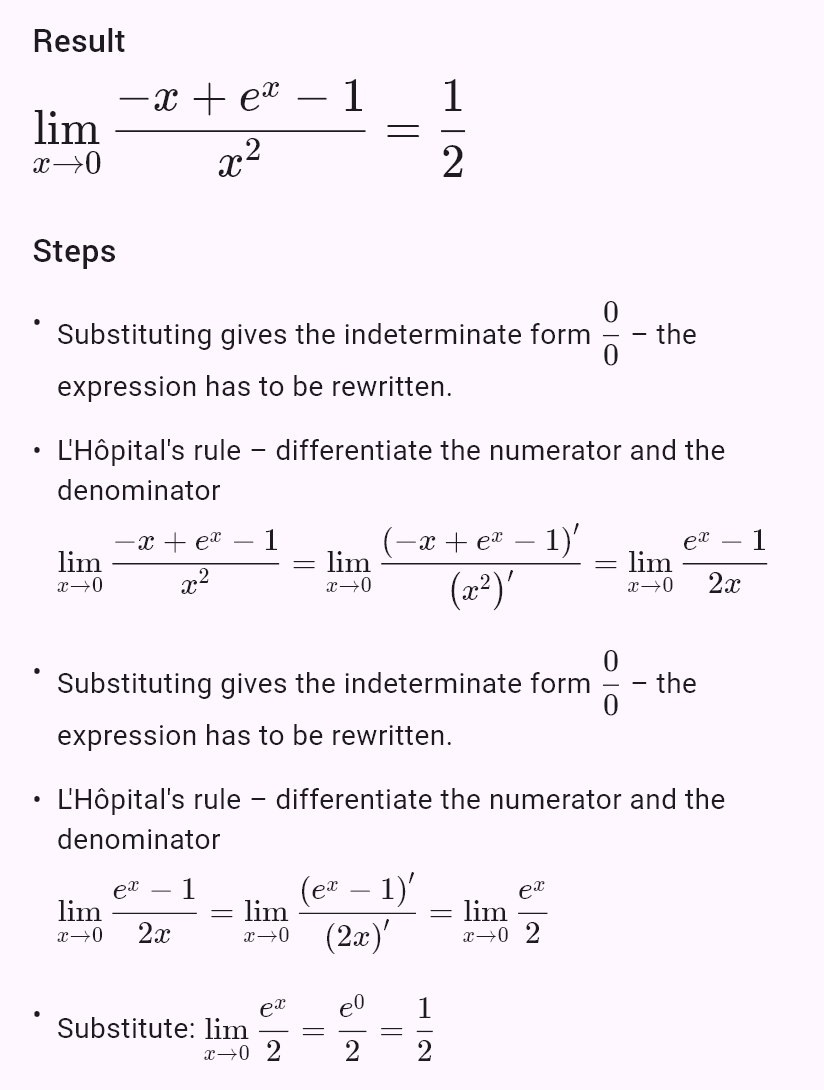
If substitution gives an indeterminate form (0/0, ∞/∞, …), it chooses a transformation by the form of the function – factoring and cancelling, multiplying by the conjugate, dividing by the highest power, a known limit (sin x / x) or L'Hôpital's rule, repeatedly if needed.
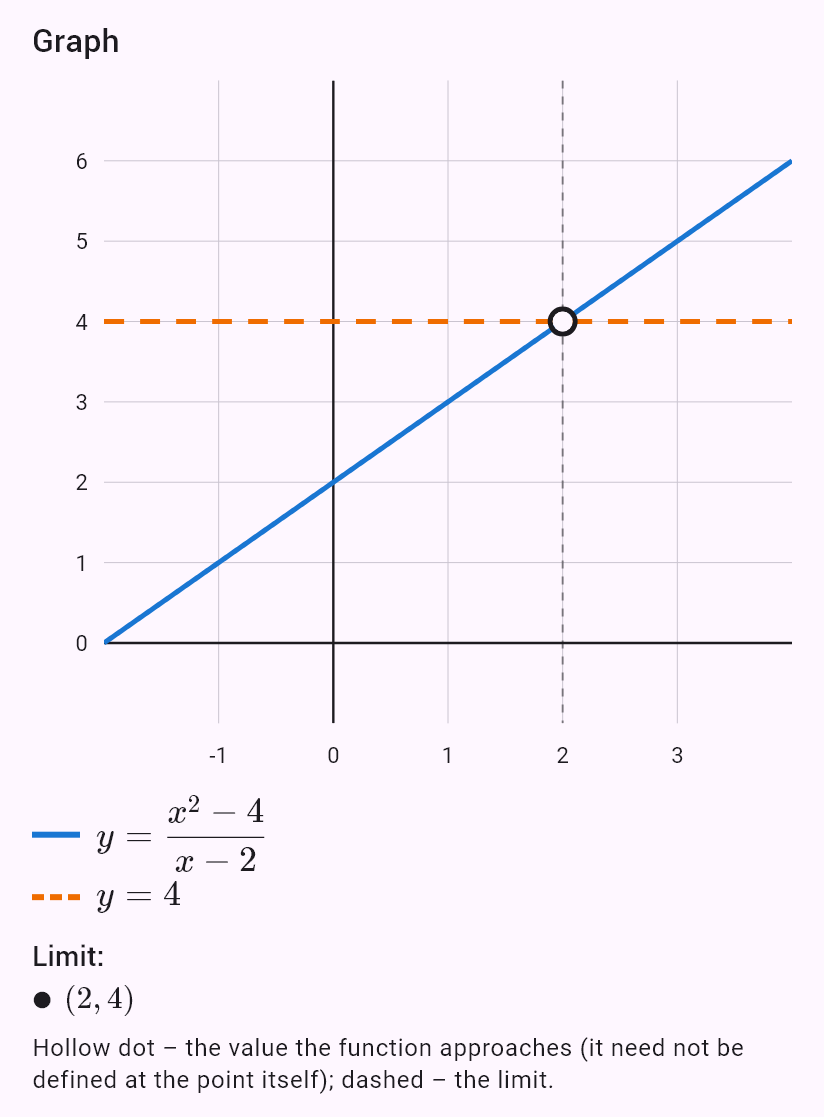
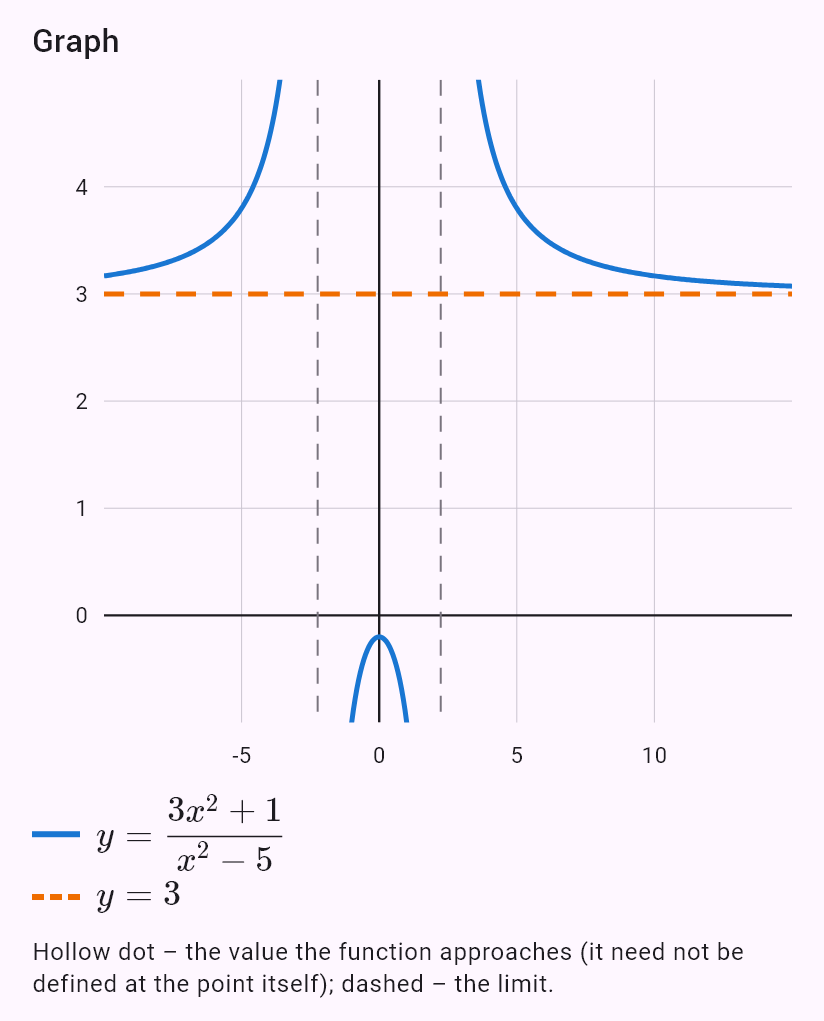
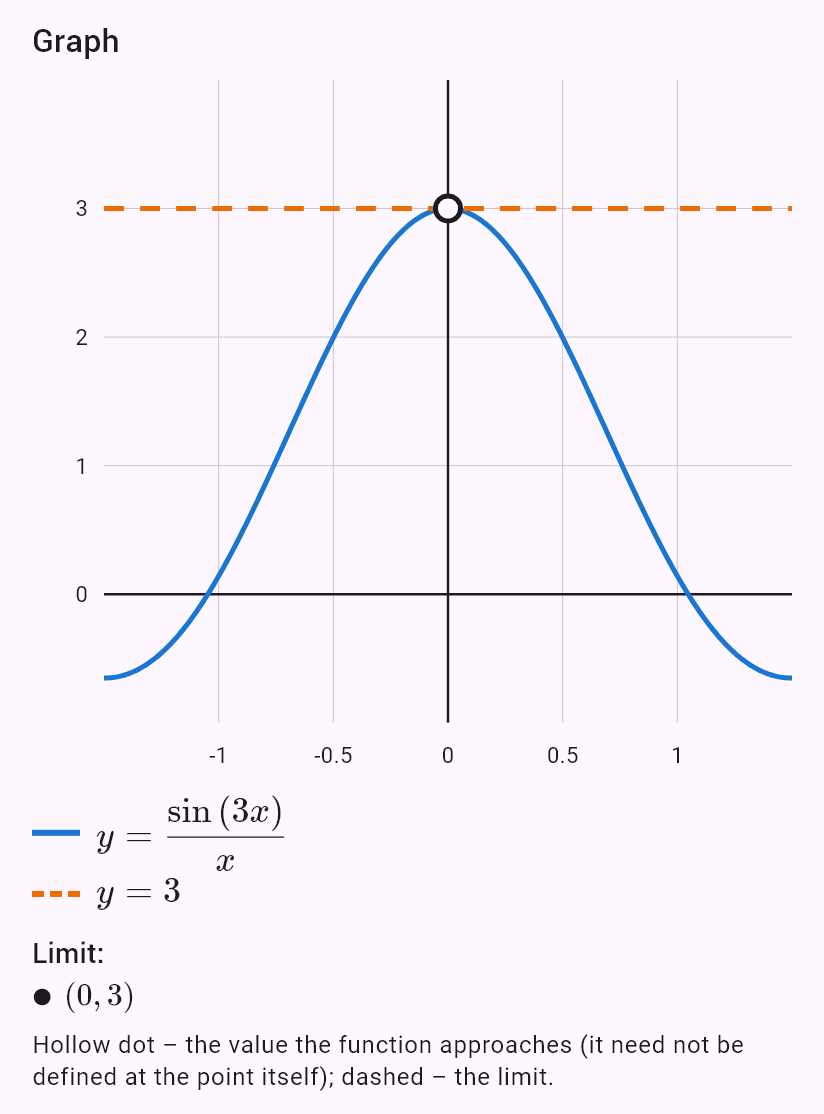
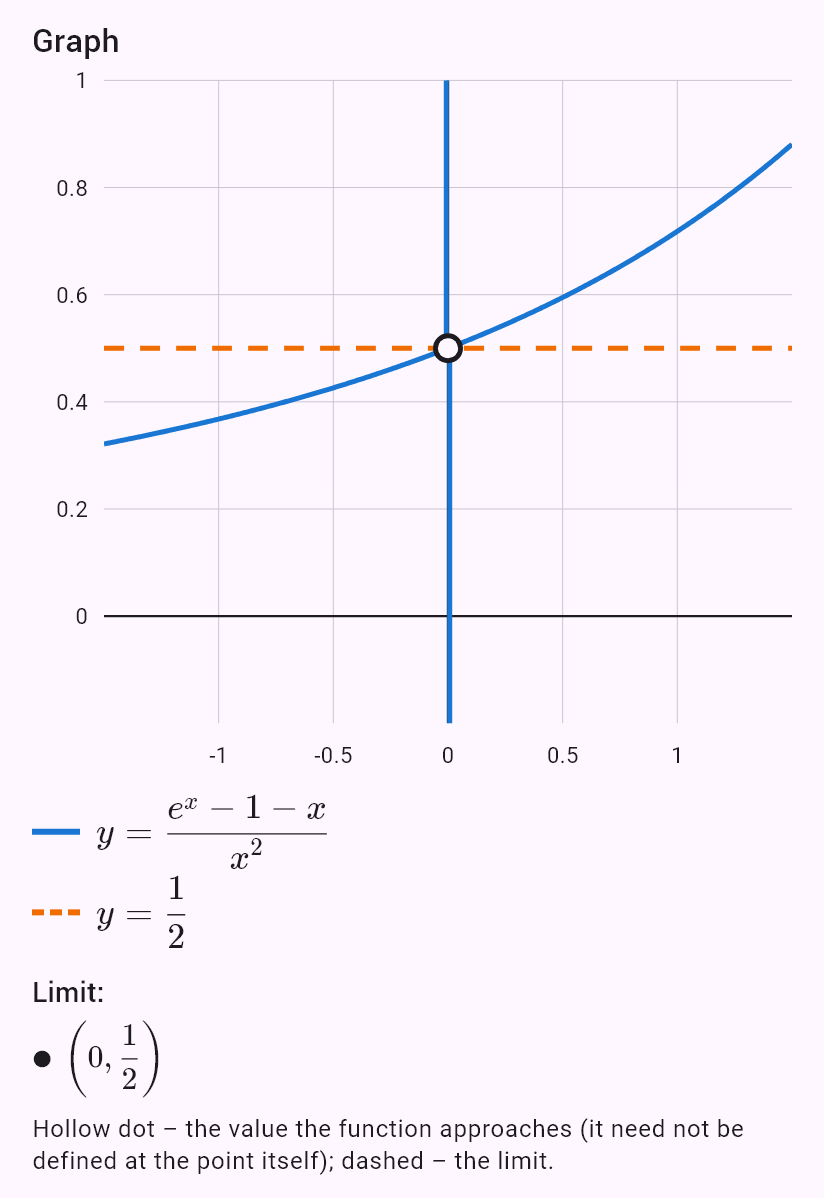
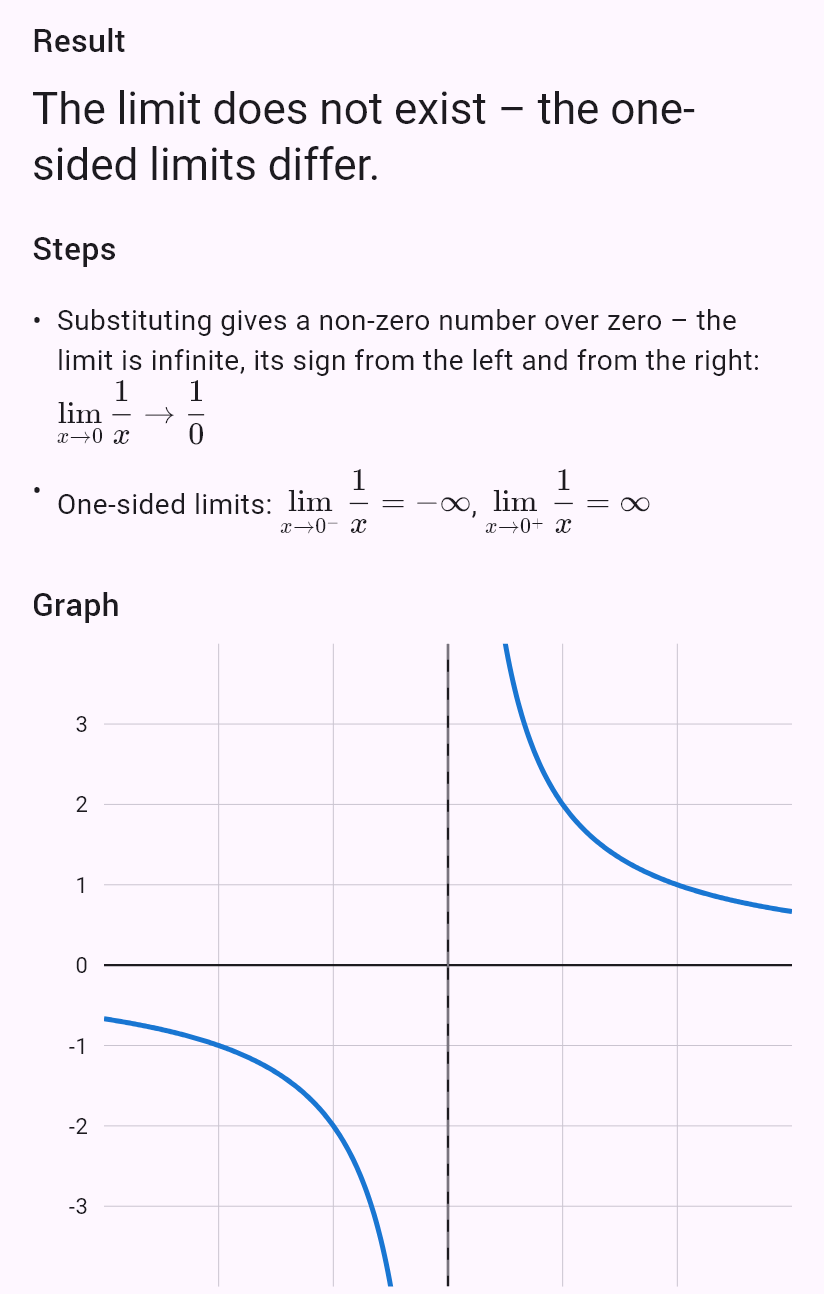
An infinite limit, or a limit that does not exist (the one-sided limits differ), is never passed off as a number – the app says so in words and shows the one-sided limits. The result comes with a graph of the function near the point with the limit value marked.
For the limit of a sequence the graph shows the points a₁, a₂, a₃, … instead of a continuous curve.
How to enter it
lim(x->2) (x^2-4)/(x-2) | A typed limit: after the word lim, in brackets the variable, the arrow -> and the point, then the function. |
lim(x->oo) (3x^2+1)/(x^2-5) | A limit at infinity: infinity is written oo (minus infinity -oo). |
lim(x->0+) 1/x | A one-sided limit: + (from the right) or − (from the left) after the point. |
\lim_{x \to 0} \frac{\sin x}{x} | From a photo, or in LaTeX as the camera recognizes it. |
lim(n->oo) ((n+2)/(n+1))^(2n+3) | The limit of a sequence at infinity. |
Examples
lim(x->2) (x^2-4)/(x-2)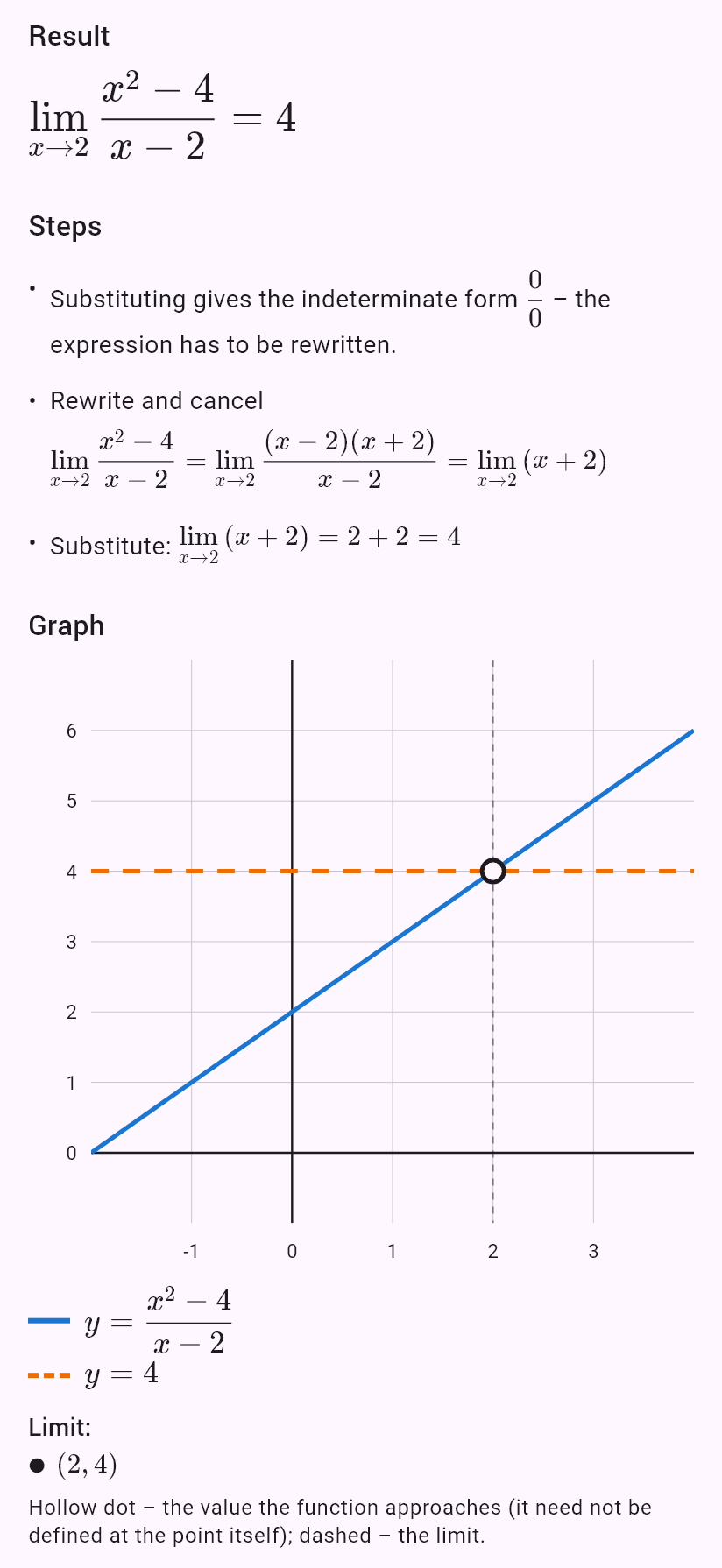
lim(x->oo) (3x^2+1)/(x^2-5)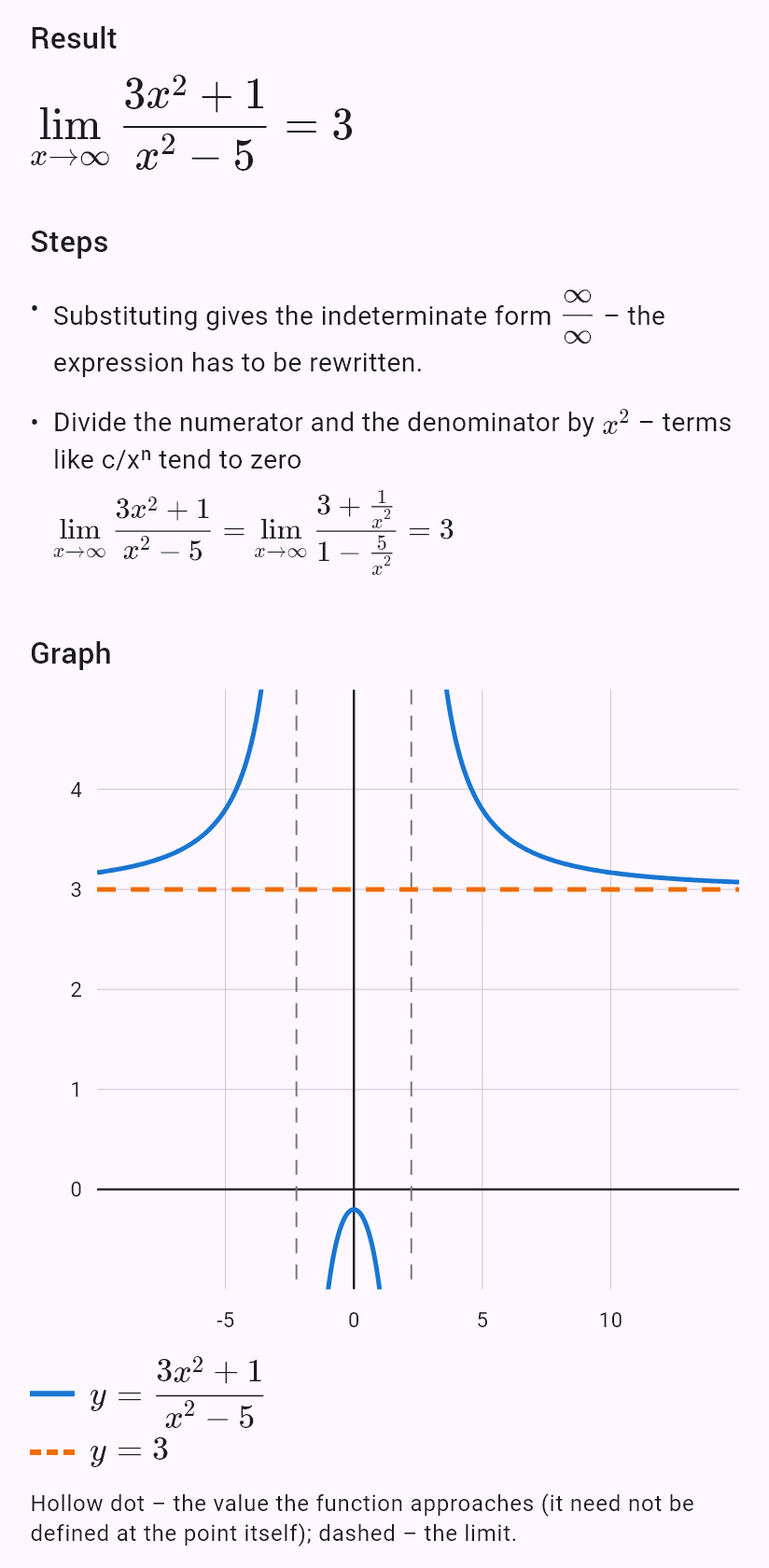
lim(x->0) sin(3x)/x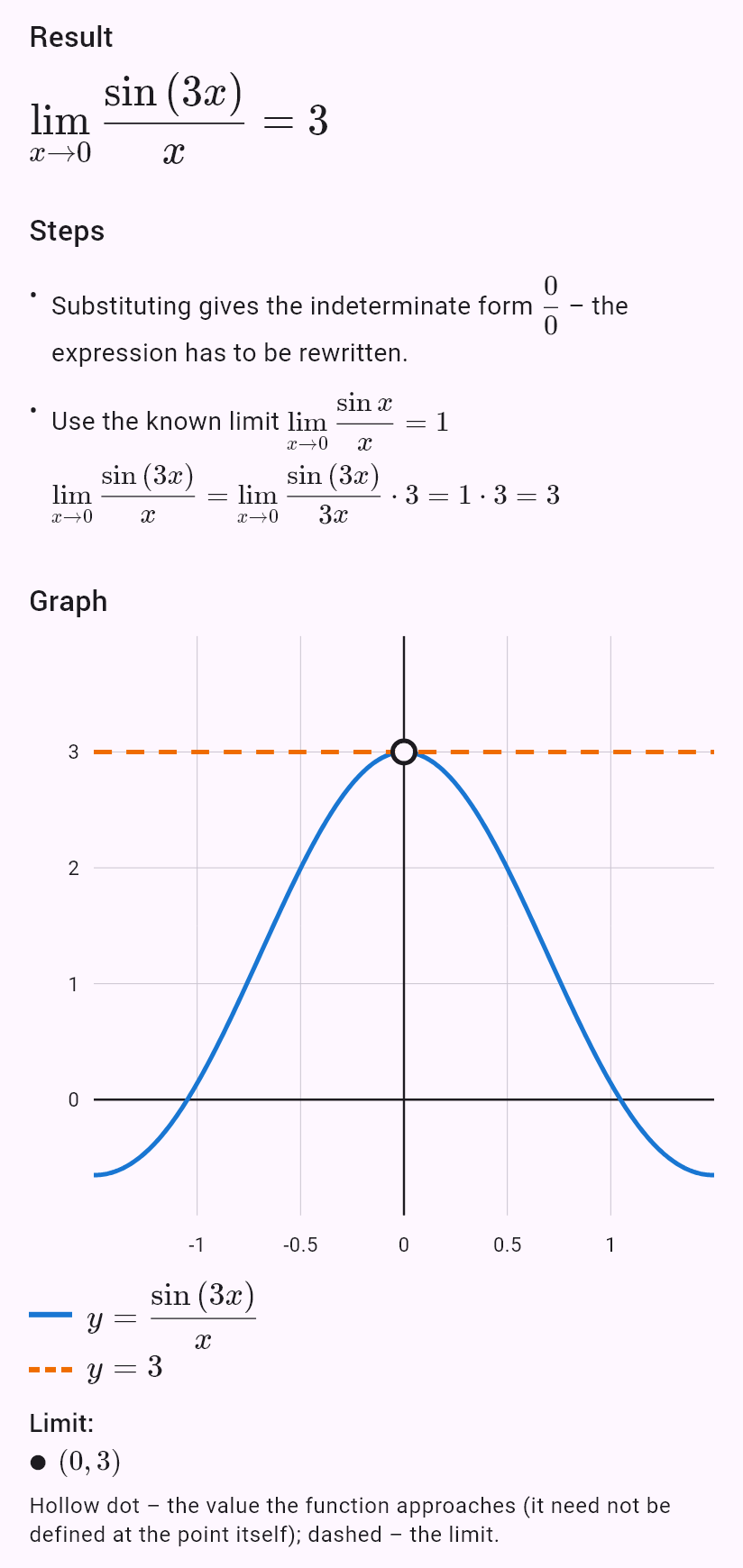
lim(x->0) (e^x-1-x)/x^2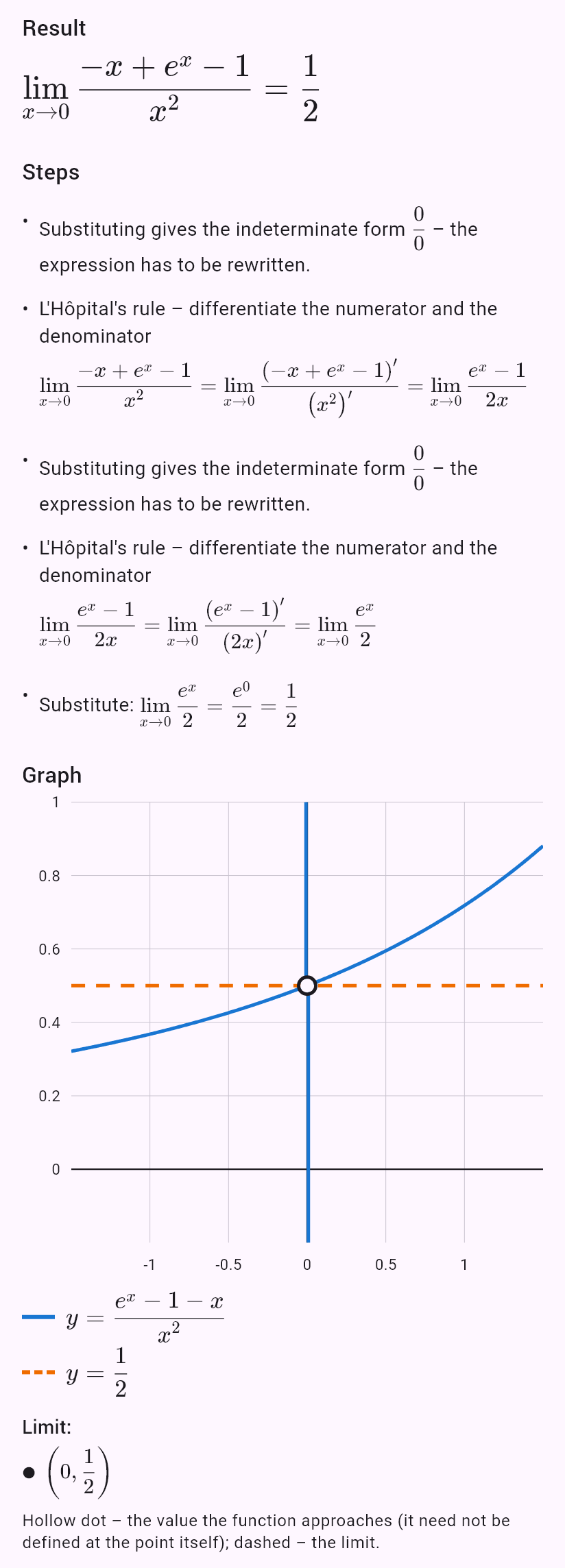
lim(x->0) 1/x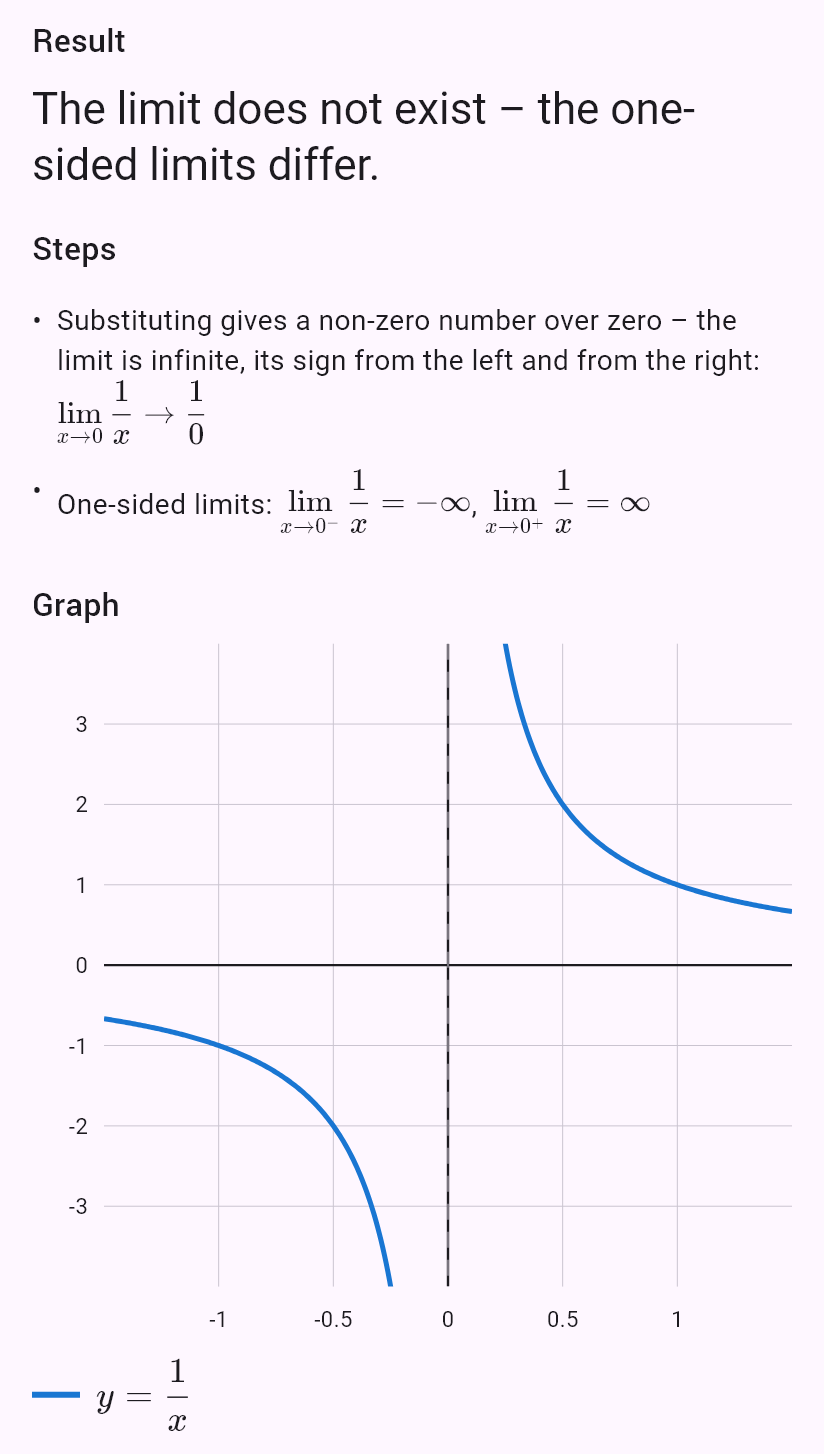

lim(n->oo) (6^n+7^n+9^n)^(1/(2n))