I. Equations, inequalities and expressions
13. Simplifying expressions
The app transforms an expression without an equals sign according to the chosen chip: it simplifies it (a rational expression over a common denominator and cancelled, with conditions), expands it, factors it (by taking out a common factor, by formulas and by synthetic division) or splits it into partial fractions – as on paper, with equations for the unknown coefficients. Factoring is over the integers; if the expression factors further over the reals (by irrational roots), the next step shows it. A root of a monomial is taken out partly – with an even root as an absolute value where the base may be negative. Complex numbers work too – a quotient by multiplying with the complex conjugate.
Numeric expressions with fractions are worked out step by step as at school: the innermost brackets first (round, square or curly), a compound fraction’s numerator and denominator separately, then powers, multiplication and division (by a fraction as multiplication by its reciprocal, also with a colon or ÷) and the addition over a common denominator last. Type a mixed number with a space – 2 1/3 (from a photo also 2⅓) – and the app first turns it into a fraction; write a product of two numbers always with a dot. A result above 1 is shown as a mixed number too.
Write a polynomial divided by a polynomial with a colon: (2x^3 + 3x^2 - x + 5) : (x^2 + 1). The app does long division as on paper – divides the leading terms, multiplies the divisor by the result and subtracts – and shows the quotient, the remainder and a check; for a divisor x − a it also offers Horner’s scheme. A fraction p/q is simplified as before; choose the division with the “Polynomial division” chip.
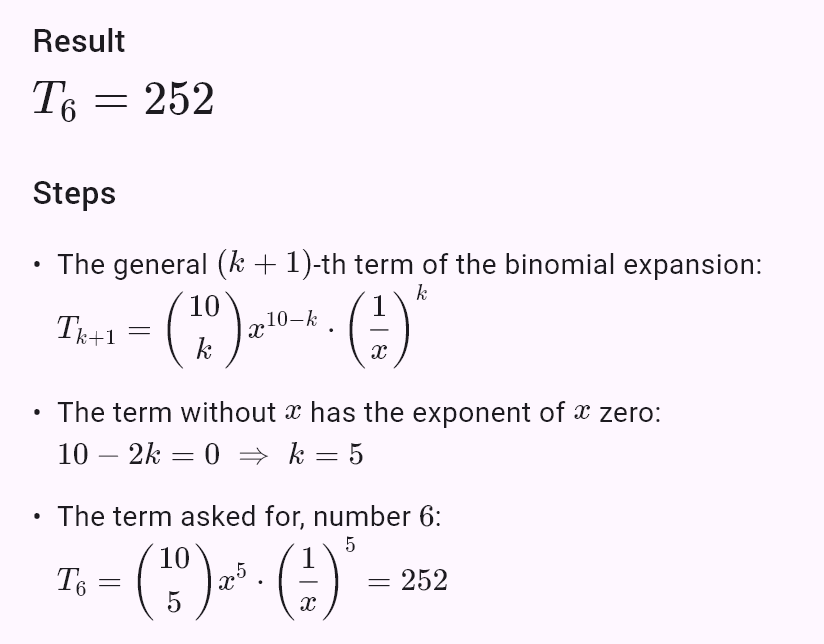
The binomial theorem: the k-th term of an expansion (“5th term of (2x - 1/x)^8”) and the term without x (“term without x in (x + 1/x)^10”) from the general term. Permutations P(5) and with repetition P′(2, 3, 1) are worked out as factorials.
Combinatorics can also be asked in a short sentence: “How many ways can we choose 3 of 10?” (with “order matters”, “with repetition”), “In how many ways can 5 people be arranged?” (also around a round table), “How many three-digit even numbers can be made from the digits 0-5 without repetition?” and “How many words can be formed from the letters of the word BANANA?”. Two classic probability problems too: the birthday problem (at least two of n people share a birthday) and the cloakroom attendant who loses the tickets (nobody gets their own coat – or letters in envelopes).
Examples
2/3 - 1/6*2 Simplify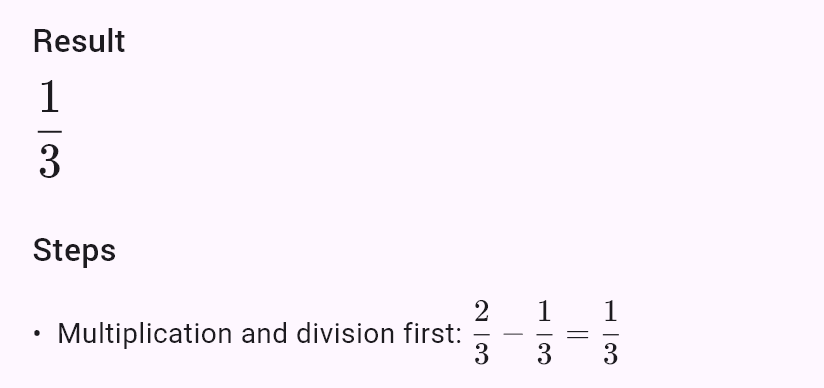
{2 - [1 - (1/2 - 1/3)]} * 6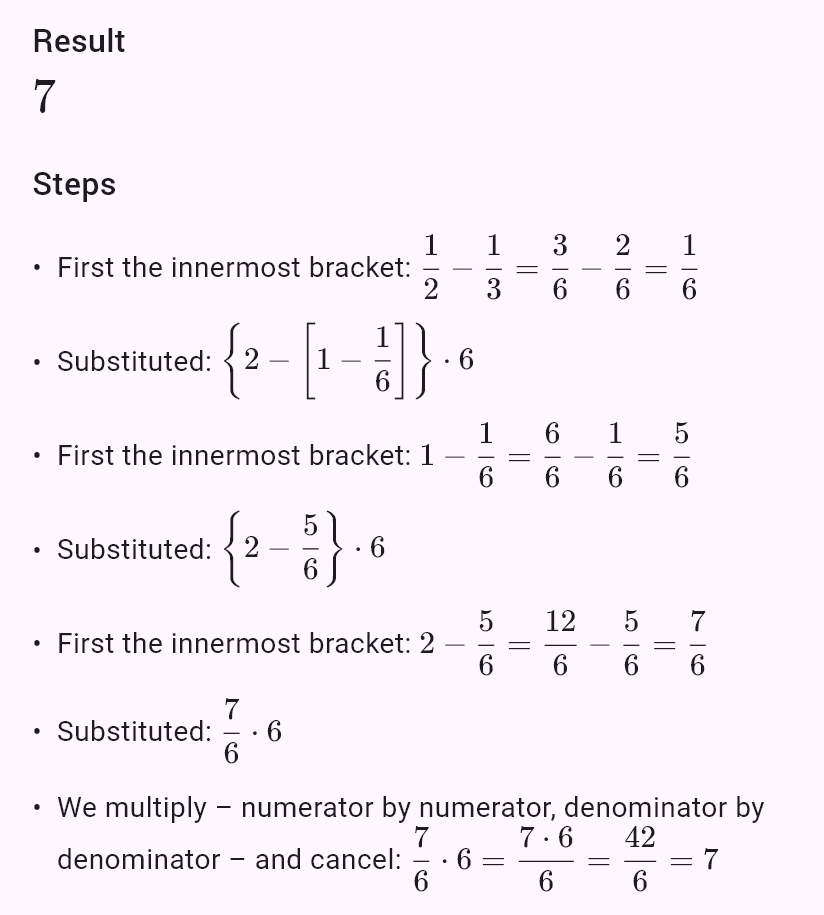
(1/2 + 1/3)/(2 - 1/4)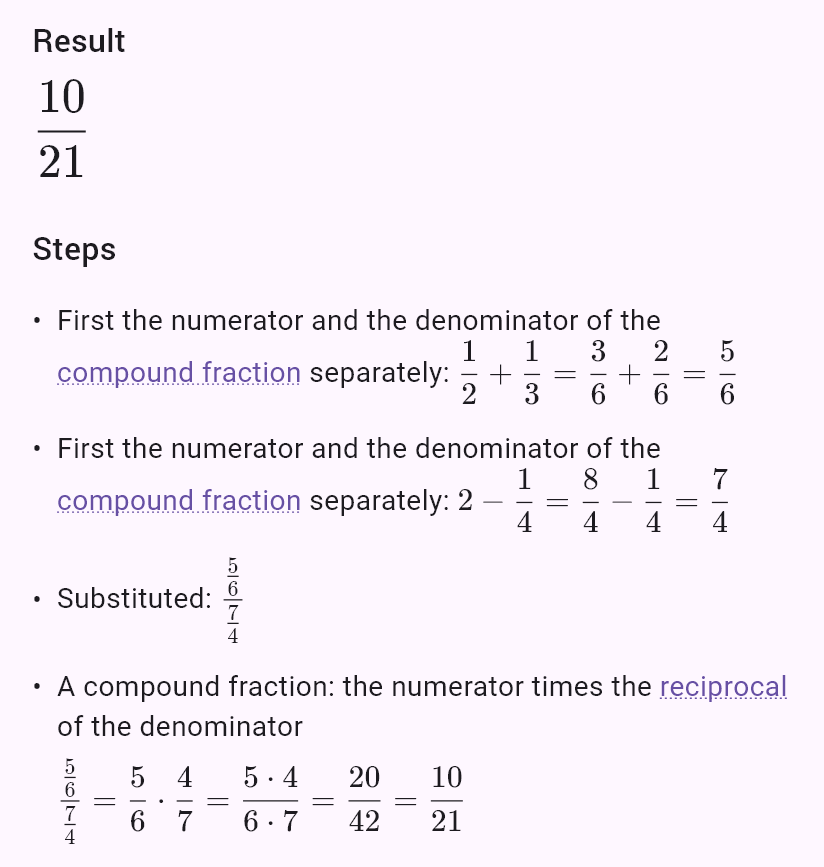
2 1/3 + 1 1/2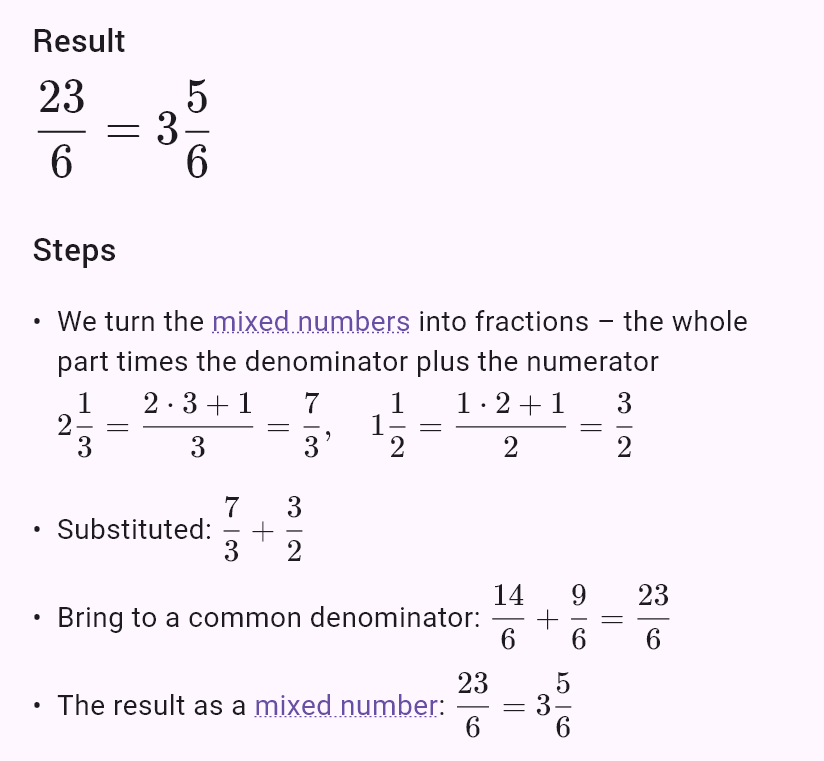
(x^2 - 1)/(x^2 + 2x + 1) Simplify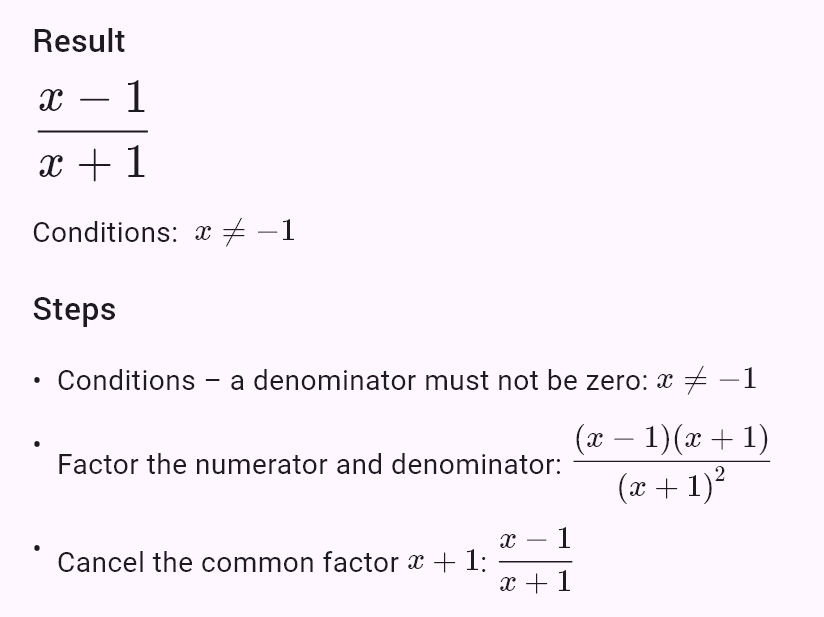
(x + 2)^3 Expand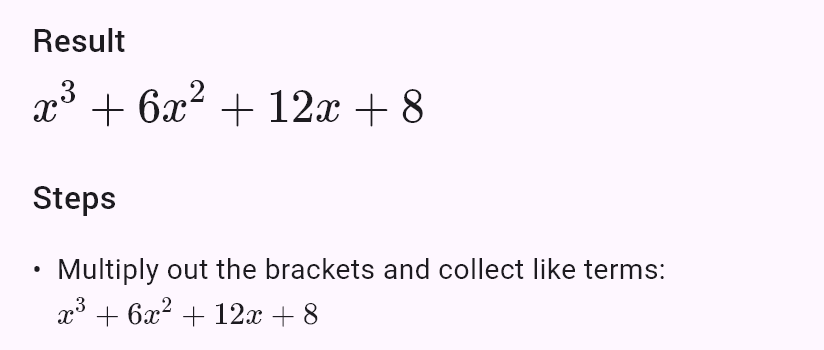
x^3 - 6x^2 + 11x - 6 Factor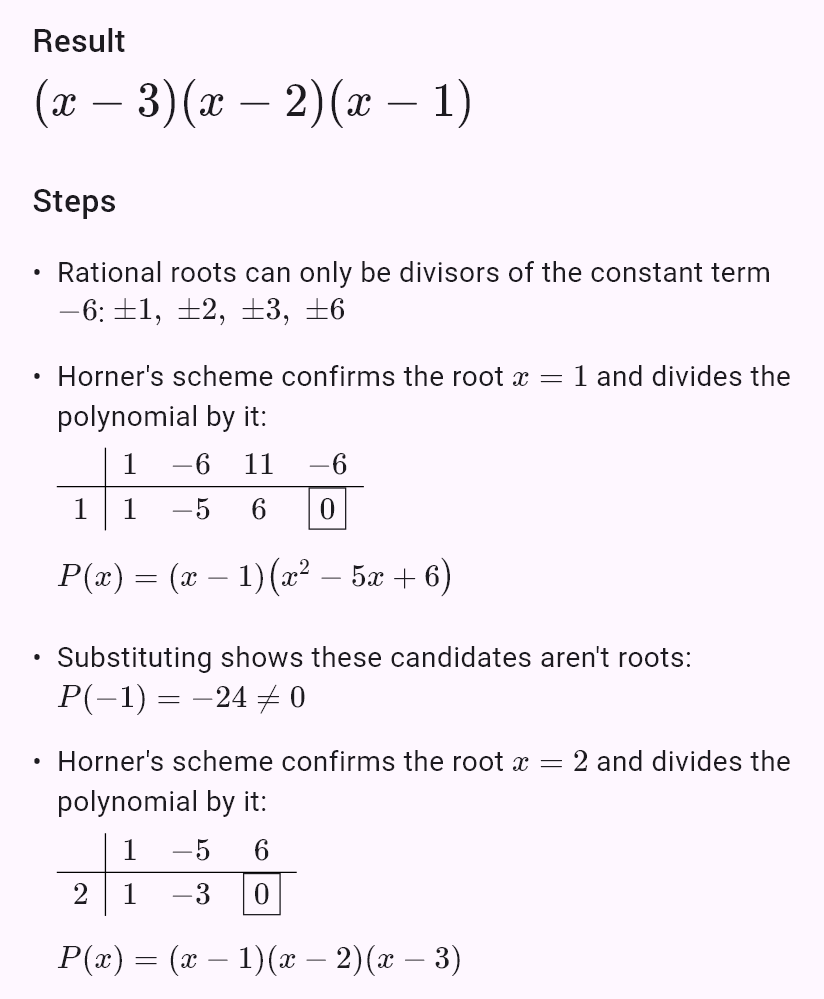
(3x + 5)/(x^2 + x - 2) Partial fractions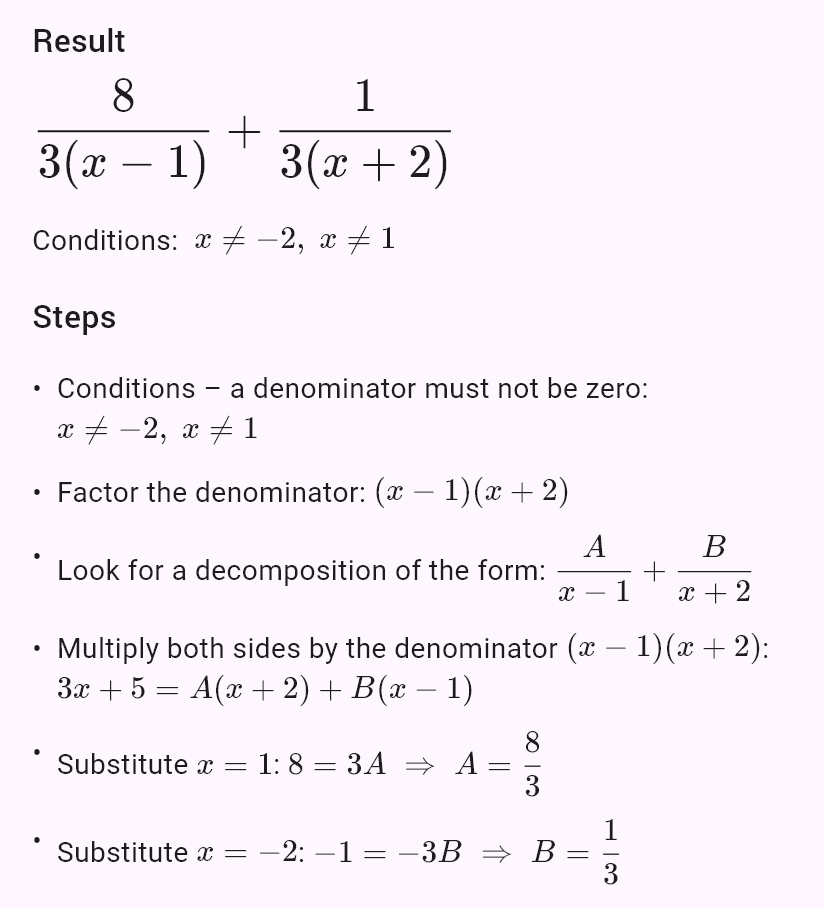
sqrt(8a^5 b^2) Simplify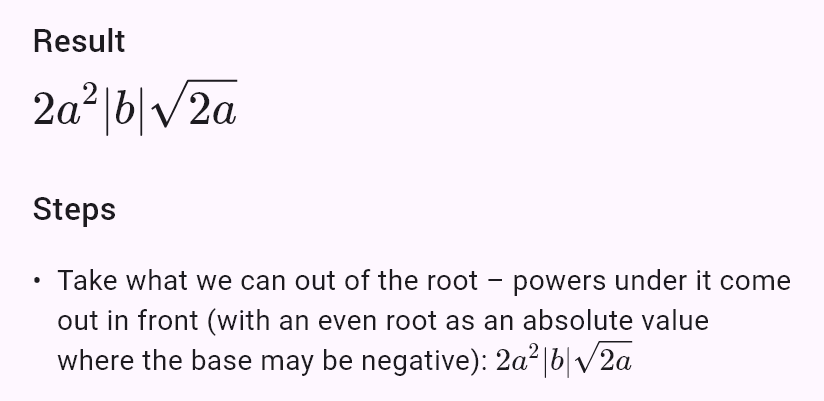
(3+4i)/(1-2i) Algebraic form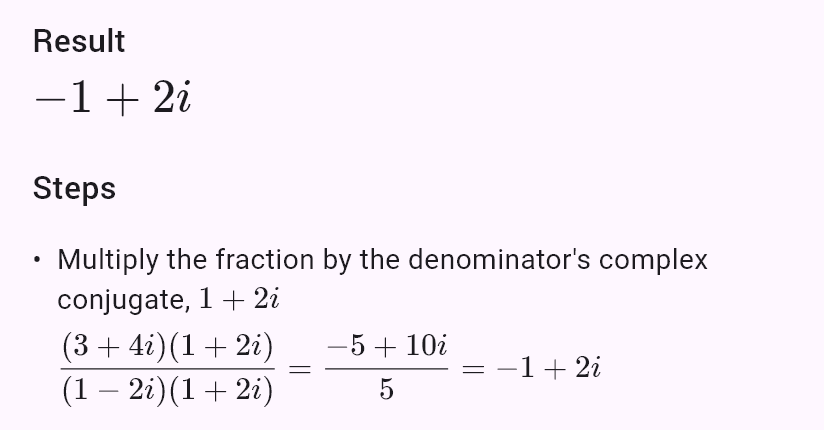
(x+1)!/(x-1)! = 30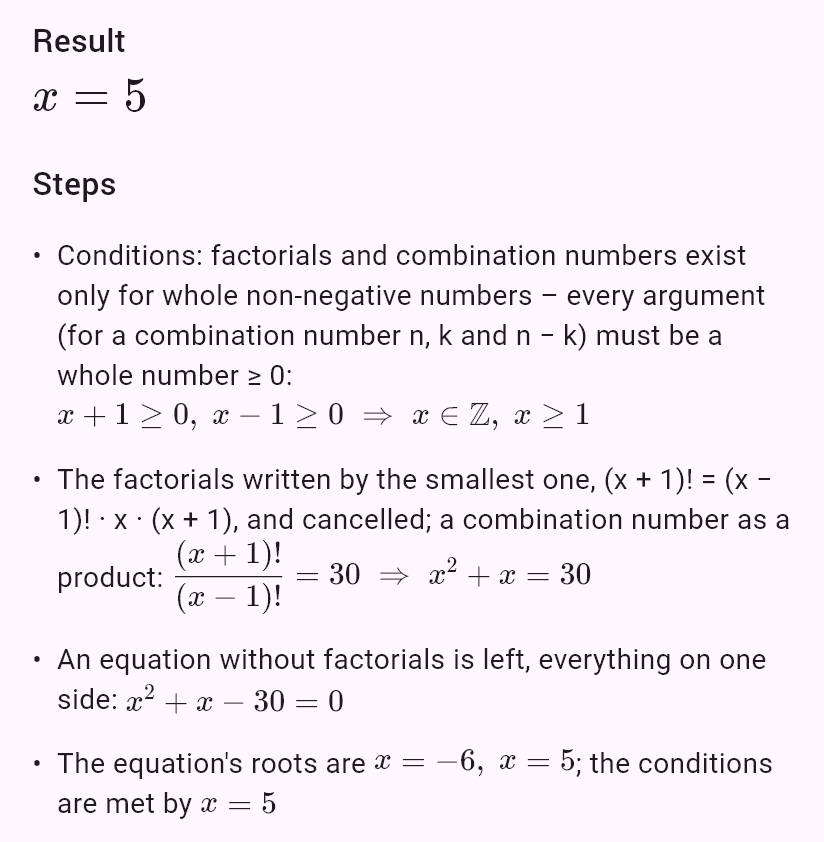
(2x^3 + 3x^2 - x + 5) : (x^2 + 1)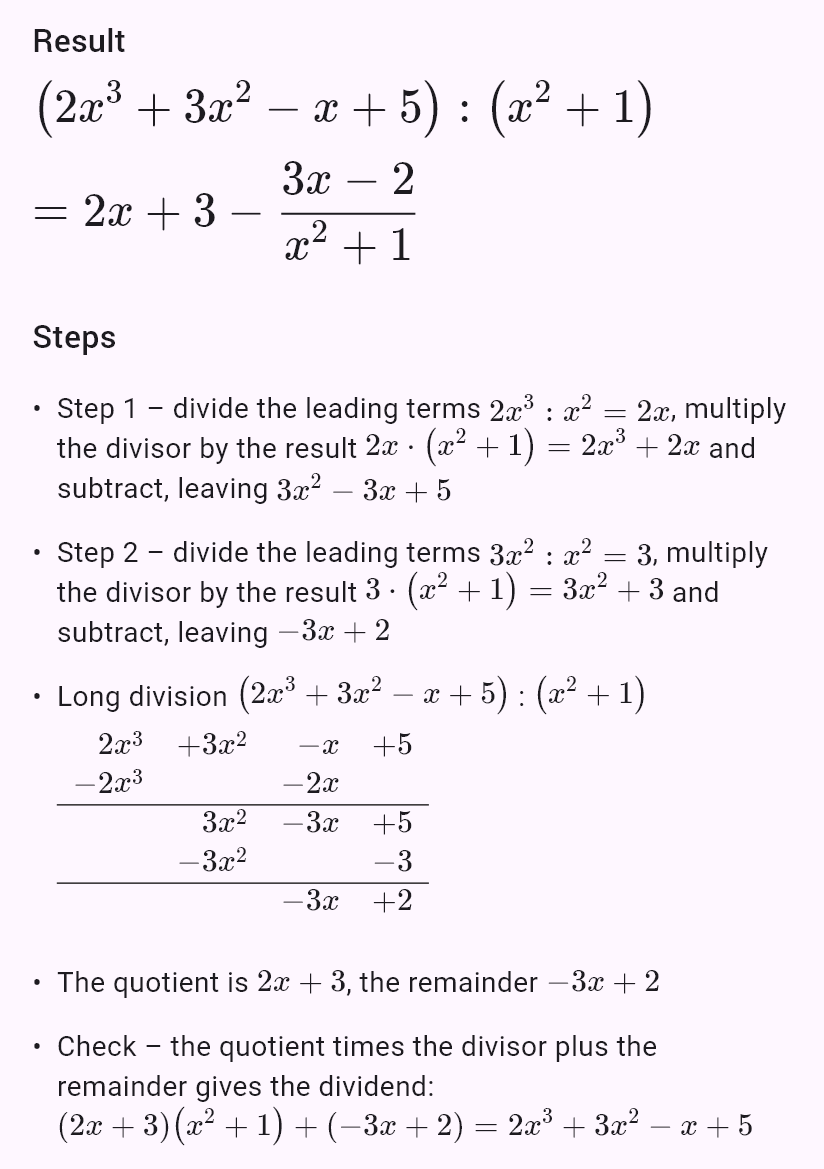
(x^3 - 2x + 1) : (x - 1) Horner’s scheme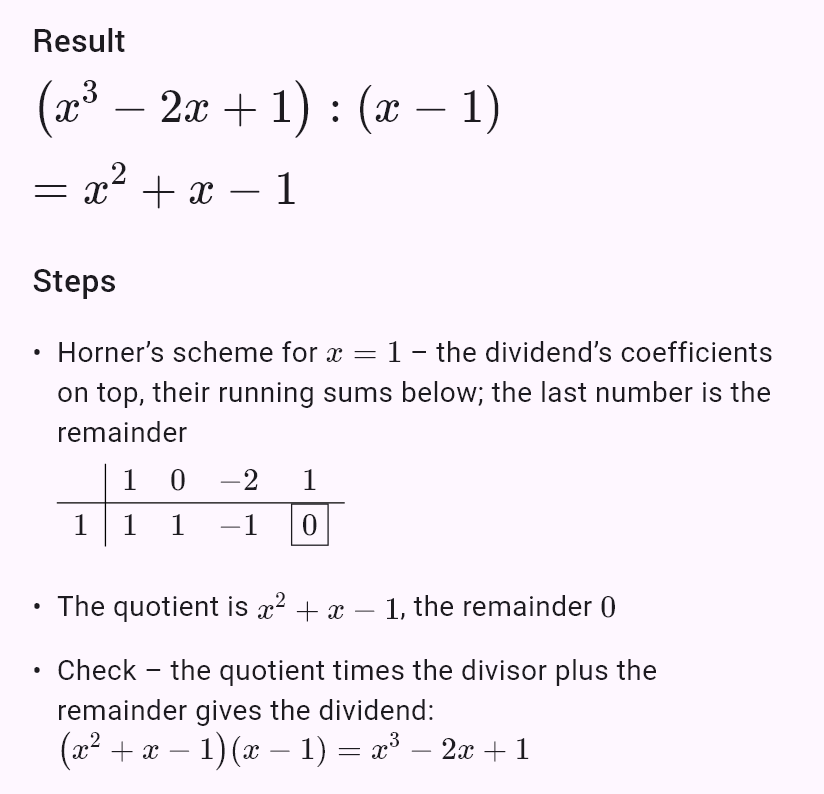
C(n, 2) = 45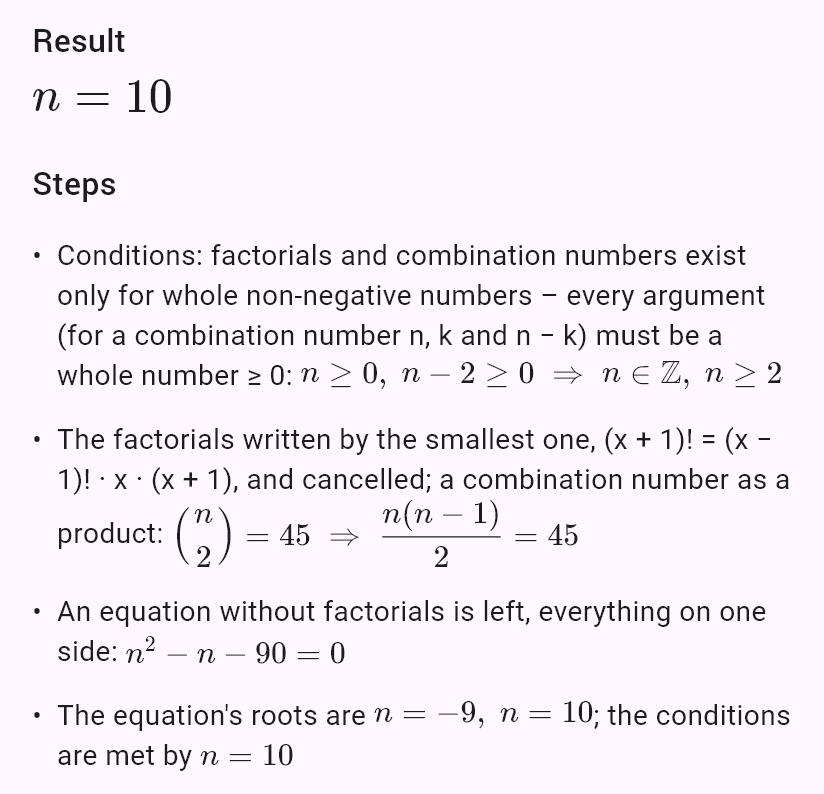
Kolika způsoby lze vybrat 3 z 10?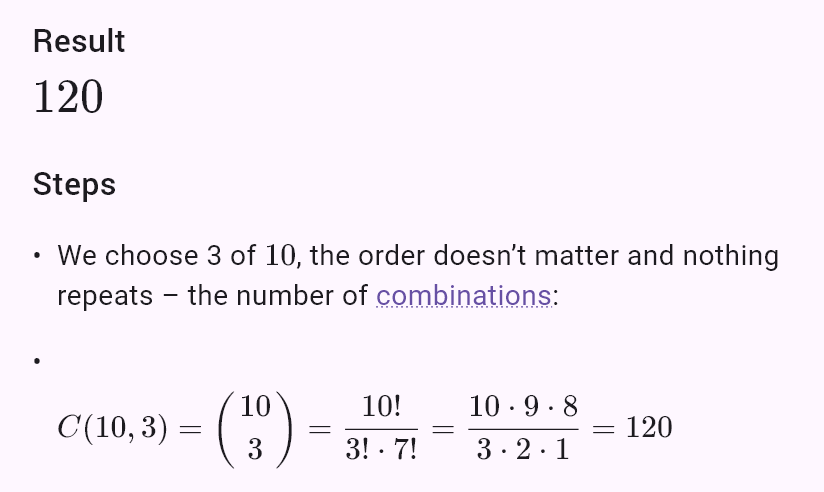
Kolik je trojmístných sudých čísel z číslic 0, 1, 2, 3, 4, 5, číslice se nesmí opakovat?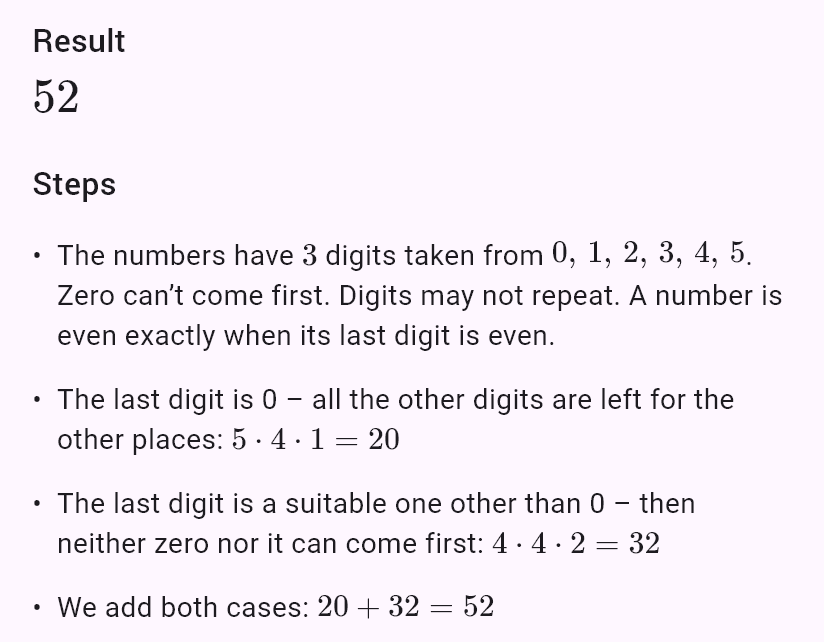
Kolik slov lze sestavit z písmen slova MATEMATIKA?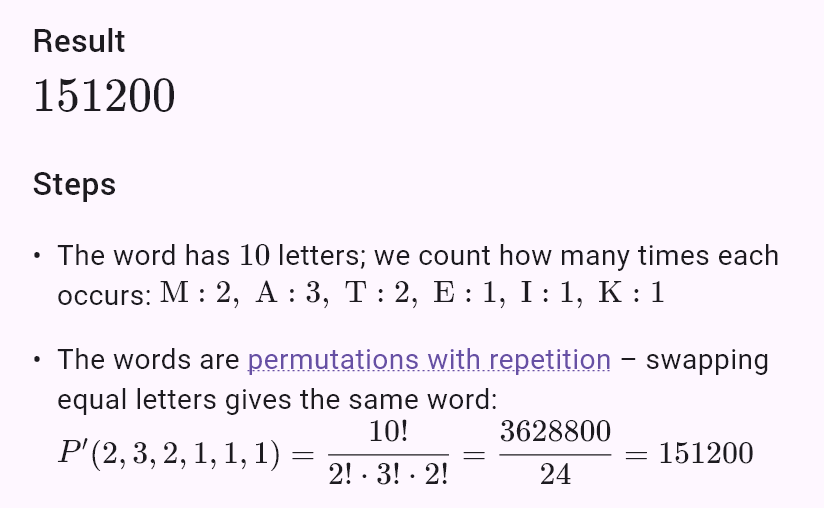
Jaká je pravděpodobnost, že ve skupině 23 lidí slaví alespoň dva narozeniny ve stejný den?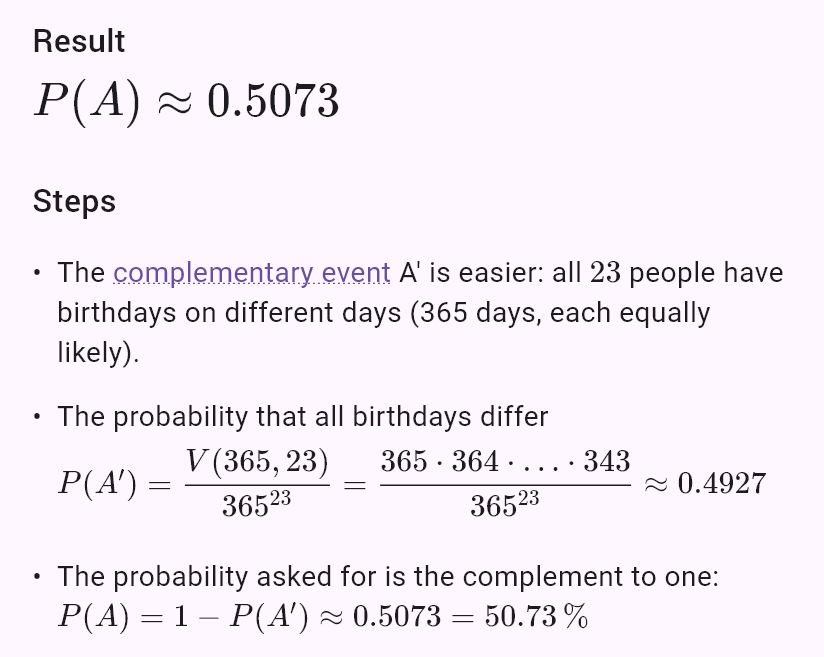
Jaká je pravděpodobnost, že nikdo z 5 lidí odcházejících z divadla nedostane svůj kabát, když šatnářka ztratí lístky?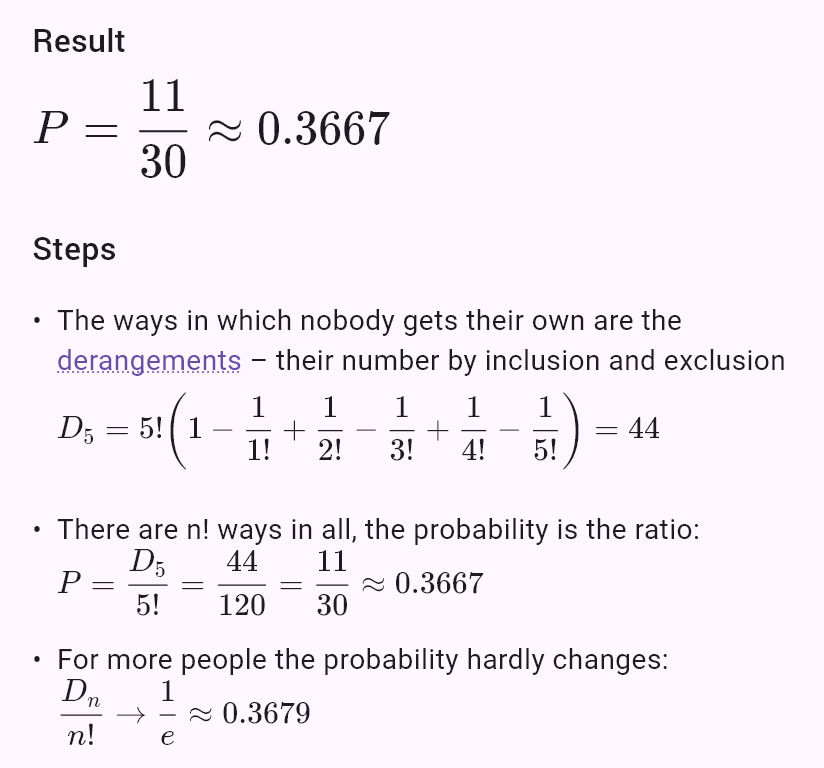
term without x in (x + 1/x)^10