I. Equations, inequalities and expressions
12. Solving a formula for a letter
A formula from mathematics, physics or chemistry (m = ρV, S = πr², v = s/t) is rearranged so that the chosen letter stands alone on one side. The other letters are given quantities – the app works with them like with known numbers. The steps are equivalent steps as at school: moving terms to the other side, multiplying by a denominator, dividing, factoring out, taking a root, reciprocals.
The letter to solve for is chosen with the “Solve for” chip; without a choice the app solves for the first letter on the formula's side. The result is the formula with its conditions – what it divides by must not be zero (V = m/ρ for ρ ≠ 0). The quantities in a formula are positive, so a root has just its positive value: r = √(S/π).
An equation in x and y is solved for y (the line 2x + y = x + 2y is y = x); the other equations in x and y have “Solve for y” and “Solve for x” among the chips of the derivative, the integral and the graph. Here a root gives both signs: x² + y² = 25 is y = ±√(25 − x²).
Equations with a parameter (2ax + a = 4x, the unknown x) are not rearranged as a formula but solved with the discussion – see the previous chapter.
How to enter it
m = ρV | A formula – a quantity alone on one side, capital and small letters (E, I, V are quantities). |
1/R = 1/R_1 + 1/R_2 | Indices with an underscore (R_1, v_0), Greek letters (ρ, rho, \rho), π is the constant. |
2x + y = x + 2y | An equation in x and y – solved for y. |
Examples
m = ρV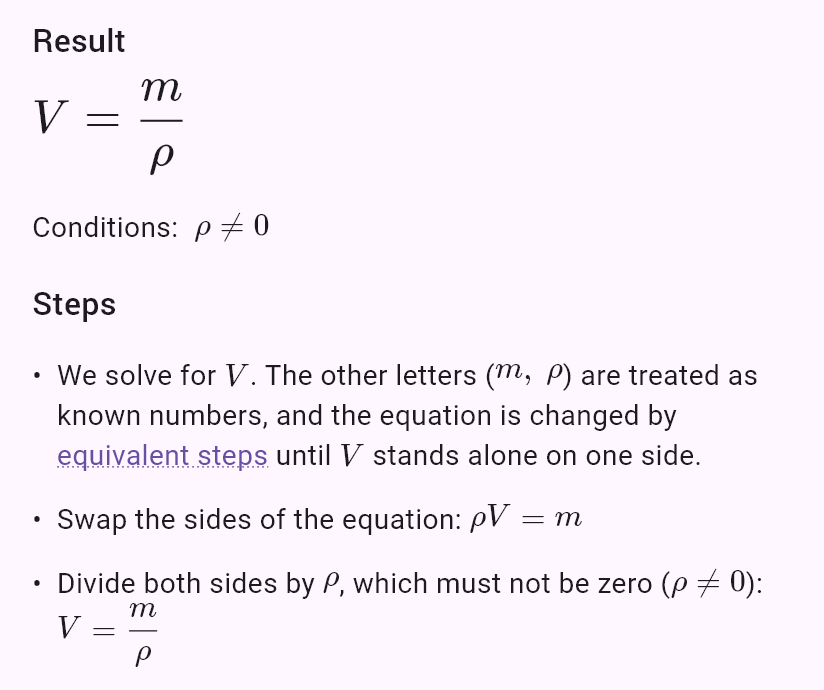
S = (a + c)/2 · v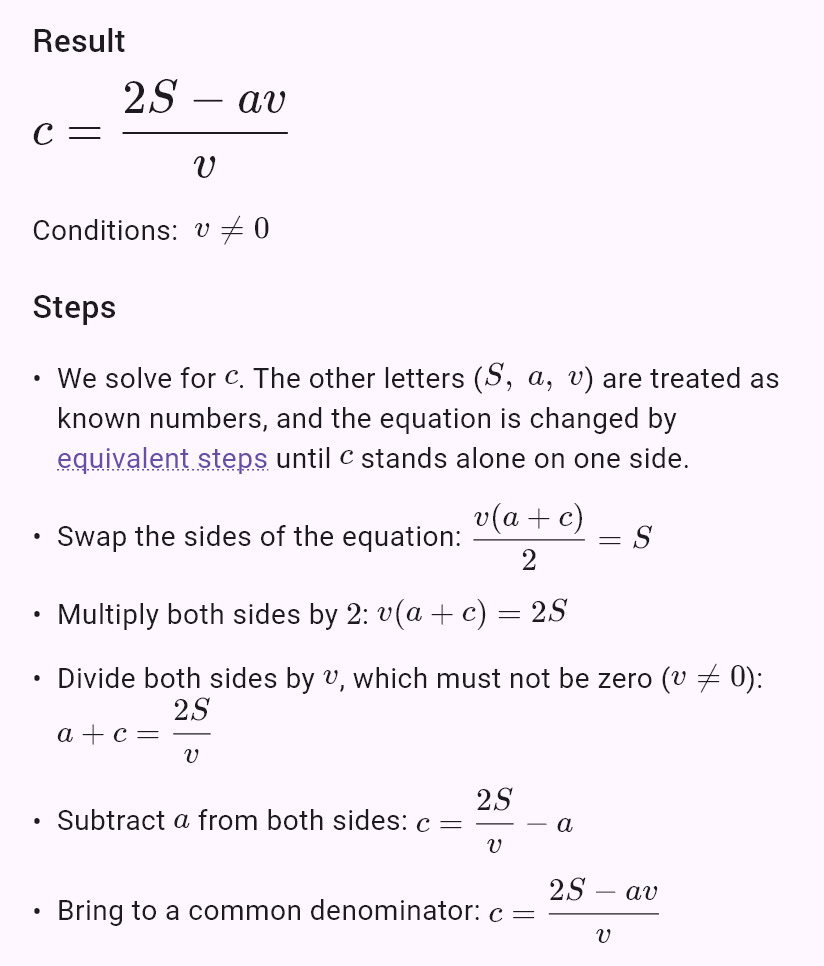
S = πr^2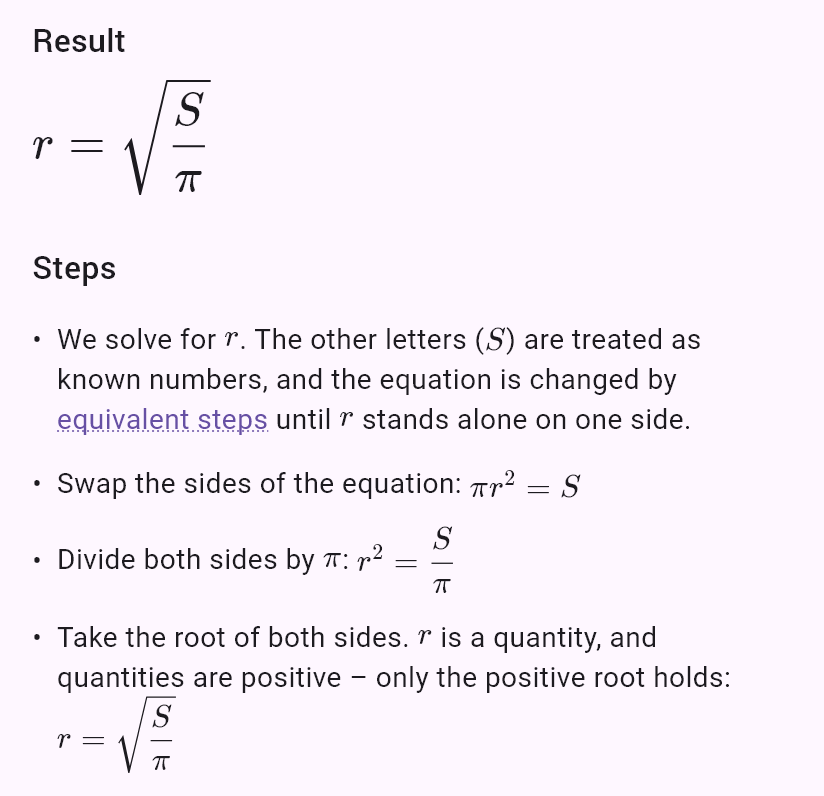
1/R = 1/R_1 + 1/R_2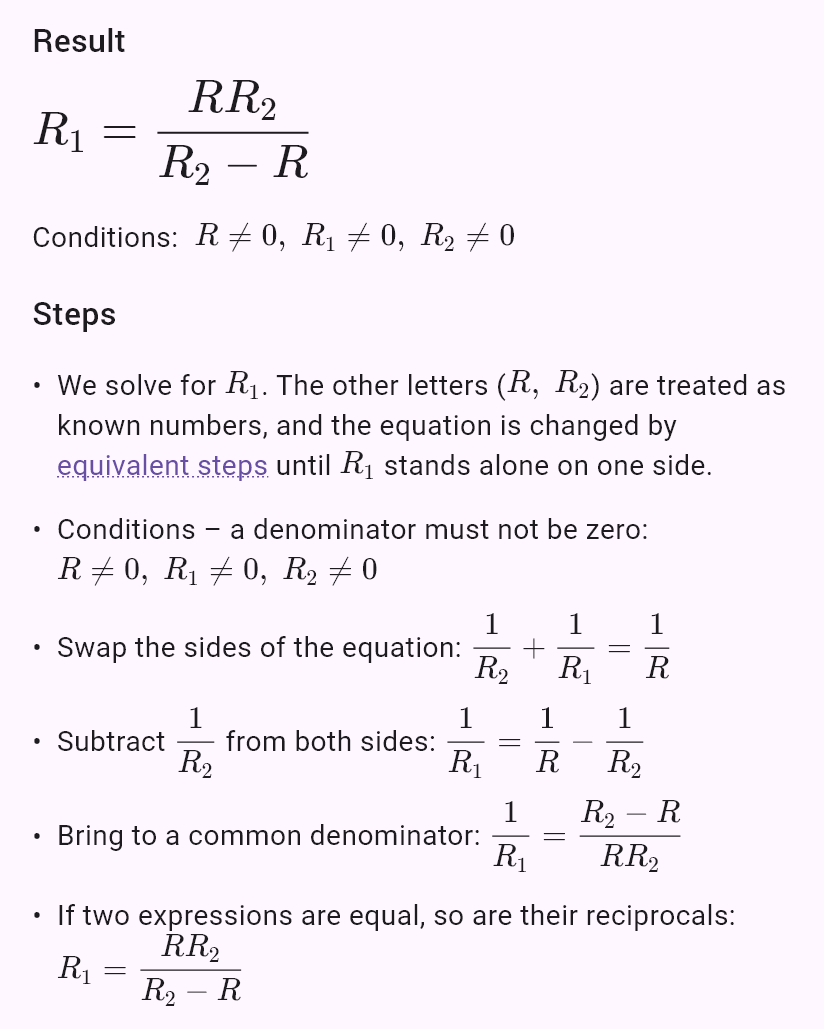
2x + y = x + 2y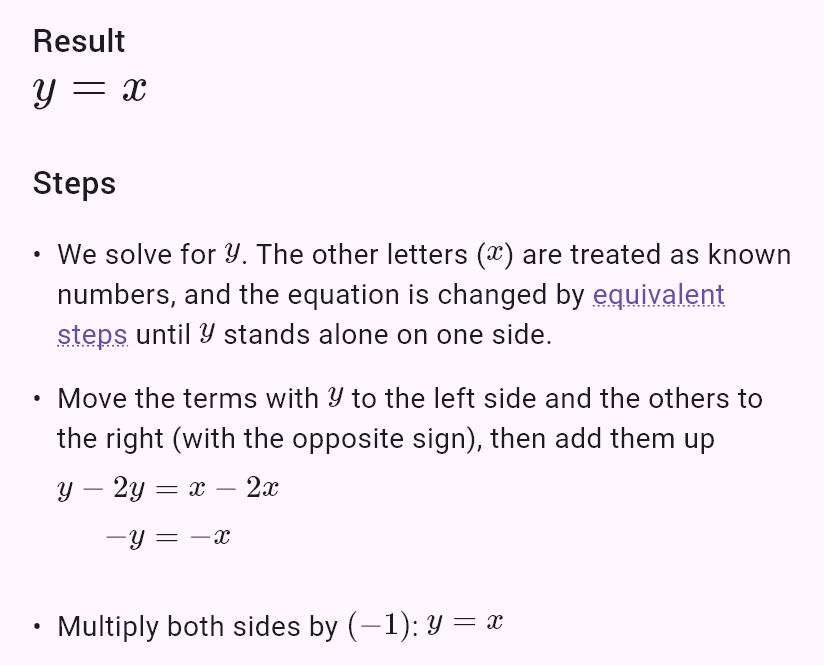
x^2 + y^2 = 25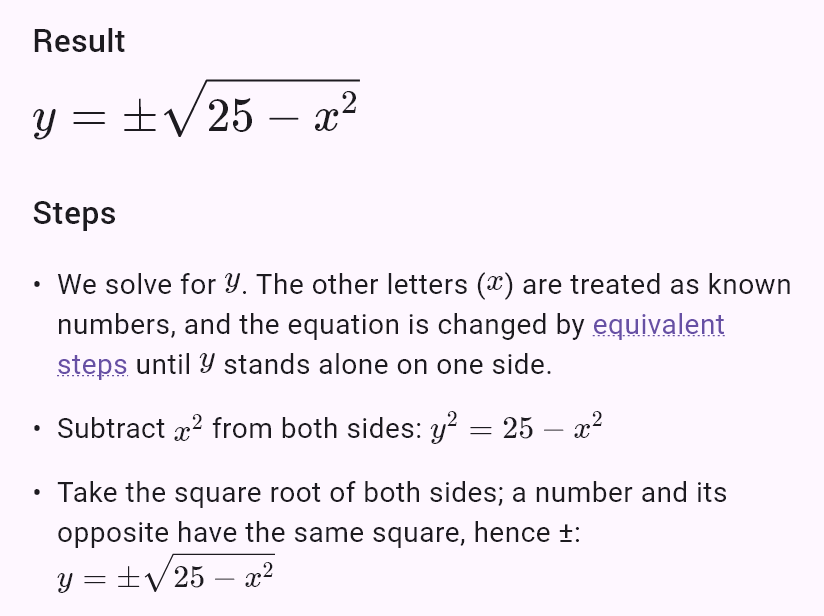
Known limitations
- The letter only in powers, fractions and roots; not yet in functions (sin, log, an exponent) or squared together with itself (s = v₀t + ½at² for t).