I. Equations, inequalities and expressions
10. Systems of equations
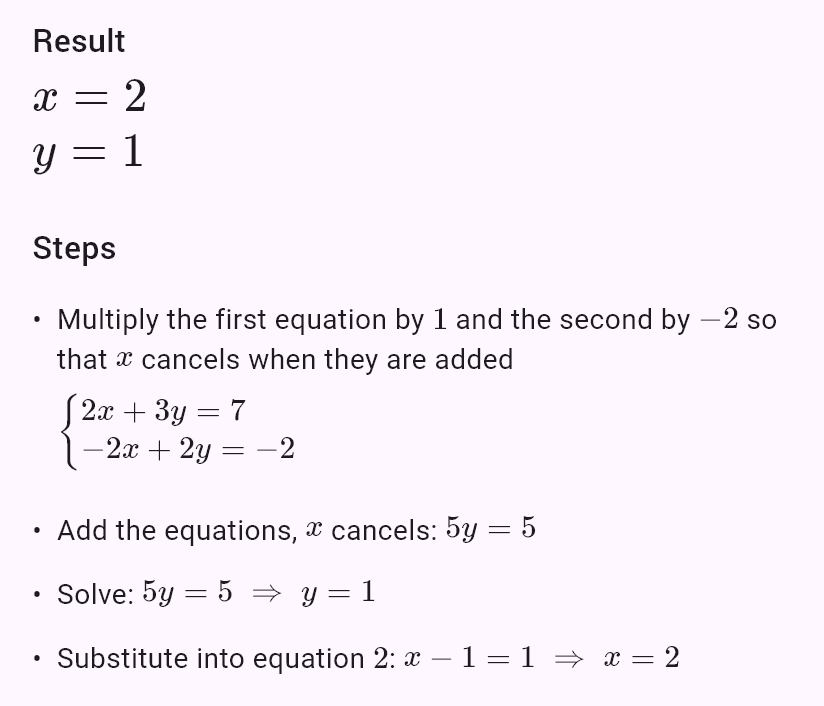
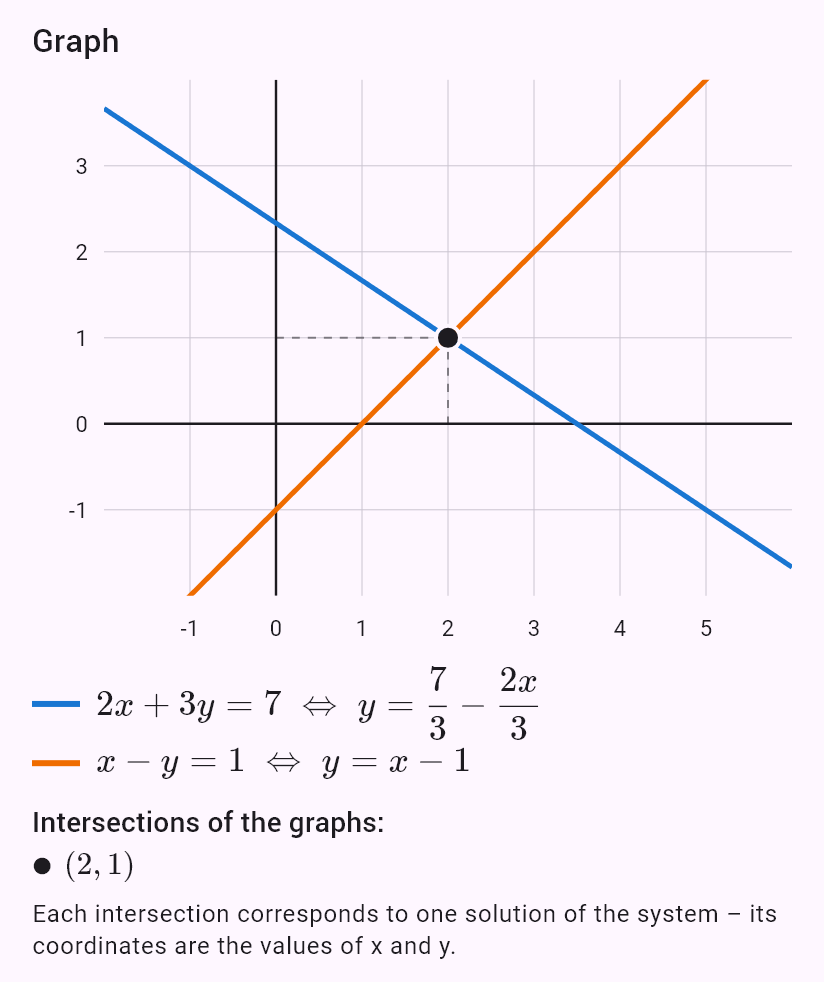
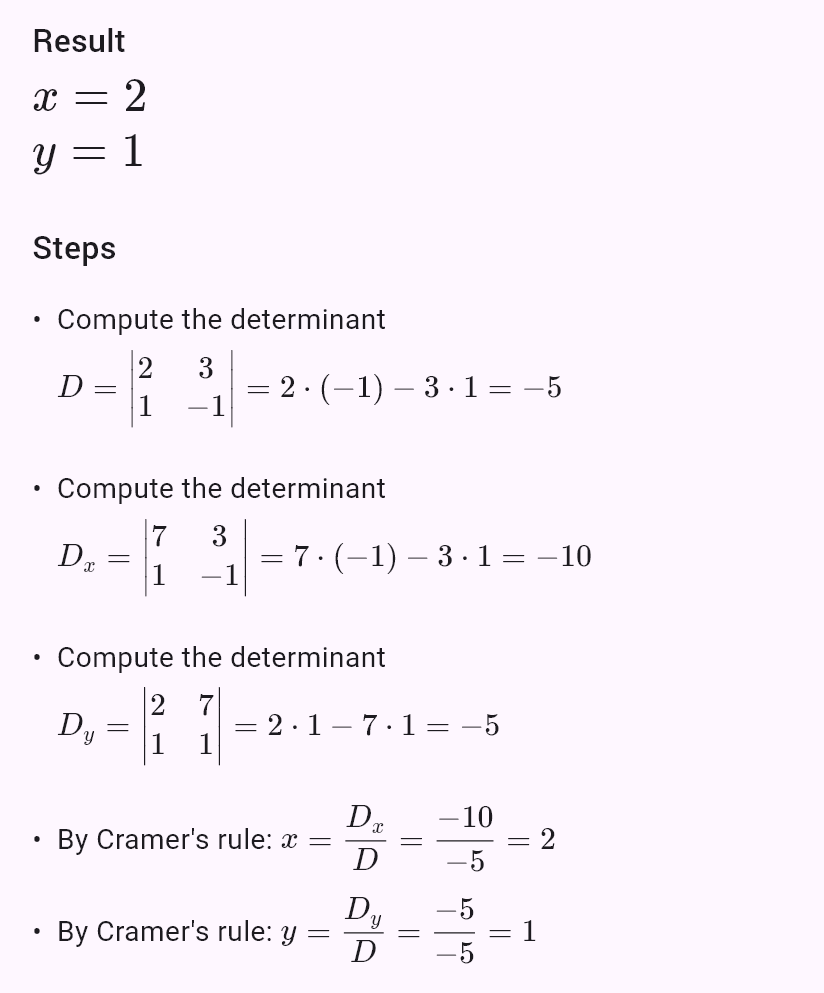
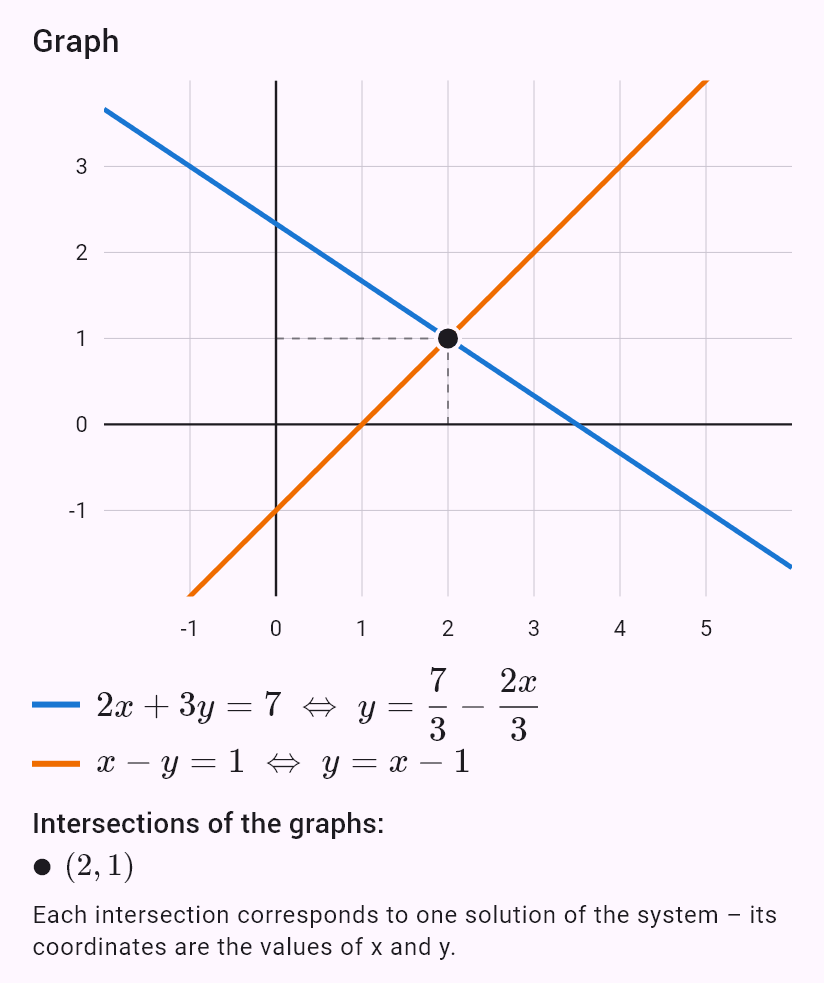
The app solves a system of linear equations in two unknowns by elimination (addition) or substitution, and larger systems by Gaussian elimination – as equations or on the matrix (the augmented matrix and row operations). A square system can also be solved by Cramer's rule (determinants). You choose the method with a chip. A system of two equations in two unknowns also gets a graph in which the solutions are the intersections of the lines or curves.
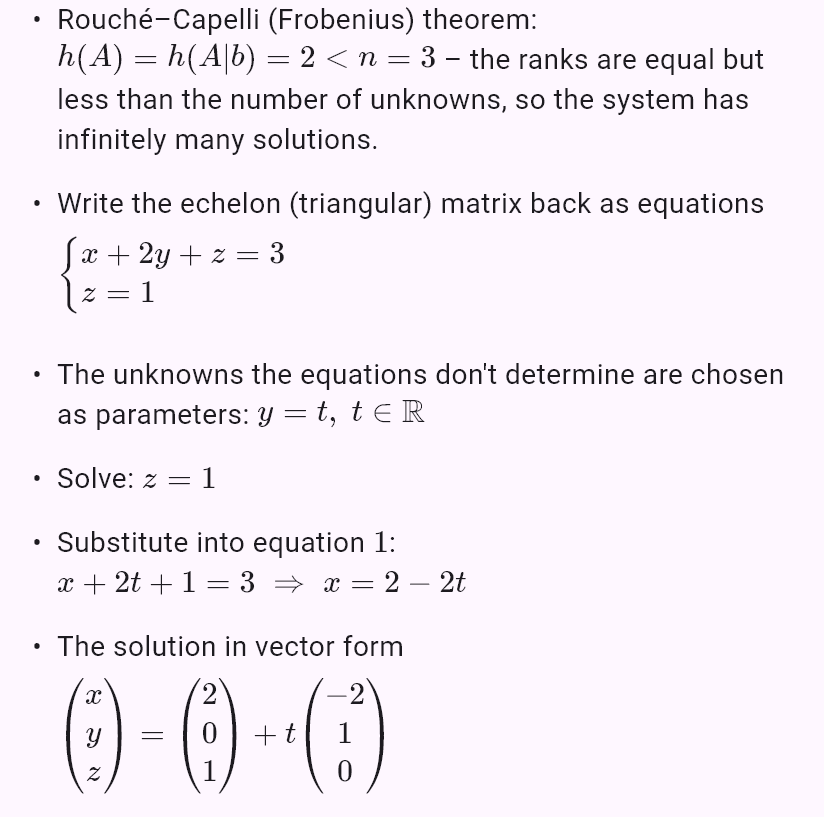
The numbers of equations and unknowns don't have to match. Gaussian elimination tells when a system has no solution (an equation like 0 = 1 comes out) and when it has infinitely many: the unknowns the equations don't determine become parameters t, s, … (chosen so the solution has no fractions), and the solution is also written in vector form. In matrix form the Rouché–Capelli (Frobenius) theorem decides the number of solutions – it compares the rank of the matrix, the rank of the augmented matrix and the number of unknowns. For a homogeneous system (all right-hand sides 0) the app shows a basis of the solution space.
Unknowns can have an index: x₁, x_1 or x1. A system can also be given by matrices – the augmented matrix with the right-hand sides after a vertical bar, or a matrix A, a vector of right-hand sides b and the equation Ax = b; the unknowns are then x₁, x₂, … and the default method is Gaussian elimination on the matrix.
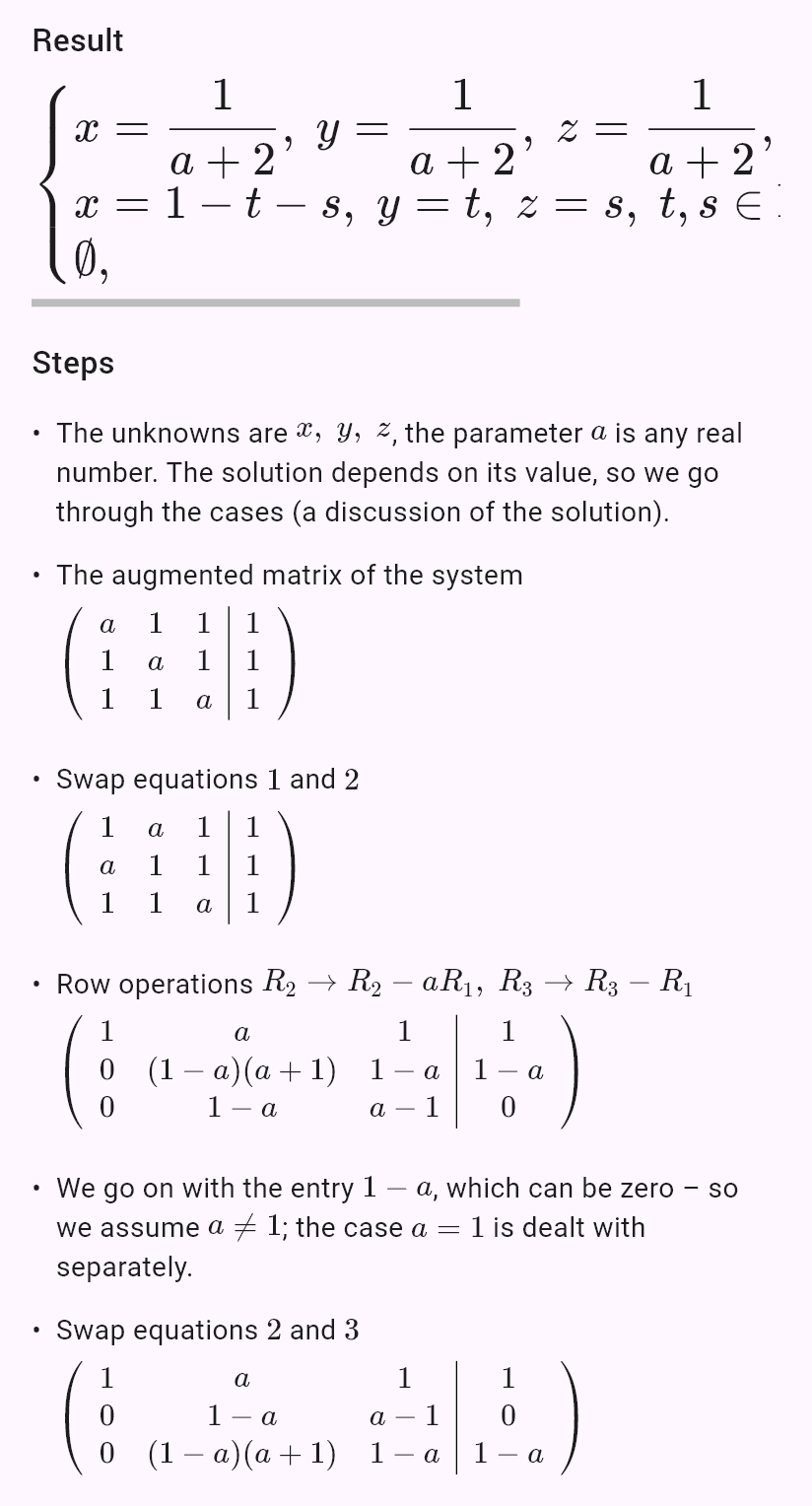
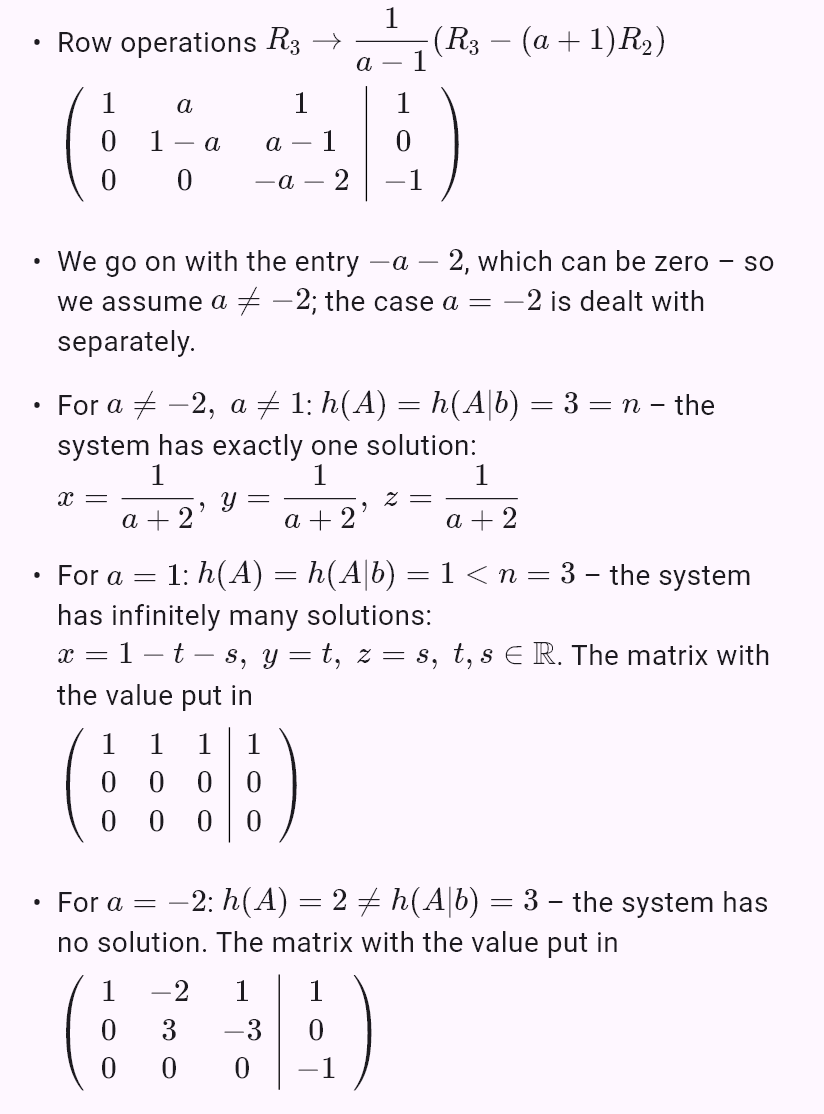
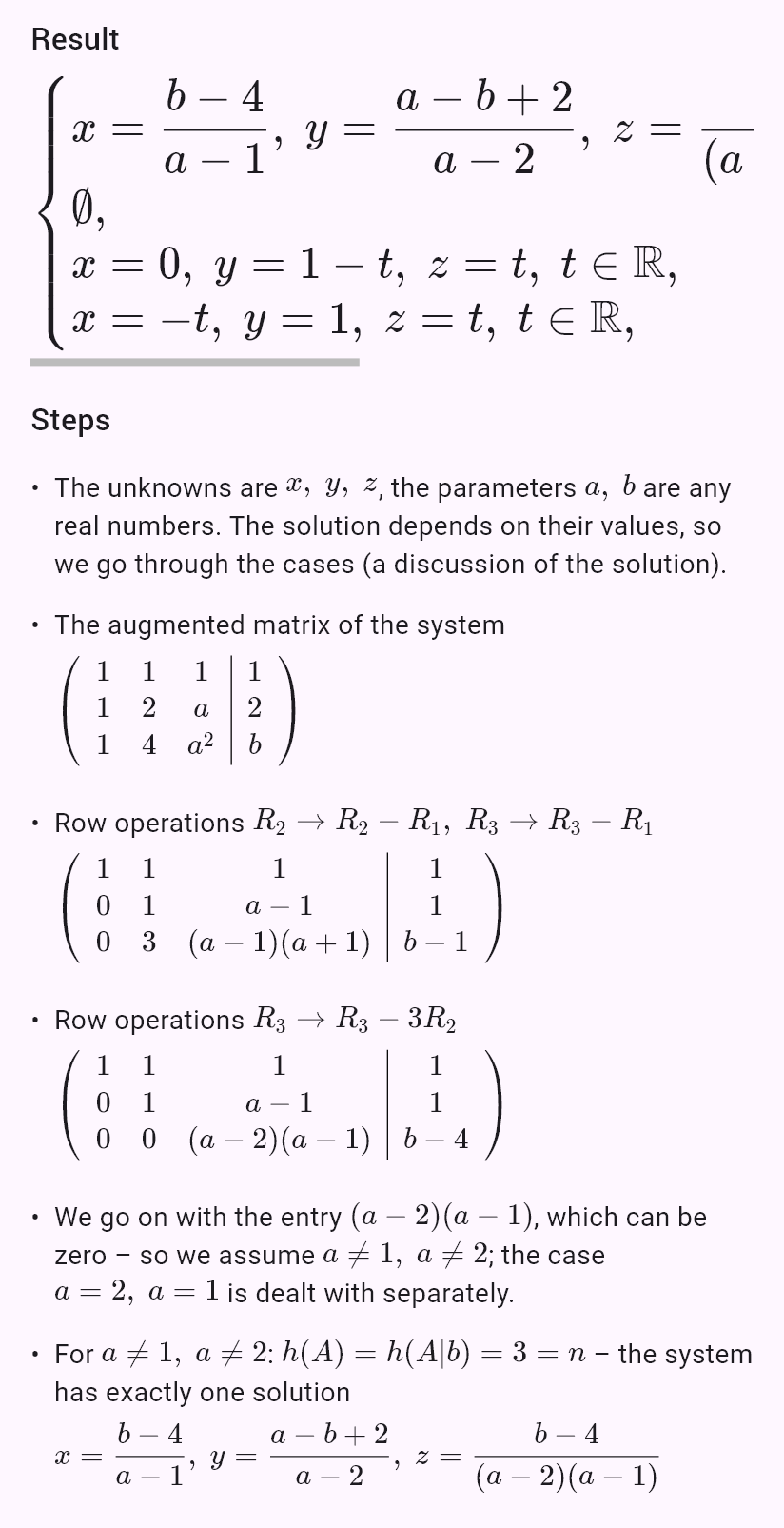
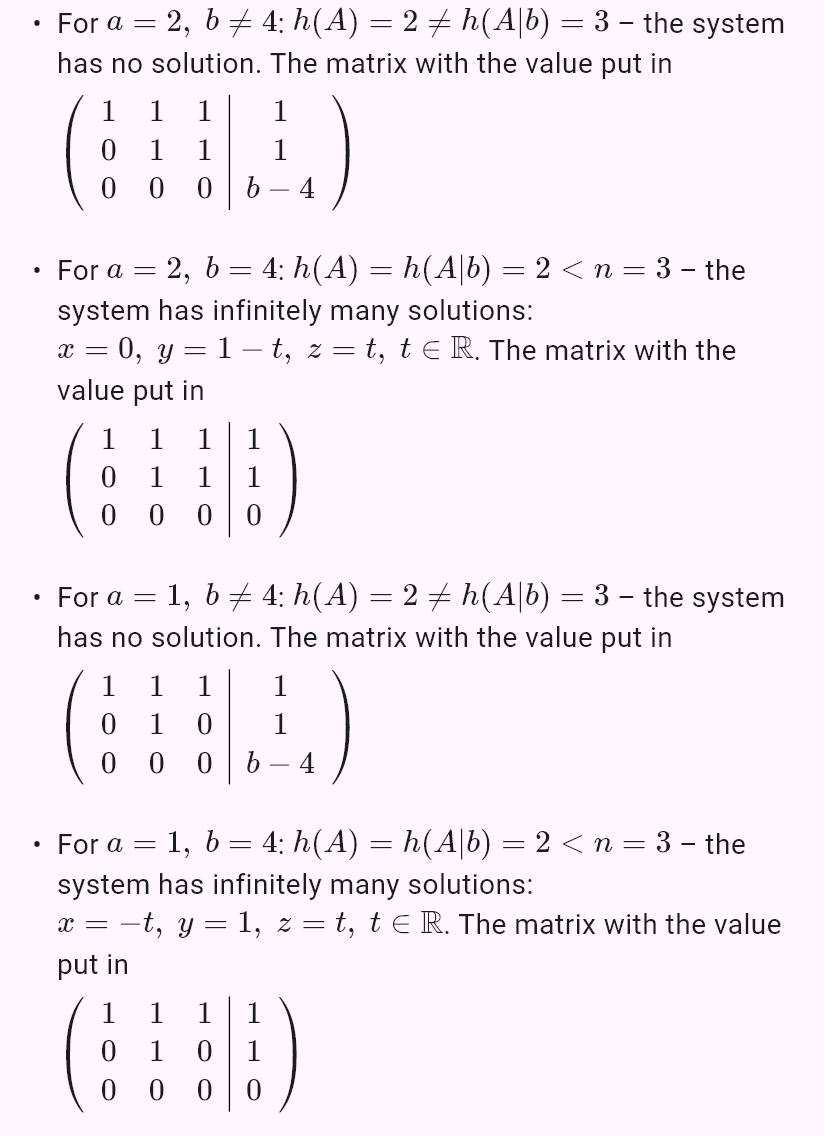
A system may contain one or two parameters – letters that aren't unknowns (the unknowns are x, y, z, u, v, w, t and x₁, x₂, …). The app then discusses solvability by the parameters' values: with the chip “Gauss – matrix” (the default for three or more equations) it reduces the augmented matrix; where it would multiply by an expression in the parameter that can be zero, it assumes it isn't, and finishes its zeros separately with the value put in – the Frobenius theorem decides in each case. With the chip “Cramer's rule” it computes the determinants as expressions in the parameter: formulas for D ≠ 0, the zeros of D put in. With two parameters there are cases like “b = 4, a ≠ 2” or “a = b”.
A nonlinear system (say a circle and a line) is solved and drawn, so far without the working.
How to enter it
x_1 + x_2 + x_3 = 6 | Unknowns with an index – x_1, x₁ and x1. |
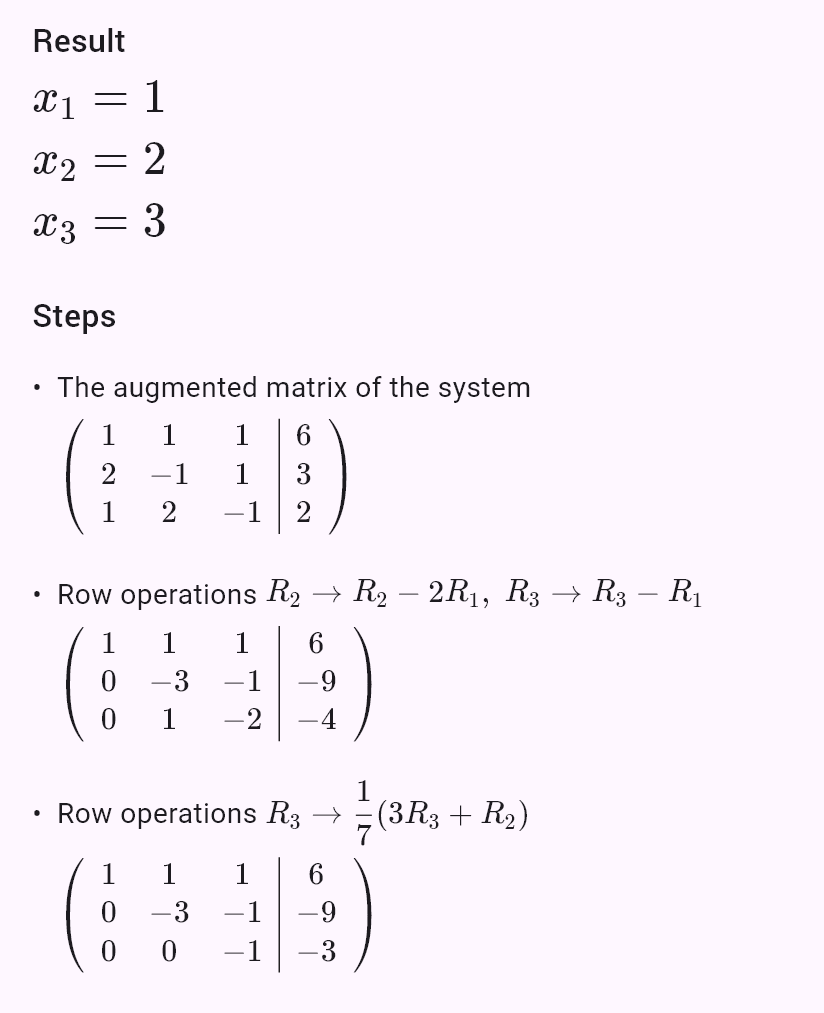
[1 1 1 | 6; 2 -1 1 | 3; 1 2 -1 | 2] | The augmented matrix – the right-hand sides after a vertical bar. |
A = [1 2; 4 5] | The matrix of the system, the vector of right-hand sides and the equation Ax = b. |
Examples
2x + 3y = 7
x - y = 1
Addition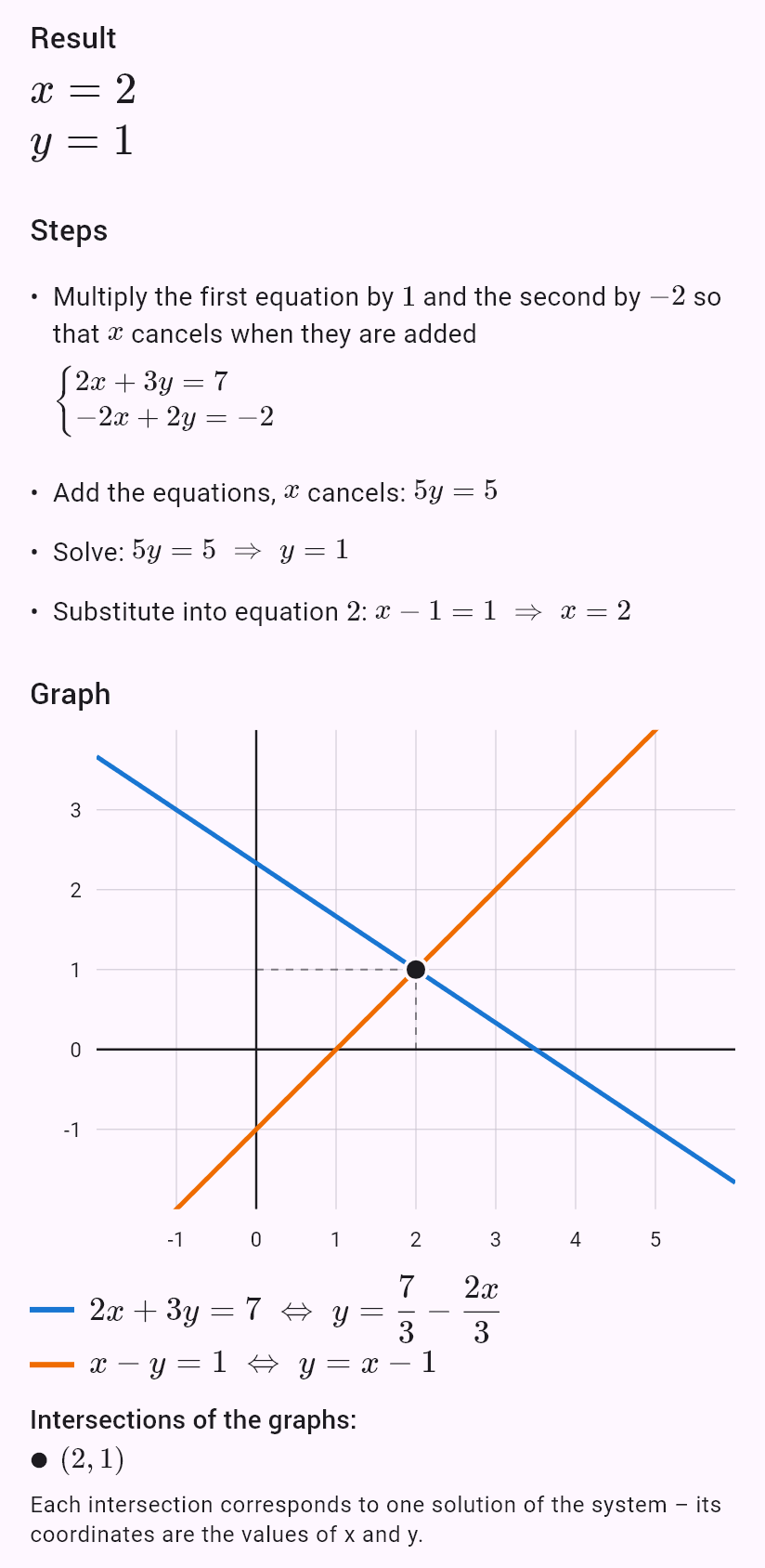
x + y + z = 6
2x - y + z = 3
x + 2y - z = 2
Gaussian elimination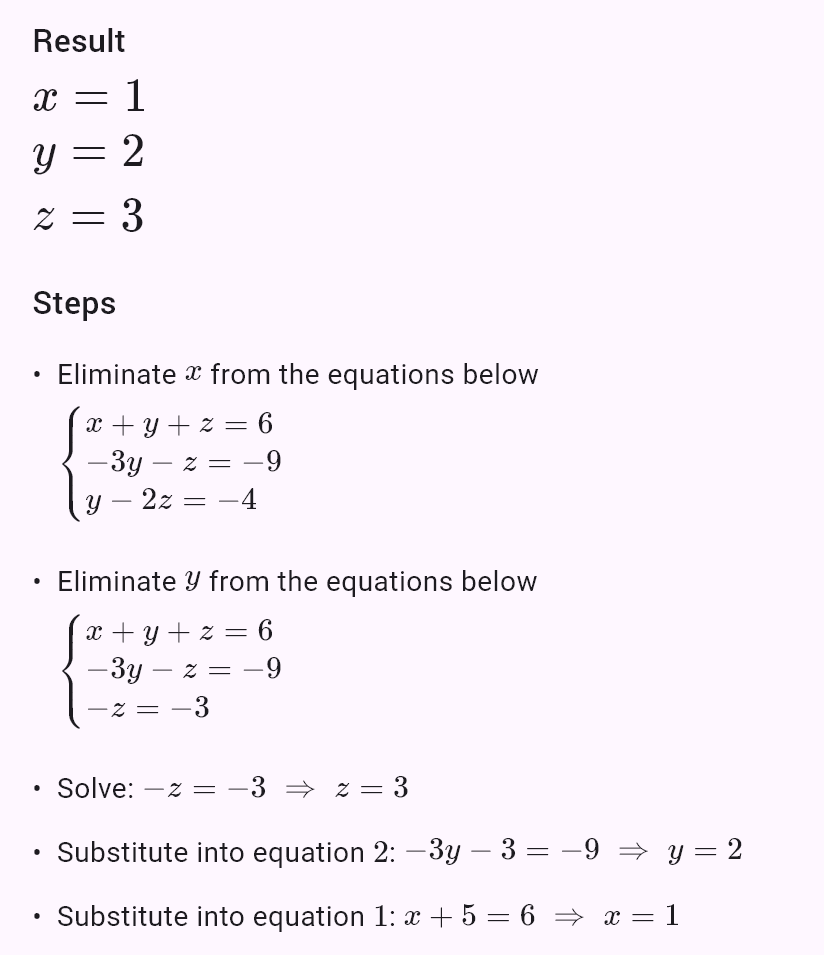
2x + 3y = 7
x - y = 1
Cramer's rule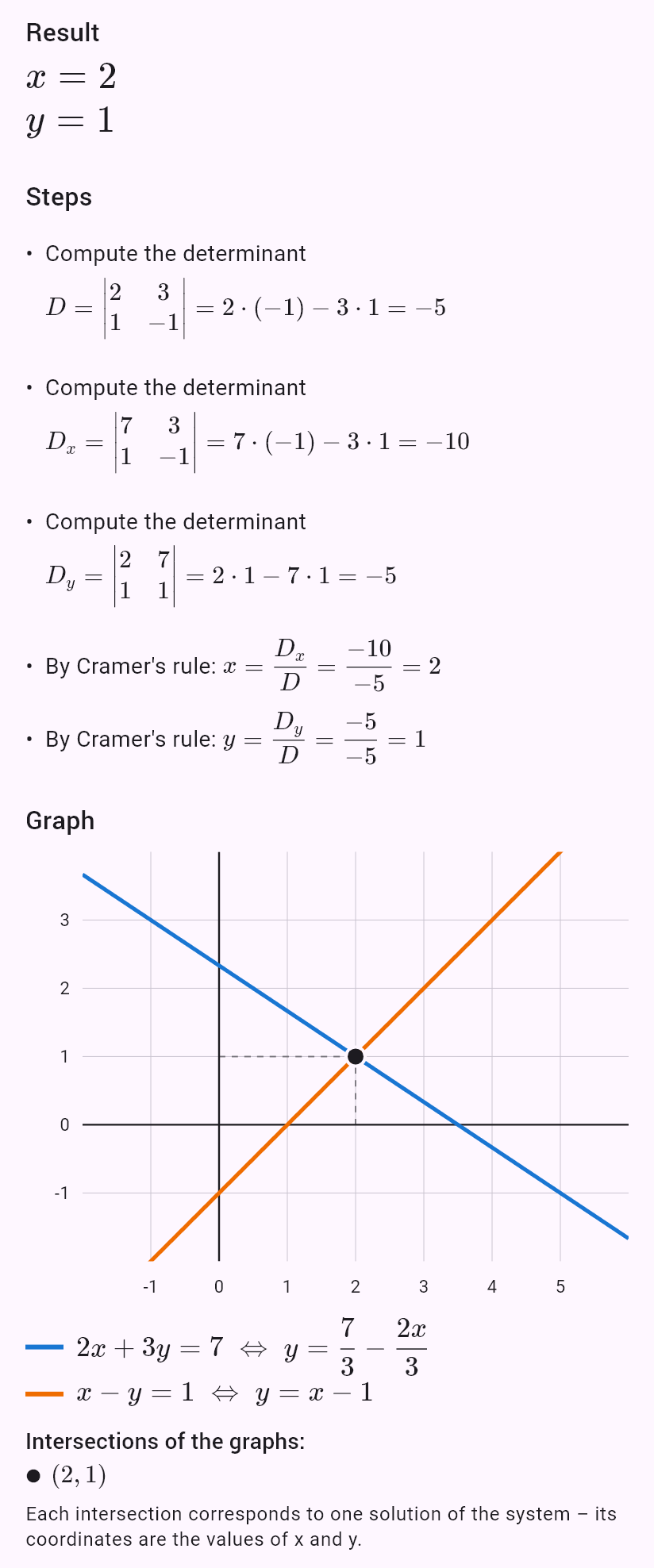
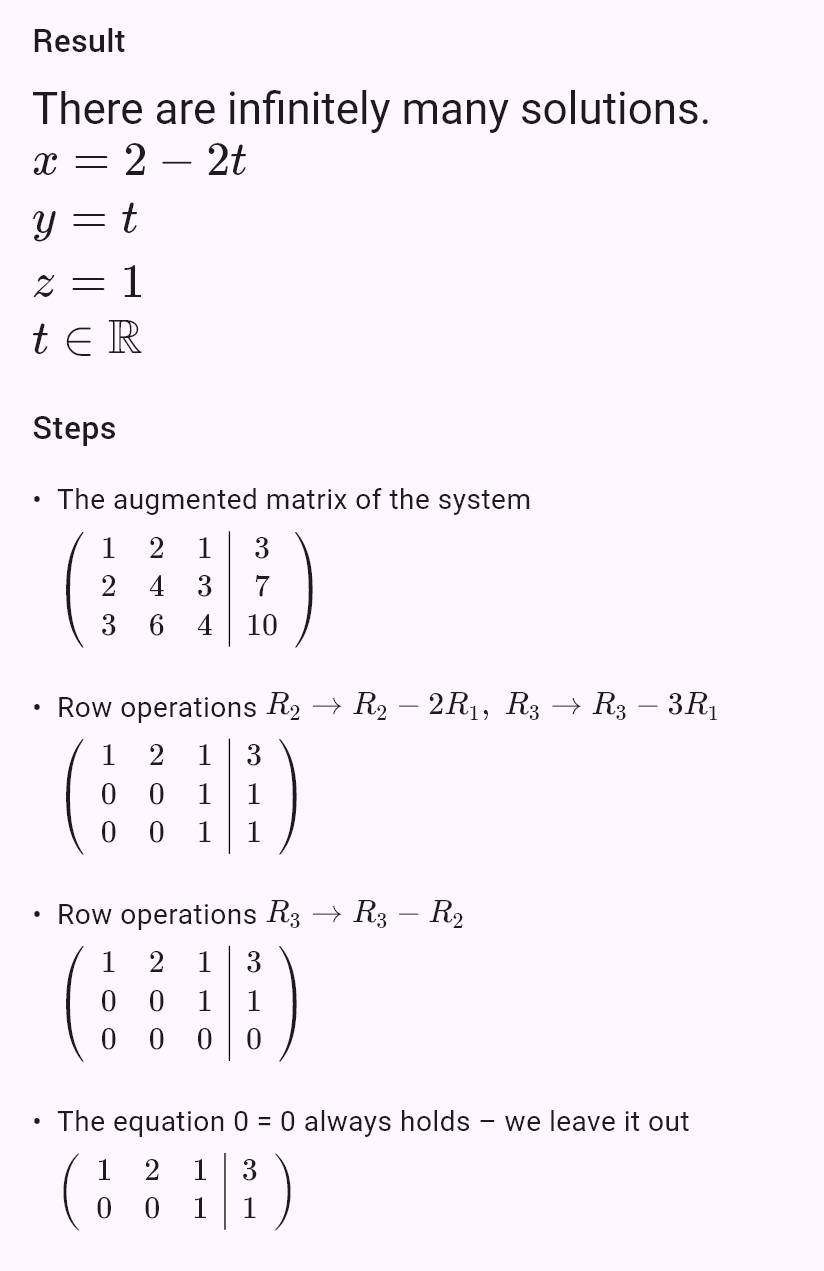
x + 2y + z = 3
2x + 4y + 3z = 7
3x + 6y + 4z = 10
Gauss – matrix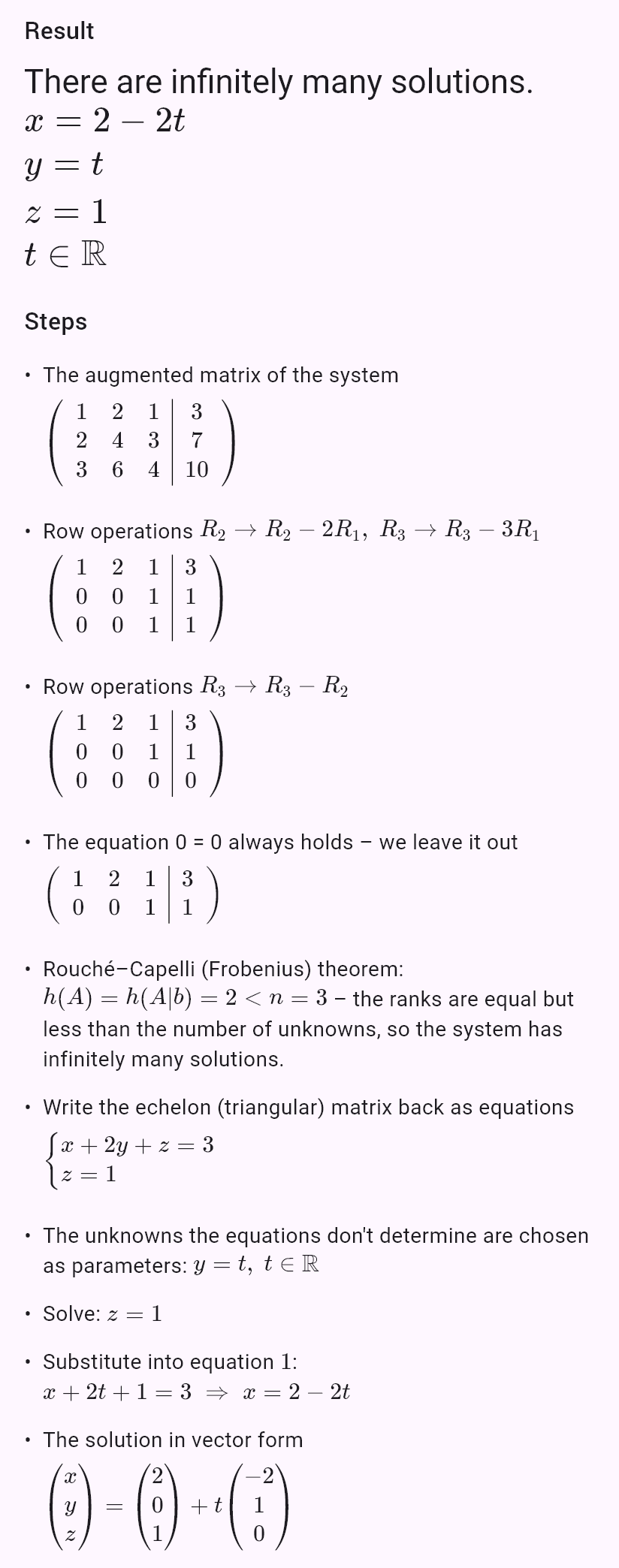
x + y + z = 2
x - y + z = 0
2x + 2z = 3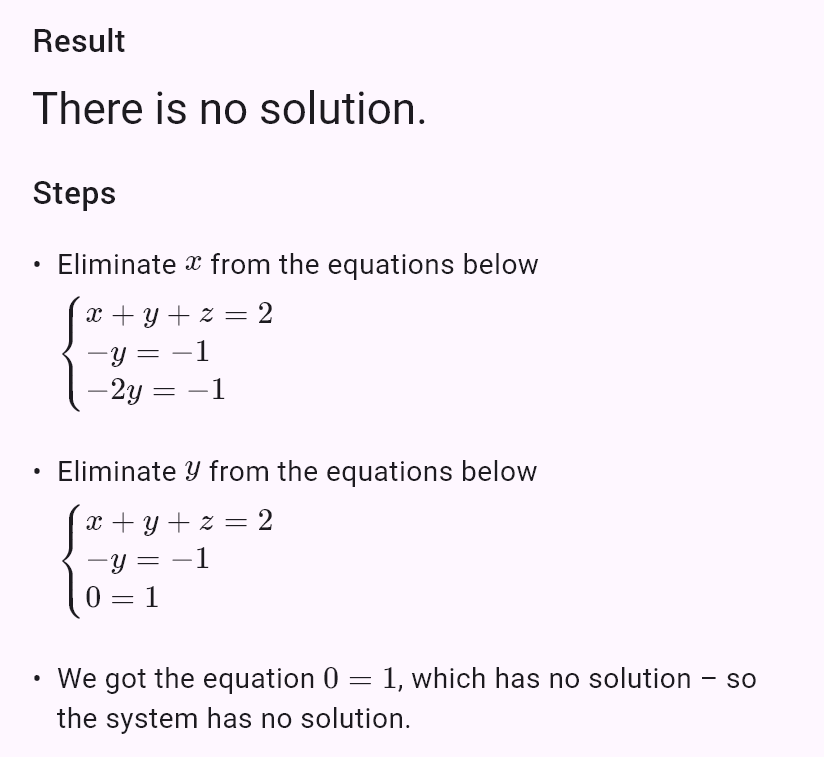
x + 2y - z = 0
2x + 4y - 2z = 0
x - y + z = 0
Gauss – matrix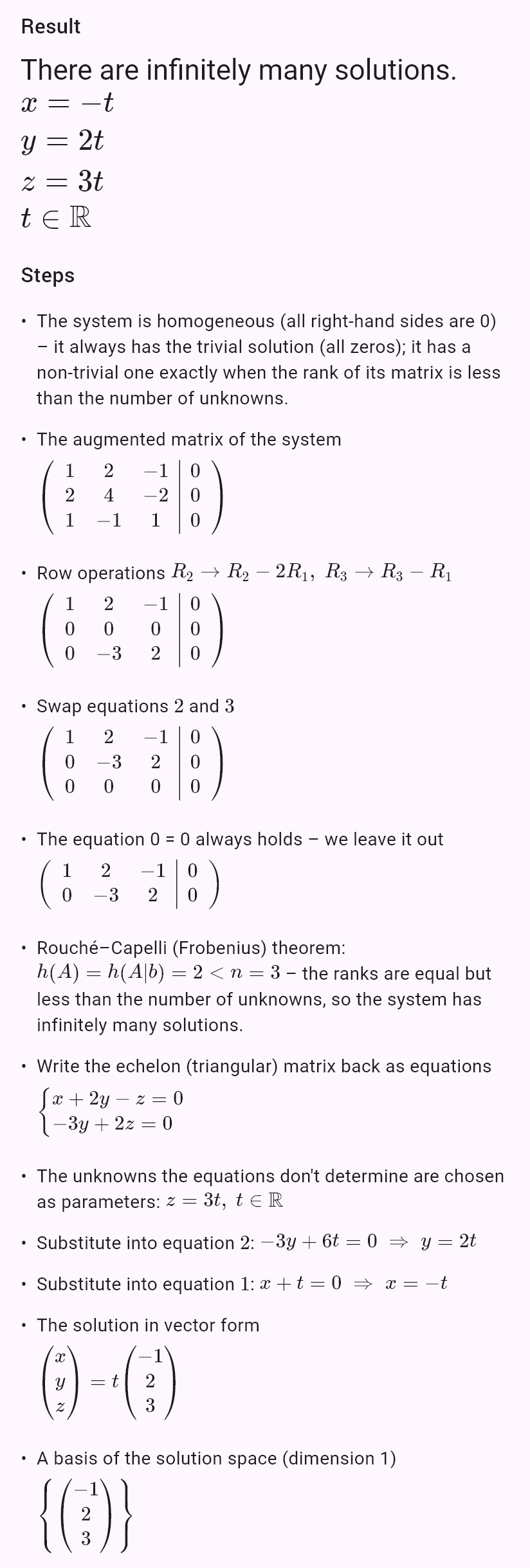
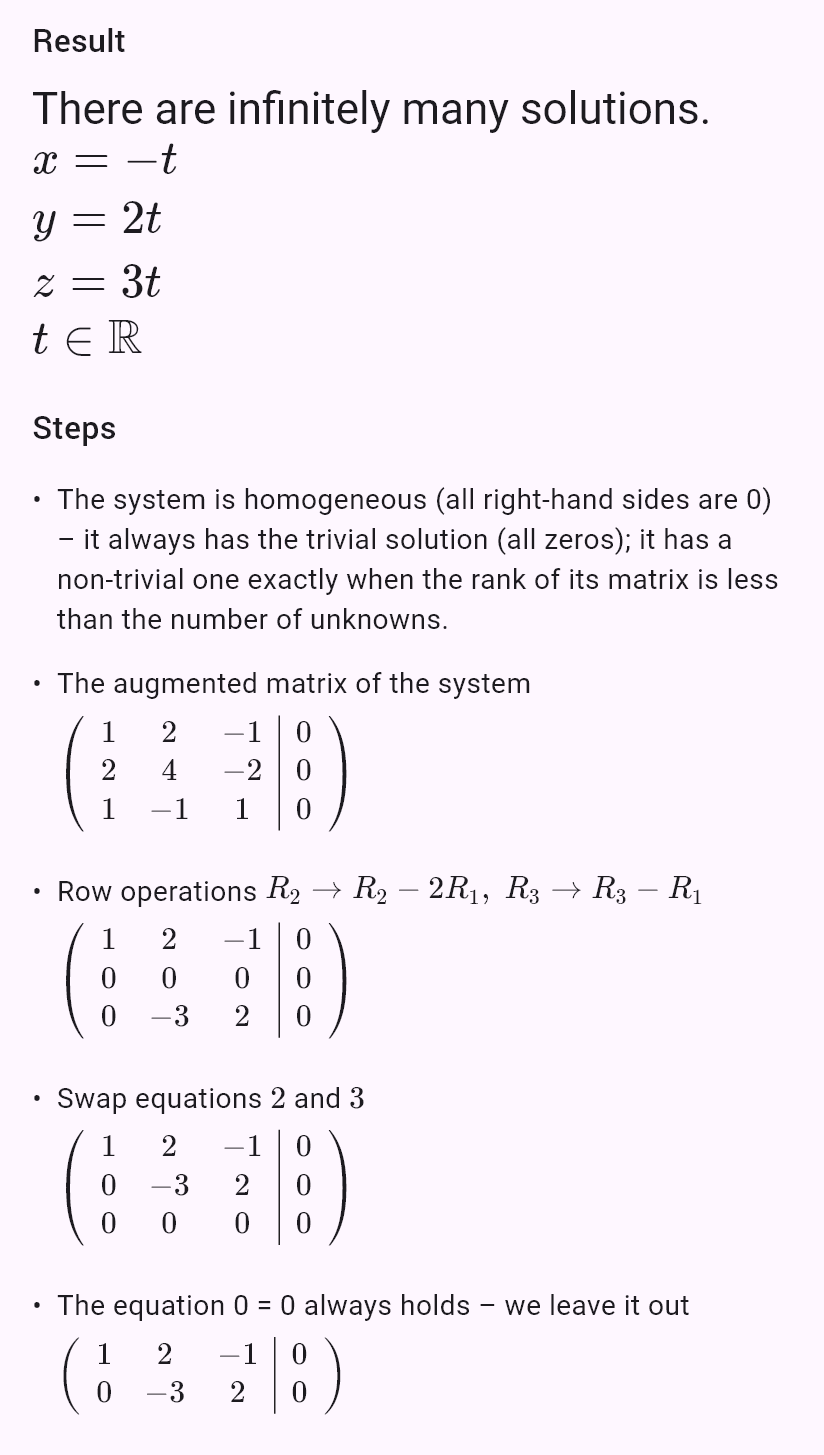
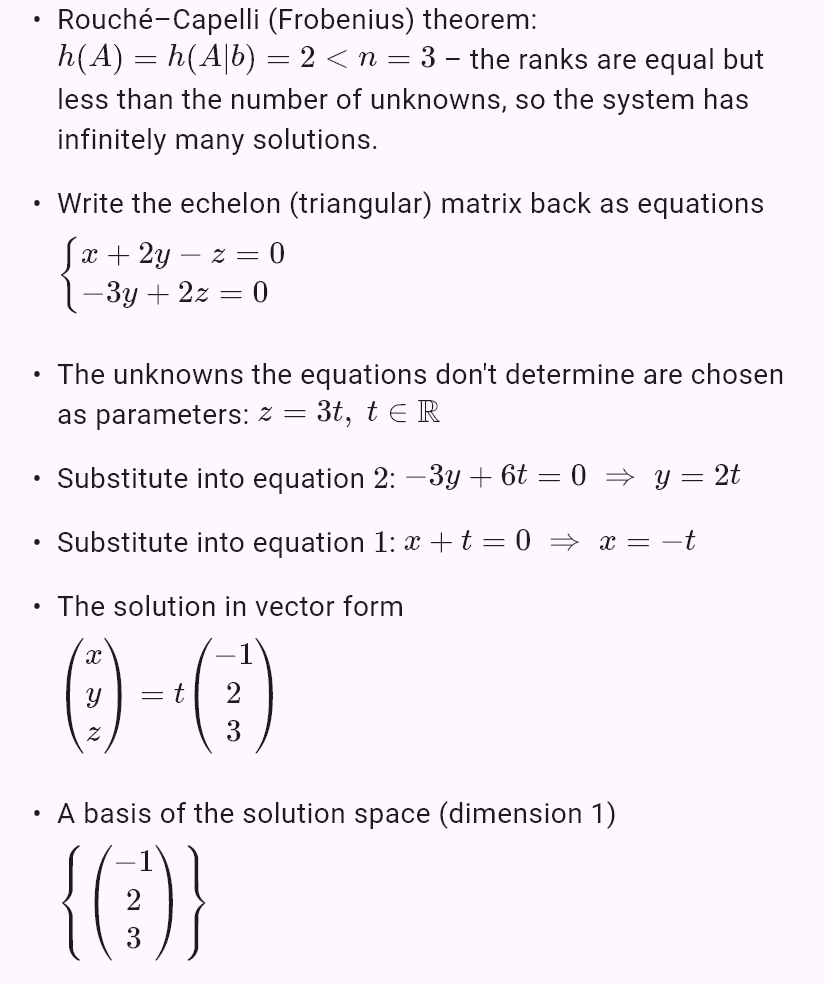
[1 1 1 | 6; 2 -1 1 | 3; 1 2 -1 | 2]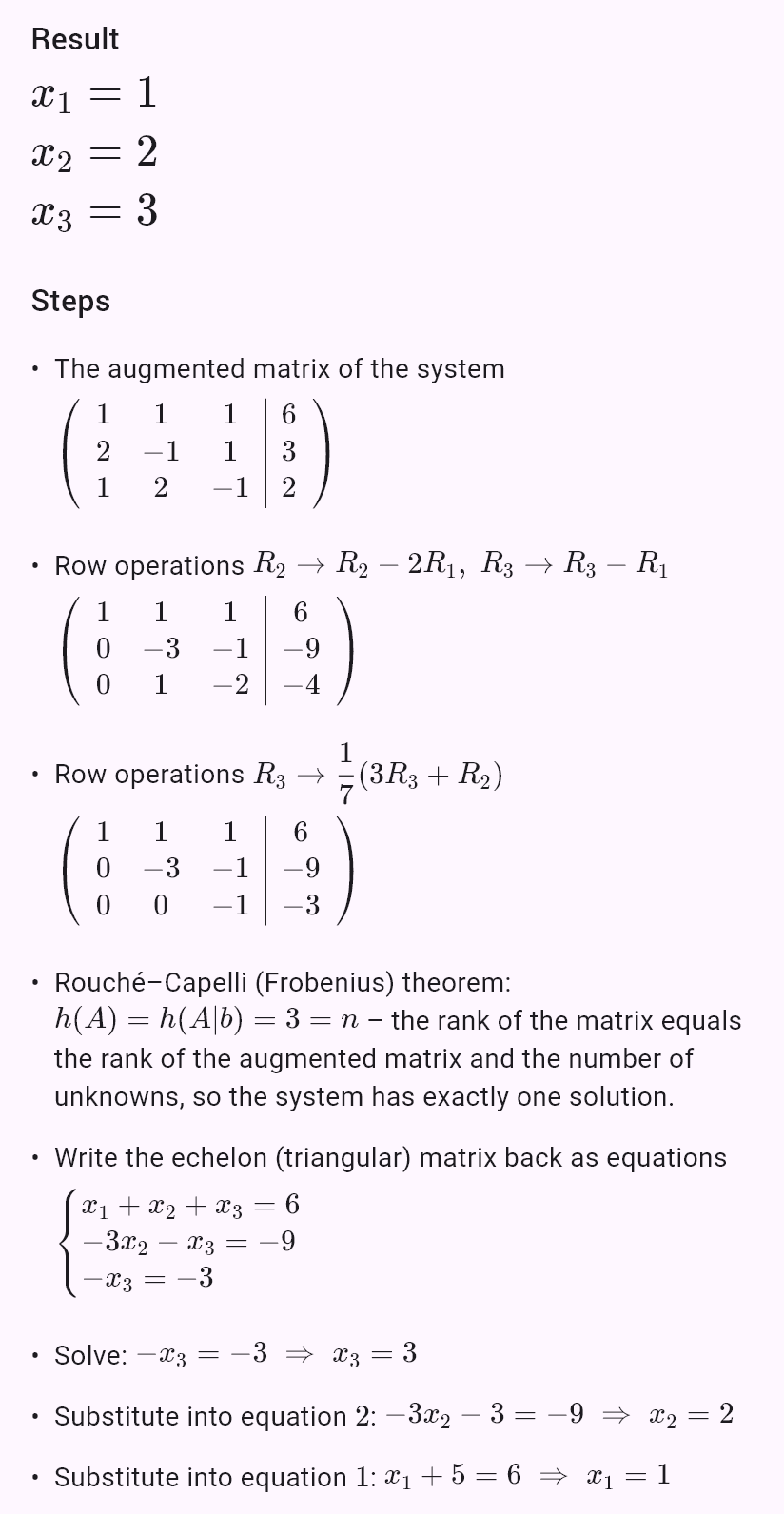
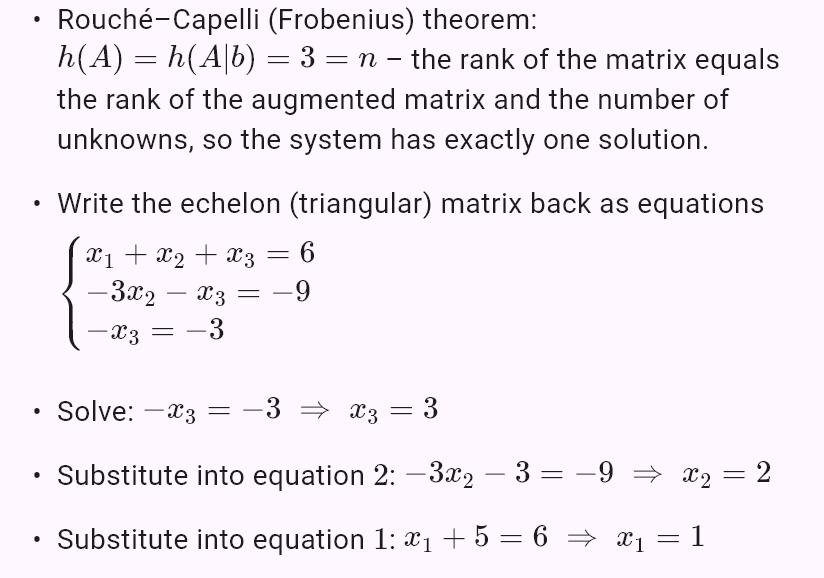
ax + y + z = 1
x + ay + z = 1
x + y + az = 1
Gauss – matrix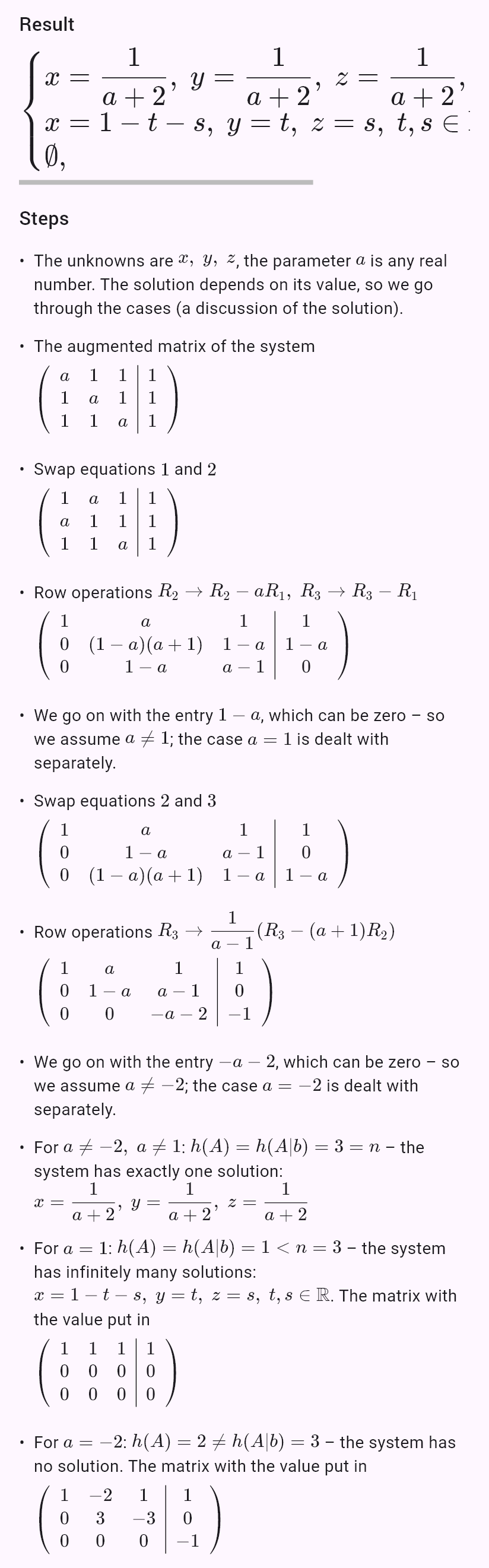
x + y + z = 1
x + 2y + az = 2
x + 4y + a^2z = b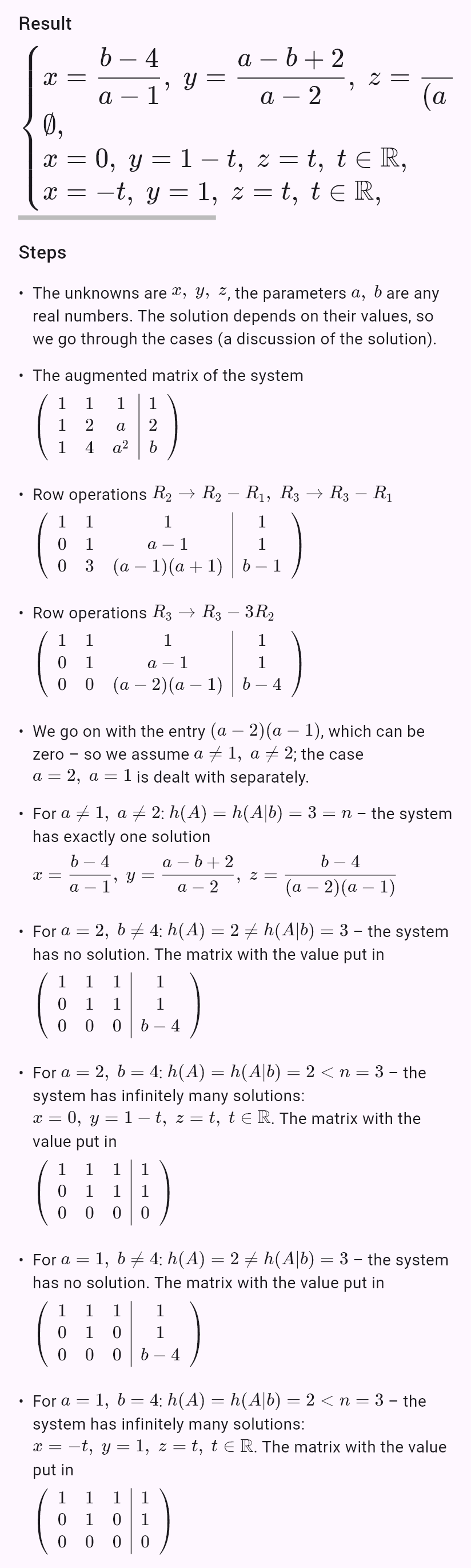
x^2 + y^2 = 25
x + y = 7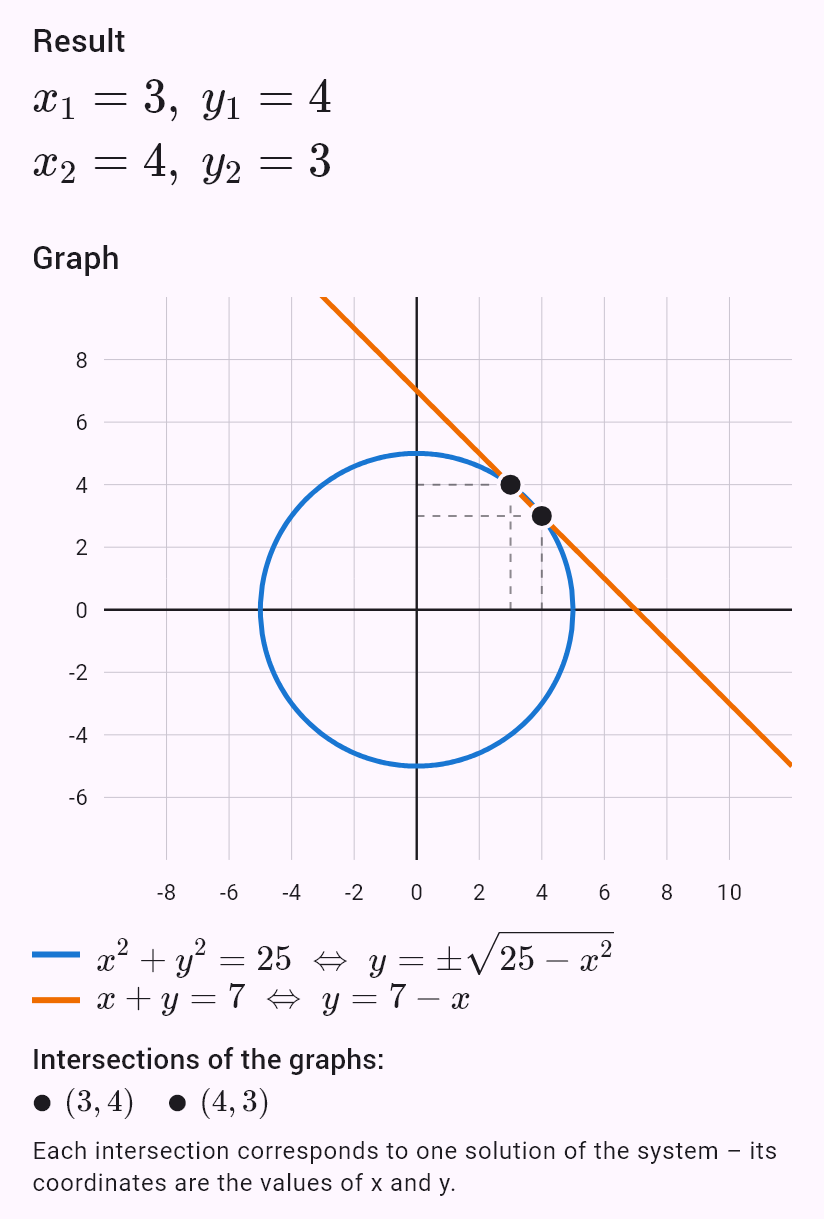
Known limitations
- Nonlinear systems come without the working for now.