I. Equations, inequalities and expressions
16. Percentages, ratios and the rule of three
Percentages are entered briefly, without a word problem: a part “20 % of 480”, the base “15 % = 45”, the rate “96 of 480 = ? %”, an increase and a decrease “480 + 15 %”, “480 − 20 %” and the original value before a change “x − 20 % = 384”. The app works through 1 % as taught at school today (1 % = 480 : 100 = 4.8); the “Formula” chip switches to part = base · rate with the rate as a decimal (480 · 0.2).
A ratio “12 : 18” is reduced to 2 : 3, a whole is split in a ratio (“300 in the ratio 2 : 3 : 5” – the parts added, one part, the shares) and a proportion “3 : 4 = x : 20” is solved by the products of the outer and inner terms. A ratio of fractions (“2/3 : 4/9”) is first multiplied by the least common multiple of the denominators; inside a longer expression the colon divides.
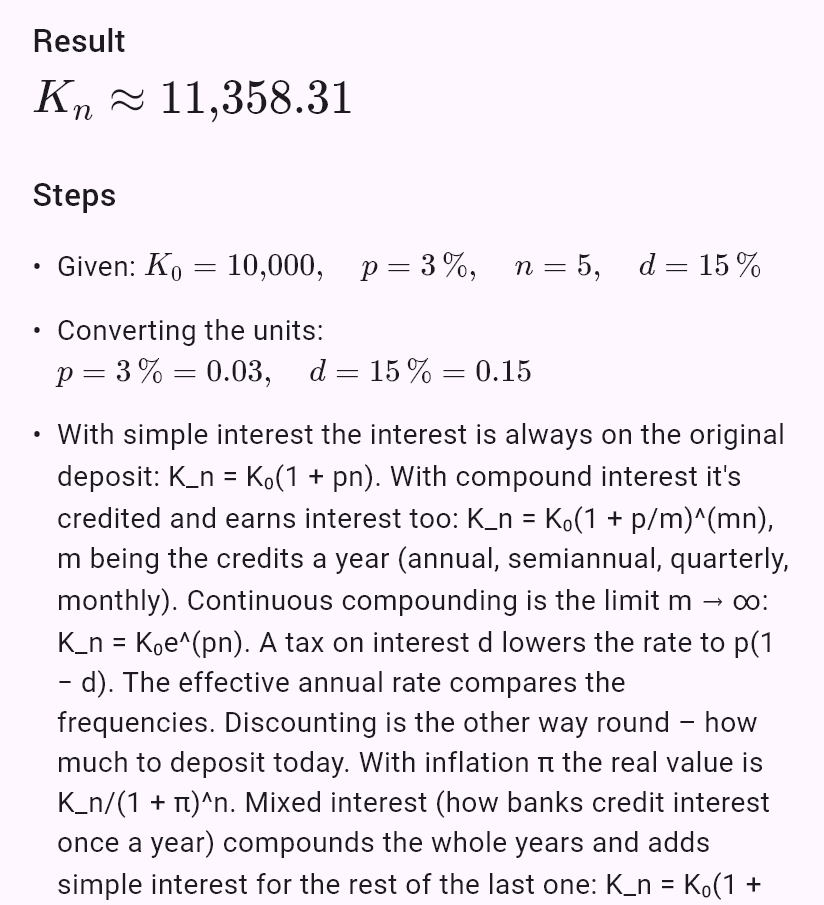
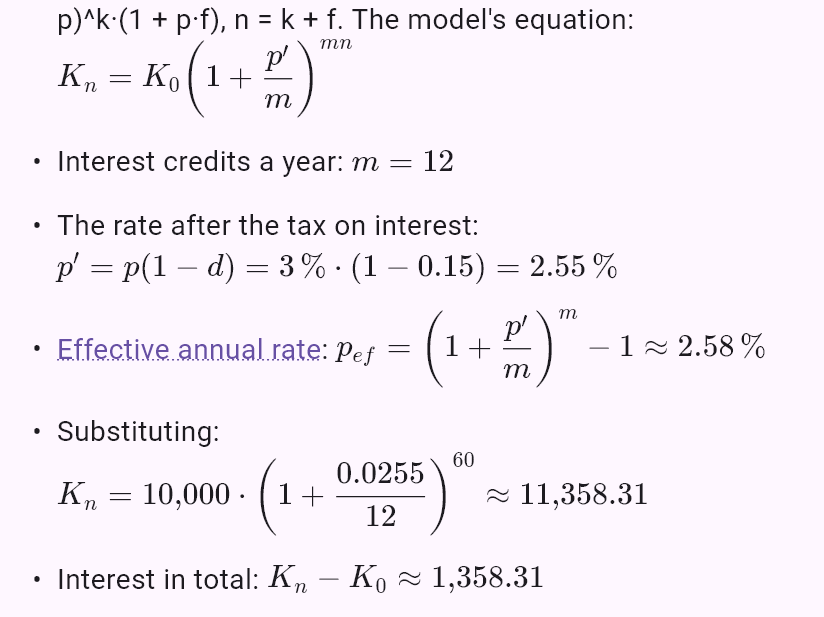
The rule of three is written as at school – two rows with three dots (or …, →): “10 kg … 250 Kč, 12 kg … x”, the units may be left out. A direct proportion by default, the “Inverse” chip (or the word “inverse” after a comma) for an inverse one. Simple interest: interest(principal, rate %, years, tax %) – the tax is optional. Compound interest: compound interest(principal, rate %, years, tax %, frequency) – the tax and the frequency (annually, semiannually, quarterly, monthly, continuously) are optional; more tasks (savings, loans, interest for days) are in Applications, the Economics chapter.
How to enter it
20 % of 480, 15 % = 45, 96 of 480 = ? %, 480 − 20 %, x − 20 % = 384 | Percentages – a part, the base, the rate, a change, the original value. |
12 : 18, 300 in the ratio 2 : 3 : 5, 3 : 4 = x : 20 | A ratio reduced, split in a ratio, a proportion. |
10 kg … 250 Kč, 12 kg … x | The rule of three – a direct and an inverse proportion. |
interest(10000, 3 %, 2, 15 %) | Simple interest with a tax. |
compound interest(10000, 3 %, 5, 15 %, monthly) | Compound interest with a tax and the crediting frequency. |
Examples
20 % z 480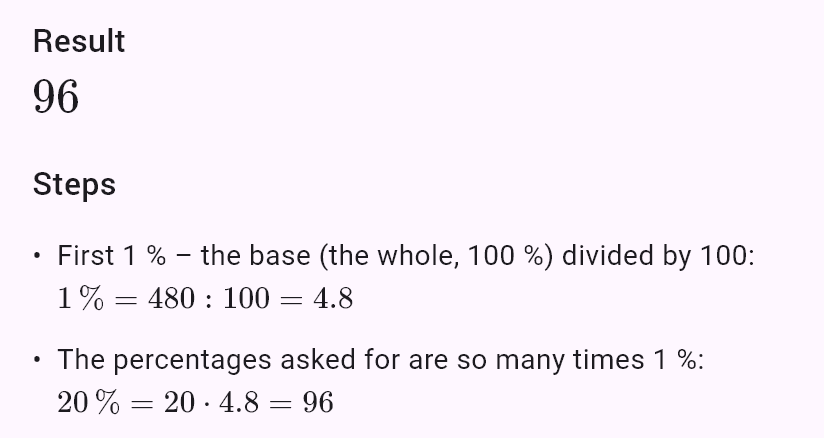
480 - 20 % Formula part = base · rate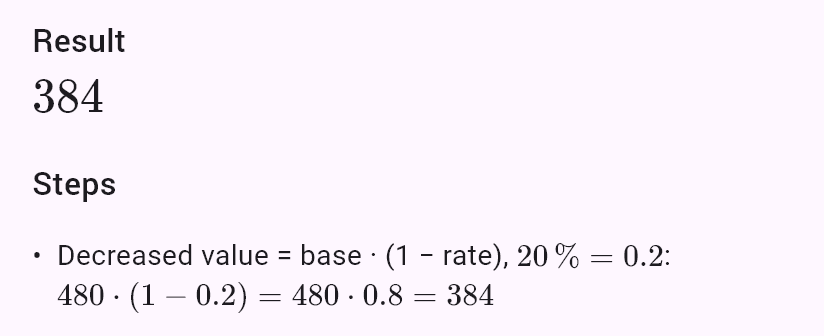
x - 20 % = 384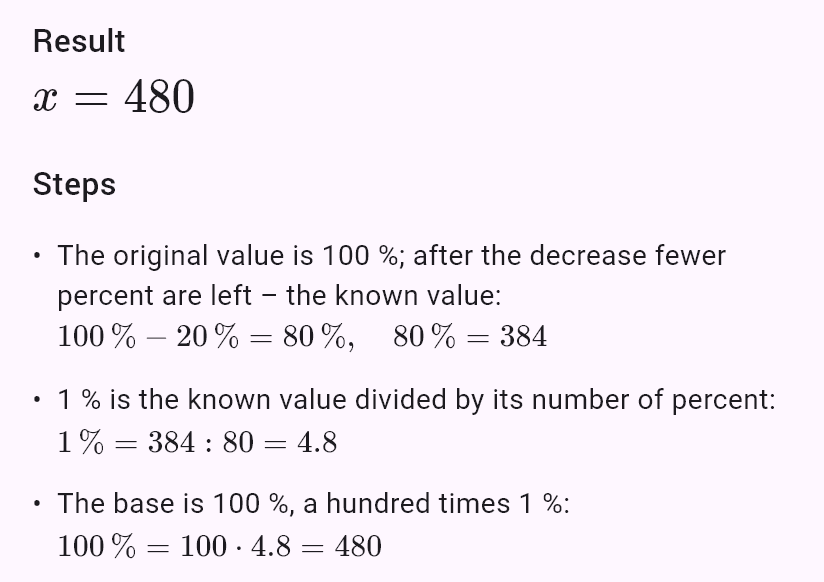
300 v poměru 2 : 3 : 5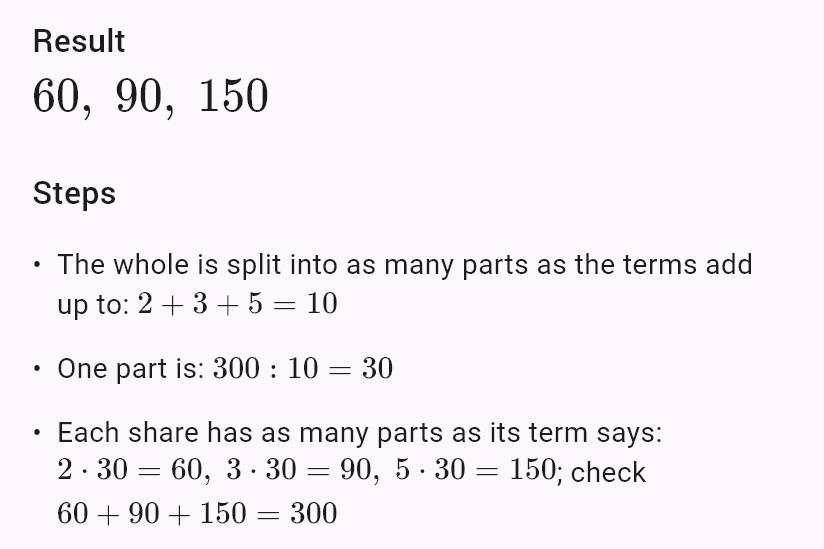
2/3 : 4/9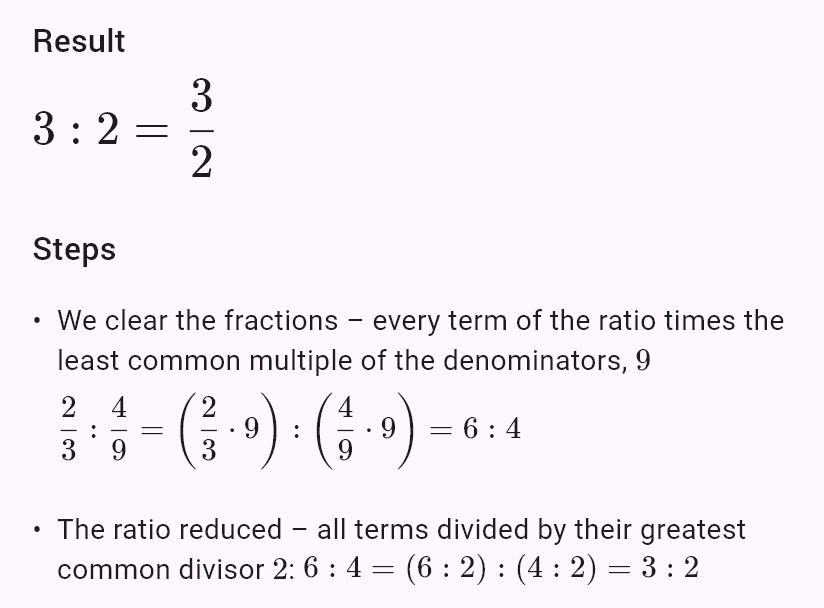
4 dělníci … 6 dní, 3 dělníci … x Inverse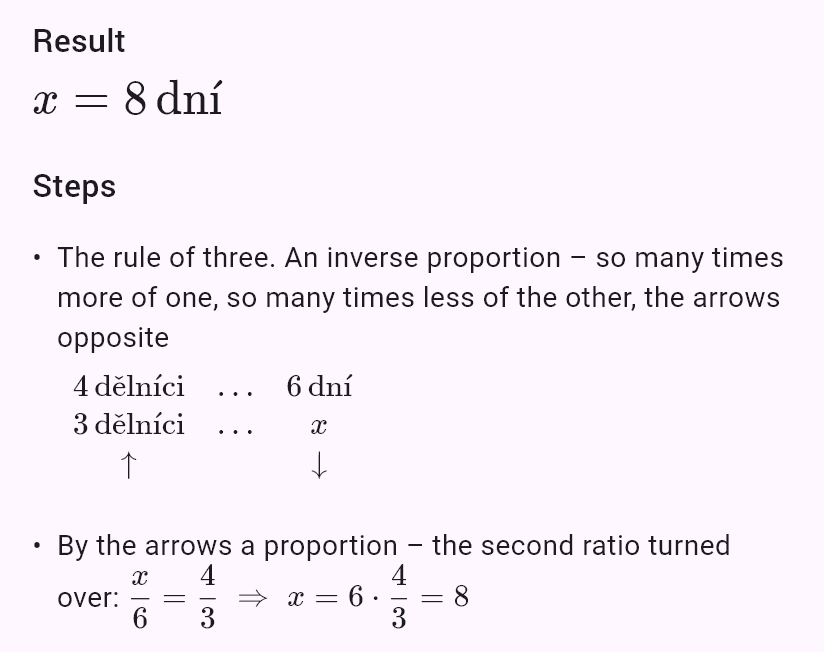
úrok(10000, 3 %, 2, 15 %)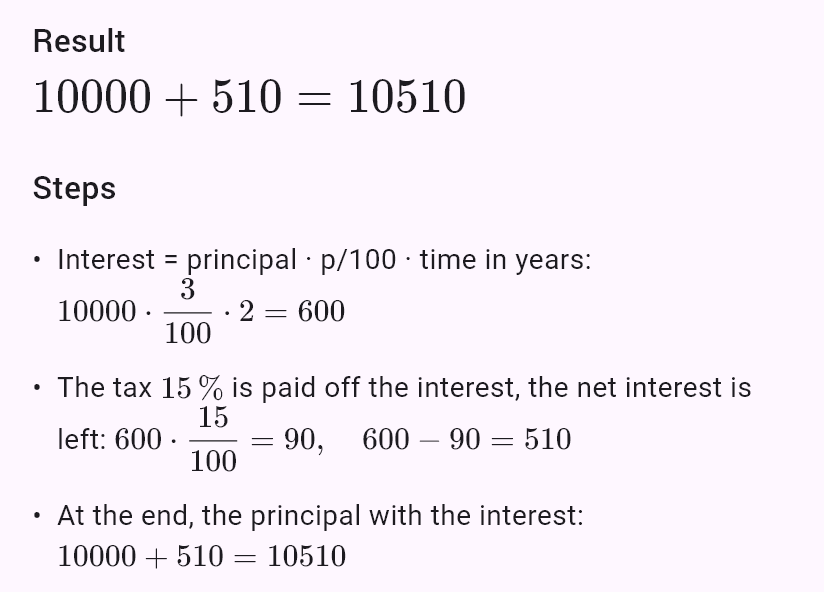
compound interest(10000, 3 %, 5, 15 %, monthly)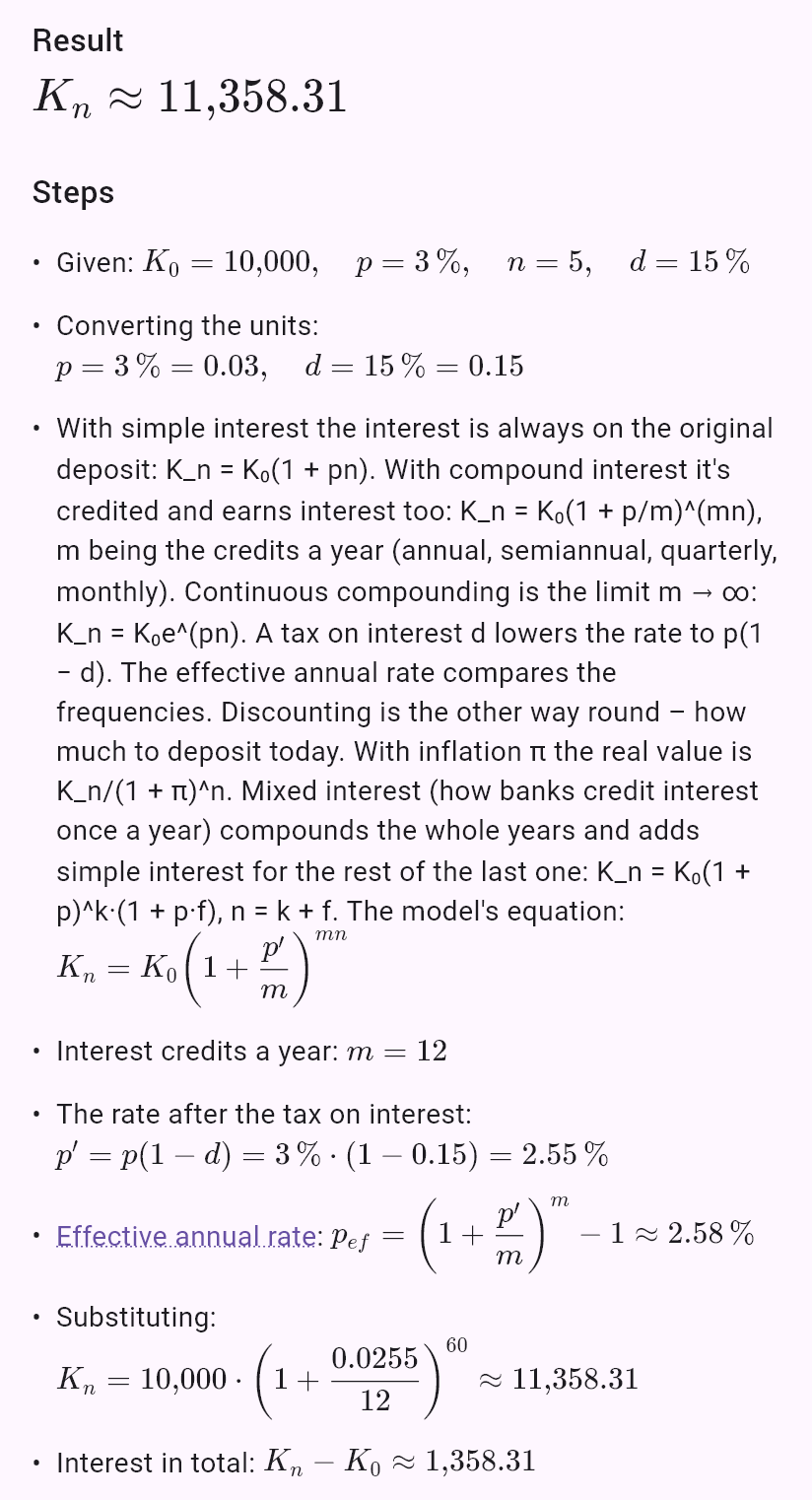
Known limitations
- No word problems yet – the problem has to be written briefly; compound interest with regular deposits and more financial tasks are in the forms in Applications.